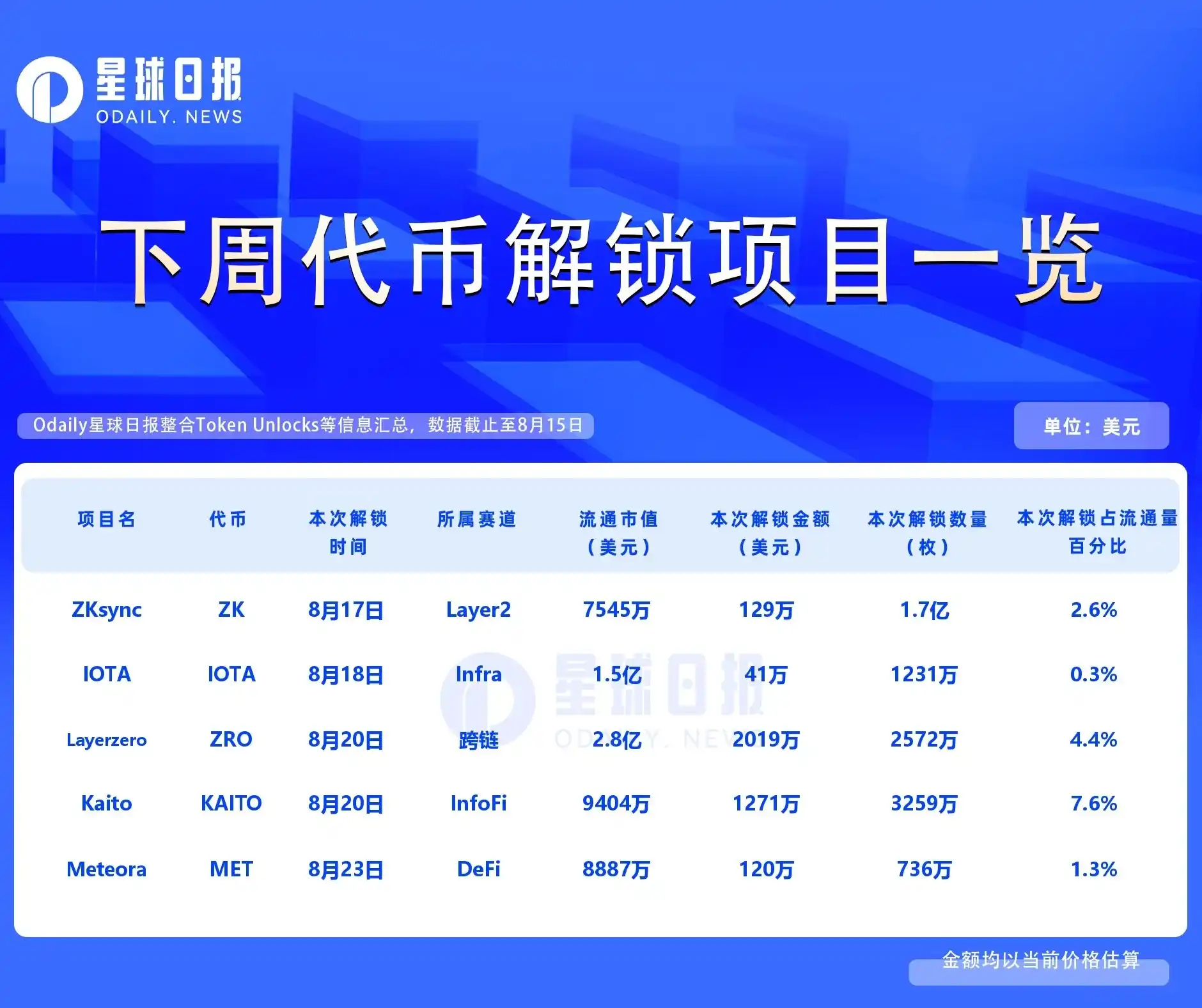
一周代币解锁:KAITO解锁达流通量7.6%代币

marsbitPublished on 2026-08-15Last updated on 2026-08-15

Abstract

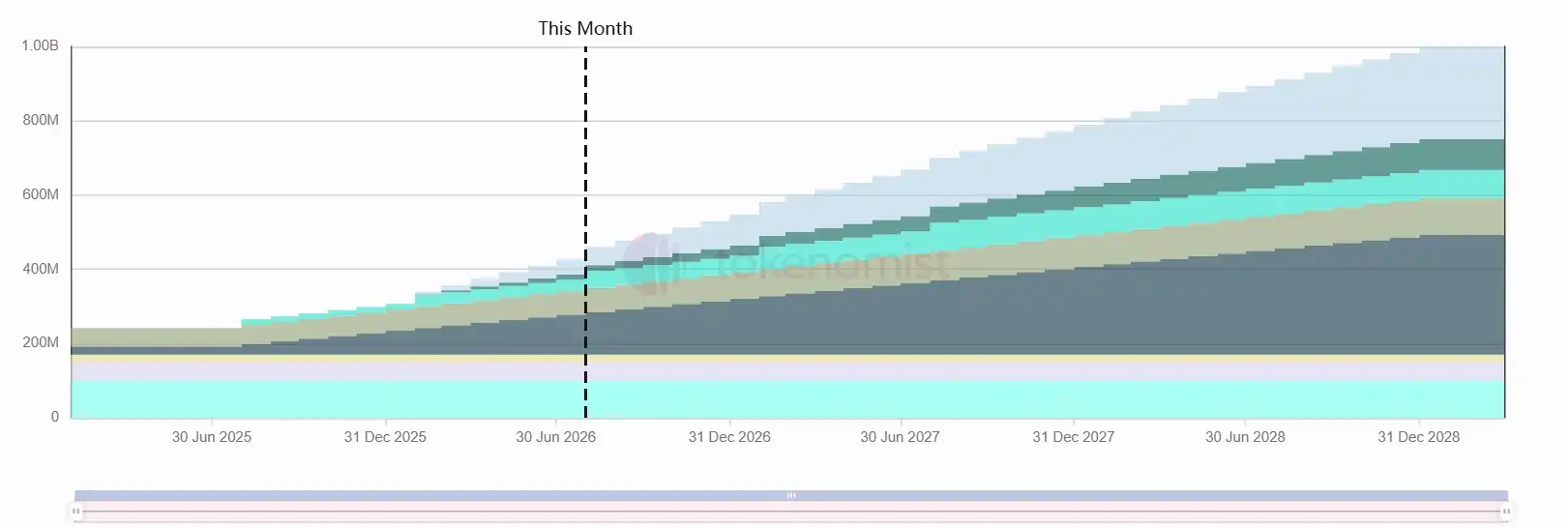
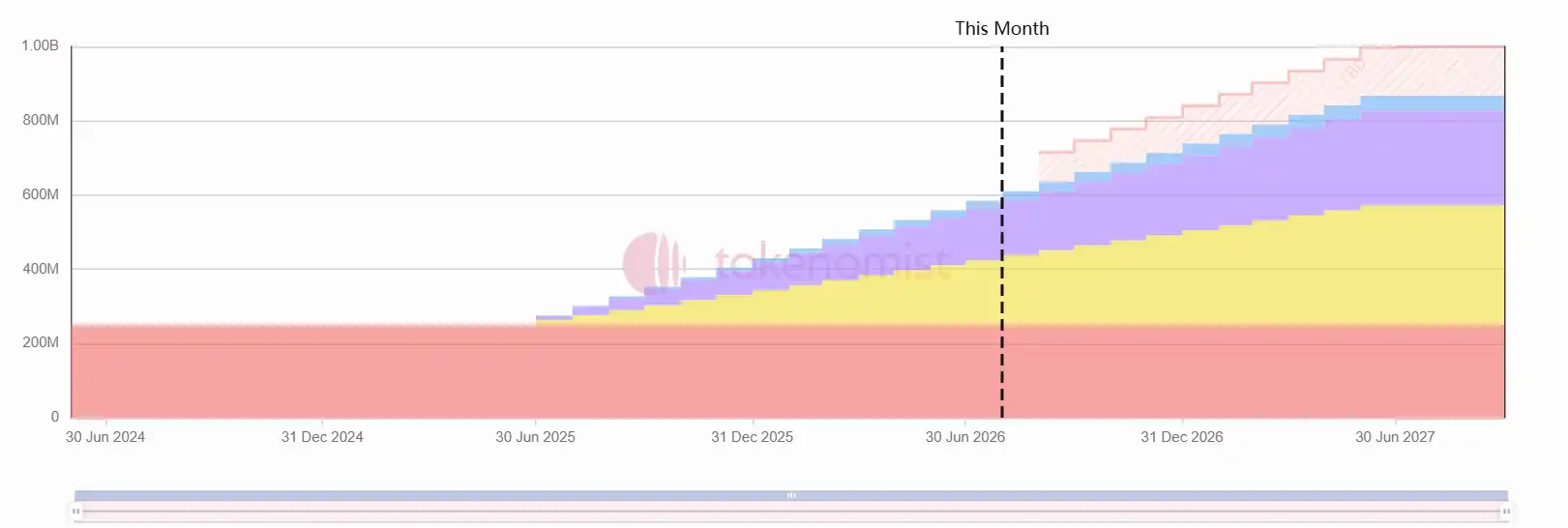
本周,Kaito与LayerZero两个项目均有大规模代币解锁。 Kaito项目本次解锁3259万枚代币,占流通量的7.6%,价值约1271万美元。Kaito是一个AI驱动的Web3信息平台,旨在聚合加密货币行业的碎片化信息,通过AI提供实时搜索、情绪分析和趋势跟踪。 LayerZero项目本次解锁2572万枚代币,价值约2019万美元。LayerZero是一个全链互操作性协议,专注于实现跨链的轻量级、可配置且去信任的消息传递。 文中附有两者代币释放曲线的图表。

Kaito

项目推特:https://x.com/KaitoAI

项目官网:https://www.kaito.ai/

本次解锁数量:3259万枚

本次解锁金额:约1271万美元

Kaito是一个AI驱动的Web3信息平台,旨在解决加密行业信息碎片化问题。通过聚合社交媒体、治理论坛等数来源,Kaito利用AI技术提供实时搜索、情绪分析和趋势跟踪。

具体释放曲线如下:

Layerzero

项目推特:https://x.com/LayerZero_Core

项目官网:https://layerzero.network/

本次解锁数量:2572万枚

本次解锁金额:约2019万美元

LayerZero 是一种全链互操作性协议,专为跨链的轻量级消息传递而设计。LayerZero 提供了可信且有保障的消息传递,并具有可配置的去信任化。

具体释放曲线如下:

Trending Cryptos

Related Questions

Q文章中提到的KAITO项目本次解锁了多少枚代币?

A3259万枚

QKaito是一个什么样的Web3平台?

AKaito是一个AI驱动的Web3信息平台,旨在通过聚合社交媒体、治理论坛等多方数据,利用AI技术提供实时搜索、情绪分析和趋势跟踪,以解决加密行业信息碎片化问题。

QLayerZero协议的主要功能是什么?

ALayerZero是一种全链互操作性协议,专为跨链的轻量级消息传递而设计,它提供了可信且有保障并可配置去信任化的消息传递。

Q根据文章,LayerZero项目本次解锁的代币价值约多少美元?

A约2019万美元

Q文章中总共介绍了几个项目即将进行代币解锁?

A两个,分别是Kaito和LayerZero

Related Reads

Jensen Huang Caught in Another Affair with Subordinate, Probability of Departing NVIDIA by Month's End Nears 90%

NVIDIA CEO Jensen Huang is facing escalating scandal after reports of a second extramarital affair. Following earlier allegations involving Alice Huang, an executive at Singapore data center company Megaspeed, The New York Times reported that Huang also had an affair with Kimberly Powell, a married NVIDIA vice president of healthcare and one of roughly 60 executives reporting directly to him. Powell, 48, joined NVIDIA in 2008 and has led its healthcare business since 2017. NVIDIA's code of conduct prohibits private relationships that could create conflicts of interest. NVIDIA's earlier statement that the matter would not affect Huang's role as CEO has reportedly been withdrawn. The Wall Street Journal reported that the board is considering meeting to discuss Huang's future, potentially appointing an interim leader while searching for a new CEO with outside firms. Polymarket odds of Huang leaving before November 30, 2026 have risen to 88%, and to 93% before March 31, 2027. Elon Musk, responding to a suggestion that he hire Huang, said it "would be an honor." The news triggered sharp stock moves: NVIDIA closed up 2.87% but fell as much as 10% after hours, shedding over $300 billion in market value and dragging down other AI stocks including Intel and Dell. A key concern is succession: NVIDIA has no clear plan, and Huang's unusual management structure—with dozens of direct reports and few layers—makes him the central node of the company. While executives like CFO Colette Kress could handle operations, none can quickly replace Huang's industry influence and role as NVIDIA's public face. Neither Huang nor NVIDIA has confirmed or denied the second affair.

Odaily星球日报2m ago

Jensen Huang Caught in Another Affair with Subordinate, Probability of Departing NVIDIA by Month's End Nears 90%

Odaily星球日报2m ago

Ethereum Plans to Move Post-Quantum and Anti-AI Upgrades Forward to 2027: Ethlabs Proposes Restructuring the Hegotá Hard Fork Plan

Ethlabs, a non-profit Ethereum R&D lab, has submitted the pqai27 community proposal to the Ethereum community forum, calling for 2027 to be the target year for achieving quantum resistance and AI resistance on Ethereum. With Ethereum's on-chain TVL exceeding $41.16 billion as of November 12, the proposal argues that Ethereum should leverage its existing hash-based cryptography and formal verification foundations to reinforce its position as the global value settlement layer as AI evolves rapidly and quantum timelines accelerate. The direct motivation is the compression of external timelines: the U.S. government has moved its quantum-resistance target from 2035 to 2030, and Google plans to complete its full cryptographic migration by 2029. AI attack capabilities are also advancing—OpenAI has used frontier models to find and patch roughly 1,000 Linux vulnerabilities and solve hundreds of math problems. "AI resistance" means relying on minimal hash primitives, formal verification, and client diversity to harden the base layer. The roadmap splits 2027 into two stages. The baseline "pqai-ready" stage requires quantum resistance at the consensus layer and ensures users can migrate to quantum-resistant accounts via the Frames account abstraction proposal EIP-8141; if existing cryptography fails early, the network can degrade to calldata to keep running. The advanced "pqai-scaled" stage targets full-capacity operation, introducing EIP-8288 for quantum-resistant signature aggregation and EIP-8479 for quantum-resistant data availability, so quantum-resistant transactions and blobs can regain normal throughput after scaling. To this end, Ethlabs recommends restructuring the scope of the Hegotá hard fork, stripping out non-critical upgrades and reassessing the impact of the FOCIL anti-censorship proposal (EIP-7805) on progress and compatibility; if the execution layer is decoupled from the consensus layer, Frames could ship independently first. The consensus layer must choose between retrofitting the existing Gasper implementation for quantum resistance and moving to decoupled consensus. Ethlabs announced it is withdrawing its push for Quick Slots (EIP-8198) in Hegotá, deferring it to 2028, while Glamsterdam and its scaling plans proceed as normal. The roadmap remains an Ethlabs community initiative; any Hegotá fork restructuring or consensus-layer switch requires further discussion and agreement among Ethereum's All Core Devs. Ethlabs notes that AI is also accelerating formal verification and zero-knowledge proof benchmark optimization, and that advancing pqai27 aims to consolidate Ethereum and ETH's role as the trust root for global value settlement during extreme security cycles.

marsbit17m ago

Ethereum Plans to Move Post-Quantum and Anti-AI Upgrades Forward to 2027: Ethlabs Proposes Restructuring the Hegotá Hard Fork Plan

marsbit17m ago

Former OpenAI Researcher Changes His Tune: Super AI Researcher Could Arrive as Early as Next Year

Former OpenAI researcher Daniel Kokotajlo and the AI Futures Project have revised their timelines, now predicting superhuman AI researchers (SARs) could arrive as early as 2027 rather than 2029. The key driver is a METR assessment of Anthropic, which found that since October 2025, the benchmark score growth rate of Anthropic's internal models reached about 1.9x the previous pace (95% CI: 1.5–2.8x) — roughly two years' worth of progress in one year. METR estimates that by October 2026, about 80% of the extra acceleration may come from AI itself, though this is a subjective guess with high uncertainty. AI is already helping researchers write experiment code, run tests, and try out more ideas. Using METR's estimates, the team calculated that by early November 2026, AI-driven acceleration alone could push overall model progress to 1.7x the historical rate — a speed that, in the original AI 2027 scenario, wouldn't be reached until around April 2027, about five months later. Notably, METR says most of the evidence underpinning its core conclusions was redacted from the public report at Anthropic's request, to avoid helping competitors; only the benchmark curves are publicly verifiable. Depending on the method used, SAR arrival estimates range from February 2027 to mid-2028. If acceleration compounds across model generations, superintelligence could arrive sooner than expected.

marsbit36m ago

Former OpenAI Researcher Changes His Tune: Super AI Researcher Could Arrive as Early as Next Year

marsbit36m ago

Aave V3.8 Officially Launches: Covering 15 Public Chains, $15.2 Billion Liquidity Pool, Introducing Low-Gas-Cost Reentrancy Protection

Aave has launched V3.8 across 15 active V3 markets, following approval by the Aave DAO and development by Aave Labs. According to DeFiLlama, Aave's total value locked exceeds $16.4 billion, with active V3 markets holding over $15.23 billion. The upgrade was deployed via AIP #541, completing a 22-day governance process that began with a forum proposal on October 21 and a Snapshot vote on October 27. V3.8 covers active instances on Ethereum (Core and Lido), Plasma, Avalanche, BNB Chain, Monad, Base, and Arbitrum, along with Mantle, X Layer, Polygon, Linea, Optimism, Gnosis, MegaETH, and Celo. Legacy markets that were frozen with zero caps were deliberately skipped. The release introduces kernel-level reentrancy protection for external callback operations on liquidity pools. Traditionally, preventing cross-function reentrancy requires writing a lock flag before state changes, but after EIP-3529 capped SSTORE refunds at 20%, maintaining persistent locks in high-frequency lending pools became gas-intensive. V3.8 instead uses EIP-1153 transient storage, where TSTORE and TLOAD cost only 100 gas per read or write and automatically clear at transaction end, providing reentrancy hardening at minimal cost. Aave Labs addressed developer concerns that the lock might block liquidation composability within flash loan callbacks. The flashLoan and flashLoanSimple entry points only check the lock status without setting it, creating asymmetric isolation: users can still compose liquidations, deposits, or repayments inside a flash loan callback, but attempts to initiate a flash loan from within a regular pool operation callback are rejected and reverted. Security verification included Certora formal verification and independent external audits before the AIP vote. The new contract code is published in the official Aave V3 repository under the Business Source License. Developers also noted that downstream integrators reading view functions such as account health factors or reserve data during callbacks should account for intermediate ledger states and ensure peripheral risk controls remain compatible.

marsbit37m ago
Aave V3.8 Officially Launches: Covering 15 Public Chains, $15.2 Billion Liquidity Pool, Introducing Low-Gas-Cost Reentrancy Protection

marsbit37m ago

Trading

Spot

Hot Articles

How to Buy KAITO

Welcome to HTX.com! We've made purchasing Kaito (KAITO) simple and convenient. Follow our step-by-step guide to embark on your crypto journey.Step 1: Create Your HTX AccountUse your email or phone number to sign up for a free account on HTX. Experience a hassle-free registration journey and unlock all features.Get My AccountStep 2: Go to Buy Crypto and Choose Your Payment MethodCredit/Debit Card: Use your Visa or Mastercard to buy Kaito (KAITO) instantly.Balance: Use funds from your HTX account balance to trade seamlessly.Third Parties: We've added popular payment methods such as Google Pay and Apple Pay to enhance convenience.P2P: Trade directly with other users on HTX.Over-the-Counter (OTC): We offer tailor-made services and competitive exchange rates for traders.Step 3: Store Your Kaito (KAITO)After purchasing your Kaito (KAITO), store it in your HTX account. Alternatively, you can send it elsewhere via blockchain transfer or use it to trade other cryptocurrencies.Step 4: Trade Kaito (KAITO)Easily trade Kaito (KAITO) on HTX's spot market. Simply access your account, select your trading pair, execute your trades, and monitor in real-time. We offer a user-friendly experience for both beginners and seasoned traders.

6.6k Total ViewsPublished 2025.02.21Updated 2026.07.29

How to Buy KAITO

Discussions

Welcome to the HTX Community. Here, you can stay informed about the latest platform developments and gain access to professional market insights. Users' opinions on the price of KAITO (KAITO) are presented below.

活动图片