Kaspa: KAS 突破关键价格阻力后,能否瞄准 0.055 美元?

ambcryptoPublished on 2026-03-17Last updated on 2026-03-18

Abstract

卡斯帕(KAS)近期表现强劲,受到加密货币市场的广泛关注。其价格在过去24小时内上涨超过11.50%,交易价格达到0.03609美元,同时交易量激增130%至3688万美元,显示市场参与度显著提升。 技术分析显示,KAS已突破关键阻力位0.035美元,若日线收盘站稳该水平,可能进一步上涨51%至0.055美元目标位。但0.040美元可能成为新的阻力位。相对强弱指数(RSI)达72.02,表明处于超买状态,可能出现短期回调。平均方向指数(ADX)为19.77,显示趋势动能较弱。 市场情绪分化:短期交易者跟随上涨趋势,而长期持有者可能正在获利了结。数据显示,0.0319美元(支撑位)和0.0358美元(阻力位)存在大量杠杆头寸,若价格波动可能导致清算。此外,过去48小时内有价值122万美元的KAS流入交易所,暗示长期持有者可能准备卖出,这对资产构成看跌信号。 总结:KAS突破关键阻力后短期看涨,但超买状态和长期持有者的抛压可能引发回调风险。

Kaspa [KAS] 因其令人印象深刻的表现而获得了加密爱好者的广泛关注。该资产不仅在更广泛的市场复苏中获得了收益,而且还突破了一个关键阻力。这表明大规模的上行反弹可能即将到来。

根据 CoinMarketCap 的数据,KAS 在过去 24 小时内上涨了超过 11.50%,截至发稿时交易价格为 0.03609 美元。此外,市场参与度显著增加。这反映在交易量上,交易量飙升了 130% 以上,达到 3688 万美元。

交易量的上升表明在价格复苏期间交易者和投资者的参与度提高,并表明市场参与者对当前趋势越来越感兴趣。

Kaspa 价格走势和技术分析

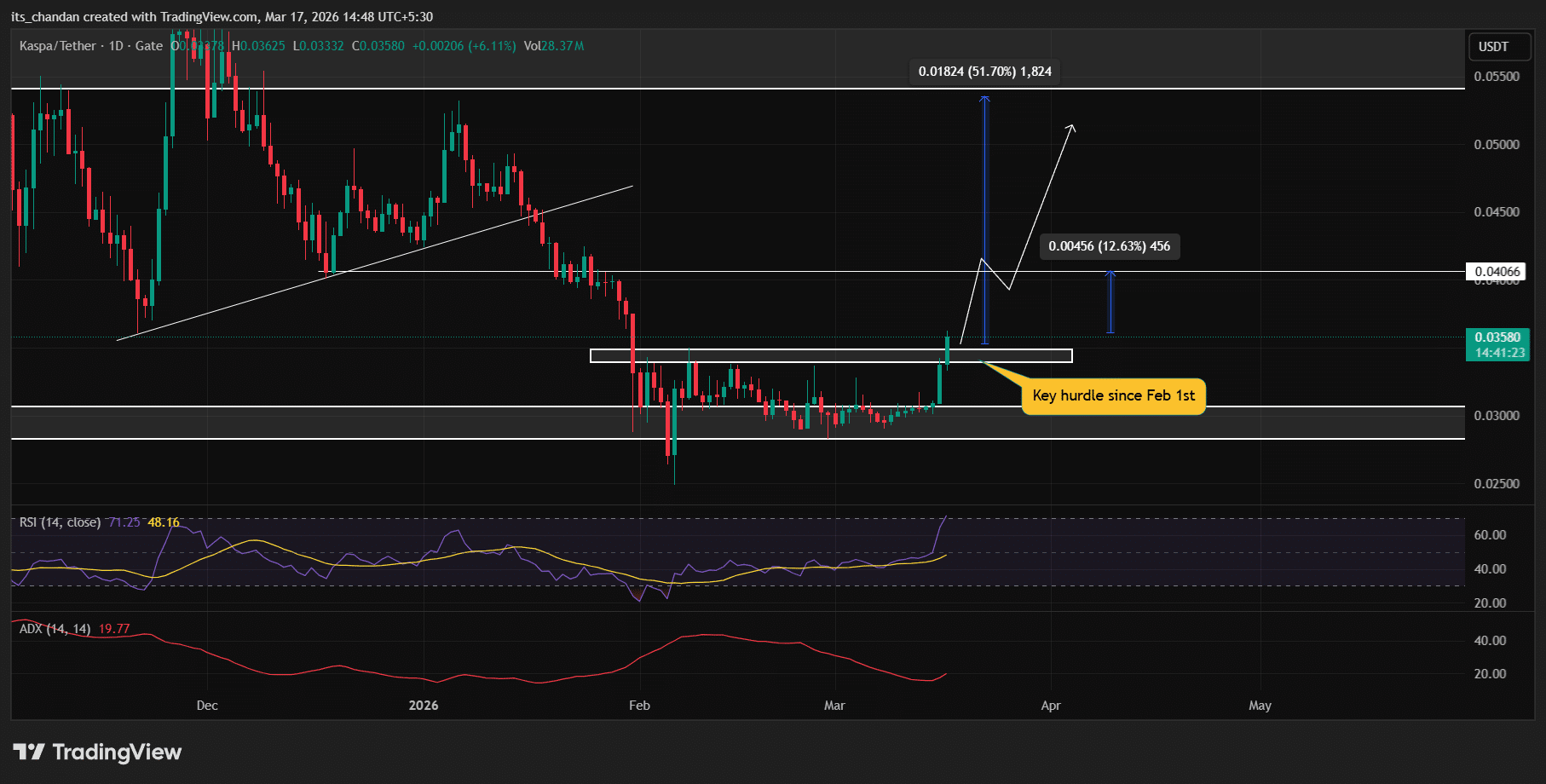
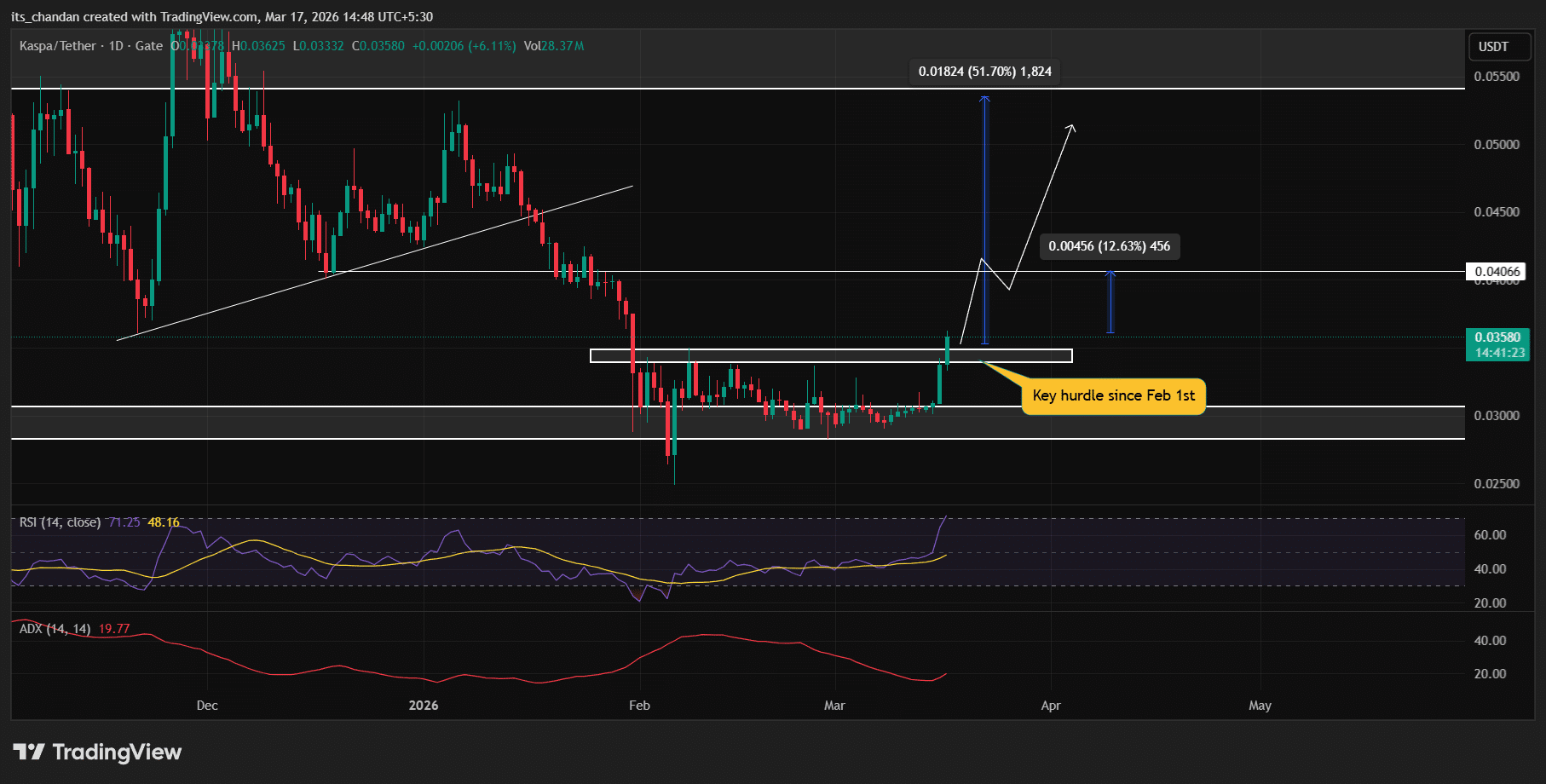
AMBCrypto 的日线图分析显示,KAS 转为看涨,并为大幅反弹做好了准备。随着最近的上行走势,该资产突破了 0.035 美元的关键阻力位。这是一个自 2026 年 2 月 1 日以来一直面临的水平。

来源: TradingView

如果 KAS 的日线收盘价高于这一关键水平,其价格可能会跃升 51%,并可能达到 0.055 美元的水平。然而,0.040 美元似乎是一个关键阻力位,可能在其即将到来的反弹中成为障碍。

尽管出现了看涨突破,但技术指标相对强弱指数 (RSI) 在撰写本文时已达到 72.02。这表明该资产处于超买区域,暗示该资产下一次上涨之前可能会出现潜在的回调。

与此同时,衡量趋势强度的平均方向指数 (ADX) 为 19.77,低于 25 的关键阈值,表明该资产的方向性势头较弱。

市场参与者对 KAS 情绪复杂

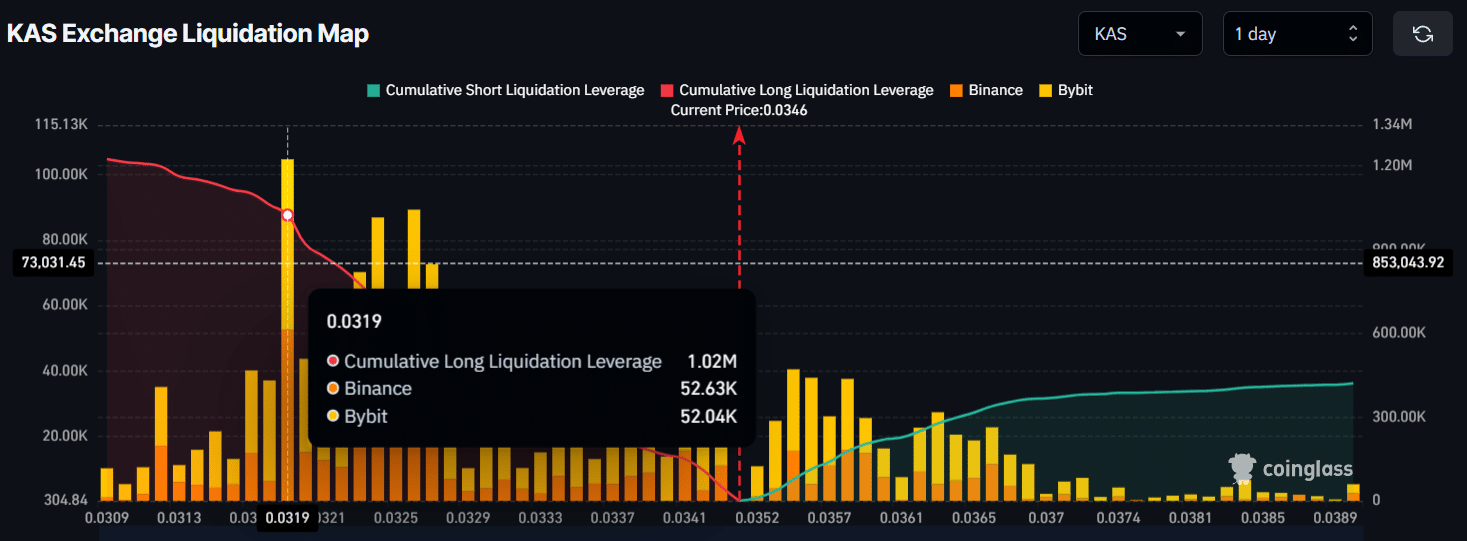
除了价格走势,CoinGlass 还显示,投资者和交易者都情绪复杂,因为短期参与者正在跟随趋势,而长期持有者似乎正在获利了结。

数据显示,下方的 0.0319 美元(支撑位)和上方的 0.0358 美元(阻力位)是交易者过度杠杆化的两个主要水平。事实上,这些水平的交易者建立了 102 万美元的多头杠杆头寸和 17.76 万美元的空头杠杆头寸。

然而,如果 KAS 价格向任一方向移动,这些头寸可能会被清算。 基于这些数据,似乎多头正在主导该资产,而卖家的兴趣似乎正在减弱。

来源: CoinGlass

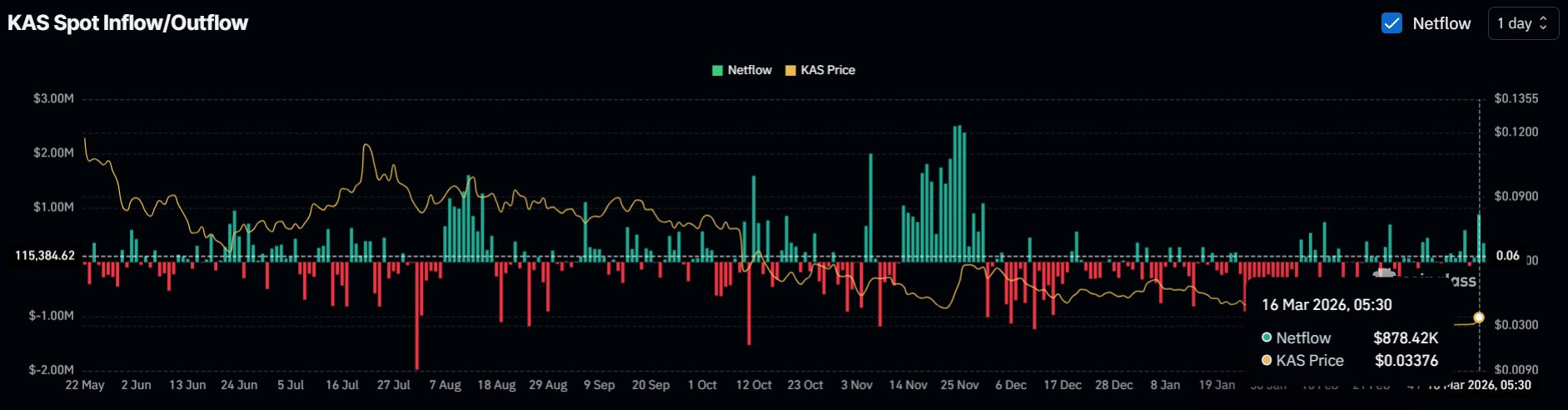
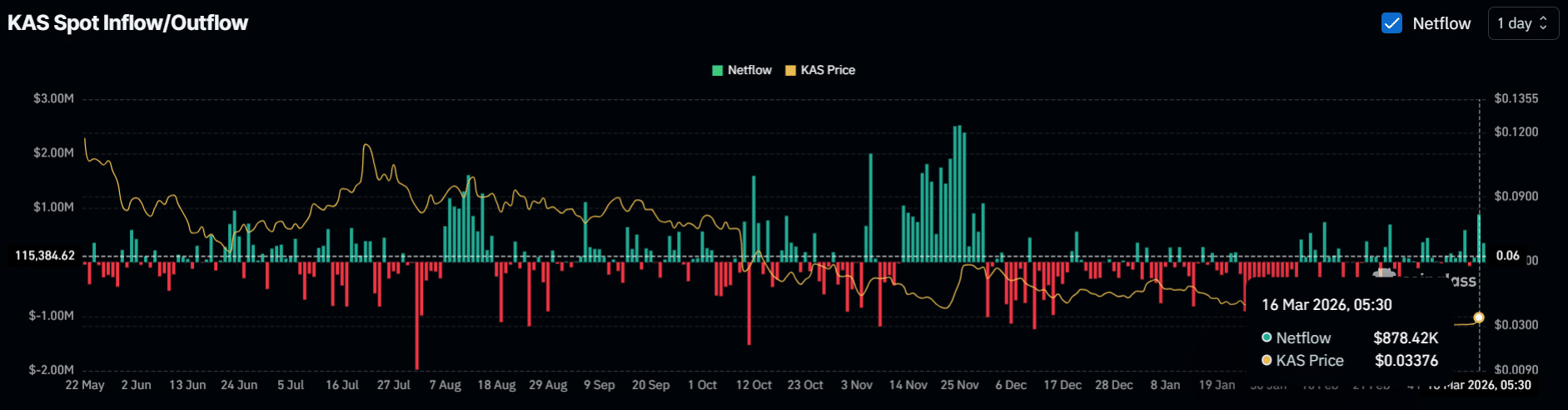
与此同时,关于 KAS 现货流入/流出的数据显示,在过去 48 小时内,有价值 122 万美元的大量资产流入了交易所。资产从钱包转移到交易所通常表明长期持有者可能正准备抛售。这一迹象被认为是该资产的看跌信号。

来源: CoinGlass

最终总结

  • 随着价格跃升 11.50%,Kaspa 突破了一个关键阻力位。
  • 衍生品数据表明,短期参与者正在跟随趋势,而长期持有者似乎表现出兴趣减弱的迹象。

Trending Cryptos

Related Questions

QKaspa (KAS) 的价格在突破关键阻力位后,下一个目标价位是多少?

A根据文章分析,如果KAS的日线收盘价能够稳定在0.035美元的关键阻力位之上,其价格可能会上涨51%,达到0.055美元的目标价位。

QKaspa (KAS) 当前的技术指标RSI值是多少?这说明了什么?

A文章指出,Kaspa的相对强弱指数(RSI)为72.02,这表明该资产已处于超买区域,可能意味着在继续上涨之前会出现一次回调。

QKaspa (KAS) 的衍生品数据反映了市场参与者的哪些情绪?

A衍生品数据显示,短期参与者正在跟随上涨趋势,而长期持有者似乎正在获利了结,显示出市场情绪存在分歧。

QKaspa (KAS) 在过去48小时内的资金流入/流出情况如何?这对其价格有何影响?

A过去48小时内,有价值122万美元的KAS流入交易所。资金从钱包转移到交易所通常意味着长期持有者可能准备抛售,这对资产价格是一个看跌信号。

QKaspa (KAS) 在突破关键阻力位后,下一个需要关注的重要阻力位是多少?

A文章提到,0.040美元是一个关键阻力位,可能会在KAS接下来的上涨行情中成为一个障碍。

Related Reads

230k-follower “Crypto God” exposed: 30 sock puppet accounts caught harvesting fans

Cupsey, a Solana meme coin trader with over 230,000 X followers, has been exposed by on-chain analytics firm Bubblemaps for allegedly running roughly 30 secret wallets to profit off his own followers. Since May 7, these linked addresses traded over 27,000 tokens and cashed out about $1.74 million on roughly 3,000 tokens using a repeated three-step scheme: four core wallets quietly accumulate a new token and spread holdings across 12 associated wallets; Cupsey's public wallet then buys the same token and he promotes it to followers; finally, the hidden wallets sell into the incoming buy orders. In some cases the secret wallets dumped tokens while Cupsey was still drafting his recommendation posts. Because new meme coins have thin liquidity, followers' buys push prices up briefly, letting the insider wallets exit while late buyers absorb the losses. The report also links Cupsey-associated wallets to a token-issuing address starting with "3z4vj," which launched over 400 tokens and earned an estimated $1.3 million. Beyond trading spreads, Cupsey reportedly received about $331,000 in Pump.fun promotion rewards. Bubblemaps has similarly exposed other top traders such as Anglio, 0xEthan, and Solstice for front-running their own recommendations, in some cases buying about 20 seconds before posting. The firm criticizes platforms for rewarding trading volume with millions in incentives while doing little to detect bundled holdings, insider wallets, or repeat offenders, turning followers into exit liquidity. Cupsey has not yet responded to the allegations.

marsbit1h ago

230k-follower “Crypto God” exposed: 30 sock puppet accounts caught harvesting fans

marsbit1h ago

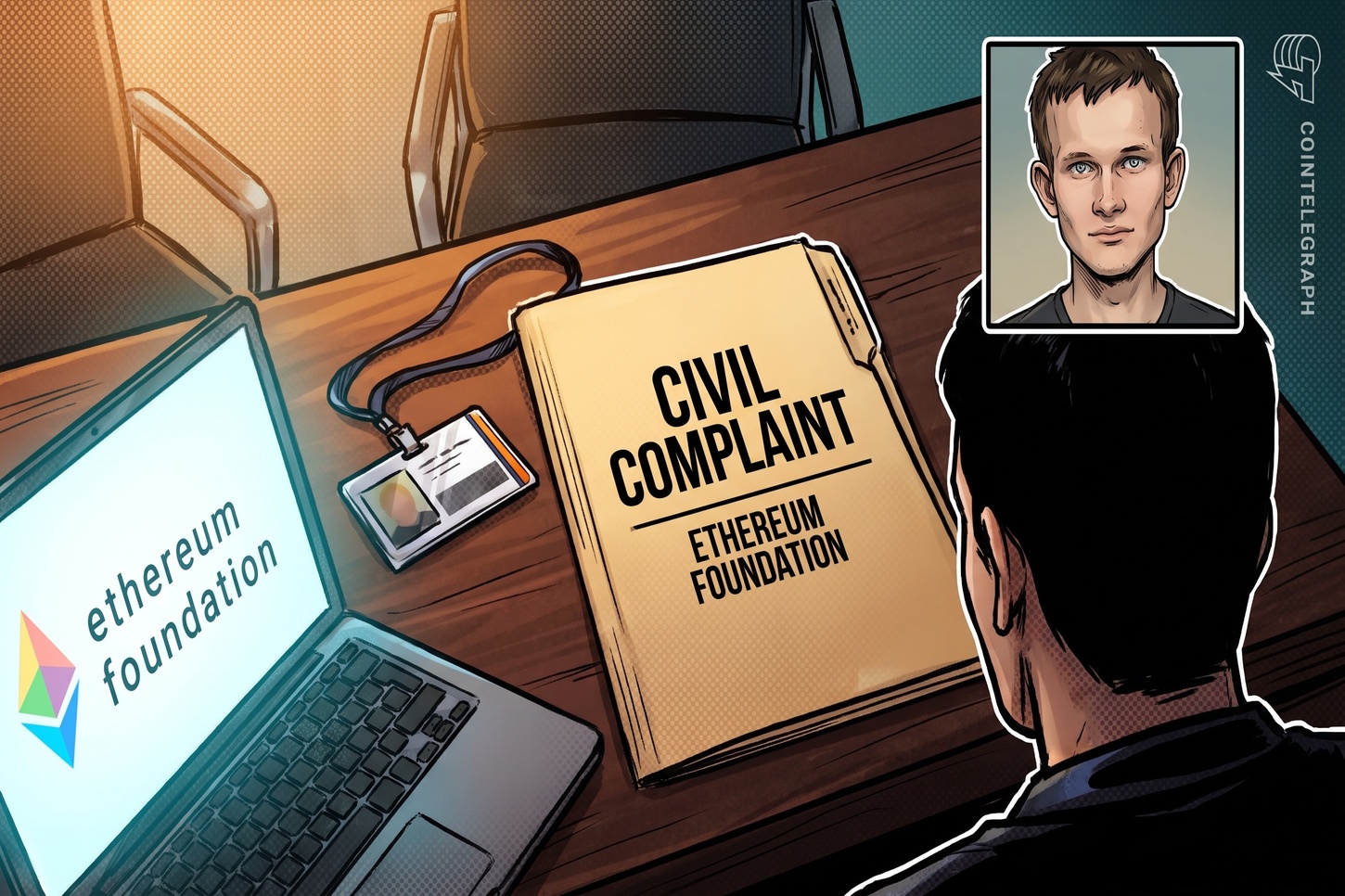
Ex-employee sues Ethereum Foundation and Vitalik Buterin over firing

A former Ethereum Foundation employee, Kayleen Fulton (known as “Nixo”), has sued the organization, co-founder Vitalik Buterin, and four others, alleging she was fired after disclosing a cancer diagnosis and organizing a staff letter challenging a directive tied to the foundation’s new mandate. Fulton, who led the protocol support team, filed the complaint on Nov. 4 in the U.S. District Court for the District of Colorado. She claims Bastian Aue, then a co-executive director, fired her on April 6, 13 days after her diagnosis disclosure, and that Buterin helped adopt and enforce the directive as a board member. Fulton and colleague Trent Van Epps organized a letter with 53 signers supporting the mandate’s goals but objecting to a requirement that employees affirm it to keep their jobs; she alleges she and Van Epps were fired 30 minutes apart days later. She alleges disability discrimination, retaliation, and interference with medical leave rights, seeking lost pay and damages. The complaint also notes some employees objected to a reference to ritual suicide in the mandate, quoting Aue saying the language was figurative. A lawyer for the foundation’s Singapore affiliate denied unlawful conduct or retaliation and said her separation agreement was binding. The foundation published its mandate in March, highlighting censorship resistance, open-source code, privacy and security, and a focus on protocol upgrades, research, and developer tools.

cointelegraph1h ago

Ex-employee sues Ethereum Foundation and Vitalik Buterin over firing

cointelegraph1h ago

Major Analog Chip Acquisition: The Account Behind Over 500 Part Numbers

On November 9, Awinic Electronics announced a trading halt to plan the acquisition of Yutai Semiconductor shares via share issuance and cash, plus supporting financing—a landmark integration in China's analog chip design sector. Both companies compete in analog chips but follow different product paths. Awinic's power management revenue reached 1.047 billion yuan in 2025 (about 37% of total), slightly down 0.03% year-on-year, deeply tied to consumer electronics like phones, AIoT, and wearables. Its real strength lies in high-performance mixed-signal chips (1.505 billion yuan, 53% of revenue), with audio power amplifiers as the core, now extending into edge AI audio for AI glasses, supplying Meta, Rokid, and RayNeo. However, consumer cyclicality and fierce 2026 price competition expose Awinic's limited coverage in industrial-grade medium/high-voltage power, telecom power, and smart meters. Yutai, founded by former Maxim designers with R&D centers in Shanghai, Silicon Valley, and Hanoi, offers over 500 product models covering DC-DC, AC-DC, LDO, battery management, and PMU. Its AC-DC line spans 5 categories and 130+ models, including PWM controllers, integrated GaN converters, synchronous rectification, and fast-charging protocols—targeting high-voltage, high-frequency, high-power-density applications like fast chargers, industrial power, and telecom equipment. Its DC-DC products, such as the ETA9121/9122 dual-phase buck converters and ETA5220 ultra-low-noise LDO (0.96μV RMS), are not commodity consumer parts. Yutai also partners with MediaTek, Intel, Spreadtrum, Rockchip, Ambarella, and NXP, covering smart meters, security, set-top boxes, and routers. The complementarity is clear: Awinic excels in low-voltage, consumer-grade, highly integrated power for phones and wearables; Yutai in medium/high-voltage, industrial-grade, full-category solutions. A merger could theoretically cover consumer to industrial communications, low to medium/high voltage, and single chips to system-level solutions. Yet product logic alone doesn't guarantee success: Saint-Gong holds 25.95% of Yutai as second-largest shareholder, potentially constraining R&D integration, customer sharing, and product roadmaps post-closing. The deal reflects China's analog chip industry moving from niche land-grabbing to platform-based consolidation. Awinic needs Yutai's industrial power lines and customer ecosystem to break consumer growth ceilings; Yutai needs Awinic's listing platform and consumer channels to offset capital and market shortcomings. But success won't be decided by synergy visions in announcements—it depends on whether the two R&D teams can work under one product definition framework after the halt ends, and how many of Yutai's 700+ part numbers truly enter Awinic's customer system and generate design wins. Products can be acquired; scenario capabilities must be digested.

marsbit1h ago
Major Analog Chip Acquisition: The Account Behind Over 500 Part Numbers

marsbit1h ago

15 Crypto Ideas That Were 'Ahead of Their Time'—Why They're Worth Rebuilding in the AI Era

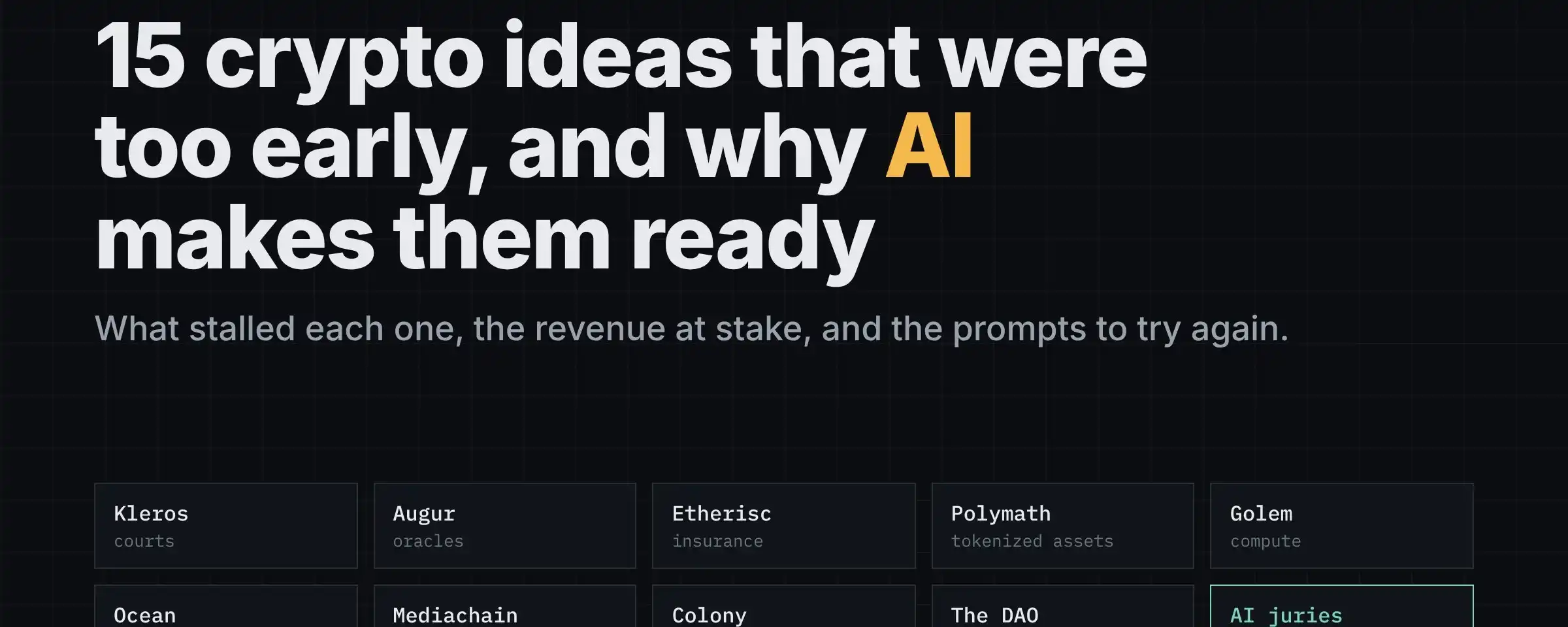
Between 2014 and 2019, crypto projects like Kleros, Augur, Etherisc, and Golem tried to bring commercial arbitration, prediction markets, mutual insurance, and decentralized compute on-chain, but failed because judgment of real-world outcomes depended on slow, bribe-prone human voting, governance tokens were volatile, and settlement was expensive. After 2023, three bottlenecks broke at once: multi-model AI juries cut the cost of real-world judgment to cents, AI agents became high-frequency on-chain transactors, and stablecoins (~$310B) plus sub-second chains like Solana made micro-settlement viable. The article ranks 15 ideas worth rebuilding by revenue potential and readiness: e-commerce arbitration courts, real-world prediction market oracles for questions lacking APIs, automatic-payout insurance without claims adjusters, escrowed task labor markets, data and media licensing, machine micropayments (x402), reputation-and-bond lending, proof of personhood, constitution-enforced DAOs, curated registries, content provenance, supply chain tracking, legally binding tokenized assets, compute and infrastructure markets, and IP with real legal contracts. Top candidates combine billion-dollar markets with components buildable in a quarter using existing AI models, stablecoins, and Solana. The article also provides a general validation prompt plus per-idea prompts, and warns of four risks: AI juries may share blind spots and err collectively, evidence can be forged, regulated sectors still require licenses, and real paid demand for micropayments and DePIN remains thin.

marsbit2h ago

15 Crypto Ideas That Were 'Ahead of Their Time'—Why They're Worth Rebuilding in the AI Era

marsbit2h ago

Trading

Spot

Hot Articles

How to Buy KAS

Welcome to HTX.com! We've made purchasing Kaspa (KAS) simple and convenient. Follow our step-by-step guide to embark on your crypto journey.Step 1: Create Your HTX AccountUse your email or phone number to sign up for a free account on HTX. Experience a hassle-free registration journey and unlock all features.Get My AccountStep 2: Go to Buy Crypto and Choose Your Payment MethodCredit/Debit Card: Use your Visa or Mastercard to buy Kaspa (KAS) instantly.Balance: Use funds from your HTX account balance to trade seamlessly.Third Parties: We've added popular payment methods such as Google Pay and Apple Pay to enhance convenience.P2P: Trade directly with other users on HTX.Over-the-Counter (OTC): We offer tailor-made services and competitive exchange rates for traders.Step 3: Store Your Kaspa (KAS)After purchasing your Kaspa (KAS), store it in your HTX account. Alternatively, you can send it elsewhere via blockchain transfer or use it to trade other cryptocurrencies.Step 4: Trade Kaspa (KAS)Easily trade Kaspa (KAS) on HTX's spot market. Simply access your account, select your trading pair, execute your trades, and monitor in real-time. We offer a user-friendly experience for both beginners and seasoned traders.

7.5k Total ViewsPublished 2024.03.29Updated 2026.06.02

How to Buy KAS

Discussions

Welcome to the HTX Community. Here, you can stay informed about the latest platform developments and gain access to professional market insights. Users' opinions on the price of KAS (KAS) are presented below.

活动图片