据Dune数据显示:Kaito或正面临集中解质押冲击,23M KAITO潜在抛压正在形成

marsbitPublished on 2026-01-23Last updated on 2026-01-23

Abstract

据Dune Analytics链上数据显示,Kaito项目正面临集中解质押带来的抛压风险。当前约800万枚KAITO(占总质押量的33%)已进入解质押冷却队列,预计将在48小时内集中释放至市场,其中1月22日解锁约485万枚,23日解锁约210万枚。这一行为呈现明显的风险规避式离场特征。 此外,剩余约2397万枚质押代币可能因价格承压触发连锁解质押,形成负反馈循环。2月20日还将迎来团队和投资人约3309万枚KAITO的解锁,价值约1362万美元,进一步加剧中期抛压。 基本面方面,X平台近期禁止奖励驱动类应用的政策直接打击了Kaito的核心商业模式,导致其暂停Yaps运营并引发价格下跌约20%。综合来看,Kaito正面临短期解质押冲击、中期解锁压力及基本面恶化的多重考验,市场需警惕流动性风险持续发酵。

据 Dune Analytics 链上数据监测,Kaito 当前正处在一个高度敏感的流动性窗口期。大量质押代币已进入解质押冷却队列,短期内可能集中流入二级市场,叠加后续解锁节点,项目或将面临持续性的抛压考验。

一、解质押风险已被「量化」:近三分之一质押代币正在撤离

根据 Dune 仪表盘数据显示:

当前处于解质押冷却队列中的 KAITO 约 8M 枚

项目剩余总质押量约为 23.97M 枚

这意味着,已有接近 33% 的质押代币进入离场流程,并将在短时间内释放至市场。

这一比例在同类质押模型项目中并不常见,通常被视为「系统性流动性预警信号」。

二、48 小时集中释放:短期流动性压力高度集中

进一步拆解解质押时间结构可以发现,本轮解质押并非自然分散,而是高度集中发生。

Dune 数据显示:

1 月 22 日:约 4.85M KAITO 已解锁可提取

1 月 23 日:约 2.1M KAITO 将解锁

48 小时内合计:约 8M KAITO 潜在进入流通市场

与此同时,解质押申请主要集中在 1 月 18 日—21 日之间,每日申请笔数维持在 50–70 笔,呈现出明显的集体撤离特征。

这一行为模式更接近「风险规避式离场」,而非正常的仓位轮动。

三、潜在连锁反应:23M 质押代币或面临「踩踏式解质押」

值得警惕的是,当前释放的 8M KAITO 并非全部风险。

在质押机制下,一旦二级市场价格承压,剩余 23.97M

KAITO 的质押者极有可能被动跟随解质押,从而形成典型的负反馈循环:

解质押代币进入市场——二级价格承压下行——更多质押者选择止损解质押——抛压进一步放大。

这种结构性风险,往往不会在第一波释放中完全体现,而是在价格出现明显回撤后加速显现。

四、时间并不站在多头一侧:2 月 20 日解锁压力已在路上

除短期解质押风险外,Kaito 还面临一个明确的中期变量。

根据代币解锁时间表:

2 月 20 日将迎来首批团队及投资人代币解锁,解锁数量约 33.09M KAITO,约占最大供应量的 3.31%,按当前价格计算,价值约 1,362 万美元。

这意味着,即便短期市场承压后出现技术性反弹,解锁抛压仍将继续存在,并不存在明确的「压力真空期」。

五、基本面触发点:商业模式受阻,加速信心松动

从基本面角度看,本轮解质押并非孤立事件。

1 月 15 日,X 平台宣布禁止所有以奖励机制驱动用户发帖的应用,该政策被市场普遍解读为对 Kaito 核心商业模式的直接打击。

随后:Kaito 社区宣布暂停 Yaps 运营;代币价格出现约 20% 的快速下跌。

结语:抛压不是「是否发生」,而是「何时与多大规模」

综合链上数据、解质押节奏、未来解锁节点及基本面变化来看,Kaito 当前面临的并非单点事件,而是一段连续的流动性压力周期。

在缺乏新增叙事或有效需求承接的前提下,市场需要警惕:

1. 短期集中解质押带来的价格冲击

2. 中期团队与投资人解锁的叠加效应

3. 情绪与价格形成负反馈后的加速下行风险

对于交易层面而言,这更像是一场「时间换空间」的抛压释放过程,而非已经结束的风险事件。

Trending Cryptos

Related Questions

Q根据Dune数据,当前有多少KAITO代币处于解质押冷却队列中?

A根据Dune数据显示,当前处于解质押冷却队列中的KAITO代币约为800万枚(8M)。

QKAITO项目在2月20日将面临什么事件?

A2月20日,KAITO将迎来首批团队及投资人代币解锁,解锁数量约为3309万枚(33.09M KAITO),约占最大供应量的3.31%,按当前价格计算价值约1362万美元。

Q为什么文章认为Kaito面临的风险是连续的流动性压力周期?

A文章认为Kaito面临连续流动性压力周期,是因为短期有集中解质押代币进入市场,中期有团队和投资人解锁的叠加效应,同时基本面受挫导致情绪与价格可能形成负反馈循环,加速下行风险。

QX平台的政策变化对Kaito产生了什么影响?

A1月15日,X平台宣布禁止所有以奖励机制驱动用户发帖的应用,这被市场解读为对Kaito核心商业模式的直接打击,导致Kaito社区暂停Yaps运营,代币价格出现约20%的快速下跌。

Q文章中提到解质押行为呈现出什么特征?

A文章指出,解质押申请主要集中在1月18日至21日之间,每日申请笔数维持在50至70笔,呈现出明显的集体撤离和风险规避式离场特征,而非正常的仓位轮动。

Related Reads

Monad's $909 Million Credit Economics: How a High-Performance Public Chain Breaks Through via Lending

Monad, developed by former Jump Trading quant engineers, has seen its on-chain revenue model shift dramatically from high-frequency trading to lending interest. Over the ten months to September 2026, global DeFi TVL fell from $111.4B to $95.5B, yet Monad's market share rose from 0.14% to 1.09%—an nearly eightfold increase—ranking tenth among all chains by DeFi TVL. Lending now dominates fee revenue: in September, lending apps contributed 71% of application fees versus just 16% from trading, with borrowers paying roughly 6.2% annualized interest on an average $903M loan book. Monad's capital efficiency is notably high, with every $1 of TVL generating $0.89 in borrowings versus 42% on Ethereum and 45% on Base. Institutional credit vaults hold $287M in uncollateralized loans—second only to Ethereum mainnet—with Accountable at 33% and Aave at 29% of lending balances. Aave's Monad market became its third-largest fee-generating deployment globally within 46 days. Spot trading fees fell to 1.2 basis points as monthly volume surged to $4B. MON trades at just 0.25x its DeFi TVL versus 7–12x for peers like AVAX, SUI, SOL, and SEI, and has outperformed competitors since its first full trading day. Annualized interest income stands at about $56.5M at current levels, with each additional $100M in loans adding $6.2M yearly—upside supported by upcoming Aave V4, infiniFi Prime, StraitsX stablecoins, and Category Labs' institutional clearing domain.

marsbit14m ago

Monad's $909 Million Credit Economics: How a High-Performance Public Chain Breaks Through via Lending

marsbit14m ago

BTC Short-Term Bottoming and Gathering Momentum, HYPE Triple Support Faces Critical Test | Guest Analysis

Last week, the crypto market was driven by news. On Nov 4, midterm election news sparked a 3.92% Bitcoin rally above $80K, but a day later, US stock declines triggered a 5.48% drop to ~$75,222, a new low since Sept 21, with fear index near 25. HYPE also fell 15.19% weekly, erasing prior gains and returning to ~$75. Key points: Bitcoin has held above the 52-week MA for eight weeks, satisfying the "price breakout principle," but the pullback confirmation signal is not yet issued and the 52-week MA (~$76,110) remains downward-sloping. The rebound from the July 1 low of $57,820 is still classified as an oversold bounce, not a confirmed bull market. On the daily chart, price remains in a descending channel, has broken below the key MA crossover (~$77,200), but holds above the 0.382 Fibonacci level ($76,130). The correction (wave i) has run 48 trading days with a max drawdown of 15.9%; a wave ii rebound is expected but not yet started. The "Shijie Ribbon" model still signals a long market. Strategy: mid-term stay in cash; short-term use 30% position for range trading, favoring buying dips near $72,500–73,500 with strict stops. HYPE: the weekly bearish engulfing candle was driven by external shocks, not fundamentals. Three support layers: the ribbon upper band (~$74.05, lower ~$71), the box lower edge (~$75, which triggered a 20% bounce on Oct 24), and the long-term uptrend line (~$68). Key support zones: $74–75 (ribbon upper + box bottom), $71 (ribbon lower), $68 (long-term trendline). Strategy: if price stabilizes at $74–75 or $68–71, consider light long positions (≤30%) with strict stops. Special rules: set initial stop at entry; move to breakeven at +1% profit; trail stop 1% per 1% gain. All analysis is personal technical opinion, not investment advice; markets carry risk.

Odaily星球日报29m ago

BTC Short-Term Bottoming and Gathering Momentum, HYPE Triple Support Faces Critical Test | Guest Analysis

Odaily星球日报29m ago

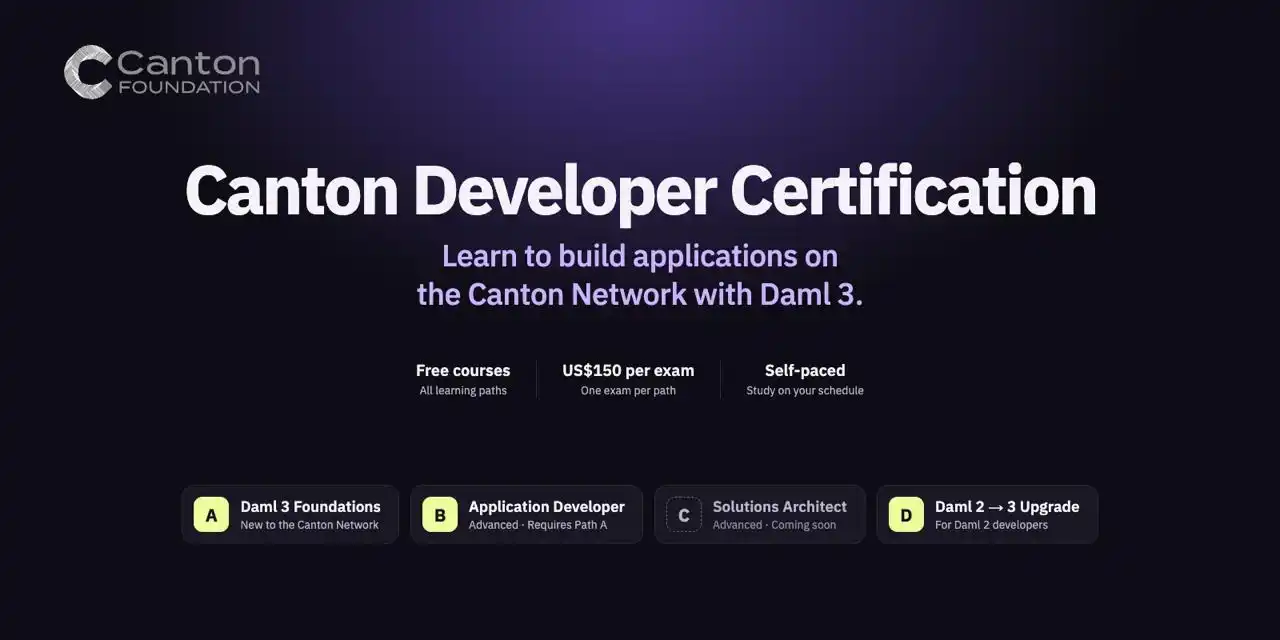
Canton Foundation Launches Official Daml 3 Certification, Expanding Developer Access and Establishing Institutional Finance Standards

Canton Foundation has launched the Canton Developer Certification, an official certification program for Daml 3, the smart contract language of the Canton Network. Combining a self-paced course with a certification exam, it offers developers worldwide a structured path to building applications for regulated financial markets. Canton Network is a public, permissionless blockchain designed for regulated finance, with over $6 trillion in on-chain assets processed by its supported applications. Daml is built to manage who may act on a contract and who may access its terms; the certification validates practical mastery of these authorization and privacy principles, establishing a recognized standard intended to strengthen institutional confidence in applications built on the network. The program is based on Daml 3 and Canton 3.x, the current technology underlying the network, letting newcomers start on the latest stack, helping production engineers deepen expertise, enabling institutional architects to design and integrate Canton deployments, and allowing existing Daml 2 developers to migrate their skills and codebases to Daml 3, unifying the community on a single, current platform. For ecosystem partners—financial institutions, application providers, system integrators, and validators—the certification provides a common technical foundation and a consistent way to assess developers' understanding of authorization and privacy requirements. Canton Foundation COO Amanda Martin said financial institutions need confidence that the applications they rely on are built by developers who understand regulated market requirements, and that the program both opens opportunities for developers globally and establishes a shared professional standard, building a stronger foundation for Canton's future growth by bringing the community together on Daml 3. The certification is now live at certification.canton.foundation; the course is self-paced and free to all developers, and the exam costs $150 per attempt. Canton Foundation is an independent nonprofit responsible for the governance and long-term development of Canton Network's shared infrastructure, supporting transparent and decentralized governance, ecosystem coordination, and broad participation by Global Synchronizer operators and network stakeholders, while working with financial institutions, technology providers, developers, and other participants to support the network's continued global growth and adoption.

marsbit40m ago

Canton Foundation Launches Official Daml 3 Certification, Expanding Developer Access and Establishing Institutional Finance Standards

marsbit40m ago

Nvidia Faces Independent Investigation, Bernstein Maintains $400 Target Price

Nvidia's board has launched an independent investigation following reports about CEO Jensen Huang's contacts with Megaspeed executive Alice Huang, though it says there is no reason to believe U.S. national security or company secrets were compromised. Three Republican House committee chairs have requested Huang attend a closed-door briefing on November 18 to explain the contacts and Nvidia's internal procedures for countering foreign intelligence activities, and Democratic Senator Chris Coons said Congress will investigate. Some reports suggested Alice Huang may have influenced Huang's lobbying to ease chip export restrictions to China, a claim Bernstein doubts, noting Huang has long publicly pushed to expand sales in China and that revenue from mainland China and Hong Kong has fallen sharply since export controls. Only H20 and limited H200 chips were approved for China sales, well behind Nvidia's most advanced products, and Bernstein sees limited room for recovery as Chinese customers prioritize domestic alternatives. Regulatory pressure may persist, with hawkish lawmakers potentially revisiting export limits. Bernstein maintains an Outperform rating and a $400 target price, about 114% above the November 6 close of $186.64, citing data center demand and earnings growth. It projects adjusted EPS of $4.77 for FY2026, $9.20 for FY2027 and $15.80 for FY2028. The target is based on average FY2028-2029 non-GAAP EPS of $19.04 at about 21x. Bernstein also flags Huang's succession as a key risk, given his central role and roughly 60 direct reports.

marsbit50m ago

Nvidia Faces Independent Investigation, Bernstein Maintains $400 Target Price

marsbit50m ago

Two Blocks Hit in 7 Hours: Two Retail Miners Take on the Entire Network's Hashrate and Walk Away with $476,000

Two individual solo miners using home mining rigs hit two Bitcoin blocks within seven hours on November 7, earning a combined $476,000. One miner using a Canaan AvalonQ home miner with roughly 80–87 TH/s earned about $239,000; the other earned roughly $237,000. A CKPool solo platform took about 2% (0.0629 BTC) as a service fee, with the rest going directly to the miners' wallets. Given current network difficulty of about 148.4 trillion, such a rig would normally need over a century to find a block, making the win a luck value of over 10,000%. This is part of a broader trend: in 2026 so far, solo miners have found 36 blocks, nearly one lucky winner per week. Earlier examples include a 6.5 TH/s Avalon Nano 3S worth a few hundred dollars earning $250,000 on October 27, another Nano 3S earning $232,000 on May 30, and a $150 Bitaxe Gamma earning $200,000 on July 10. Home solo mining is often called "plug-in lottery": a 1.2 TH/s mini miner has about a 1-in-16,000 annual chance of winning, far better than Powerball's 1-in-292 million, but rigs cost thousands of dollars and electricity runs $400–$1,100 monthly, with zero income until a block is found. Each viral win serves as free advertising for the industry. Rig manufacturers sell the dream of "maybe I'll win too"; solo pool platforms collect a steady ~2% fee from any winner; and the Bitcoin network preserves its "anyone can participate" narrative despite mining being dominated by large farms. The people paying for it all are ordinary buyers who purchase miners and pay electricity bills hoping for a life-changing jackpot.

marsbit1h ago

Two Blocks Hit in 7 Hours: Two Retail Miners Take on the Entire Network's Hashrate and Walk Away with $476,000

marsbit1h ago

Trading

Spot

Hot Articles

How to Buy KAITO

Welcome to HTX.com! We've made purchasing Kaito (KAITO) simple and convenient. Follow our step-by-step guide to embark on your crypto journey.Step 1: Create Your HTX AccountUse your email or phone number to sign up for a free account on HTX. Experience a hassle-free registration journey and unlock all features.Get My AccountStep 2: Go to Buy Crypto and Choose Your Payment MethodCredit/Debit Card: Use your Visa or Mastercard to buy Kaito (KAITO) instantly.Balance: Use funds from your HTX account balance to trade seamlessly.Third Parties: We've added popular payment methods such as Google Pay and Apple Pay to enhance convenience.P2P: Trade directly with other users on HTX.Over-the-Counter (OTC): We offer tailor-made services and competitive exchange rates for traders.Step 3: Store Your Kaito (KAITO)After purchasing your Kaito (KAITO), store it in your HTX account. Alternatively, you can send it elsewhere via blockchain transfer or use it to trade other cryptocurrencies.Step 4: Trade Kaito (KAITO)Easily trade Kaito (KAITO) on HTX's spot market. Simply access your account, select your trading pair, execute your trades, and monitor in real-time. We offer a user-friendly experience for both beginners and seasoned traders.

6.5k Total ViewsPublished 2025.02.21Updated 2026.07.29

How to Buy KAITO

Discussions

Welcome to the HTX Community. Here, you can stay informed about the latest platform developments and gain access to professional market insights. Users' opinions on the price of KAITO (KAITO) are presented below.

活动图片