狗狗币暴跌50%:所有支撑位失守,第四季度将以下跌告终

bitcoinistPublished on 2025-12-30Last updated on 2025-12-30

Abstract

狗狗币(DOGE)价格在第四季度暴跌50%,预计将以亏损收官。分析师KrissPax指出,自10月10日闪崩事件后,DOGE持续走弱,多次失守关键支撑位,目前交易价格约为0.126美元,月度跌幅达15%,年内跌幅超60%。技术图表显示,DOGE已形成“死亡交叉”看跌形态,且每次横盘整理后均进一步下跌,反映市场抛压持续而买盘无力支撑,表明其面临深层次结构性弱势而非短暂回调。

狗狗币(DOGE)正因市场波动加剧和价格走势震荡而艰难挣扎。随着第四季度(Q4)最后几天快速临近,技术分析师指出DOGE价格结构疲软,并强调该迷因币已下跌50%,可能正准备进一步回调。若此情况发生,狗狗币或将以下跌态势结束今年,无法收复前期高点。

暴跌50%后,狗狗币第四季度或将收跌

加密货币分析师KrissPax在X平台分享了新的狗狗币价格分析,警告该迷因币可能在2025年第四季度陷入深度衰退。据其分析,狗狗币价格在第四季度已暴跌约50%,反映出10月短暂稳定后的持续疲软。

KrissPax在文中解释称,狗狗币在10月初曾显现韧性,价格走势遵循向上倾斜的支撑趋势线。但该结构在10月10日的闪崩和清算事件中被彻底打破,分析师指出这是一次杠杆清扫,标志着市场行为的重大转变。

该分析师表示,自此次毁灭性事件后,狗狗币持续走低,未出现实质性复苏。尽管过去几个月该迷因币曾尝试突破下跌趋势,但其疲软的价格走势和负面市场情绪抑制了任何强劲的看涨反弹。

KrissPax还强调了迷因币多次失守关键支撑位的现象,表明存在更深层次的结构性疲软而非暂时价格回调。这种弱势清晰反映在狗狗币的价格走势中。根据CoinMarketCap数据,DOGE现报0.126美元,月内下跌15%,年内跌幅超60%。

图表揭示的信号

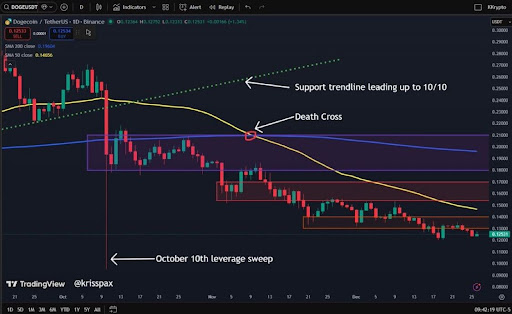
KrissPax在分析中分享了一张详细价格图表,呈现了狗狗币全年看跌态势。该市场分析师透露,他通过紫色、红色和棕色等多个支撑区域追踪迷因币价格走势——所有这些支撑均未能守住。

来源:X

10月10日暴跌后,狗狗币难以收复已破位的支撑趋势线,确认其已成为阻力位而非上涨趋势延续的基础。分析师强调图表中最显著的信号之一是死亡交叉形态。该技术形态通常与延长的下跌趋势和看跌市场情绪相关。

狗狗币形成死亡交叉后,其价格连续数月持续走低。图表还显示多个 consolidation 区间最终向下突破。每次横盘整理后都伴随新一轮下跌,表明这些停顿期间存在大量派发而非吸筹。关键支撑区域的反复失守进一步表明,即便在抛压持续的情况下,DOGE买家也无力阻止币价进一步下跌。

DOGE再度下探 | 来源:Tradingview.com上的DOGEUSDT

Trending Cryptos

Related Questions

Q根据文章,狗狗币(DOGE)在第四季度(Q4)已经下跌了多少百分比?

A根据文章,狗狗币在第四季度已经下跌了大约50%。

Q分析师KrissPax认为导致狗狗币市场行为发生重大转变的关键事件是什么?

A分析师KrissPax指出,10月10日的闪崩和清算事件是一个杠杆清扫事件,标志着市场行为发生了重大转变。

Q文章中提到,狗狗币价格图表上出现的哪个技术形态通常与长期下跌趋势和看跌市场情绪相关?

A文章中提到,狗狗币价格图表上出现了'死亡交叉(Death Cross)'形态,这通常与长期下跌趋势和看跌市场情绪相关。

Q截至文章撰写时,狗狗币的当前交易价格是多少?与年初相比表现如何?

A截至文章撰写时,狗狗币的当前交易价格为0.126美元,与年初相比已下跌超过60%。

Q分析师KrissPax如何解释狗狗币在横盘整理后的价格走势?这暗示了市场处于什么状态?

A分析师KrissPax指出,每次横盘整理之后都伴随着又一次价格下跌,这表明在这些暂停期间市场处于'大量派发(heavy distribution)'而非积累的状态。

Related Reads

Polkadot’s first batch of parachain champions can’t hold on either: Acala and Karura plan to halt their chains in February next year

Acala, the flagship DeFi parachain on Polkadot, has submitted governance referendum Acala #195 proposing to shut down the network, with sister chain Karura launching Karura #137 in parallel. If passed, both chains will stop producing blocks on February 10, 2027. In a letter to the community, the team said Polkadot's multi-parachain architecture has deeply fragmented ecosystem funds, leaving DeFi liquidity severely insufficient, with node and network maintenance costs persistently exceeding actual revenue. The exit of a flagship network after seven years of building and operation raises direct questions about application sustainability under the multi-chain vision. The shutdown plan sets clear cross-chain withdrawal deadlines. Holders must move DOT, KSM, and bridged assets such as USDT and USDC to other networks before February 10, 2027. Native assets ACA and KAR cannot be exported cross-chain and will remain permanently in their respective ledgers after the shutdown. Liquid staking products have staggered unbonding deadlines: Polkadot's standard unbonding takes 28 days, and LDOT bound to specific validators requires an additional 28 days, so applications must be filed by December 16, 2026; the unbonding deadlines for regular LDOT and LKSM are January 12 and February 2, 2027, respectively. The early clearing window is driven by technical security concerns: after the shutdown, network code and historical state ledgers will be public, and any third party could recompile and restart the chain. With AI-assisted code audit tools becoming widespread, legacy systems lacking ongoing maintenance are prone to exposing governance vulnerabilities, so clearing retained assets early can block potential theft of stranded funds. Looking back at Polkadot's first parachain auction in November 2021, Acala won the network's first slot, attracting over 81,000 on-chain addresses to participate in the crowdloan and locking more than 32.5 million DOT. The 96-week lease term secured shared security from the relay chain but also caused massive funds to sit idle for long periods, constraining capital turnover efficiency. Five years later, most of the first batch of winning projects have exited or stalled. Moonbeam stopped producing blocks around July 31, 2026 and migrated GLMR to Base; Parallel Finance closed its products after a security incident; Clover also left its original parachain identity, leaving only Astar still actively maintained and upgraded. The multi-chain structure and separate cross-chain wallet interactions worsen the fragmented experience, and scarce on-chain liquidity is continually diluted. Although Polkadot has now shifted to the elastic coretime model described in its Agile Coretime documentation and is advancing the parallel computing upgrade outlined in the JAM protocol gray paper, early ecosystem funds that flowed out are unlikely to return in the short term. The shutdown plan is currently at the signaling vote stage. Subsquare on-chain data shows Acala Referendum #195 has about 23.1 million ACA in favor and Karura Referendum #137 about 1.28 million KAR in favor, with zero opposing votes so far. After the signaling vote passes, the team will initiate an on-chain execution proposal to implement the shutdown. The team pledges to maintain node operation and coretime availability before the shutdown; external assets not withdrawn by the deadline will be returned to the corresponding Asset Hub addresses on a best-effort basis without a full guarantee, while treasury external assets are planned to be donated to the corresponding relay chain treasury.

marsbit11m ago
Polkadot’s first batch of parachain champions can’t hold on either: Acala and Karura plan to halt their chains in February next year

marsbit11m ago

Airwallex Founder "Slaps His Own Face": From Ranting Against Stablecoins to Building His Own Chain

Jack Zhang, co-founder and CEO of Airwallex, publicly dismissed stablecoins in June 2025, saying they could not lower costs and that crypto had solved no real-world problems in 15 years. Just 17 months later, he co-founded Alta, a blockchain company that raised $80 million to build an L1 designed specifically for licensed financial institutions. The turnaround reflects a broader industry shift: Stripe acquired Bridge for $1.1 billion and incubated Tempo, Circle launched Arc, and stablecoin market cap doubled past $300 billion as U.S. and Hong Kong regulation brought institutional certainty. Alta, co-founded with Loong Wang and Catherine Porter, uses recursive zero-knowledge cryptography to combine compliance with privacy, embedding programmable compliance and identity directly into the protocol—features general-purpose chains cannot offer banks. Airwallex serves as Alta's distribution channel, connecting the chain to its network across 200 countries and 90 currencies. Zhang's stated logic is consistent: he never endorsed crypto broadly, but now sees stablecoins as the on-chain form of fiat currency and a new settlement layer. The real battle is over who controls stablecoin settlement infrastructure, with Stripe, Circle, Fireblocks, and Canton Network all racing to build chain-level rails. Zhang's shift is less a conversion than a commercial necessity: as stablecoin settlement becomes standard for enterprise payments, payment companies that do not own the settlement layer risk becoming application-layer interfaces running on someone else's chain.

marsbit2h ago

Airwallex Founder "Slaps His Own Face": From Ranting Against Stablecoins to Building His Own Chain

marsbit2h ago

The Art of the Trade: How They Made Money Arbitraging USDE Stock

Starkiller Capital outlines a arbitrage trade on StablecoinX (Nasdaq: USDE), a crypto treasury company holding about 20% of ENA tokens. At Friday's close, USDE traded at $6.43 per share, with each share backed by 125.48 ENA worth $20.10—meaning investors pay 32 cents per $1 of ENA, or $155M for $485M in tokens. The firm's approach: buy USDE stock while shorting an equal dollar amount of ENA, so if both fall but the stock falls less, short gains offset stock losses. Starkiller first entered in August at 0.18x mNAV, took profits as the discount narrowed to 0.60x, and has rebuilt a larger position at 0.32x. The key new catalyst: Ethena's foundation waived all token lockups effective October 5, letting the company sell ENA to fund an approved share buyback. At current prices, every $1 of ENA sold repurchases shares representing $3.13 of token assets, strongly accretionary to NAV per share. The discount widened recently not because of company fundamentals but because crypto market beta fell—ENA dropped 29% and比特币 7% in October—and because USDE holders exiting ENA exposure sold the illiquid stock; short interest rose 78% to ~15% of float. Risks include: no redemption mechanism forcing convergence (GBTC traded at a discount for two years), the foundation controls the exit path and must approve token sales, a resale S-1 covers over half the A-shares, mNAV has ranged from 0.13x to 0.61x, warrants at $11.50 and $15 strike could dilute upside, and a crypto crash could push mNAV back to lows. Catalysts to watch: the Q3 10-Q filing (due by Nov 16) for buyback details. Starkiller argues the stock should eventually trade around 0.7x mNAV, implying roughly 56% upside on the long leg just from a return to the October 5 level.

marsbit2h ago

The Art of the Trade: How They Made Money Arbitraging USDE Stock

marsbit2h ago

Embedded chip vendors are starting to sell modules directly?

On November 5, Texas Instruments (TI) announced the TICS100MOD, a multi-protocol industrial communication System-on-Module (SoM) supporting EtherCAT, PROFINET, and EtherNet/IP, with volume availability expected by the end of 2026. The module integrates TI's AM2612 real-time MCU—featuring dual Arm Cortex-R5F cores and PRU-ICSS—along with two DP83826AI 100Mbps Ethernet PHYs, protocol stacks, SDK, and development tools in a 30mm × 18mm package. It connects to an external host MCU or MPU via SPI or QSPI, handling industrial Ethernet protocol processing while the host runs device control and applications. The article notes that while MPU-based SoMs are common, MCU-based SoMs are relatively rare, and TI's MCU is powerful and complex enough to justify a module. TI is not the first chip vendor to offer its own SoM products: Microchip has offered SoMs such as the ATSAMA5D27-SOM1 and SAM9X60D1G-SOM, some suitable for surface-mount reflow soldering, while AMD offers the Kria K26 and K24 SoM series. In wireless connectivity, Espressif and Silicon Labs similarly provide chips alongside modules. In China, SoMs are typically called core boards, with vendors including Chuanglong Technology, MYIR Electronics, Forlinx, ZLG, and Alientek, covering TI, NXP, ST, Renesas, and domestic platforms such as Rockchip and Allwinner. TI continues to partner with third-party SoM vendors—including Chuanglong, MYIR, and Alientek around the AM62L processor, and internationally with Toradex, Variscite, Ezurio, and PHYTEC. TI's new TICS100MOD focuses specifically on industrial Ethernet communication, while customers needing complex computing platforms are still served through third-party partners.

marsbit2h ago

Embedded chip vendors are starting to sell modules directly?

marsbit2h ago

Trading

Spot

Hot Articles

How to Buy RED

Welcome to HTX.com! We've made purchasing RedStone (RED) simple and convenient. Follow our step-by-step guide to embark on your crypto journey.Step 1: Create Your HTX AccountUse your email or phone number to sign up for a free account on HTX. Experience a hassle-free registration journey and unlock all features.Get My AccountStep 2: Go to Buy Crypto and Choose Your Payment MethodCredit/Debit Card: Use your Visa or Mastercard to buy RedStone (RED) instantly.Balance: Use funds from your HTX account balance to trade seamlessly.Third Parties: We've added popular payment methods such as Google Pay and Apple Pay to enhance convenience.P2P: Trade directly with other users on HTX.Over-the-Counter (OTC): We offer tailor-made services and competitive exchange rates for traders.Step 3: Store Your RedStone (RED)After purchasing your RedStone (RED), store it in your HTX account. Alternatively, you can send it elsewhere via blockchain transfer or use it to trade other cryptocurrencies.Step 4: Trade RedStone (RED)Easily trade RedStone (RED) on HTX's spot market. Simply access your account, select your trading pair, execute your trades, and monitor in real-time. We offer a user-friendly experience for both beginners and seasoned traders.

8.1k Total ViewsPublished 2025.03.05Updated 2026.07.21

How to Buy RED

Discussions

Welcome to the HTX Community. Here, you can stay informed about the latest platform developments and gain access to professional market insights. Users' opinions on the price of RED (RED) are presented below.

活动图片