Wallet in Telegram rebrands to Walt as Gram wallet debuts

cointelegraphPublished on 2026-09-01Last updated on 2026-09-01

Abstract

Telegram has restructured its cryptocurrency services around two main offerings: the new self-custodial Gram wallet and the rebranded broader crypto platform, Walt (formerly Wallet in Telegram). Gram wallet is now the default option in Telegram settings, focusing on payments, transfers, and purchases within the app. Walt, accessible via search, expands into services like trading, investing, and supporting assets across multiple blockchains. The two remain linked, with Walt enabling multichain deposits to the Gram wallet. This shift centralizes a self-custodial wallet for daily transactions while positioning Walt as a comprehensive crypto and financial products hub.

Telegram is reshaping its crypto offering around two key services: its new self-custodial Gram wallet and Wallet in Telegram, the broader crypto platform now rebranding as Walt.

Telegram has rolled out its native Gram wallet across the messaging app, making the self-custodial service its default wallet in user settings, according to an announcement shared with Cointelegraph.

Gram wallet will focus on payments, transfers and purchases across Telegram, while Walt will offer broader crypto services including trading, investing and support for assets across multiple blockchains. Walt will no longer serve as Telegram’s default crypto wallet and will instead be accessible through search.

The split marks a major shift in Telegram’s crypto ecosystem, putting a native self-custodial wallet at the center of everyday transactions while repositioning Walt around a wider range of crypto and financial products. Telegram founder Pavel Durov first teased Gram wallet in July, saying the company planned to bring a native non-custodial wallet to every Telegram app.

“We’ll be gradually rolling it out to our billion+ users over the next couple of weeks,” he said Monday in a Telegram post.
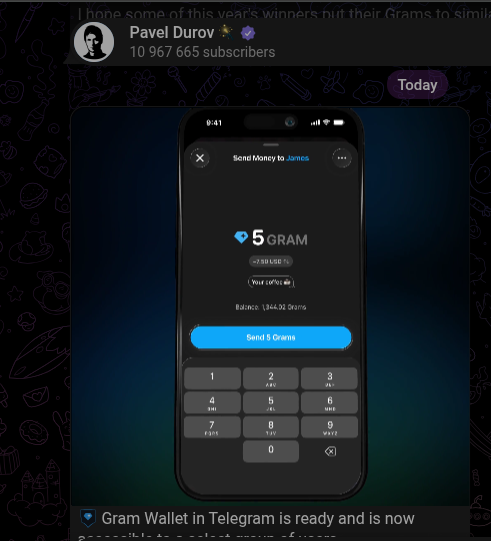
Source: Pavel Durov on Telegram

Gram and Walt will remain connected

Gram wallet will serve as Telegram’s transaction layer for transfers and payments. The self-custodial wallet will support purchases of Telegram Collectibles, including gifts, usernames and phone numbers, as well as payments for services and everyday purchases.

Gram wallet and Walt will remain connected, with Walt allowing users to make multichain crypto deposits to Gram wallet.

Wallet in Telegram becomes Walt

Wallet in Telegram’s rebrand reflects the service’s expansion beyond its origins as a wallet primarily used to buy and hold Gram (GRAM), formerly known as Toncoin (TON).

Walt supports deposits, holdings and withdrawals for more than 300 crypto assets across four blockchains, alongside trading in more than 200. The platform also offers more than 100 tokenized stocks, exchange-traded funds (ETFs) and metals.

Related: Apple briefly removes Telegram from App Store, Gram rebounds

Its other products include crypto yield services and perpetual futures, a type of derivative contract without an expiration date. Walt offers perpetual trading across more than 70 assets, including cryptocurrencies, oil, natural gas and metals.

“We started as a simple wallet for buying TON, but over the past four years we’ve grown into a full-scale crypto platform inside Telegram, launching Earn, real-world assets and perpetual trading,” said Andrew Rogozov, founder and CEO of The Open Platform (TOP) and Walt.

Magazine: Do the Coldcard attacks mean all hardware wallets are now insecure?

Related Questions

QWhat are the two key crypto services Telegram is focusing on after the recent changes?

ATelegram is focusing on two key crypto services: the new self-custodial Gram wallet, which becomes the default for transactions, and the rebranded Walt platform, which offers a wider range of crypto and financial services.

QWhat is the primary function of the new Gram wallet within Telegram?

AThe primary function of the Gram wallet is to serve as Telegram's transaction layer for payments, transfers, and purchases, including Telegram Collectibles and payments for services.

QHow did the service formerly known as 'Wallet in Telegram' change, and what does the new name 'Walt' signify?

AThe service formerly known as 'Wallet in Telegram' has been rebranded to 'Walt'. This change reflects its expansion from a simple wallet primarily for buying TON (now GRAM) into a full-scale crypto platform offering trading, investing, yield services, perpetual futures, and support for assets across multiple blockchains.

QAccording to the article, how are the Gram wallet and Walt platform connected?

AGram wallet and Walt remain connected. The Walt platform allows users to make multichain crypto deposits into their Gram wallet.

QWhat did Telegram founder Pavel Durov announce regarding the rollout of the Gram wallet?

ATelegram founder Pavel Durov announced that the company plans to gradually roll out the native Gram wallet to its more than one billion users over the next couple of weeks.

Related Reads

Tech Veteran: Anthropic IPO Will Be the Peak of the US AI Rally, Will "Go Big on China AI" If Conditions Allow

Veteran tech investor Jack Selby, head of Copper Sky and managing partner of Peter Thiel's family office, warns that Anthropic's planned IPO—aiming to raise up to $100 billion—could mark the peak of the AI market rally. He cautions that if the highly anticipated IPO prices well below expectations, the expiry of lock-up periods could trigger significant selling pressure and a large-scale AI market correction. Selby names SoftBank and Oracle as "canaries in the coal mine," flagging Oracle's higher debt ratio as a bigger risk, and suggests investors needing AI exposure consider Google instead. Selby also questions Anthropic's fundamentals: over 80% of its revenue is non-recurring and vulnerable to competitors closing the technology gap within six to nine months. He notes the business is extremely capital-intensive—requiring costly data, energy, data centers, and chips—and that with interest rates no longer near zero, calling it a trillion-dollar company seems far-fetched. He further highlights Chinese competition, saying DeepSeek and other Chinese AI models trail Anthropic by only about six months, posing a direct threat. Selby says he would "aggressively go long on Chinese AI" if conditions allow, arguing that Anthropic cannot claim all its business must rely on U.S. models, since most AI use cases resemble basic tool applications, leaving room for Chinese alternatives.

marsbit1h ago

Tech Veteran: Anthropic IPO Will Be the Peak of the US AI Rally, Will "Go Big on China AI" If Conditions Allow

marsbit1h ago

Grayscale's $1 Million Sponsorship Can't Save It: Why ZEC, Once Hyped as the Belle of the Ball, Crashed Again?

Grayscale announced a $1 million ecosystem sponsorship for Zcash on November 10, pledging to return all first-year management fees from its Zcash ETF (ZCSH) to network development and marketing, with the first $100,000 distributed to four nonprofit organizations. Yet the same day, ZEC plunged 11.3% to around $1,043, extending its 30-day decline to nearly 20%. After two months of hype from overseas KOLs and institutions touting ZEC as a "second spring for old coins," the token quickly turned into a slow bleed under the weight of $2.3 billion in open interest. The article argues that Wall Street's narrative halo and Grayscale's PR subsidy have been exhausted, and ZEC—lacking fundamental support—has once again become an ATM for highly leveraged speculators to cash out on good news. Grayscale's pledge, while seemingly generous, is voluntary and can be modified or terminated at any time; only $400,000 of the $1 million has actually been paid, making it more brand marketing for its own ETF than genuine ecosystem donation. The sum is negligible relative to Zcash's market cap, and the Zcash ETF has not attracted sustained institutional capital the way Bitcoin or Ethereum ETFs did. Without new external liquidity, the inflated narrative cannot hold. The core problem is market structure: ZEC perpetual futures open interest stands at roughly $2.3 billion, dominated by high-volatility leveraged gamblers. The article contends that the earlier social media hype was a precise harvest of derivatives liquidity—promoters used the "first privacy ETF" theme to lure retail into leveraged longs, then exited as open interest peaked and the sponsorship news landed. Compounding this, Zcash's privacy pool suffered a critical vulnerability about three months before the ETF listing, halving the price and shattering conservative investors' confidence despite a July fix. The piece concludes that "old coin re-hype" follows a familiar script: find a traditional-finance-approved angle, package a grand revaluation narrative, use KOLs to drive retail buying, then distribute chips at peak liquidity. Those who hyped ZEC have largely cashed out, leaving behind a broken price and $2.3 billion in unsettled leverage. Grayscale's advertising cannot save Zcash; a real revival requires far more than Wall Street's charity.

marsbit2h ago

Grayscale's $1 Million Sponsorship Can't Save It: Why ZEC, Once Hyped as the Belle of the Ball, Crashed Again?

marsbit2h ago

Trading

Spot
活动图片