How long does it take for a company to go from registration to a valuation of one billion US dollars?
A few years ago, the standard answer was about 5 years. Angel, Series A, Series B, Series C... proving oneself round by round, shedding several layers of skin along the way. In 2026, the answer has shortened to three months.
In March of this year, Lin Junyan left Alibaba; on May 13th, he registered a company in Xuhui, Shanghai; by August, when it was officially announced, this three-month-old company with zero products had a valuation of approximately 2 billion US dollars—Gaorong Capital and Sequoia Capital China each invested 100 million US dollars, and Tencent followed with 20 million US dollars.
Lin Junyan is not an exception.
We counted: from the beginning of 2026 to early September, at least 9 companies, both domestic and international, crossed the unicorn threshold within half a year of their establishment.
The list of these founders reads like a roll call of the AI industry: a Turing Award winner, a co-founder of xAI, the youngest P10 at Alibaba who made Qwen the world's number one open-source model, the technical leader who built Li Auto's intelligent driving system from 0 to 1, and a business unit spun out of a robotics company.
Why is the money coming so fast and so urgently? What exactly are they buying?
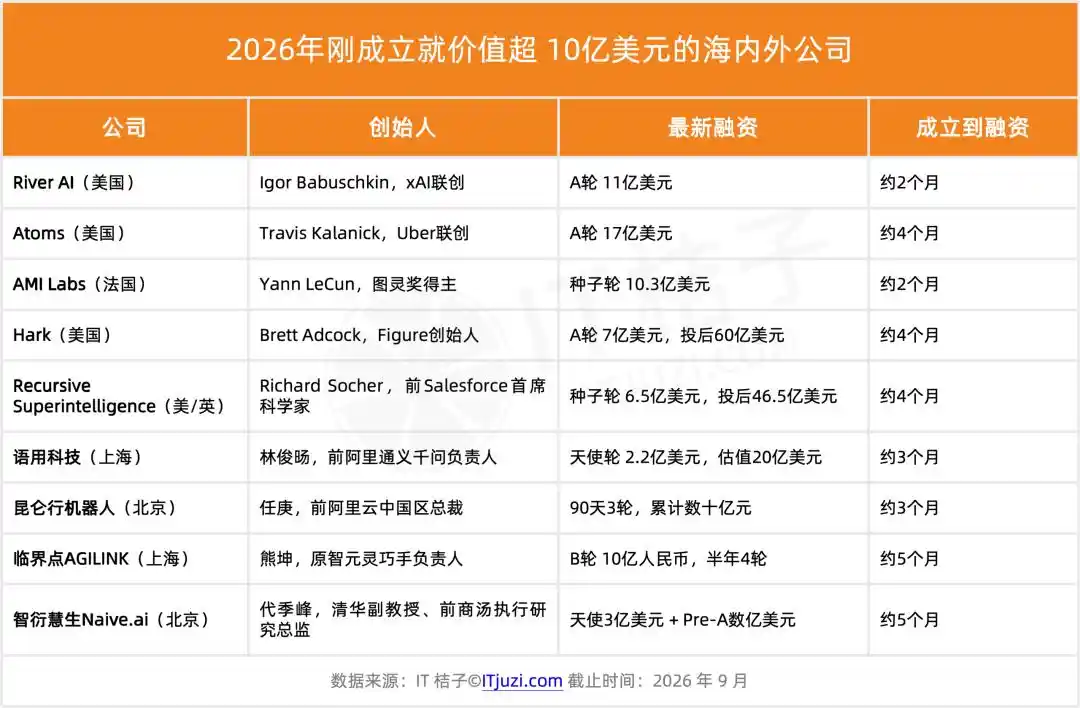
The Four Ways Domestic Unicorns Emerge
These four domestic companies have different paths, but they share one common point: the founders' previous work experience is sufficiently convincing.
Pragmatics Technology: Three Months, 2 Billion Dollars
Lin Junyan's last job was at Alibaba. Born in 1993, he studied English at the University of International Relations for his bachelor's degree and linguistics at Peking University for his master's. He joined Alibaba's DAMO Academy in 2019, was promoted four levels in six years, and became Alibaba's youngest P10 at age 32. Qwen series was his creation—with over 200,000 derivative models on Hugging Face and downloads exceeding 1 billion, it ranked first globally among open-source models; the 2025 Qwen3-Max had parameters exceeding a trillion. He left in March this year, established Pragmatics Technology in May. Its official website lists only four directions: Digital Agents, Physical Agents, Frontier Research, and Real Products.
This company currently has zero products, zero revenue, and a valuation of 2 billion US dollars. A rare detail is that Lin Junyan controls approximately 88% through direct shareholding and two affiliated entities—an outlier in a startup circle where dilution to below 30% by capital is common. The term "Pragmatics" comes from his early training in linguistics, meaning pragmatism, which is also his stance on where AGI should head. KunlunXing: One Who Managed Trillion-Dollar Business, and One Who Built Intelligent Driving
KunlunXing Robotics takes another path: a combination of two people.
Founder Ren Geng worked on core businesses at Huawei and Alibaba, served as President of Alibaba Cloud China Region and Chief of Staff, and also as President of Xin'ao Group; Co-founder Lang Xianpeng is the former Senior Vice President and President of Autonomous Driving at Li Auto, a rare figure in the industry who built autonomous driving AI from 0 to 1, and then to large-scale deployment.
The company registered in Beijing Economic-Technological Development Area on March 16th. By the end of June, it had completed three consecutive funding rounds, accumulating several billion RMB. The list includes Gaorong, Hillhouse Capital, CAS Investment, CICC, Huaye Chengzhi, Innovation Works, Xin Capital, C&D Capital, with all first-round investors making follow-on investments in the latter two rounds.
Technologically, they are betting on "physically innate causality"—enabling robots to understand the physical principles behind actions, not just imitate movements. The core is the Kunlun World Model (KWM), which adds physical causality modeling on top of the mainstream international vision-language-action model. They also built a counterfactual evaluation system, using real physical outcomes to distinguish whether a model's generalization ability is genuine or not.
On the hardware side, they integrate self-research in robotics body, motion control, and integrated testing, with a straightforward goal: engineering for mass production.
Xin Wang, a partner at Gaorong Capital, stated that the barrier to entry for embodied intelligence is extremely high, requiring a team that simultaneously understands AI, hardware, and commercialization—this company has gathered "someone who has managed a trillion-dollar business" and "someone who has mass-produced autonomous driving AI."
Critical Point AGILINK: The Only One Making Money
The most special among the four is Critical Point AGILINK, because it is the only one that was "spun out."
On January 14th this year, Zhiyuan Robotics spun out its dexterous hand business to establish this company. Founder Xiong Kun graduated with a master's from the Robotics Institute of Hong Kong University of Science and Technology in 2018, joined the newly formed Tencent Robotics X Lab, participated in its journey from 0 to 1, then worked at IDEA Research Institute and Inovance Technology. In November 2024, he joined Zhiyuan to oversee dexterous hands.
In the following six months, this company conducted four rounds of financing: Angel round in January, Series A of several hundred million RMB in February, Series A+ in May, and Series B of 1 billion RMB in June. Tencent, C Capital, Puhua Capital, Union Capital, SAIC Motor, Joyson Electronic, Longcheer Technology, Baidu Ventures, Yunfeng Capital are all on the list. From registration to a valuation exceeding 10 billion RMB: five months.
But what truly sets it apart from the other eight is: it's making money.
Within less than half a year of establishment, the OmniHand series dexterous hands delivered over 8,000 units, and gripper shipments exceeded 10,000 units—profitable from inception. Xiong Kun calls dexterous hands the "last ten centimeters" for embodied intelligence entering factories and homes. His judgment is that competition in this category is not in the lab, but on the production line. This also explains why industrial capital is sitting at the same table as financial capital—SAIC Motor and Joyson are not just buying shares, they are securing supply chain positions.
Naive.ai: A Professor's Bet on Post-Training
The last one, Naive.ai, founder Dai Jifeng has the most impressive academic resume on this list. Bachelor's and PhD from Tsinghua University's Department of Automation, worked on computer vision at Microsoft Research Asia, major author of Deformable Convolution and R-FCN—both later became standard operators in PyTorch, with total paper citations exceeding 50,000; went to SenseTime as Executive Research Director in 2019, leading a 150-person team, during which time he proposed BEVFormer, which almost became the standard paradigm for autonomous driving perception, praised by Jensen Huang on stage; returned to Tsinghua University's Department of Electronic Engineering as a tenured associate professor in 2022, leading the development of the open-source multimodal model InternVL at Shanghai AI Lab.
This January, he started his own company, focusing on post-training and Agents for open-source models.
In June, he secured a 300 million USD Angel round from Tencent, Huakong, Boyu, Wanwu Capital; a month later, another several hundred million USD Pre-A round saw Sequoia Capital China, IDG Capital, Matrix Partners, Legend Capital, Yuanhe Puhua all crowding in. Two rounds in half a year, exceeding 500 million USD.
Capital is betting on his ability to compress theory into engineering results—the deep research system he led previously once ranked first in open-source on authoritative benchmarks.
Those Who Left the Lab
These five overseas companies are almost all variations of the same story: someone walks out of the most elite lab, and then capital rushes money into their hands at the fastest speed possible.
River AI: Two Months After Leaving xAI
Igor Babuschkin left xAI in August 2025.
His prior resume is almost a brief history of deep learning—working on generative modeling and reinforcement learning at Google DeepMind, leading large-scale training at OpenAI, co-founding xAI with Elon Musk in 2023.
In April 2026, he registered a new company in Nevada, surfaced in June, and announced an 1.1 billion USD funding round in August—all within two months.
What he's building is called River AI: it helps enterprises perform LoRA fine-tuning and reinforcement learning on top of open-weight models. What originally required a dedicated infrastructure team and months of work can be completed on his platform in 15 to 20 minutes, at a cost of one-fourth to one-half of closed-source solutions, and charging only for tokens actually consumed. The company has about 20 people, mostly from xAI and Tesla. The latest funding was led by General Catalyst and AMP PBC, with strategic investment from NVIDIA and AMD Ventures, and participation from Y Combinator and Temasek.
Babuschkin's statement is: "AI should belong to the people who use it, not the labs that train it." This sounds idealistic, but the General Catalyst CEO's expression is more realistic—he called this investment a priority for American AI resilience. Translated: the open-weight ecosystem must be supported, otherwise, whose chips the next generation of AI runs on and whose rules it follows will no longer be decided by Americans.
NVIDIA and AMD investing in a two-month-old company at the same time are buying into that.
Hark: 70 People, 6 Billion Dollars
Another is Brett Adcock. You may not be familiar with this name, but the two companies he previously built you've probably heard of: the humanoid robotics company Figure AI, and the electric aircraft manufacturer Archer Aviation.
At the end of 2025, he self-funded 100 million USD to start Hark. In May this year, he announced a 700 million USD Series A, with a post-money valuation of 6 billion USD. The company then had 70 people, not a single product on the market.
6 billion USD divided by 70 people equals about 85 million USD per engineer.
This number only makes sense under one premise: investors believe this is not a hardware company, but a frontier lab.
The shareholder list is worth pondering—NVIDIA, AMD, Intel Capital, Qualcomm Ventures, four directly competing chip giants appearing in the same consumer hardware financing round, which almost never happened in the past. They collectively need a future where "AI runs on personal devices," and they collectively fear that future being monopolized by Apple and Google.
There's an interesting detail in Adcock's approach: he wants to release multimodal models and software first, then hardware.
This order is deliberately reversed. Humane's AI Pin and Rabbit R1 both sold hardware first and supplemented capabilities later, resulting in failure. Hark also partnered with AT&T—the operator invested, while also providing cellular connectivity and device certification, enabling the device to connect to the network independently, completely detached from phones and Wi-Fi. It aims to build a "universal interface between humans and the digital world," something that remembers you and sees what you see.
AMI Labs: The Turing Award Winner's Parisian Bet
The most different among these five is a company whose product direction isn't even fully defined yet.
Yann LeCun walked into Mark Zuckerberg's office last November and said he was leaving. He spent 12 years at Meta, building one of the world's most respected AI research organizations from scratch, and is also the most famous critic of the large language model route—according to him, LLMs are merely statistical illusions—impressive-looking, but not actually intelligent.
In January this year, his AMI Labs launched in Paris; in March, announced a 1.03 billion USD seed round, with a pre-money valuation of 3.5 billion USD, the largest seed round in European history. He initially aimed to raise 500 million euros, but subscription far exceeded expectations, eventually rising to 890 million euros.
Interestingly, he refused to be CEO. His exact words: "I'm a scientist, a dreamer, I'm too disorganized and too old to manage people." So the CEO role went to Alexandre LeBrun, founder of the medical AI company Nabla. The rest of the core team is almost entirely from Meta's AI research organization, with Chief Scientist Saining Xie poached from Google DeepMind.
AMI wants to build world models, based on the JEPA architecture LeCun proposed in 2022: instead of predicting the world pixel-by-pixel or token-by-token, it learns how the world operates in an abstract space.
Among the team's achievements is one that can coherently predict the next 10 seconds of a scene, including object trajectories and light changes, based on a 16-second first-person video.
The company says it will only conduct research in the first year, start discussing deployments with industry partners in one to two years, and aim to build "a fairly general intelligent system" within three to five years.
The investor list reads like a snapshot of the times: led by Cathay Innovation, Greycroft, Hiro Capital, HV Capital, and Jeff Bezos's Bezos Expeditions, with participation from NVIDIA, Toyota, Samsung, Temasek, Bpifrance (French national investment bank). Individual investors include Eric Schmidt, Mark Cuban, and World Wide Web inventor Tim Berners-Lee.
They are not buying a company, but an option: if the LLM path really hits a ceiling, who can provide an alternative path? Also, Europe's obsession with not losing again in AI.
Recursive Superintelligence: Letting AI Improve Itself
The fifth, Recursive Superintelligence, has a name that's frankly a bit intimidating.
On May 13th this year, it came out of stealth mode, simultaneously announcing a 650 million USD seed round, with a post-money valuation of 4.65 billion USD, led by GV and Greycroft, with NVIDIA and AMD appearing together again.
Leading it is Richard Socher—author of GloVe and Recursive Neural Networks, former Chief Scientist at Salesforce, and founder of You.com.
Co-founders include Yuandong Tian, who led Meta FAIR research for eight years; former DeepMind researcher Tim Rocktäschel; former OpenAI researcher Jeff Clune; and Alexey Dosovitskiy, author of the Vision Transformer paper. The entire company has fewer than 30 people.
What they want to do can be summarized in one sentence: let AI improve itself.
Today, the iteration speed of all labs is ultimately limited by the capacity of human researchers—humans doing evaluation, selecting data, designing experiments. RSI aims to remove humans from this loop.
The first public project is to train a "system with the capability of fifty thousand doctors," but the purpose is not diagnosis; it's to have it do the work of AI scientists: reading literature, designing experiments, analyzing results.
No product, no model, no papers, 25 people, valuation 4.65 billion USD.
Atoms: Kalanick's Third Time, and That Money from Uber
The most special among the five overseas companies is Atoms, because its founder, Travis Kalanick, no longer needs to prove he can build a company—he built Uber.
Atoms stayed in stealth mode for eight years, surfaced this March, announced a 1.7 billion USD funding round in July, led by a16z with Ben Horowitz personally joining the board, with debt support from five banks including Goldman Sachs and J.P. Morgan. One name on the investor list made everyone pause: Uber. It was precisely this company's board that ousted him nine years ago.
Kalanick's statement is "building a computer for the physical world—the CPU is manufacturing, storage is real estate, the network is transportation." The company merged three businesses: CloudKitchens (valued at 15 billion USD in 2022) doing cloud kitchens; Pronto, an autonomous mining company acquired from Anthony Levandowski; and a newly established logistics segment. It's pursuing a wheeled industrial robot route, not the currently more fashionable humanoid robots.
However, there's also a questionable aspect to this 1.7 billion USD: the valuation wasn't disclosed, nor any landing cities, commercialization timelines, or consumer products announced. Waymo spent over a decade and burned tens of billions of dollars to achieve paid autonomous driving in a few cities. Atoms is six months old. a16z is clearly buying a person, not a progress chart.
What Is Capital Really Buying?
Putting these nine companies together, the most glaring fact is: almost none of them have financial data to look at. No revenue, mostly no products, and for a few, the product direction is still in the paper stage. So what exactly are investors pricing?
The answer is people. When product, revenue, and users are all zero, the only asset left that can be priced is the resume. LeCun spent twelve years at Meta, Lin Junyan made Qwen the world's number one open-source model, Socher's papers are cited 50,000 times, Ren Geng managed a trillion-yuan scale business, Kalanick built two billion-dollar companies. Due diligence targets not the business, but whether this person can do it again next time. This is also why these companies can complete financing within a month or two—what needs to be seen can be gleaned by flipping through the resume.
The second commonality is the highly concentrated focus of their sectors. All nine companies fall into three lines: making AI belong to individuals and be customizable (River AI, Hark, Naive.ai), bringing intelligence into the real world (Atoms, KunlunXing, Critical Point), and betting on the next-generation underlying AI route (AMI Labs' world model, RSI's recursive self-improvement, Pragmatics Tech's digital + physical agents). The reason is simple: only in areas where the technological narrative is solid enough and certainty is sufficiently high, dare institutions write such checks without revenue.
The third is that the posture of giants has changed. NVIDIA invested in four of these nine, AMD in three; domestically, Tencent appears three times, Hillhouse twice. They are no longer content with waiting for companies to grow before partnering; they now directly enter the shareholder list. Chipmakers investing in AI hardware are finding the next generation of terminals for themselves; SAIC and Joyson investing in dexterous hands are locking in key components for themselves; Uber investing in Atoms is buying a future supplier in the transport network. For giants, the cost of boarding the wrong vehicle is far lower than not boarding at all.
Another obvious change is that the term "round" is losing its meaning. 650 million USD can be called a seed round, 1.7 billion USD can be a Series A, 300 million USD can also be an angel round. Critical Point raised four rounds in half a year, KunlunXing three rounds in 90 days, Naive.ai two consecutive rounds within a month. Fundraising is no longer a milestone but an ongoing resource grab—there are only a few good projects; be a quarter late, and the price is no longer the same.
Domestically, there's an additional path not seen overseas: incubation within the system.
Critical Point was spun out from Zhiyuan, starting with an existing team, existing technology, existing clients, and the backing of the parent company, essentially moving the unicorn incubation cycle from the market inside the company. This playbook isn't new—SenseTime's "1+X" strategy has already spun out a series of companies like Xi Wang, Da Xiao Robotics, SenseTime Medical, etc., with just SenseTime-affiliated financings exceeding 47 billion RMB in the first half of this year.
As external financing windows become increasingly crowded, spinning out businesses for independent fundraising is becoming a new way for large companies to retain talent.
The Exam That Hasn't Started Yet
After discussing the excitement, it's time to talk about risks. What these companies have received now is a unicorn ticket in terms of valuation, not in terms of business.
Among the nine, only Critical Point has actually generated revenue. AMI Labs is doing only research in its first year; RSI has no publicly released models or papers yet; Hark's product hasn't been launched; Pragmatics Technology, three months old, has zero products and zero revenue; Atoms hasn't announced any landing cities or commercialization timelines. The remaining ones are also waiting for their first delivery that can prove themselves.
The money from giants isn't free either. NVIDIA and Tencent entering the shareholder list means these companies are tied to specific ecosystem chariots from day one, compressing their neutral space. Historical experience shows that once a giant's internal project produces something good enough, external investments quickly cool down.
And the cost of valuation coming first and validation later is that drawdowns can be equally severe. When the price is already filled with expectations, any misstep in technical route or delivery delay will be magnified. Hark must face Apple and Google head-on; River AI bets that enterprises are truly willing to pay to "have their own model"; Atoms faces Waymo, which has been operating for over a decade. The answers to these questions will take at least 12 to 24 months.
However, speaking of which, a market that allows a company to complete a five-year fundraising journey in half a year is itself a statement: the logic of capital has shifted from "prove it first, then add more" to "pay for scarcity first."
Whether this is efficiency or an illusion will be known only when these companies deliver their first products—some will turn that 2 billion USD valuation into a real thing, while others will quietly disappear from this list.
Which of the nine are you most optimistic about? Betting on the founder's resume, or betting that the product can truly land?
This article is from the WeChat public account "IT Juzi" (ID: itjuzi521), author: Judy