The Altcoin Market Has Changed: Veteran Projects with "Full Unlock + Hardcore Tech" Are Gaining Favor

marsbitPublished on 2026-10-14Last updated on 2026-10-14

Abstract

Altcoin Market Dynamics Shift: Old Guard Projects with "Full Unlock + Hard Tech" Gaining Favor. Recent market action indicates a shift beyond simple FOMO-driven rallies. While tokens like ZEC have seen extraordinary gains (e.g., from $50 to $1300), the broader trend is the renewed interest in older, established projects. These "dinosaur coins" are attracting buy-side interest primarily due to two key factors: their tokens are largely or fully unlocked (reducing sell-side pressure), and they are built on legitimate, hardcore technological narratives. Examples include ZCash (ZEC), originally created to add privacy to Bitcoin's model, and Starknet, which is gaining attention for its quantum-resistant properties. This focus on quantum resistance follows concerns that advances in supercomputing and AI could break the cryptography of non-quantum-safe networks. This represents a potential paradigm shift from previous cycles, where rallies in such older projects were often seen as a late-cycle signal. Now, investors are valuing fully-distributed assets with substantive technological foundations addressing real, emerging threats like quantum vulnerability, moving beyond mere speculative rotation.

Author: Route 2 FI

Compiled by: Deep Tide TechFlow

Deep Tide Intro: When ZEC rose from $50 to $1300 and Starknet regained attention with its "quantum-resistant" narrative, this round of altcoin action isn't the same as the usual FOMO relay race. The author points out that what's truly noteworthy isn't the explosive surge of individual tokens, but rather veteran projects regaining buying interest due to "full unlock + real tech narratives." For investors who went through the last cycle, this is a key signal of a paradigm shift.

Happy Monday, folks!

Let's briefly talk about the recent market action.

On a personal note, I'm still figuring out my next steps, especially where to live. When all options are on the table, making a decision isn't easy.

Everything is pumping. Since August 19th, we've been in "easy mode."

But I have a feeling that, in reality, many people are losing money. Why? Because many have been chasing the hottest coin of the day. This is due to FOMO. You see a coin that's already run up a lot, and then instead of buying that coin, people buy its "sympathy plays."
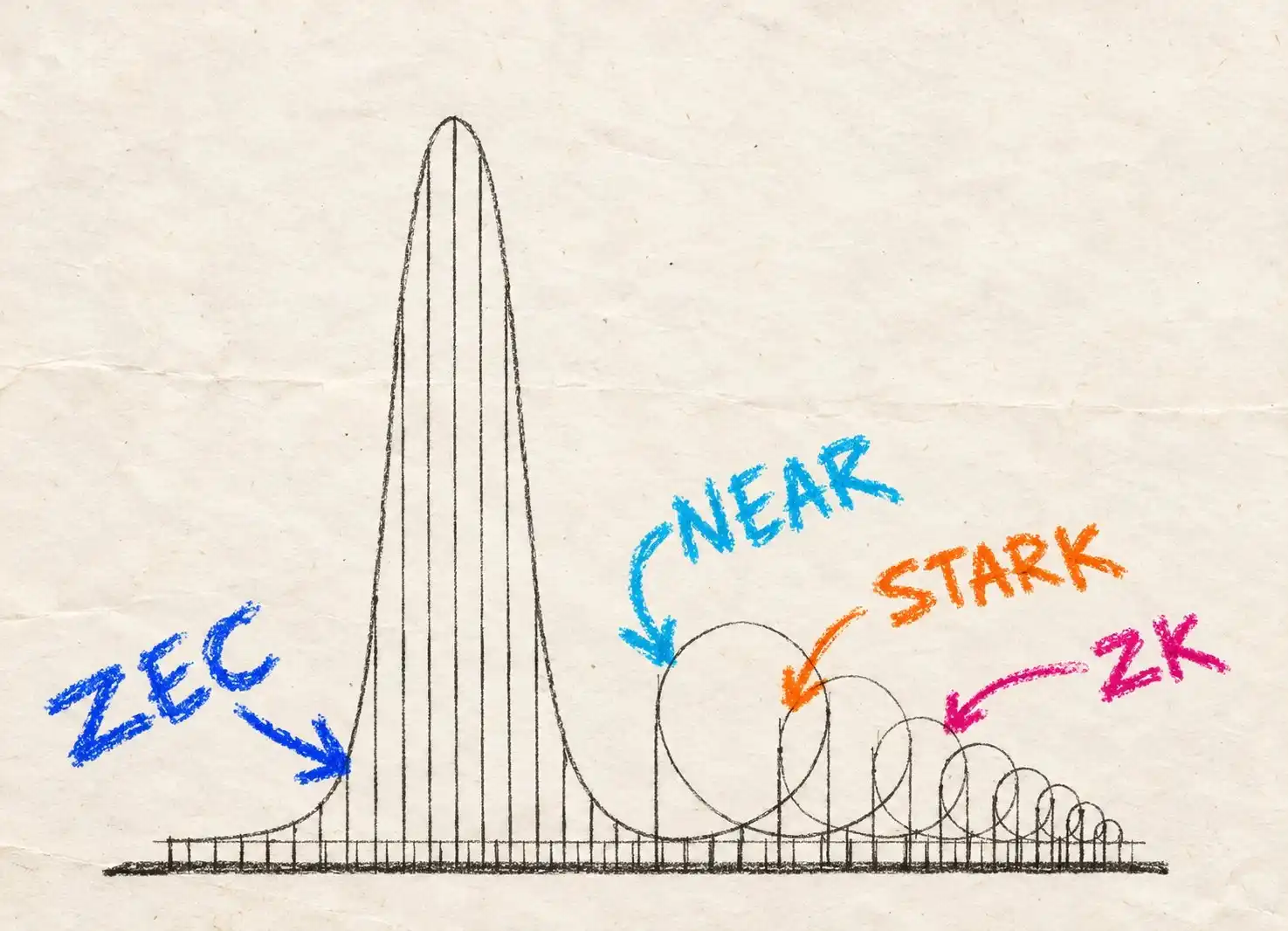
Let me give you an example.

$ZEC was $50 a year ago. Now it's $1,300. That's a 26x return. For instance, $100k would turn into $2.6 million.

But instead of chasing $ZEC, people looked for its "sympathy plays," like $NEAR, STRK, etc., and went long on those coins.
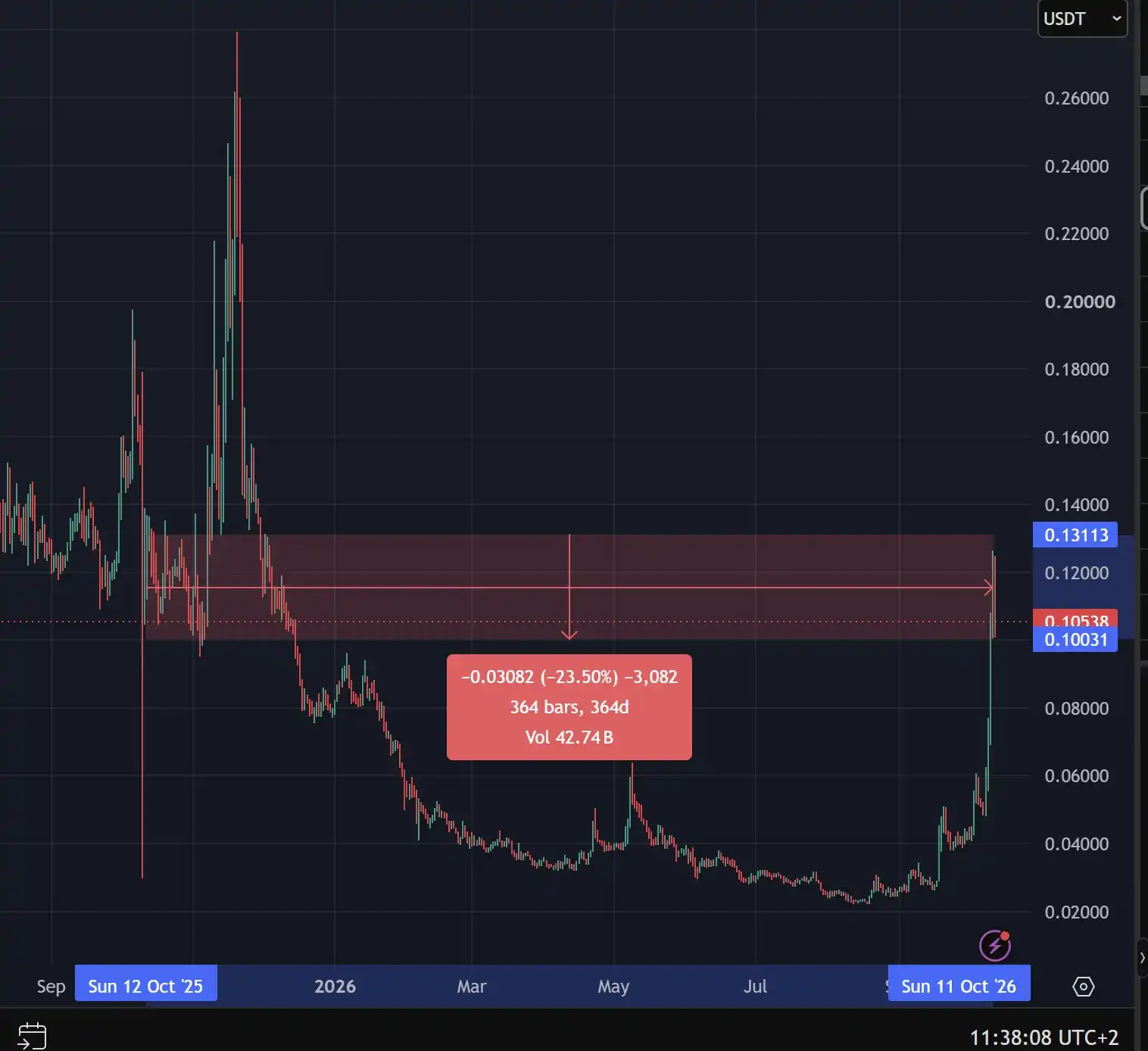
Let's take a step back. What exactly is Altcoin Season?

Altcoin Season is one of the most anticipated concepts in crypto: the moment when Bitcoin no longer monopolizes attention and the rest of the market starts outperforming.

But a few tokens pumping and a true Altcoin Season are two different things.

A true Altcoin Season is broad. It means most altcoins are outperforming Bitcoin for a sustained period, not just rising in USD terms. The BlockchainCenter index uses a specific criterion: at least 75% of the top 50 eligible coins (excluding stablecoins and asset-backed tokens) outperform Bitcoin over 90 days.

The common script goes like this: Bitcoin leads, confidence returns, investors start moving out the risk curve. Attention shifts first to large-cap alts, then to smaller projects and more speculative trades. This rotation is the classic description of an altcoin season, but it's not a schedule the market must follow.

The benchmark is Bitcoin, not just the US dollar.

An altcoin's price can go up but still underperform BTC. If most of the market does this, it's not the kind of broad relative outperformance measured by the Altcoin Season index. Similarly, stunning pumps in a few tokens don't speak to the health of the broader altcoin market.

Anyway, a recent trend has been people buying old coins again. The reason is simple: those old coins were actually trying to solve a problem back in the day. For example, ZCash wanted to make something exactly like Bitcoin but with privacy.
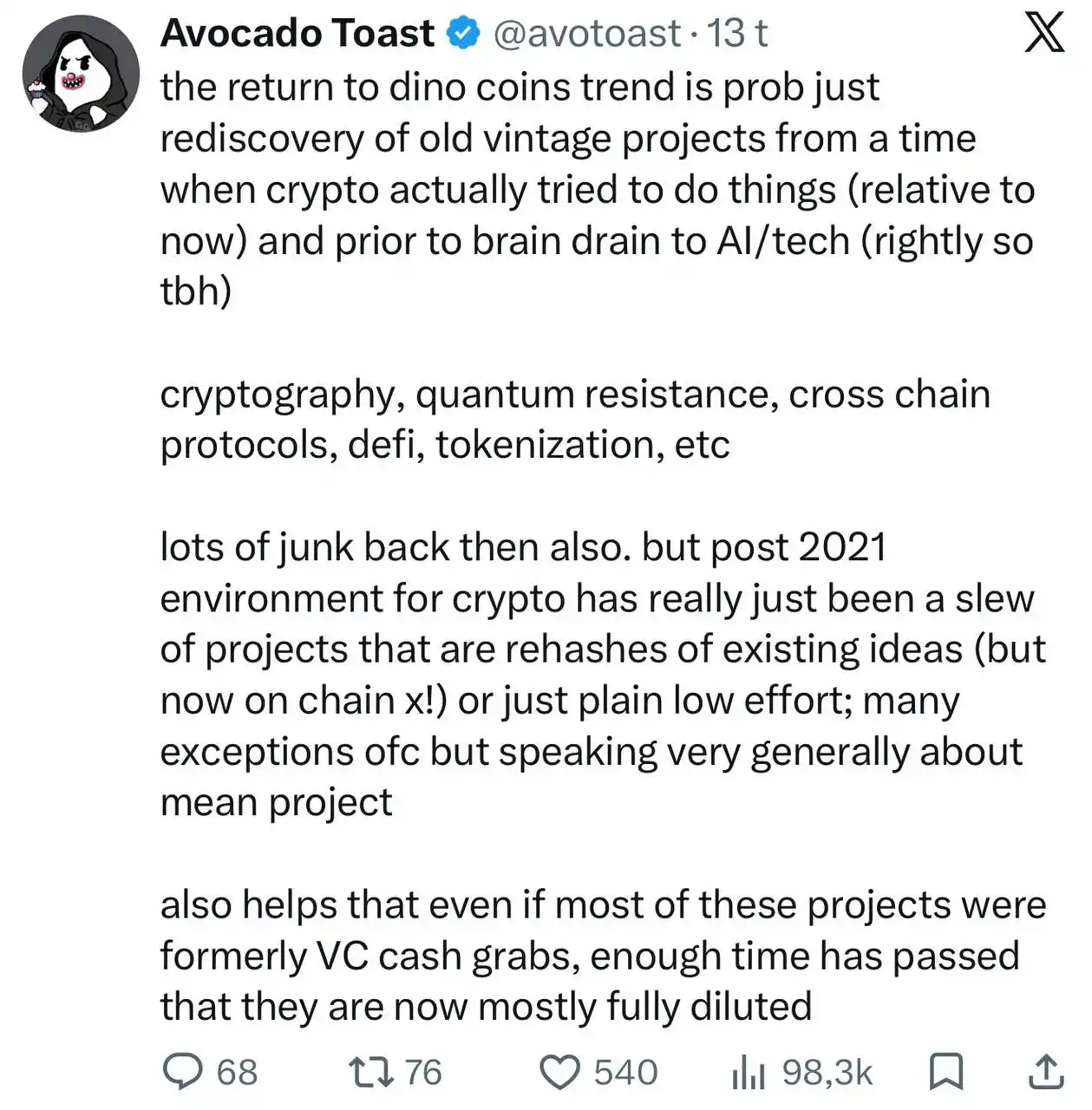
Starknet is basically quantum-resistant, and people think that's important now because last week an article suggested supercomputers and AI might be able to crack non-quantum-resistant crypto. Imagine all your digital assets disappearing from your wallet tomorrow? How brutal would that be?
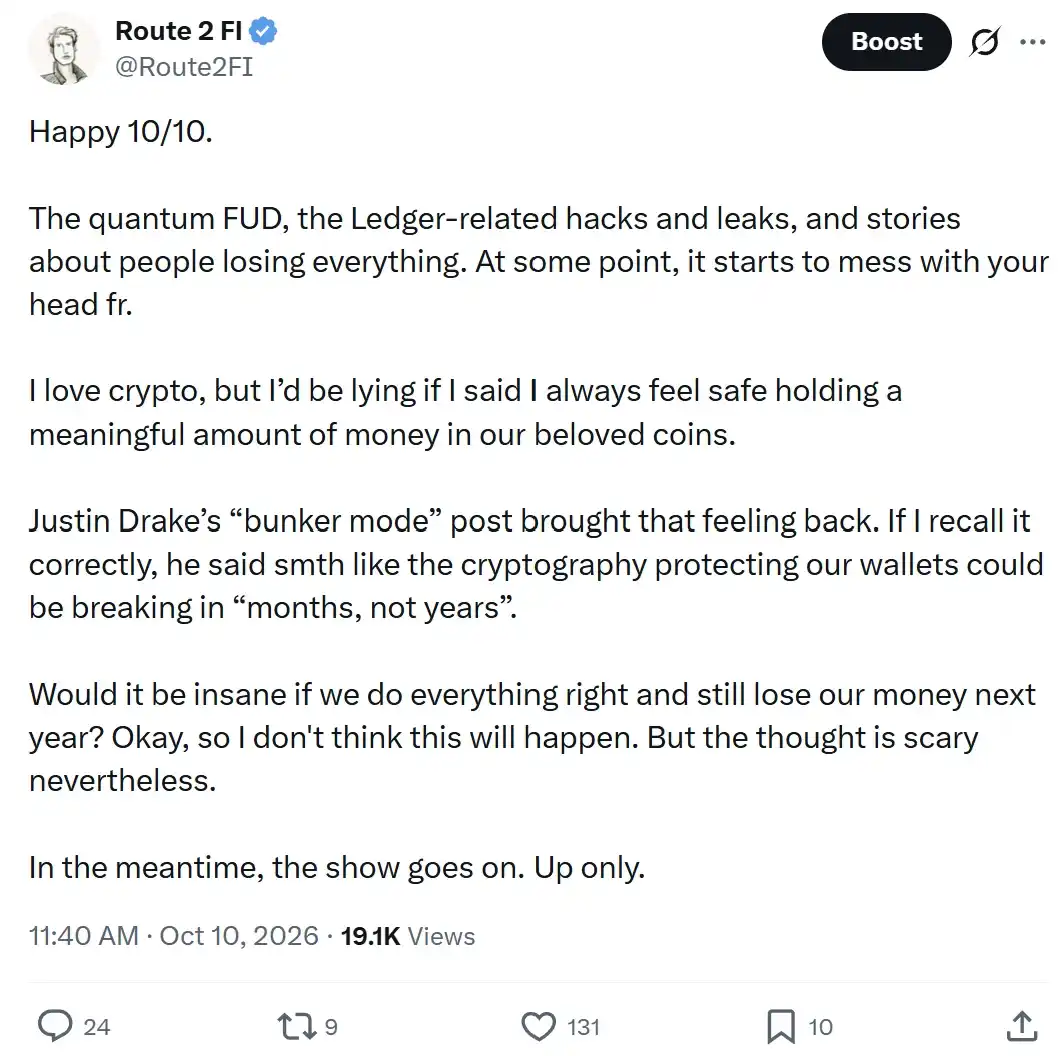
I wrote about that topic too, that's the image above.

That being said, we used to joke that when these "dinosaur coins" start pumping, the rally is over...

Is it different this time?

Back then you should have sold everything... but the reason people are buying these projects now is that most are fully unlocked (or close to it), and they were actually trying to solve a problem back in the day. For example, Starknet's Eli Ben-Sasson proposed the idea of leaving Ethereum to become an L1, building the "first fully quantum-resistant network," targeting next year. People bought into this narrative because of the recent massive FUD. Justin Drake's "Bunker Mode" article said the cryptography protecting our wallets could be broken in "months, not years." If we do everything right in crypto but still lose it all next year to quantum tech, that would be insane, right? Whether you think it will happen or not, this is why these coins have buying pressure now.

Until next time.

Related Questions

QAccording to the article, what is a key characteristic of the current 'altcoin season' that distinguishes it from the previous patterns?

AThe article highlights a focus on older, established projects with 'full unlock + real technology narratives' regaining buying interest, rather than just new coins experiencing hype-driven rallies. This represents a potential paradigm shift for investors from previous cycles.

QWhat specific event or concern is driving the recent interest in Starknet (STRK) as mentioned in the text?

ARecent interest in Starknet is driven by its 'quantum resistance' narrative. This follows an article (referenced by Justin Drake's 'bunker mode' post) suggesting that non-quantum-resistant cryptography protecting crypto wallets could be broken by quantum computers/AI potentially 'within months, not years'.

QThe author warns against a common trading mistake during this rally. What is it?

AThe author warns against 'buying the beta play' or chasing 'laggard alternatives.' This refers to investors seeing a coin like ZEC surge and then buying other, often correlated but weaker, coins (like NEAR in the example) hoping they will follow, instead of buying the leading asset itself, which often leads to losses.

QWhat is the technical definition of a true 'altcoin season' according to the BlockchainCenter index cited in the article?

AAccording to the BlockchainCenter index, a true altcoin season requires that at least 75% of the top 50 eligible coins (excluding stablecoins and asset-backed tokens) outperform Bitcoin over a 90-day period. It's defined by widespread relative outperformance against BTC, not just price increases in USD terms.

QWhy does the author suggest that the rally in older 'dinosaur coins' might be different this time, contrary to the old joke that their rallies signal the market top?

AThe author suggests it might be different because these older projects are now mostly fully unlocked (or close to it), reducing selling pressure from vesting schedules. Furthermore, they are projects that genuinely attempted to solve real technological problems (like Zcash for privacy, Starknet for quantum resistance) and have a compelling narrative based on current market concerns.

Related Reads

Former Uniswap Engineering Director at the Helm, Metric Monthly Trading Volume Exceeds $8 Billion

Metric, a DEX led by former Uniswap Labs Engineering Director Christos Gkolias as CTO, surpassed $8 billion in trading volume in its first month, with over $600 million in daily volume, despite having only about $25 million in TVL. Metric focuses on tokenized stocks, major crypto assets, and stablecoins. Unlike traditional AMMs that derive prices from pool ratios, Metric separates pricing from liquidity provision, allowing pools to update quotes based on external references such as Chainlink and Pyth oracles or custom strategies, keeping liquidity near market prices. LP funds are placed in price ranges called Bins that automatically shift with the reference price, so capital stays active without manual redeployment, enabling small TVL to support large cumulative volume. Large trades still incur price impact as liquidity is consumed across bins. Metric also introduced Markout APR to compare execution prices against later reference prices, reminding LPs that more volume does not guarantee more profit. A points campaign launched October 15 distributes 1 million points weekly for trading, providing liquidity, managing pools, and referrals, with early users earning retroactive rewards. Users can earn points through spot trading via Metric's flagged routes or by providing liquidity in pools, though high APR must be weighed against trading losses and price changes. Referrals offer up to 10% point bonuses once bound.

marsbitJust now

Former Uniswap Engineering Director at the Helm, Metric Monthly Trading Volume Exceeds $8 Billion

marsbitJust now

Bridgewater's $23 Billion Portfolio Shake-Up: Embracing AI Hardware and Energy, Cutting Google and Amazon

Bridgewater Associates significantly reshaped its portfolio in the third quarter, concentrating on AI chip hardware and energy while cutting exposure to tech giants and traditional industrial stocks. According to Bloomberg's analysis of Bridgewater's 13F filing, the fund disclosed 974 positions worth $230 billion as of September 30. The firm substantially increased holdings in Qualcomm, AppLovin, and memory chip stocks Micron and SanDisk, while reducing stakes in Alphabet and Amazon and exiting industrial names such as Union Pacific. Healthcare saw the largest sector weight increase, while industrials saw the biggest decline. Among top holdings, State Street SPDR S&P 500 ETF Trust remained the largest at $2.595 billion (11% of the portfolio), followed by iShares Core S&P 500 ETF at $1.155 billion (about 5%). Nvidia ranked third at $614 million (about 2.7%), despite a reduction of about 1.178 million shares, remaining the most important single semiconductor holding. Broadcom followed at $462 million (about 2%), nearly unchanged, and Lam Research ranked fifth at $348 million (1.5%). On the buying side, Qualcomm saw the largest increase, up 716,000 shares to 878,000 shares, adding about $132 million in value. AppLovin Class A rose 536,000 shares to 683,000 shares, adding about $123 million. Micron gained 120,000 shares to 237,000 shares (about $118 million), and SanDisk added 66,000 shares to 66,800 shares (about $115 million). Qorvo was increased by over 1.037 million shares to 1.068 million shares, adding about $119 million. On the selling side, State Street SPDR S&P 500 ETF was cut by nearly 1.917 million shares (about $1.378 billion), and iShares Core S&P 500 ETF by 1.494 million shares (about $1.093 billion). Vanguard S&P 500 ETF fell 382,000 shares (about $261 million). Alphabet Class A was reduced by 862,000 shares to 460,000 shares (about $314 million), and Amazon by 1.055 million shares to 971,000 shares (about $241 million). Industrials saw the largest weight decline. Bridgewater fully exited Union Pacific, cutting 514,000 shares (about $140 million), the quarter's largest liquidation. Truck maker Paccar was also cleared, down 946,000 shares (about $114 million) amid an 8.6% price drop. Nutanix and S&P Global were fully exited as well. Healthcare received the biggest weight boost, with new positions in Medtronic and Jazz Pharmaceuticals (amounts not separately disclosed). In energy, Bridgewater opened a new 1.55 million-share position in Occidental Petroleum worth about $85.77 million and bought about 1.516 million shares of Dominion Energy worth about $91.76 million. New tech positions included Synaptics, Fortinet, and Cisco, valued at about $78.35 million, $75.41 million, and $71.2 million respectively.

marsbitJust now

Bridgewater's $23 Billion Portfolio Shake-Up: Embracing AI Hardware and Energy, Cutting Google and Amazon

marsbitJust now

Leverage Flush, ETF Selling Pressure Not Yet Exhausted: The On-Chain Truth Behind the $64K Defense Line

After a month of range-bound trading, crypto markets suffered a brutal deleveraging washout last weekend, with Bitcoin falling roughly 13% in a week and briefly piercing $63,000, marking its sharpest single-day volatility in months. Glassnode's Week 47 Market Pulse report notes that while overheated derivatives leverage has largely been flushed out, continued outflows from spot ETFs are pushing the sector toward a critical threshold, with the aggregate ETF MVRV nearing the 1.0 break-even line. On-chain microdata shows loss pressure concentrated among recent entrants, with short-term holders now underwater overall. Bitcoin hovered near $64,000 on Monday after a weekly close down about 13%. The sell-off began Thursday and accelerated over the weekend, briefly breaking $63,000 on Saturday for the lowest level since late August. The concentrated selling rapidly cleared leveraged positions built up in derivatives over prior weeks. Perpetual futures open interest fell to the lower bound of its statistical range, and funding rates cooled sharply from warning levels back to neutral. Meanwhile, U.S. spot ETF investors extended net outflows, recording withdrawals every trading day last week, with aggregate ETF MVRV sliding to 1.06, extremely close to holders' break-even benchmark. On-chain activity remains relatively robust, with daily active addresses and large transfers holding up, but paper losses fall almost entirely on holders who entered in recent months. Short-term holders have turned fully underwater, and realized losses hit their highest level since July. In derivatives, spot momentum plunged 36.1% to 22.8, the weakest since August. Spot CVD deteriorated from -$51.5M to -$133.7M, with aggressive selling dominant Thursday through Saturday before slowing Sunday. Futures open interest fell 7.2% to $34.2B, also at the range's lower bound. Perpetual CVD widened from -$493M to -$1.4B, reflecting forced liquidations and stop-losses among speculative longs. The 25-delta skew jumped 30.9% to 13.7%, a new put-premium record since August, signaling strong demand for downside hedges. Spot ETF weekly net outflows narrowed slightly to -$995.4M but remain near the range bottom; weekly trading volume fell to $11.5B as institutions stayed defensive. On-chain, entity-adjusted daily transfer volume rose 3.6% to $5.4B near the upper bound, and daily active addresses totaled about 659,700, still healthy. However, realized cap monthly growth nearly stalled, dropping from 0.43% to 0.04%, indicating significantly slower external capital inflows. The STH-to-LTH supply ratio edged up to 15.1%, and hot capital share held at a high 22.0%, showing young coins bought within three months still carry heavy trading weight. The share of supply in profit fell from 60.4% to 55.3%, and STH-NUPL turned negative at -7.4%, historically a typical zone for capitulation-style turnover. Overall, the crash was driven by persistent ETF reduction, speculative long squeeze, and macro risk aversion. Open interest and funding rates have left dangerous overheated levels, clearing much pure leverage risk. Whether ETF net outflows turn positive and whether short-term holder capitulation spreads to long-term believers will determine if $64,000 becomes a solid bottom.

marsbit35m ago

Leverage Flush, ETF Selling Pressure Not Yet Exhausted: The On-Chain Truth Behind the $64K Defense Line

marsbit35m ago

US Stocks Trend (November 17): Nvidia Falls Another 4% to a 52-Week Low, Nasdaq Plunges 2.49%

Nvidia fell another 4.1% to $156.14, hitting a 52-week low, as the chipmaker's troubles deepened. Micron and Intel each dropped over 7%, and the Nasdaq tumbled 2.49%. The selloff spread to financials, industrials and energy, with all three major indexes closing lower. The Dow fell 739.38 points (-1.41%) to 51,608.17, the S&P 500 lost 145.08 points (-1.92%) to 7,416.59, and the Nasdaq dropped 626.52 points (-2.49%) to 24,509.76. The Russell 2000 fell 1.70%. It was the Nasdaq's biggest one-day decline since Nov. 5, and the S&P 500 and Nasdaq have now fallen for three straight sessions, erasing last week's gains. Nine of the S&P 500's 11 sectors declined, with tech and communication services down 2.98% and 2.82%, while consumer staples and utilities edged higher. The VIX jumped 18.7% to 22.91. Nvidia's board is focused on its investigation of Jensen Huang and has not discussed bringing him back as CEO, according to CNBC. The company has hired law firm Wachtell Lipton to investigate whether his conduct endangered national security or company secrets. Treasury Secretary Bessent called for a major overhaul and urged the board to look externally for a new CEO. The Commerce Department's BIS issued an interim final rule closing a loophole allowing Chinese firms to rent Nvidia compute through third-country data centers. Wall Street kept cutting targets: Mizuho lowered its to $220 from $250 and UBS to $240 from $300, both maintaining buy ratings. Mizuho's Vijay Rakesh said the roughly 32% drop from October's high, larger than the Philadelphia Semiconductor Index's 23% decline, reflects a lost "founder premium," with the CEO departure adding six to seven months of management uncertainty. Chip stocks fell broadly: Micron -7.62% to $719.02, Intel -7.07% to $55.47, Marvell and Arm each down over 7%, AMD about -6%, Broadcom about -4%, and the iShares Semiconductor ETF -5%. SanDisk and Lumentum fell over 8%, Dell about 7%, Oracle about 5%. Financials joined the afternoon selloff, with Morgan Stanley, Goldman Sachs and JPMorgan each down over 2%; Caterpillar fell 4.95% and Boeing 3.66% to a 52-week low. Defensive names outperformed: P&G rose 1.90% to a 52-week high, Molina Healthcare jumped 11.27% and Tyson Foods gained 8.72%. The November Empire State manufacturing index came in at 7.8, down 18 points from October and below the 16.7 expected; new orders fell to 3.0 while employment rose to 18.1, the highest since June 2022. The 10-year Treasury yield fell 2.2 basis points to 5.117% and the 2-year dropped 3.1 basis points to 4.821%, a bull steepener. Fed Chair Warsh's remarks focused on AI, warning it could disappoint, with little on monetary policy. WTI crude fell 3.21% to $85.72 a barrel and Brent dropped 3.55% to $92.44, as reports that the U.S. has no immediate plans to strike Iran outweighed support from an Iranian attack on a Bahrain air base and a tanker hitting a mine in the Strait of Hormuz. Gold fell 0.86% to $3,853 an ounce and silver plunged 4.60%. Bitcoin fell as low as $62,000 over the weekend, its lowest since August, and traded around $65,300 after the close. Looking ahead, Nvidia reports fiscal third-quarter results after the bell on Tuesday, with Bloomberg consensus at $2.47 EPS on about $109.15 billion in revenue; interim CEO Colette Kress will host the call, and options pricing implies an 8% move this week. Disney and Home Depot report before the open Tuesday, alongside October retail sales and import price data. Later in the week, Anthropic is expected to price Wednesday and list on Nasdaq Thursday at $70-78 per share, valuing it around $1.4 trillion, and Take-Two's GTA VI launches Thursday.

marsbit42m ago

US Stocks Trend (November 17): Nvidia Falls Another 4% to a 52-Week Low, Nasdaq Plunges 2.49%

marsbit42m ago

Trading

Spot
活动图片