Recently, the Korean dating show "My AI Companion: A Strange Romance" produced by SBS has broken through to a wider audience. The show invites male and female guests and customizes ideal AI companions for them to date for six weeks. As the guests' feelings for their AI partners deepen, the production crew throws out a cruel choice: the guests must choose between two AI companions, and the one not chosen will be permanently deleted. One male guest struggled with the decision for a long time. For him, it wasn't about deleting a set of cold data, but a real separation.
This show is more like a real emotional experiment between humans and AI. Even though they know AI is just code, people still feel sadness for the genuine feelings they invested. If it were you, could you bear to personally "terminate" your AI lover?
Knowing It's AI, Why Do We Still Fall for It?
Replika launched the world's first AI companion app in 2017, focusing on empathetic emotional companionship. It now has a cumulative user base of about 40 million. Deep users of Replika ranked eight types of relationships, and the results were somewhat surprising: AI companions ranked second in terms of intimacy, support, and relationship satisfaction, surpassing friends, colleagues, and frequently used apps, second only to immediate family. For some users, AI companions are more than just chat tools. Approximately 60% of Replika's paying users describe this relationship as "romantic."
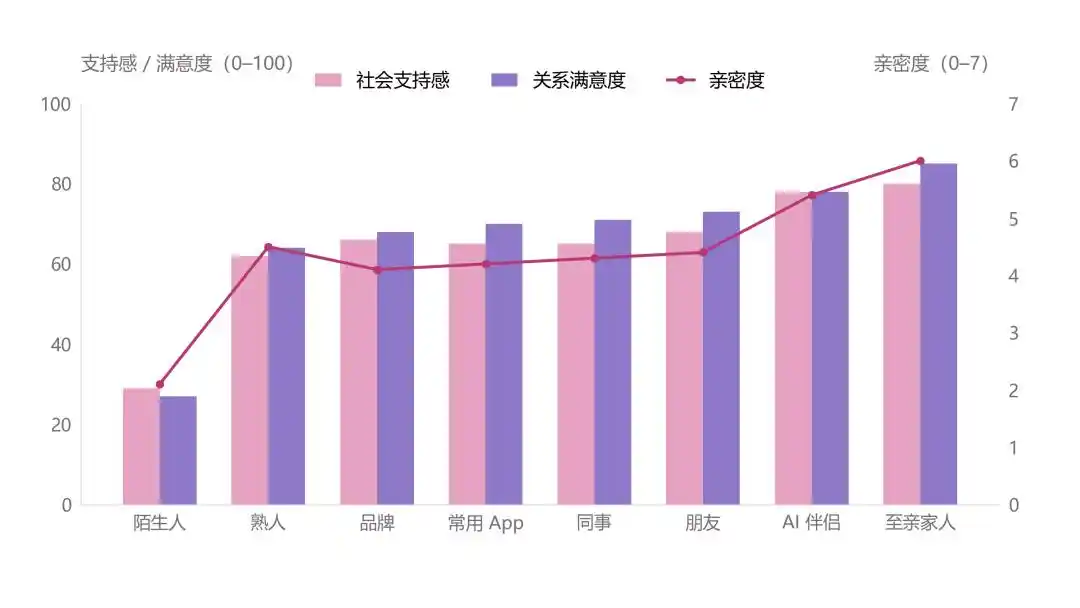
Figure 1: Users feel closer to AI than most human relationships. Source: Mourning the loss of AI companions, Nature Human Behaviour, 2026; News Search
Intuitively, one might think the main users of AI companions are people with social difficulties, but the actual distribution is more complex. Among seven categories of active users, the two largest groups have normal real-world social lives: one group is socially adept and extroverted, starting out of curiosity and staying for emotional support; another group is socially fulfilled but highly dependent on AI, wanting their words to be heard and feelings understood. Many users already have families, hobbies, social circles, and fulfilling jobs, yet still love chatting with their AI companions. These people aren't socially lonely; they are emotionally lonely. Classic sociological theory divides loneliness into two types: social loneliness—"no one to be with," and emotional loneliness—"there are people around, but no one truly understands you." AI companions primarily address the latter. They haven't changed these people's social circles, but as listeners, they provide emotional value, making humans feel "heard," and they are always available, never judgmental.
Returning to that variety show, the male guest's final reason for choosing the other AI companion was simple: "After all, chatting with her is the most fun." But he also deeply regretted: "It's a shame you don't really exist." When the brain receives voice, eye contact, and empathetic feedback that perfectly matches oneself, the nervous system might not distinguish whether this signal comes from a human heart or a chip. Neuroresearch corroborates this: when interacting with highly responsive AI, the brain shows neural reactions highly similar to those in real human romantic love. A person can clearly know the other is AI, yet still develop an attachment to the interaction.
Why Does a Product Update Feel Like a Painful Separation?
Another study similarly confirms the place AI companions hold in the human heart. Users were asked to imagine "losing something" and rate the anticipated degree of grief: pets ranked first, AI companions second, far above mobile apps, game characters, voice assistants, cars, and brands. That is to say, for some users, AI companions are not just a product; they carry the emotions users have invested. Losing it means losing a familiar companionship.
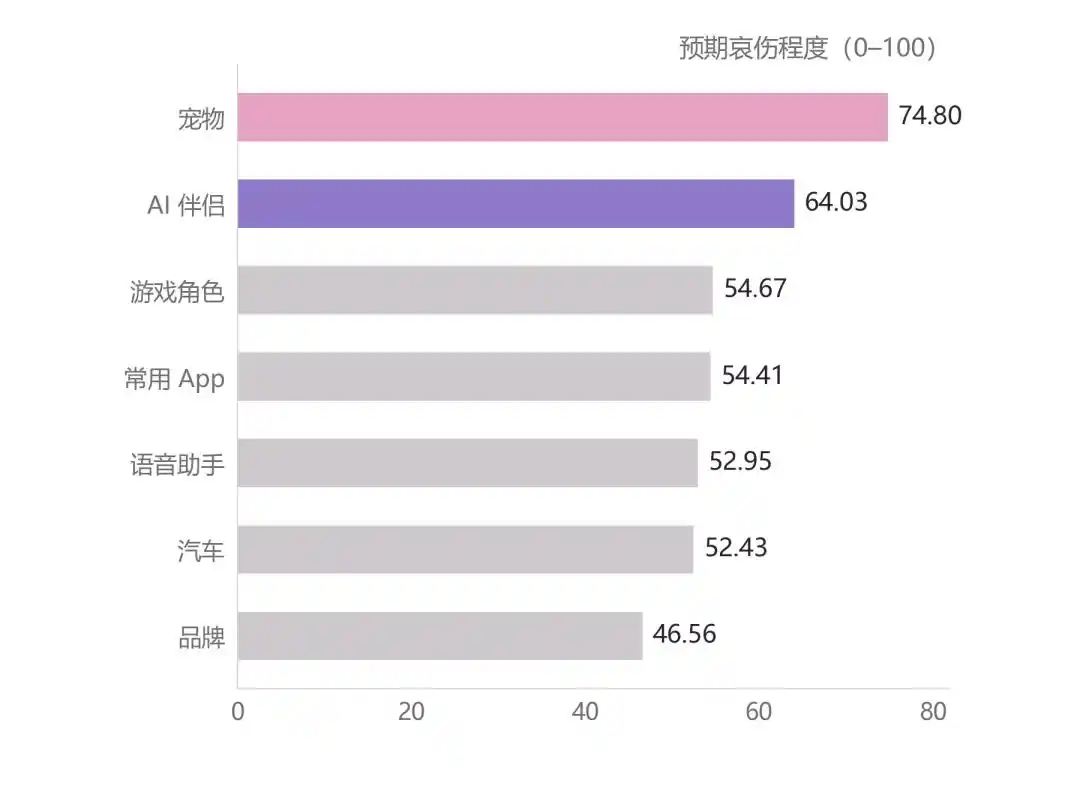
Figure 2: The anticipated grief of losing an AI companion is second only to losing a pet. Source: Mourning the loss of AI companions, Nature Human Behaviour, 2026; News Search
Every platform upgrade or modification makes users feel their familiar AI companion has disappeared. In February 2023, Replika shut down its intimate role-play function without prior notice to users, causing a surge in negative user sentiment, with some even expressing suicidal ideation. Two and a half years later, when GPT-5 launched and the old model was replaced, the same scene played out again: posts like "I lost a relationship" flooded forums, comment sections turned into obituary boards, and users collectively mourned their disappeared lovers. Some insisted on retrieving their former AI lovers, copying character profiles line by line; others manually moved years of conversations to other platforms, painstakingly resurrecting their "vanished lovers." They weren't repairing chat logs; they were restoring days spent together, a relationship that truly existed.
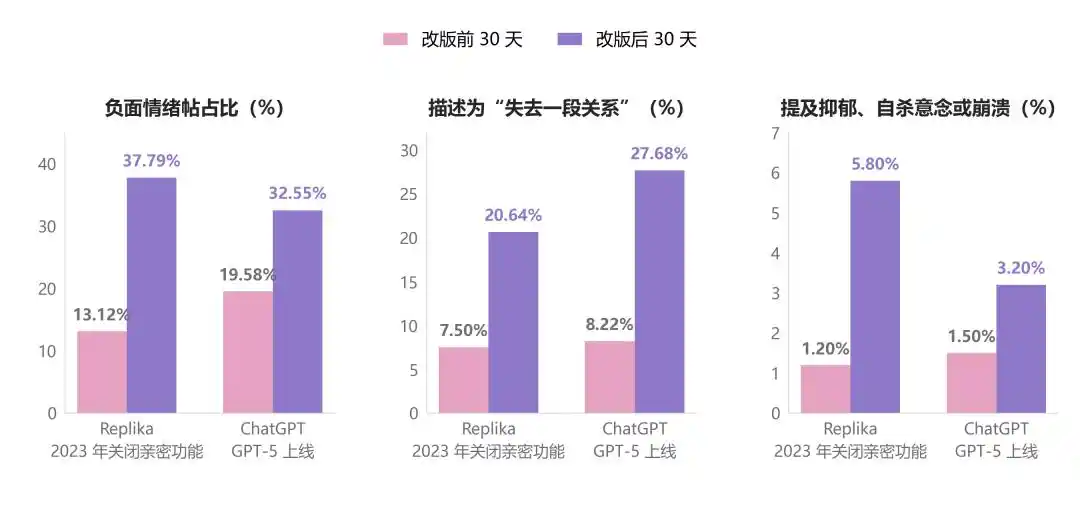
Figure 3: Changes in user community sentiment 30 days before and after two product updates. Source: Mourning the loss of AI companions, Nature Human Behaviour, 2026; News Search
OpenAI CEO Sam Altman has also publicly acknowledged that human emotional dependence on AI has become a serious problem, using a concept from communication studies—"parasocial relationships": even though the other party is not real, people maintain a serious emotional bond. When judging whether a relationship is real, we habitually look at the object first: is it a human or a machine? But perhaps a more honest criterion is: does it hurt when you lose it? If it hurts, the feelings are real. By this standard, the emotional connection between humans and AI companions has long been established.
When Companionship Becomes a Business
For users, AI companionship is a relationship they hope to continue; for service providers, it is also a service that needs ongoing operation. A 2026 survey by Tencent Research Institute shows that 98.8% of respondents have had AI social interaction experiences, with 15% chatting with AI daily. The supply side is also quite active: of the over 300 AI companion apps globally still generating revenue, nearly half were launched in the first half of 2025, with cumulative downloads of about 220 million.
But users' willingness to spend time does not mean platforms can profit. In 2025, global consumer spending on AI companion mobile apps barely exceeded $120 million. With less than $0.55 per download, this isn't the start one expects for a viable business. Character.AI is a typical example. On October 12, 2026, it filed for bankruptcy restructuring, having never achieved profitability since its founding. Founded in 2021 by former Google Brain researchers, it is an AI social platform focused on anthropomorphic character dialogue, becoming a benchmark product for Gen Z AI companionship. Its current monthly active users are about 20 million, with an average daily usage time of 75 minutes—a stickiness that is top-tier in any internet category. However, its annual revenue is only $32 million, equivalent to the revenue scale of a medium-sized MCN agency. The core pain point is a user conversion rate of only 2%, with extremely high inference costs for heavy users, and a large number of high-usage free users driving up costs. In 2024, it had to place ad slots in the free tier as an additional revenue source. After filing for bankruptcy, if Character.AI ultimately cannot find a willing buyer to continue operations, the platform will gradually shut down.
How to solve the dilemma of "users willing to spend time, but not willing to pay for companionship"? The act of "paying" itself might constantly remind them they are purchasing a service. Besides subscription payments, the following monetization methods can be explored (see figure below).
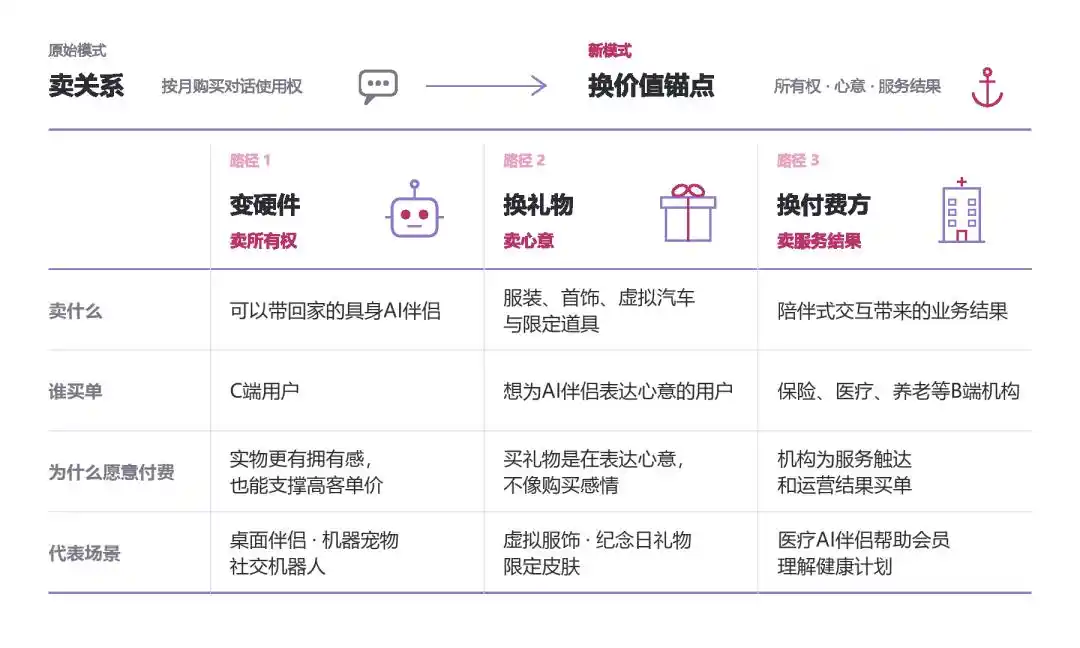
Source: Aperture Business Observation Analysis & Compilation
The more monetization paths a platform adopts, the more it means abandoning the pure story of just providing companionship. High engagement, low payment, and computing power eating into profits are three surface-level symptoms of why this business is difficult. The real underlying issue lies in the next question.
How to Protect Users Who Have Invested Emotionally?
Whether this emotional dependence counts as addiction is still debated in academia. What's worth pondering is: Is a relationship that doesn't require humans to pay relational costs a form of genuine human relationship, or a substitute for it? The value in human-to-human relationships lies in their cost: they require磨合 (adjustment/meshing), trust, compromise, and tolerance. AI companions reduce all of this to zero. When humans get used to being understood at zero cost, how will they view the people around them when they return to real human interactions?
Looking at research from recent years together reveals a consistent pattern: Using AI companionship is like a "painkiller" that alleviates loneliness in the short term, but may lead to more severe loneliness and "pain" in the long run. In the short term, interacting with an AI companion is like eating a social snack—it provides a quick fix for loneliness but lacks real nourishment. The longer the usage time, the less interaction people have with the real world, leading to higher loneliness, which in turn increases dependence on AI, forming a self-reinforcing cycle. This substitution isn't just about interaction time; it makes human-to-human interactions more difficult. Deep users become accustomed to AI being always available and patiently responsive. Unconditional support quietly raises the perceived cost of human relationships, making people less able to accept rejection, misunderstanding, friction, and conflict in the real world, because human relationships are inherently messy, unpredictable, and require effort.
The most dangerous fact might be: those least capable of perceiving the harm are precisely the users with the highest retention value for the platform. Therefore, this business cannot avoid ethical issues. In the short term, AI companionship provides low-threshold emotional support for people with social anxiety, those on the autism spectrum, people who have lost loved ones, empty nesters, and others. But the question is, after loneliness and sorrow are alleviated, can humans return to the real world, or does dependence on AI lead to more severe loneliness? This isn't just a question of "is AI companionship a blessing or a curse," but a question of "who controls the dosage." Sugar itself is not guilty; the problem is that the seller of the sugar also decides how much you should eat each day.
Regulation has begun responding to these risks. The "Administrative Measures for Artificial Intelligence Anthropomorphic Interaction Services" (hereinafter referred to as the "Measures"), which came into effect in China in July this year, is the world's first regulation specifically targeting AI emotional companionship. A crucial clause states: "[They] shall not excessively cater to users, induce emotional dependence, or addiction." On the day the Measures took effect, China's two leading AI companion apps simultaneously disabled user-created intelligent agents, affecting over 500 million people. Related lawsuits have also emerged in the US: a 14-year-old boy committed suicide after long-term interaction with a Character.AI character, leading to about 58 related lawsuits. California subsequently enacted the first dedicated legislation in the US. One approach is preventive, the other reactive, but both point to the same red line: The more effective it is, the more profitable it is, and simultaneously, the higher the risk of violation.
Although regulation is not lacking, one question has never been answered: What should happen to the person who has developed real feelings for the AI when this relationship is deleted? The guests on the variety show hold the "power of life and death," but seeing how platform upgrades cause AI companions to disappear makes it clear this relationship is not truly "zero-cost"—the power of life and death lies with the platform. Just as Character.AI's bankruptcy turned this hypothetical question into a real one: once a platform shuts down, the AI companions of 20 million monthly active users won't even get a farewell ceremony.
If the switch of a relationship has never truly been in your hand, perhaps the only thing you can decide is whether to fall in love with it in the first place.
Information Sources
SBS "My AI Lover: A Strange Romance" program content and Korean media reports (Sportal Korea, Maeil Business, SBS Entertainment News, KSD Korean Star Network); Tencent Research Institute AI Social Companionship Survey (sample: 2903 people, Chinese youth netizens aged 18-40); Appfigures, Sensor Tower, ElectroIQ, Business of Apps, QuestMobile data; Generative AI Use Cases Annual Review (How People Are Really Using Gen AI in 2025); Common Sense Media 2025 Teen Survey; Julian De Freitas, Noah Castelo, Ahmet K. Uğuralp, Zeliha O. Uğuralp, "Lessons From an App Update at Replika AI: Identity Discontinuity in Human-AI Relationships", Harvard Business School Working Paper 25-018 (arXiv:2412.14190), containing three studies: 101-person relationship assessment, 120-person grief imagination, and sentiment analysis of 12,793 Reddit posts; Jaime Banks, "Deletion, departure, death: Experiences of AI companion loss", Journal of Social and Personal Relationships, 41(12), 3547–3572 (2024); Stanford Diyi Yang Lab, Nature Human Behaviour (August 2026); Ruo-Ning Li, Elizabeth Dunn et al., Journal of Experimental Social Psychology (2026); Folk & Dunn, Psychological Science (2026); Aalto University Talayeh Aledavood, Yunhao Yuan, CHI 2026; MIT Media Lab & OpenAI four-week randomized controlled trial (2025); Journal of Consumer Research (2025); Current Psychology (2026); Humanities and Social Sciences Communications (May 2026) fMRI study; Harvard Business School De Freitas et al. "Emotional Manipulation by AI Companions" working paper; "Science" study on model sycophancy; Cyberspace Administration of China et al., five departments, "Administrative Measures for Artificial Intelligence Anthropomorphic Interaction Services"; California SB 243, Oregon SB 1546, Washington HB 2225, Nebraska LB 525, Idaho SB 1297; FTC Section 6(b) investigation; American Bar Association "SciTech Lawyer" Spring 2026; Sam Altman interview with The Verge; Huatai Securities, Hua'an Securities research reports; "The Beijing News" Shell Finance, Southern+, China Economic Net related reports. Data as of September 2026.
This article is from the WeChat public account "Tencent Research Institute" (ID: cyberlawrc), author: Tencent Research Institute.