# Vaults Related Articles

HTX News Center provides the latest articles and in-depth analysis on "Vaults", covering market trends, project updates, tech developments, and regulatory policies in the crypto industry.

Is DeFi Lending a Security? Aave and Morpho Camps Deliver Two Answers

Two legal frameworks address whether DeFi lending and vaults fall under U.S. federal securities law. On November 2, Aave Labs, Kamino Foundation, and Veda Tech Labs published a 16-page summary arguing that decentralized lending protocols and non-custodial vaults are not governed by federal securities law, following a detailed confidential submission to the SEC's crypto task force on October 26. Earlier, in October, the Crypto Council for Innovation (CCI) released a roughly 238-page vault report, "Under Control," drafted by Chapman and Cutler and backed by a Morpho, Bitwise, and Galaxy-led vault coalition. Both documents agree that ordinary overcollateralized lending is not a security, contrasting on-chain mechanics—funds held in smart contracts, no transfer of ownership, mandatory overcollateralization, automatic liquidation, and transparent on-chain positions—with collapsed centralized platforms like BlockFi and Celsius, where users surrendered ownership and relied on platform solvency. The real disagreement concerns vaults where a manager allocates user funds. CCI applies the Howey Test's "efforts of others" prong, offering 10 verifiable conditions—covering custody separation, redemption rights, timelocks and advance disclosure of parameter changes, immutable or objectively parameterized allocation, independent safeguard roles, audits, and conflict-of-interest rules—under which a vault should not be treated as a security. Aave's camp argues under Howey's "common enterprise" prong and the Reves Test that no note exists, ownership stays with users, no one promises returns, and managers cannot touch funds, so vaults are not securities; it asks the SEC to confirm no exemption is needed and that upgradeability or ongoing DAO governance should not imply a security. CCI, accepting some vaults may be funds, proposes an exemption roadmap modeled on ETFs, including a designated compliance entity. The split reflects business models: Aave's pools are DAO-governed, while Morpho's and Kamino's vaults rely on active managers. The SEC has not yet responded.

marsbit11/06 14:16

Is DeFi Lending a Security? Aave and Morpho Camps Deliver Two Answers

marsbit11/06 14:16

The Liquidity Restaking Gold Rush Cools Down: Narrow Profit Margins Force Five Leading Protocols to Undergo Collective Transformation

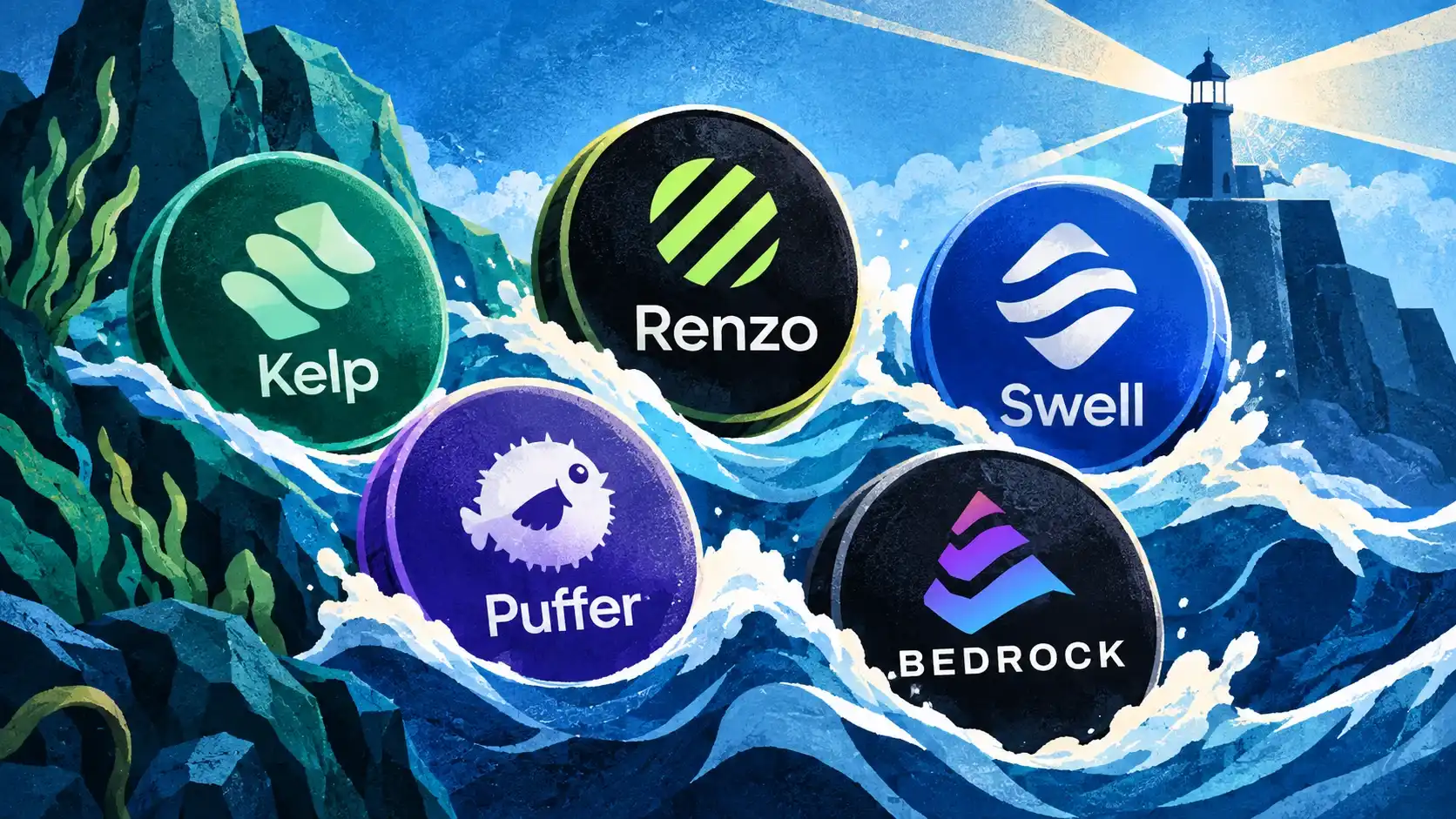
The once-hot sector of liquidity re-staking tokens (LRTs), once touted as "Ethereum's yield engine," is undergoing a collective transformation. Facing minuscule profits and significant risks, the top five LRT protocols are abandoning their singular focus and pivoting to new models. Pioneer ether.fi announced it will exit re-staking entirely to become a crypto neobank, citing a lack of meaningful yield and security risks. The sector's total value locked stands at approximately $1.45 billion, generating just around $100,000 in weekly protocol revenue. Other leading protocols are following suit with diverse strategies. Kelp, after a major hack, is shifting from earning yield spreads to offering short-term credit liquidity products like stablecoin KUSD. Renzo has rebranded to a structured yield platform, packaging trading strategies into vaults and moving beyond merely issuing its ezETH token. Swell closed its dedicated L2 chain to focus on Faro, an AI-powered non-custodial trading terminal on Hyperliquid. Puffer is pivoting to Ethereum execution-layer infrastructure, developing services like pre-confirmations and a novel Based Rollup architecture. Bedrock has largely migrated its focus from ETH to BTC, aiming to build an independent "Smart Yield Engine" for Bitcoin capital. Despite their different paths, these protocols share a common new logic: LRTs are no longer the core product but are becoming a mere capital entry point. The future lies in generating "explainable cash flows" through upper-layer services like asset management (structured products/vaults), trading, credit, and infrastructure, moving away from dependence on unsustainable re-staking rewards and airdrop incentives.

marsbit10/01 11:53

The Liquidity Restaking Gold Rush Cools Down: Narrow Profit Margins Force Five Leading Protocols to Undergo Collective Transformation

marsbit10/01 11:53

MiCA is coming for DeFi vaults, but regulation will be difficult

The European Commission is exploring whether to extend the Markets in Crypto-Assets (MiCA) regulation to cover decentralized finance (DeFi) lending and borrowing, including lending vaults. These vaults, which channel billions into on-chain credit markets, present significant regulatory challenges because their decentralized structure doesn't map neatly onto existing financial frameworks. Their legal status is currently based on non-binding interpretations that they fall outside MiCA and EU fund rules. The article uses Morpho's decentralized lending protocol as an example, illustrating how responsibilities are divided among various participants (owner, curator, allocator, sentinel), making it difficult to identify a single "provider" to regulate. Experts warn that broadly categorizing "DeFi lending" could inadvertently capture vastly different structures. They argue that any regulatory approach should focus on the specific structure and control mechanisms of a vault, rather than using decentralization as a simple dividing line, and that DeFi lending may require a dedicated, carefully crafted framework distinct from traditional finance. The Commission's consultation closes on September 30, 2026. The core challenge for regulators is not just whether to regulate DeFi lending, but how to design rules that distinguish between different forms of on-chain lending and the entities that control them.

cointelegraph08/22 21:36

MiCA is coming for DeFi vaults, but regulation will be difficult

cointelegraph08/22 21:36

活动图片