S&P Global brings risk assessments to growing crypto lending vault sector

cointelegraphPublished on 2026-10-06Last updated on 2026-10-06

Abstract

S&P Global Ratings has launched a new risk assessment framework specifically for the growing sector of digital asset lending vaults. This framework evaluates vaults—which pool investor deposits to deploy through predefined yield-generating strategies—across six key risk areas: portfolio credit quality, liquidity mismatch, curator risk, blockchain risk, protocol risk, and vault security and governance. According to S&P analyst Lisa Schroeer, a material weakness in any single factor can constrain the overall assessment, as the sector has "many points of risk/failure that can break." The assessments aim to provide transparency on potential loss risks for investors, not to offer credit ratings or evaluate yields. Deposits in these vaults have surged to around $10 billion as of September, up from $1.5 billion two years prior, driven by offerings from major platforms like Kraken and Wallet in Telegram. However, this rapid growth has been accompanied by significant risks, including an $8.5 million exploit on Term Finance in August, and increased regulatory scrutiny in the U.S., where officials suggest some vault products may fall under securities laws.

S&P Global Ratings has launched a risk assessment framework for digital asset lending vaults as the onchain investment products gain traction.

According to Monday’s announcement, the framework evaluates vaults across six areas: portfolio credit quality risk, liquidity mismatch risk, curator risk, blockchain risk, protocol risk, and vault security and governance risk.

S&P said the assessments will evaluate the risk of losses to investors in lending vaults, but will not constitute credit ratings or evaluate yields. As well, the framework was not designed to single out any one category of the six that poses a greater risk than the others, according to S&P Global Ratings analyst Lisa Schroeer.

“A material weakness in any factor can constrain the overall VRA,” Schroeer told Cointelegraph. “A strong score in one factor does not offset a material weakness in another.” She said that the approach reflects a sector where “there are many points of risk/failure that can break.”

Digital asset lending vaults pool investor deposits and deploy them through predefined strategies managed by smart contracts or human curators. Depositors receive tokens representing their share of the vault’s assets and returns.

According to S&P, deposits in digital asset lending vaults reached about $10 billion in September, up from $1.5 billion two years earlier. S&P said it plans to publish its first Vault Risk Assessments in future announcements, though it did not identify which vaults will be assessed first.

Explaining the framework’s potential role for investors, Schroeer said: “The assessment aims to provide more transparency on the risks so that any entity can make more informed decisions when deciding how to allocate capital to DeFi vaults.”

Related: Kraken adds S&P 500 to funded trading program, commodities to follow

Crypto vaults grow as risks draw scrutiny

Crypto vaults have expanded over the past year as exchanges, wallets and DeFi platforms have rolled out products that package lending and other yield-generating strategies for users.

In February, Wallet in Telegram introduced self-custodial BTC, ETH and USDT vaults using infrastructure from Morpho, TAC and Re7. Kraken followed in May with a Bitcoin yield vault powered by Veda and curated by Sentora, attracting $30 million from 4,000 wallets within its first 10 hours.

The model has since expanded into tokenized securities. In September, Kraken launched yield vaults for tokenized versions of Nvidia, the SPDR S&P 500 and Invesco QQQ ETFs, with Sentora managing strategies that lend the assets through DeFi markets.
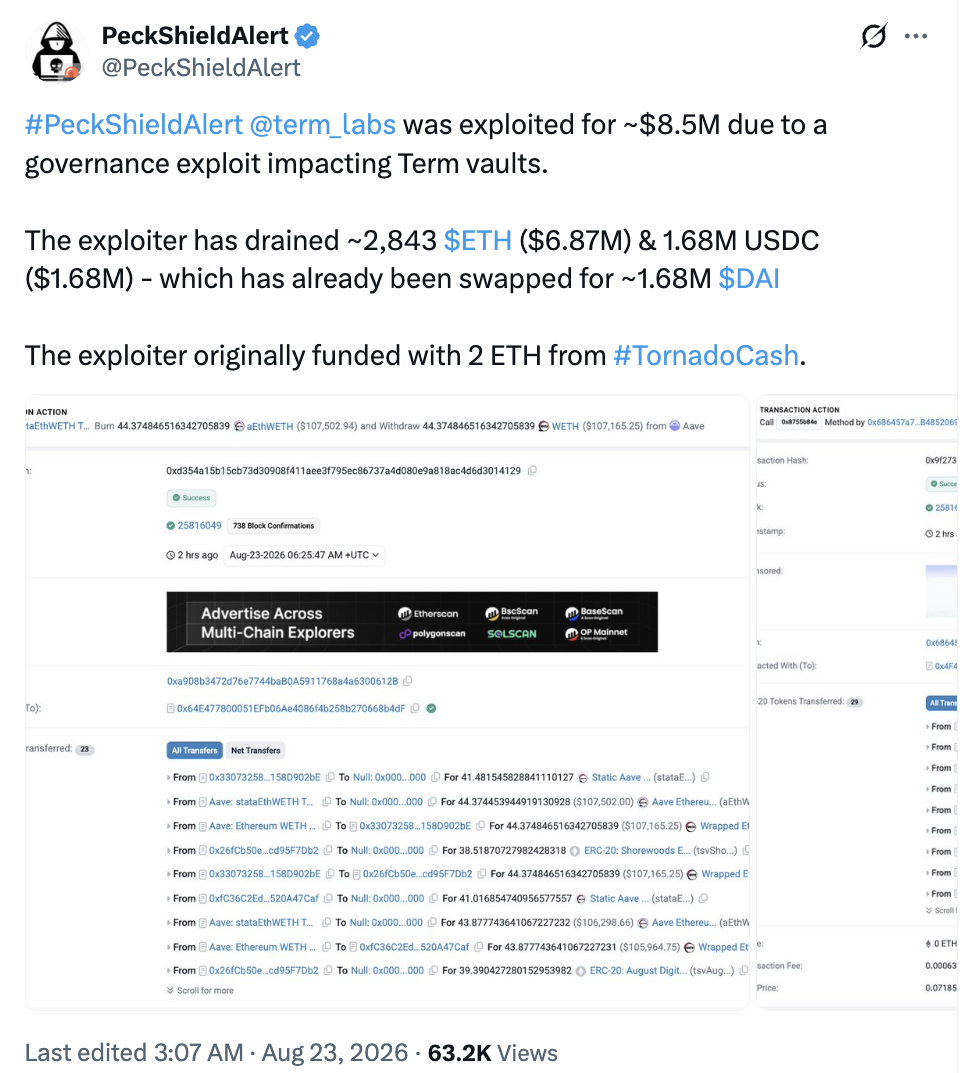
Source: PeckShieldAlert

The growing popularity of crypto vaults has not come without risks. In August, lending protocol Term Finance lost an estimated $8.5 million after an attacker exploited governance control of its Meta Vaults.

For the time being, crypto vaults remain in a regulatory gray area in the United States. In July, SEC Commissioner Hester Peirce said some vaults and onchain lending products could fall under federal securities laws depending on how they are structured and operated.

Peirce said vaults involving discretionary decisions over asset allocation, yield strategies, lending terms or liquidation thresholds could trigger securities, investment company or investment adviser requirements.

Magazine: Former SEC boss made AI Czar, Bitcoin may hit $600K this cycle: Hodler’s Digest

Related Questions

QWhat is the main purpose of S&P Global's new risk assessment framework for digital asset lending vaults?

AThe main purpose is to evaluate the risk of losses to investors in digital asset lending vaults by assessing factors like credit quality, liquidity, curator risk, blockchain risk, protocol risk, and security/governance risk, providing more transparency for informed capital allocation decisions.

QWhat are the six key risk areas evaluated by S&P Global's Vault Risk Assessment framework?

AThe six key risk areas are: portfolio credit quality risk, liquidity mismatch risk, curator risk, blockchain risk, protocol risk, and vault security and governance risk.

QAccording to the article, what is the current regulatory status of crypto vaults in the United States?

ACrypto vaults remain in a regulatory gray area in the United States. SEC Commissioner Hester Peirce has indicated that some vaults and onchain lending products could fall under federal securities laws depending on their structure and operation.

QHow did S&P Global describe the total deposits in digital asset lending vaults as of September?

AS&P Global stated that deposits in digital asset lending vaults reached about $10 billion in September, which is a significant increase from $1.5 billion two years earlier.

QWhat was a notable example of a risk event involving a crypto lending vault mentioned in the article?

AIn August, the lending protocol Term Finance lost an estimated $8.5 million after an attacker exploited governance control of its Meta Vaults.

Related Reads

Backed by $80 Million, Alta is Building the Infrastructure to Bring Global Banking Onchain

Alta, a financial infrastructure company building institutional-grade blockchain infrastructure for global finance, has announced $80 million in total funding, including a $47.5 million Series A led by Index Ventures with participation from GV, Blackbird Ventures, Square Peg, and Capital 49, plus $32.5 million in prior seed financing. Unlike blockchains built mainly for crypto-native applications, Alta is designed to meet the privacy, compliance, neutrality, and operational needs of regulated financial institutions while supporting transactions across assets, chains, and jurisdictions. Its architecture is built on recursive zero-knowledge cryptography, keeping balances, transactions, identities, and compliance policies private while verifying that transactions meet required rules. CEO Loong Wang said existing blockchains aren't designed for institutional privacy and compliance requirements, and Alta builds these features directly into the chain. President Catherine Porter noted that as AI agents increasingly make financial decisions and execute transactions, trust becomes even more critical. Airwallex has chosen to build on Alta, connecting its global payments infrastructure to Alta's blockchain technology, supporting stablecoin pay-ins and pay-outs plus connectivity to local fiat payment networks across 200 countries and 90 currencies. Alta's first product will help businesses manage liquidity more efficiently, reducing cash buffers tied up in prefunded accounts—an estimated $4 trillion globally—through tokenized assets, just-in-time funding, more efficient foreign exchange, and instant movement in and out of yield-bearing tokenized assets. Investors praised the founding team's deep-tech blockchain engineering, institutional go-to-market knowledge, and track record of scaling multi-billion-dollar businesses. The new funding will support continued development of Alta's blockchain infrastructure, expansion of institutional partnerships and global financial connectivity, and growth of its engineering and compliance teams.

TheNewsCrypto7h ago

Backed by $80 Million, Alta is Building the Infrastructure to Bring Global Banking Onchain

TheNewsCrypto7h ago

Hitting a Record for U.S. Tech IPO Fundraising, Anthropic to Raise Up to $90.4 Billion, Fully Diluted Valuation of $1.4 Trillion

Anthropic is pursuing what would be the largest tech IPO in U.S. history, targeting a fully diluted valuation of $1.4 trillion and aiming to become the first publicly listed frontier AI lab. According to its SEC filing, Anthropic seeks to raise up to $90.4 billion through an IPO and private placement—a base IPO of up to $64.4 billion plus $26 billion from seven tech giants (Alphabet, Nvidia, AMD, Broadcom, Micron, Microsoft and TSMC). Shares are priced at $70–78; at the top end the valuation is about $1.02 trillion, slightly above its $965 billion private valuation. The stock will list on Nasdaq under ANT, with Goldman Sachs and Morgan Stanley as lead underwriters, pricing on Nov 18. Including the greenshoe, proceeds could approach $100 billion, surpassing SpaceX's $86.5 billion record. The filing reveals rapid growth: Q3 revenue neared $17 billion versus $1.4 billion a year earlier, with annualized revenue around $81 billion as of Oct 31 and over 11,900 customers spending more than $100,000 annually. Profitability remains unstable—Q3 operating expenses jumped 292% to $17.5 billion, producing a $567 million operating loss after a brief Q2 profit, hit by $5 billion in short-term compute contracts and $2 billion in non-cash charitable matching costs. Price cuts trimmed Q3 revenue growth by about $600 million. Costs are enormous: total committed spending is $895 billion, mostly for compute and chips, with about $70 billion due within a year. Revenue depends almost entirely on AI services. Anthropic is embedding Claude in healthcare, life sciences, legal and accounting work, with over 90% of its codebase now contributed by Claude. It lists as a public benefit corporation with a Long-Term Benefit Trust controlling board elections, and warns AI could pose catastrophic or existential risks. Rival OpenAI targets a 2027 IPO at a $1.25 trillion valuation. Each of Anthropic's seven co-founders holds about 1.4%.

marsbit7h ago

Hitting a Record for U.S. Tech IPO Fundraising, Anthropic to Raise Up to $90.4 Billion, Fully Diluted Valuation of $1.4 Trillion

marsbit7h ago

Trading

Spot
活动图片