No other way! Silicon Valley has gone completely! insane! in the fight for AI compute.
Even Dario Amodei, CEO of A-something (presumably Anthropic), had to humbly beg at rival Meta's door:
Bro, can you spare some compute...

Guess what happened? Zuck politely declined, and Musk reaped the benefits:
SpaceX acted as a second-hand dealer for NVIDIA GPUs, reselling compute to Anthropic, making an absolute killing—
The August earnings report showed impressive growth, with quarterly AI business revenue alone reaching a staggering $2.561 billion, a 247% year-over-year increase, and more than doubling quarter-over-quarter.

Wow! For compute, Silicon Valley is going all out, the era of the Great Alliances has officially arrived.
No matter how viciously they trash-talked each other online before, they still have to bend the knee for GPU power offstage.
They have to bend. Just look at Google, which is falling behind.
Top scientist Noam Shazeer, lured back with a cool $2.7 billion, left for OpenAI within two years because of a lack of compute.
Others spend money and at least hear a sound; Google is just purely doing charity. (doge)

Anyway, Silicon Valley has finally gotten the taste:
Whether talent can be retained, whether models can stay ahead, whether AI can truly generate cash... these questions increasingly depend on how much compute one has left in hand.
GPUs Become Silicon Valley's Hard Currency
In the past, the shortages were money and talent; now it's the compute economy taking the spotlight.
Even a tech giant as strong as Google cannot guarantee its star researchers sufficient GPU resources.

Mention Noam Shazeer, and the first thing that comes to mind is one of the Transformer eight authors. He left Google in 2021 to found Character.AI, dedicated to developing generative AI chatbots.
In 2024, Google spent $2.7 billion in a deal to bring Shazeer back, appointing him as co-head of Gemini.
A researcher like this should be someone giants fight to guarantee resources for.
But according to the latest foreign media reports, his team also faced the difficult situation of having compute resources reassigned, forcing Shazeer to defect to rival OpenAI.
Similarly, Demis Hassabis had long expressed dissatisfaction with insufficient compute for projects, which to some extent also influenced his decision to step down as DeepMind CEO.
Currently within Google, there are significant disagreements about resource allocation. Sergey Brin sometimes directly intervenes, reallocating resources to projects he deems important.
But ultimately, it's still a shortage of compute resources, forcing them to cut costs and be frugal.
External competition has made industry relationships even more complex.
Top startups like OpenAI and Anthropic aren't just competing on model capabilities; they're also fighting for data centers, servers, and power supply capacity.

Take Anthropic as an example. Its model's compute demand has grown so large that it needs to discuss supply with another model company.
The cooperation agreement with SpaceX in May stipulated receiving over 300 megawatts of new capacity that month, involving 220,000 NVIDIA GPUs, while increasing usage quotas for Claude Code and the API.
In other words, the purpose is to let the backend secure more compute to supply the frontend. With compute secured, models become stronger, and users stay.
Thus, the competition among model companies now operates on two simultaneous logics:
At the product level, they still fight for users and development talent; at the infrastructure level, whoever can provide resources promptly could become a potential partner.

What about small AI startups surviving in the cracks?
Their situation is even more dramatic.
These companies struggle to build their own data centers, but in the past, they could rely on flexibly renting GPUs from cloud platforms like AWS, paying as they go.
However, as top AI labs lock down vast compute resources, some cloud service providers now demand multi-year contracts, with upfront payments as high as 30% of the contract value, even requiring startups to find payment guarantors.
All of the above puts startups in a dilemma.
Buy too much compute, and if future user growth falls short of expectations, the continuously burning cash is wasted; buy too little, and they might miss growth opportunities due to lack of computing resources to handle demand.

This situation has ironically spawned a new business: global compute gold rush.
That is, finding underutilized AI server resources around the world and then leasing this compute to needy companies.
For example, the representative company San Francisco Compute once went to old chicken coops in rural America to collect servers, and Musk also discussed further compute cooperation with TSMC.
Top VCs in Silicon Valley have also started hoarding GPUs themselves. YC launched a dedicated GPU cluster for its portfolio companies in July, and Radical Ventures helps its portfolio companies coordinate supplier contracts.
This slightly alleviates the urgent needs of small teams currently training or deploying models.
AI Compute War Spins Out of Control
But blocking isn't as good as channeling. The reasons for this compute shortage are actually quite complex.
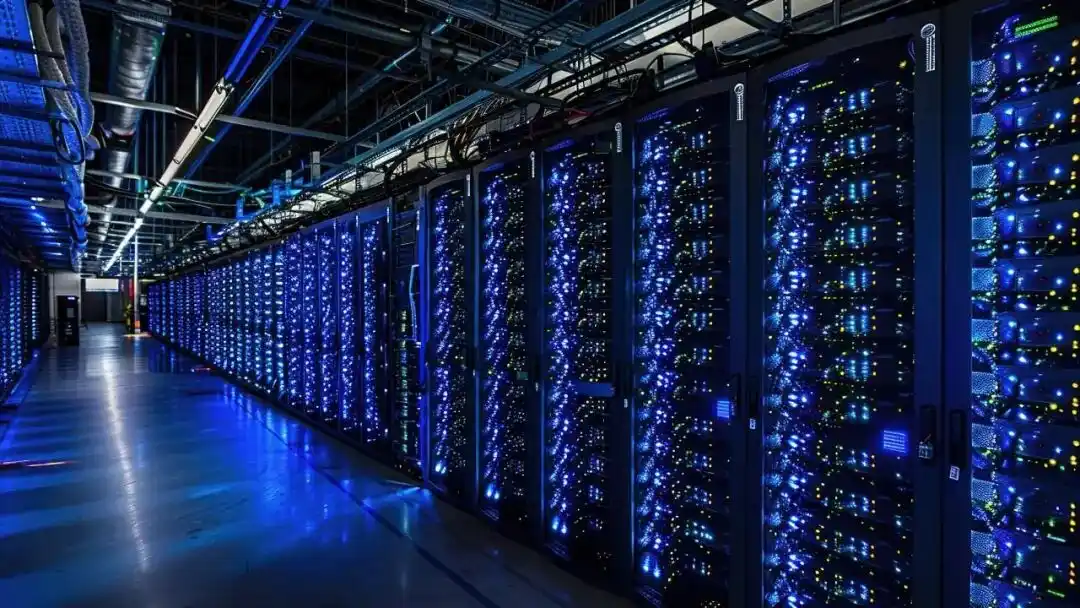
OpenAI, Meta, and even Google are actively building new data centers, promising future massive GPU resources.
But the rapidly growing demand from models can't wait. This time gap, or the big promises being made, is one reason companies still have to scrounge for compute everywhere.
The way users employ AI also unintentionally adds pressure on supply.
Starting this year, Agents began replacing Q&A as the core paradigm for user interaction. Continuous, long-duration work tasks force servers to handle more parallel computing.
After demand increased, even the leasing market for chips changed dramatically.
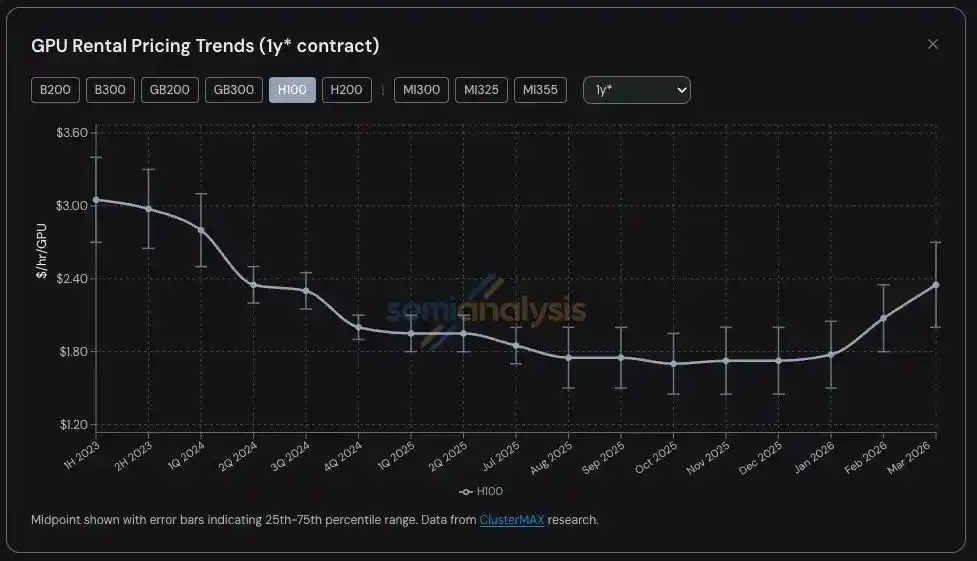
Data released by SemiAnalysis in April shows that the one-year lease contract price for H100 GPUs rose from a low of $1.70 per GPU per hour in October 2025 to $2.35 in March 2026, an increase of nearly 40%.
The saying that GPUs are like gold is not unfounded.
Truly available, immediately deliverable, and stably running compute is insufficient, while new compute is still a distant promise. Together, they create the predicament of the compute market.
Thus, compute hegemony becomes concrete.
The narrative of startups challenging industry giants will increasingly fade. Even if someone has a vision and a roadmap, without enough computing resources, it's game over.
It's clear that compute is becoming the entry barrier for the AI era, reinforcing the advantages of large companies with self-built infrastructure.
You could say: with compute, comes power.
Those making AI products also have more to consider. They must worry about products having no users, and also worry about user growth outpacing their own compute expansion.
But hardship is also opportunity; the middlemen selling shovels are overjoyed.
Isn't that right, Jensen?
References
[1]https://www.wsj.com/tech/ai/ai-computing-power-demand-a63da9b9?st=tzDj41
[2]https://www.anthropic.com/news/higher-limits-spacex
[3]https://newsletter.semianalysis.com/p/the-great-gpu-shortage-rental-capacity
This article is from the WeChat public account "QbitAI", author: Lu Yu