Russia Introduces Protocol for Seizing Crypto Assets, Already Applied in Practice

cryptonews.ruPublished on 2026-10-12Last updated on 2026-10-12

Abstract

Russian authorities have reportedly used a new protocol for seizing crypto assets in a practical case. According to a published investigative action protocol (from October 10, 2026), an investigator in the Republic of Tatarstan seized $6,328 in digital currency. The funds were transferred from a trading account on the RoboForex platform, converting them to USDT and sending them to a specified TRON network address. The procedure was conducted with the participation of the account owner, a defense lawyer, and a specialist, following a court order to seize property. This case aligns with new Russian legislation effective from March and July 2026, which regulates the seizure and storage of digital assets as property in criminal proceedings. The rules establish a framework for transferring seized crypto to special state-controlled addresses. It is noted that the action described constitutes an arrest to secure the assets, not a final confiscation, which would require a separate court ruling. The authenticity of the specific protocol could not be independently verified.

  • An investigator from the Main Investigative Department of the Russian MVD in the Republic of Tatarstan seized digital currency amounting to $6328.
  • From a previously confiscated laptop, he initiated a withdrawal from a RoboForex trading account, choosing to receive the funds in $USDT via the TRON network.

A purported protocol of the investigative action has been published online, showing how the new Russian mechanism for seizing and storing digital assets can work in practice.

According to the document dated October 10, 2026, an investigator from the Main Investigative Department of the Russian MVD in the Republic of Tatarstan

The Happy Coin News editorial team was unable to confirm the authenticity of the published protocol; however, the procedure described in it aligns with the rules for handling seized digital currency that came into force this year.
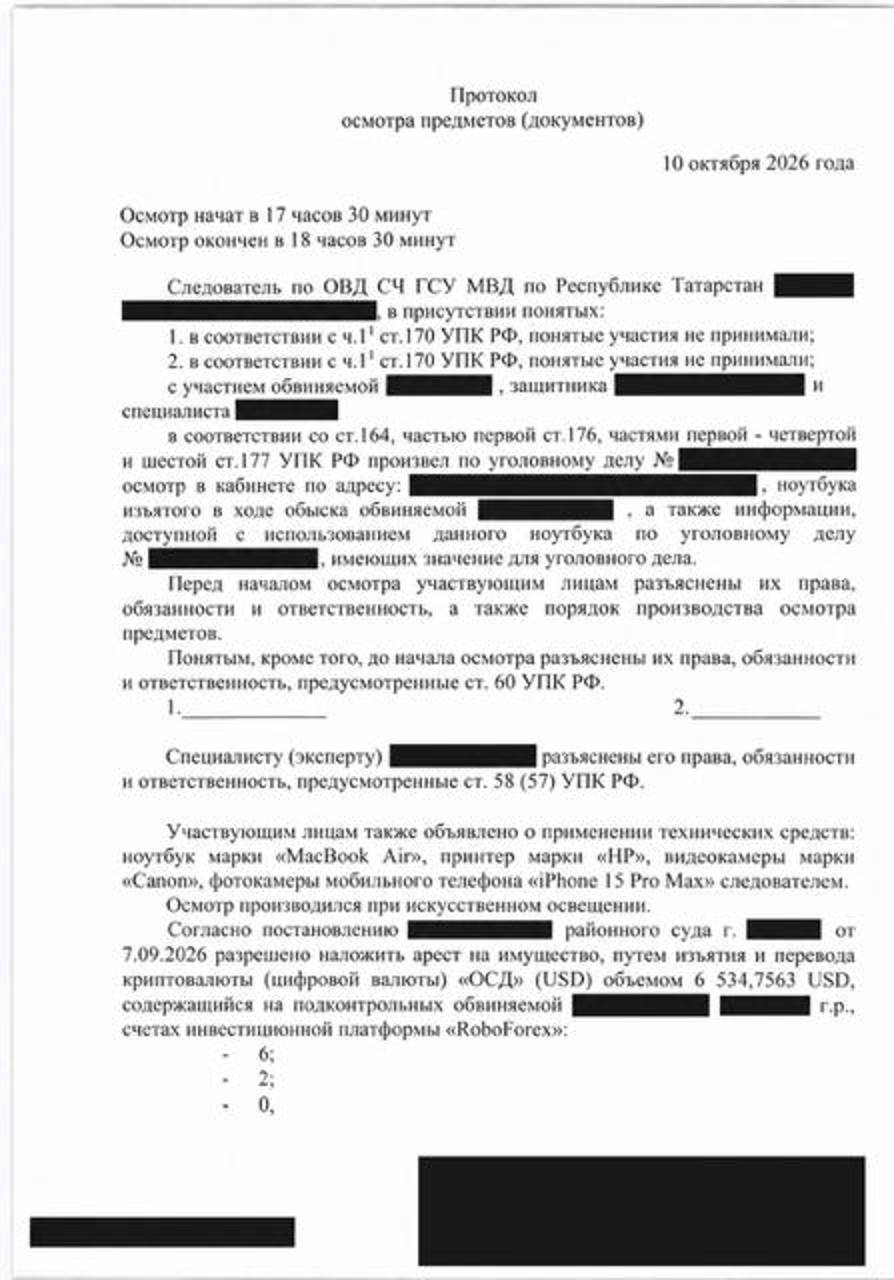
A fragment of the published protocol

How the Investigator Withdrew Funds via RoboForex

It follows from the document that the object of inspection was an HP Pavilion x360 Convertible laptop, previously seized during a search. The basis for the actions was a ruling by a district court in Kazan dated September 7 to seize property.

The accused provided access to the laptop and phone and, according to the protocol, voluntarily confirmed consent to the transfer of funds as part of cooperation with the investigation. Thus, the document does not describe account hacking or bypassing security; the investigative action was conducted with the participation of the owner of the credentials, a defense lawyer, and a specialist.

After logging into RoboForex, the account displayed a balance of $6641.84. The investigator opened the withdrawal section and specified an amount of $6328.

The subsequent operation went through the Difinex payment service. According to the data recorded in the protocol, the interface showed the receipt of approximately 6331.33 $USDT, a commission of 3 $USDT, and the option to choose a blockchain. The investigator specified TRON and entered the recipient address provided to him.

The official RoboForex instructions confirm the general procedure for such operations: the user selects a trading account and payment system, enters a password and amount, after which the selected service may require additional data or confirmation.
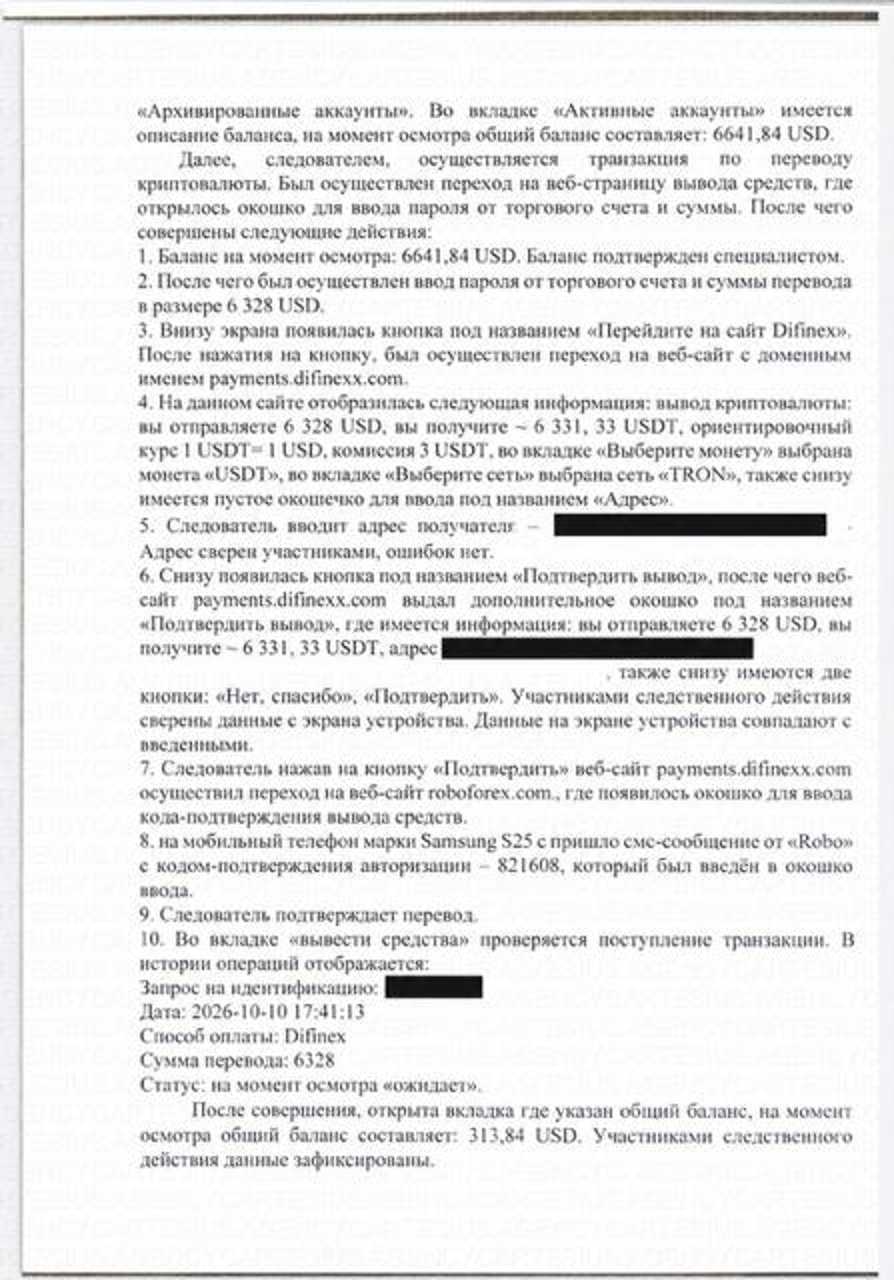
The investigator initiated a withdrawal of $6328 from RoboForex, receiving $USDT via the TRON network. At the time the inspection ended, the transaction was pending

After additional SMS confirmation, the request appeared in the RoboForex transaction history, and the account balance decreased to $313.84.

However, there is a crucial detail here: at the time the inspection was completed, the transfer had not yet been confirmed as received at the final address. Its status in the protocol is designated as "currently pending," with a processing time from five seconds to three days.

New Rules Only Came into Effect This Summer

The practical significance of the document is linked to changes in Russian legislation. Since March 3, 2026, Article 164.2 of the Criminal Procedure Code separately regulates the seizure of digital currency. Investigative actions must be conducted with the participation of a specialist, and to preserve the assets, they are allowed to be transferred to a special identifier address when technically possible. The protocol must record the type and quantity of digital currency, the sender and recipient addresses, and data allowing identification of the transaction.

Since July 3, government-approved Rules for the Storage, Transfer, and Accounting of Digital Currency in Criminal Proceedings have been in effect. They provide for an infrastructure in which a state agent bank, together with an authorized organization, provides identifier addresses for the MVD, FSB, Investigative Committee, Prosecutor's Office, FSSP, Federal Customs Service, and other agencies.

The published protocol fits well into this scheme: the investigator received an address for storing the asset, the participants verified it, after which it was used as the destination address for withdrawing $USDT.

However, it is impossible to determine the owner of the specific TRON address from the document—it is obscured in the published image.

This is Seizure for Now, Not Confiscation

Another important distinction concerns the legal status of the funds. Since March 2026, digital currency has been recognized as property for the purposes of criminal legislation, so it can be seized, including to secure a civil claim, a fine, or possible subsequent confiscation.

But seizure is not the same as confiscation. The latter implies the forced transfer of property into state ownership based on a corresponding court decision. The presented protocol records an investigative action to ensure the preservation of assets, not their final transfer to the state.

Risk Warning:

The information on the site is for informational and educational purposes only and is not investment advice or financial guidance. Cryptocurrencies and digital assets involve a high level of risk, including potential loss of capital. The editorial team is not responsible for decisions made based on published materials. It is recommended to conduct your own research (DYOR) before making investment decisions. Review the editorial policy at https://happycoin.news/about/


Related Questions

QWhat is the main topic and practical significance of the Russian protocol discussed in the article?

AThe article discusses the practical application of a new Russian protocol for seizing and storing cryptocurrency assets. Its significance lies in showcasing the operational mechanics of Russia's recently implemented legal framework, which allows law enforcement to officially arrest and transfer seized digital assets to government-controlled crypto addresses during criminal investigations.

QBased on the protocol, how did the investigator from Tatarstan transfer the cryptocurrency?

AThe investigator accessed a previously seized laptop and, with the owner's cooperation, logged into a RoboForex trading account. From there, he initiated a withdrawal of $6,328. Using the Difinex payment service, he chose to receive the funds in USDT via the TRON blockchain and sent them to a specific recipient address that was provided to him, likely a government-held 'identifier address' as per new regulations.

QWhat are the key differences between 'arrest' and 'confiscation' of cryptocurrency under the new Russian laws mentioned in the article?

AAccording to the article, 'arrest' is a provisional measure to secure and preserve assets during an investigation, ensuring they are available to satisfy potential future civil claims, fines, or confiscation orders. It does not transfer ownership. 'Confiscation' is a final court-ordered penalty where the property is forcibly transferred to state ownership. The described protocol documents an arrest, not a confiscation.

QWhich two key legal changes in 2026 established the framework for the procedure described in the protocol?

A1. Effective March 3, 2026: Amendments to Article 164.2 of the Russian Criminal Procedure Code (УПК РФ) officially recognized cryptocurrency as property for criminal law purposes and established procedures for its seizure, requiring specialist participation and allowing transfer to special storage addresses. 2. Effective July 3, 2026: Government-approved 'Rules for the storage, transfer, and accounting of digital currency in criminal proceedings' created the infrastructure, involving a state agent bank and an authorized organization to provide 'identifier addresses' for law enforcement agencies to hold seized assets.

QWhat crucial detail about the transaction's status was noted at the end of the on-site inspection in the protocol?

AAt the conclusion of the on-site inspection documented in the protocol, the USDT transfer from RoboForex was still pending final confirmation on the blockchain. Its status was recorded as 'currently awaiting' processing, with an estimated completion time ranging from five seconds to three days. The funds had left the trading account but had not yet been confirmed as received at the destination wallet.

Related Reads

Polkadot’s first batch of parachain champions can’t hold on either: Acala and Karura plan to halt their chains in February next year

Acala, the flagship DeFi parachain on Polkadot, has submitted governance referendum Acala #195 proposing to shut down the network, with sister chain Karura launching Karura #137 in parallel. If passed, both chains will stop producing blocks on February 10, 2027. In a letter to the community, the team said Polkadot's multi-parachain architecture has deeply fragmented ecosystem funds, leaving DeFi liquidity severely insufficient, with node and network maintenance costs persistently exceeding actual revenue. The exit of a flagship network after seven years of building and operation raises direct questions about application sustainability under the multi-chain vision. The shutdown plan sets clear cross-chain withdrawal deadlines. Holders must move DOT, KSM, and bridged assets such as USDT and USDC to other networks before February 10, 2027. Native assets ACA and KAR cannot be exported cross-chain and will remain permanently in their respective ledgers after the shutdown. Liquid staking products have staggered unbonding deadlines: Polkadot's standard unbonding takes 28 days, and LDOT bound to specific validators requires an additional 28 days, so applications must be filed by December 16, 2026; the unbonding deadlines for regular LDOT and LKSM are January 12 and February 2, 2027, respectively. The early clearing window is driven by technical security concerns: after the shutdown, network code and historical state ledgers will be public, and any third party could recompile and restart the chain. With AI-assisted code audit tools becoming widespread, legacy systems lacking ongoing maintenance are prone to exposing governance vulnerabilities, so clearing retained assets early can block potential theft of stranded funds. Looking back at Polkadot's first parachain auction in November 2021, Acala won the network's first slot, attracting over 81,000 on-chain addresses to participate in the crowdloan and locking more than 32.5 million DOT. The 96-week lease term secured shared security from the relay chain but also caused massive funds to sit idle for long periods, constraining capital turnover efficiency. Five years later, most of the first batch of winning projects have exited or stalled. Moonbeam stopped producing blocks around July 31, 2026 and migrated GLMR to Base; Parallel Finance closed its products after a security incident; Clover also left its original parachain identity, leaving only Astar still actively maintained and upgraded. The multi-chain structure and separate cross-chain wallet interactions worsen the fragmented experience, and scarce on-chain liquidity is continually diluted. Although Polkadot has now shifted to the elastic coretime model described in its Agile Coretime documentation and is advancing the parallel computing upgrade outlined in the JAM protocol gray paper, early ecosystem funds that flowed out are unlikely to return in the short term. The shutdown plan is currently at the signaling vote stage. Subsquare on-chain data shows Acala Referendum #195 has about 23.1 million ACA in favor and Karura Referendum #137 about 1.28 million KAR in favor, with zero opposing votes so far. After the signaling vote passes, the team will initiate an on-chain execution proposal to implement the shutdown. The team pledges to maintain node operation and coretime availability before the shutdown; external assets not withdrawn by the deadline will be returned to the corresponding Asset Hub addresses on a best-effort basis without a full guarantee, while treasury external assets are planned to be donated to the corresponding relay chain treasury.

marsbit11m ago

Polkadot’s first batch of parachain champions can’t hold on either: Acala and Karura plan to halt their chains in February next year

marsbit11m ago

Airwallex Founder "Slaps His Own Face": From Ranting Against Stablecoins to Building His Own Chain

Jack Zhang, co-founder and CEO of Airwallex, publicly dismissed stablecoins in June 2025, saying they could not lower costs and that crypto had solved no real-world problems in 15 years. Just 17 months later, he co-founded Alta, a blockchain company that raised $80 million to build an L1 designed specifically for licensed financial institutions. The turnaround reflects a broader industry shift: Stripe acquired Bridge for $1.1 billion and incubated Tempo, Circle launched Arc, and stablecoin market cap doubled past $300 billion as U.S. and Hong Kong regulation brought institutional certainty. Alta, co-founded with Loong Wang and Catherine Porter, uses recursive zero-knowledge cryptography to combine compliance with privacy, embedding programmable compliance and identity directly into the protocol—features general-purpose chains cannot offer banks. Airwallex serves as Alta's distribution channel, connecting the chain to its network across 200 countries and 90 currencies. Zhang's stated logic is consistent: he never endorsed crypto broadly, but now sees stablecoins as the on-chain form of fiat currency and a new settlement layer. The real battle is over who controls stablecoin settlement infrastructure, with Stripe, Circle, Fireblocks, and Canton Network all racing to build chain-level rails. Zhang's shift is less a conversion than a commercial necessity: as stablecoin settlement becomes standard for enterprise payments, payment companies that do not own the settlement layer risk becoming application-layer interfaces running on someone else's chain.

marsbit2h ago

Airwallex Founder "Slaps His Own Face": From Ranting Against Stablecoins to Building His Own Chain

marsbit2h ago

The Art of the Trade: How They Made Money Arbitraging USDE Stock

Starkiller Capital outlines a arbitrage trade on StablecoinX (Nasdaq: USDE), a crypto treasury company holding about 20% of ENA tokens. At Friday's close, USDE traded at $6.43 per share, with each share backed by 125.48 ENA worth $20.10—meaning investors pay 32 cents per $1 of ENA, or $155M for $485M in tokens. The firm's approach: buy USDE stock while shorting an equal dollar amount of ENA, so if both fall but the stock falls less, short gains offset stock losses. Starkiller first entered in August at 0.18x mNAV, took profits as the discount narrowed to 0.60x, and has rebuilt a larger position at 0.32x. The key new catalyst: Ethena's foundation waived all token lockups effective October 5, letting the company sell ENA to fund an approved share buyback. At current prices, every $1 of ENA sold repurchases shares representing $3.13 of token assets, strongly accretionary to NAV per share. The discount widened recently not because of company fundamentals but because crypto market beta fell—ENA dropped 29% and比特币 7% in October—and because USDE holders exiting ENA exposure sold the illiquid stock; short interest rose 78% to ~15% of float. Risks include: no redemption mechanism forcing convergence (GBTC traded at a discount for two years), the foundation controls the exit path and must approve token sales, a resale S-1 covers over half the A-shares, mNAV has ranged from 0.13x to 0.61x, warrants at $11.50 and $15 strike could dilute upside, and a crypto crash could push mNAV back to lows. Catalysts to watch: the Q3 10-Q filing (due by Nov 16) for buyback details. Starkiller argues the stock should eventually trade around 0.7x mNAV, implying roughly 56% upside on the long leg just from a return to the October 5 level.

marsbit2h ago

The Art of the Trade: How They Made Money Arbitraging USDE Stock

marsbit2h ago

Embedded chip vendors are starting to sell modules directly?

On November 5, Texas Instruments (TI) announced the TICS100MOD, a multi-protocol industrial communication System-on-Module (SoM) supporting EtherCAT, PROFINET, and EtherNet/IP, with volume availability expected by the end of 2026. The module integrates TI's AM2612 real-time MCU—featuring dual Arm Cortex-R5F cores and PRU-ICSS—along with two DP83826AI 100Mbps Ethernet PHYs, protocol stacks, SDK, and development tools in a 30mm × 18mm package. It connects to an external host MCU or MPU via SPI or QSPI, handling industrial Ethernet protocol processing while the host runs device control and applications. The article notes that while MPU-based SoMs are common, MCU-based SoMs are relatively rare, and TI's MCU is powerful and complex enough to justify a module. TI is not the first chip vendor to offer its own SoM products: Microchip has offered SoMs such as the ATSAMA5D27-SOM1 and SAM9X60D1G-SOM, some suitable for surface-mount reflow soldering, while AMD offers the Kria K26 and K24 SoM series. In wireless connectivity, Espressif and Silicon Labs similarly provide chips alongside modules. In China, SoMs are typically called core boards, with vendors including Chuanglong Technology, MYIR Electronics, Forlinx, ZLG, and Alientek, covering TI, NXP, ST, Renesas, and domestic platforms such as Rockchip and Allwinner. TI continues to partner with third-party SoM vendors—including Chuanglong, MYIR, and Alientek around the AM62L processor, and internationally with Toradex, Variscite, Ezurio, and PHYTEC. TI's new TICS100MOD focuses specifically on industrial Ethernet communication, while customers needing complex computing platforms are still served through third-party partners.

marsbit2h ago

Embedded chip vendors are starting to sell modules directly?

marsbit2h ago

Trading

Spot
活动图片