Ripple Enters the Financing Business of Leveraged US Stock Funds. Should XRP Holders Be Excited?

marsbitPublished on 2026-10-08Last updated on 2026-10-08

Abstract

Ripple, through its institutional brokerage arm Ripple Prime, has entered the traditional finance business of providing funding for leveraged stock ETFs. By charging retail-focused funds an estimated 8% annual financing cost, Ripple generates a new fiat revenue stream. However, XRP's price has shown no positive reaction to this news. This capability stems from Ripple's $1.25 billion acquisition of Hidden Road (renamed Ripple Prime), which holds the necessary licenses and relationships. The business involves funds using total return swaps to gain leveraged exposure, with Ripple Prime acting as the financing counterparty. A core issue for XRP holders is that the profits from this Wall Street-style business flow directly to Ripple the company, not to XRP token holders. There is no mechanism for distributing the financing income or using it to buy back XRP. The primary potential benefit for XRP lies in increased institutional adoption if new clients use Ripple Prime's services for XRP spot trading or collateral management. Usage of the XRP Ledger for settlement would generate minimal token demand due to its low, fixed transaction fees. While expanding Ripple's traditional finance footprint, this move highlights the disconnect between the company's profitable ventures and direct value accrual to its native XRP token.

Author: Claude, Deep Tide TechFlow

Deep Tide TechFlow Introduction: Ripple is extending its business tentacles into a hidden profit zone of traditional Wall Street: providing financing for leveraged equity ETFs. By charging retail investors pursuing amplified returns an annualized financing cost of approximately 8%, Ripple has successfully opened up a new fiat revenue stream. However, the XRP price has reacted coolly. For token holders, the core contradiction lies in this: the Wall Street spreads earned by Ripple at the company level are not, by mechanism, converted into genuine buy-side demand for XRP.
In the US stock market, if investors want to magnify their daily returns through a 2x long ETF, the fund issuer must borrow capital from financial institutions to maintain the leveraged exposure, paying ongoing financing fees for it. This business, long monopolized by traditional banks and prime brokers, is now seeing the entry of crypto players.

Citing a report from *The Wall Street Journal*, CoinDesk notes that Ripple's institutional brokerage business, Ripple Prime, has officially entered the financing service for leveraged equity ETFs. Taking the Tradr 2x long SanDisk fund mentioned in the report as an example, this fund pays the overnight bank funding rate plus a 4-percentage-point premium. Calculated at current market levels, this financing cost equates to approximately 8% annualized.

This means that while retail investors on the front end pay for and bear the decay of stock volatility, Ripple is at the back end, as the capital provider, steadily extracting this liquidity premium.

But the price of XRP has not responded accordingly yet. As of the time of writing on October 8th, XRP is approximately $1.41, down about 3.8% over the past 24 hours and down about 6.5% over the past seven days. It closed around $1.49 on September 30th and was around $1.42 on October 7th. There was also no significant pre-announcement price surge.

A $1.25 Billion Wall Street Business

Ripple's ability to charge stock funds relies on an acquired brokerage business.

In 2025, it spent $1.25 billion to acquire Hidden Road, rebranding it as Ripple Prime after completing the transaction in October. Funds can trade, clear, and obtain financing through this company without needing to find separate counterparties for each asset type.

The contracts purchased by the funds are called total return swaps. The broker agrees to pay the fund the returns corresponding to the stock's gains and losses, while the fund pays a financing fee; the broker then manages its risk by holding the actual stock, etc. The leveraged ETFs that retail investors buy on exchanges are backed by these institutional contracts.

Traders hold the fund, the broker sells the leverage. The more capital drawn in by stock market trends, the more financing the funds require, creating more fee opportunities for Ripple.

On August 27th of this year, Ripple formally launched swap services for US stocks, indices, and digital assets. On October 6th, hedge fund management firm Brevan Howard expanded its cooperation with Ripple, adopting its cross-asset brokerage, clearing, and financing services.

Today's report adds specific client and fee details. The licenses, teams, and institutional relationships Ripple bought are now starting to receive business.
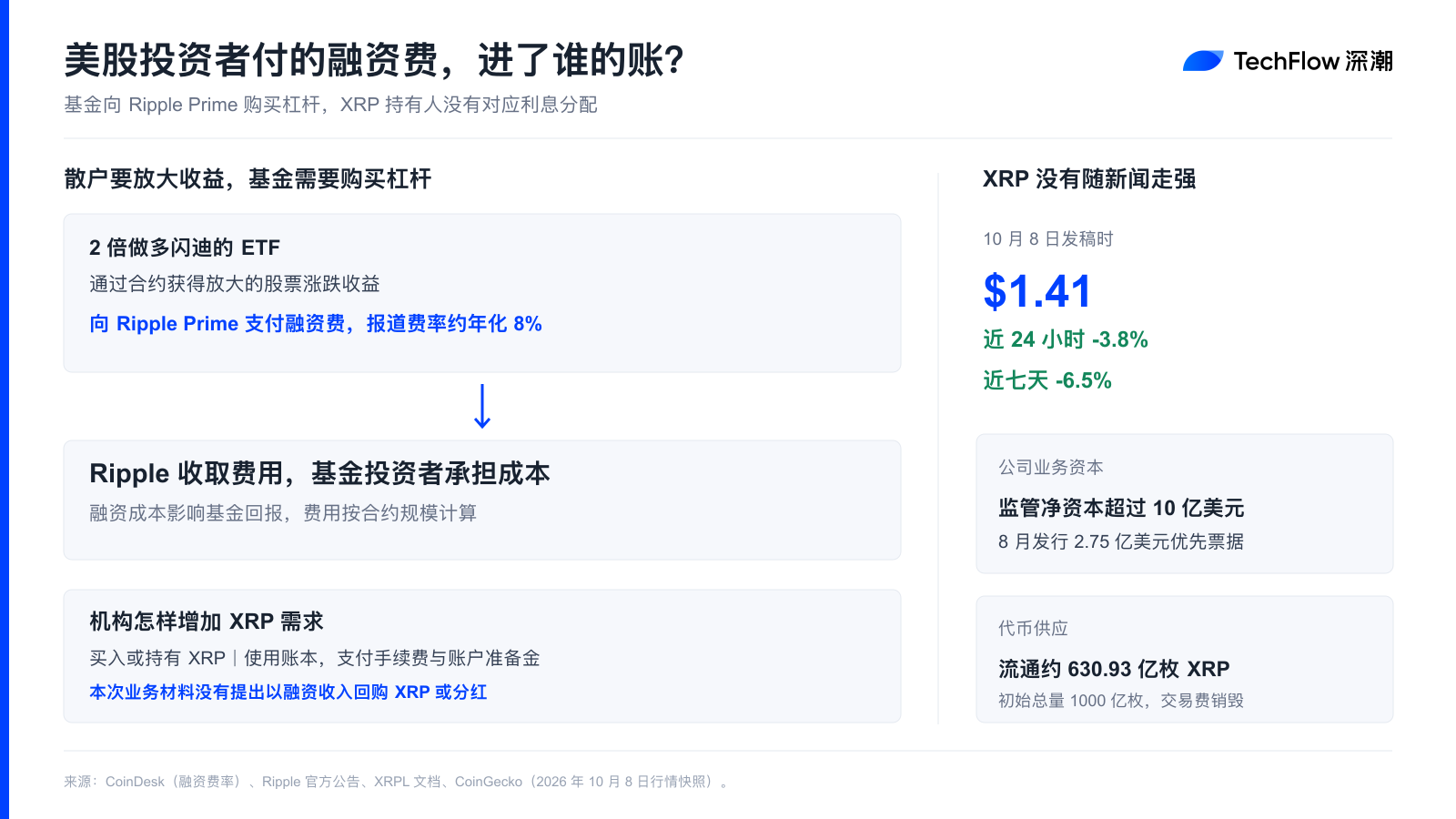
Chart: ETF investors bear the cost of obtaining leverage, the fund pays financing fees to Ripple Prime. XRP gains usage demand through institutional holdings, on-chain fees, and account reserve requirements.

But financing companies also need to borrow money.

Official disclosures state Ripple Prime's regulatory net capital exceeds $1 billion. In August, it issued $275 million in senior unsecured notes and had previously secured $200 million in debt financing. The roughly 8% financing fee paid by clients needs to cover funding, hedging, and operational costs; what remains is profit. Therefore, it remains to be seen whether this business shift will ultimately be profitable.

What XRP Holders Actually Get

Under the currently disclosed arrangement, this financing revenue is collected by Ripple Prime. Holding XRP does not entitle one to a corresponding interest distribution, and the business announcement did not propose using this money to buy back XRP. The addition of new clients first expands the company's business.

Ripple had already outlined how to connect the brokerage to its products during the acquisition. The plans at the time included using the USD stablecoin RLUSD as collateral and migrating some post-trade processing to the XRP Ledger. Funds could manage collateral with the stablecoin, and brokers could use the ledger to reduce settlement and operational costs.

For XRP, the relationship is more direct with actual institutional token holdings and trading.

Ripple Prime already offers OTC spot trading for XRP, and institutions can also manage margin by combining XRP spot holdings with other digital asset positions. If new clients increase their XRP allocations through these services, capital would flow into the token market.

Merely using the ledger generates far less demand. The standard base fee for a regular transaction is 0.00001 XRP, which is directly burned after payment; new accounts currently require reserving 1 XRP. Calculating with the standard base fee, one million regular transactions burn 10 XRP. Low costs facilitate institutional adoption but also indicate that large-scale US stock financing cannot be directly translated into large-scale XRP consumption.

The new revenue also doesn't change the XRP supply arrangement.

Approximately 63.093 billion XRP are currently in circulation. A snapshot from June 30th shown on Ripple's website indicates about 32.6 billion more were still in escrow lock-up. The escrow releases monthly, with unused portions re-locked for subsequent months. This stock financing business announcement did not disclose conditions requiring additional XRP lock-ups.

If you buy XRP because of this news, you are betting that Ripple's new clients will ultimately also become users of XRP. But holding XRP will not entitle you to receive, for instance, the interest paid by the SanDisk leveraged equity fund, nor is this a direct model where business revenue is used for token buybacks.

Or, one might say, many old crypto projects aligning with traditional finance is a current trend, but their original tokens have not been updated to be part of that new calculus.


Related Questions

QWhat is the core contradiction for XRP holders regarding Ripple's new leverage ETF financing business, according to the article?

AThe core contradiction is that while Ripple the company is generating new fiat revenue streams from this traditional finance business, the earnings are not directly converted into real buying demand for the XRP token itself. The revenue goes to Ripple Prime, and there is no mechanism for distributing profits to token holders or using the money for XRP buybacks.

QHow did Ripple acquire the capability to offer financing services to leverage stock ETFs?

ARipple acquired this capability by spending $1.25 billion to purchase the brokerage firm Hidden Road in 2025. After the acquisition was completed in October, it was renamed Ripple Prime, which provides the trading, clearing, and financing services that allow Ripple to enter this business.

QAccording to the article, what are the two main ways for Ripple's new business to potentially generate demand for the XRP token?

AThe two main ways are: 1. If Ripple Prime's institutional clients increase their XRP spot holdings and manage them alongside other digital assets using the platform. 2. By migrating parts of the post-trade settlement processes onto the XRP Ledger, which would generate minimal standard transaction fees (paid in XRP and burned) and potentially require XRP for account reserves.

QWhy is the direct positive impact of this business on the XRP token considered limited, as explained in the article?

AThe impact is considered limited because the transaction fees on the XRP Ledger are very low (e.g., 0.00001 XRP per standard transaction, which is burned), and only a small amount of XRP is needed for new account reserves. Therefore, the large-scale financing business for stock ETFs cannot be directly translated into a significant consumption or demand for XRP tokens.

QWhat did the price of XRP do around the time of the report on this new business development, and what does the article suggest this indicates?

AThe price of XRP did not show a positive response. At the time of writing (October 8), it was around $1.41, down approximately 3.8% in 24 hours and 6.5% over the previous week. There was no noticeable price increase preceding the report either. This suggests the market did not view the news as a direct catalyst for XRP token value.

Related Reads

Arthur Hayes ‘flattered’ as Coinbase backs US stock perps

Arthur Hayes, co-founder of BitMEX, said he was "flattered" by Coinbase's support for the CFTC in a US legal dispute over stock perpetual futures. Hayes noted that when BitMEX launched the perpetual swap in 2016, Washington's reaction was "less than warm," and remarked that "imitation is the sincerest form of regulation." Coinbase and five other companies submitted a brief opposing the Capital Markets Alliance Association's (CMAA) request to block trading in perpetual futures tied to individual stocks. The CMAA argues these contracts should be treated as security-based swaps, which face tighter retail trading restrictions. The SEC reportedly submitted a proposed brief opposing the alliance's request to temporarily halt trading, saying it is reviewing the exchanges' rules for listing the contracts. The CMAA said the CFTC approved the contracts without adequately explaining its decision or addressing unresolved regulatory questions, citing about $375 million in reported 24-hour notional trading volume for Kalshi's stock perpetuals shortly after launch. US District Judge Valerie Caproni denied the group's request for a temporary restraining order, finding the alliance was likely to succeed on its claim that the CFTC exceeded its authority. Stock perpetuals let traders speculate on share prices without owning the underlying stocks and have no fixed expiration date. Wojciech Kaszycki, strategy adviser to BTCS SA, said the lack of a fixed expiration or delivery date could complicate treating perpetual contracts as futures, but warned that a ruling against the CFTC could push trading toward offshore and decentralized platforms: "The product doesn't die; it just changes address."

cointelegraph34m ago

Arthur Hayes ‘flattered’ as Coinbase backs US stock perps

cointelegraph34m ago

TechFlow Intelligence: Jensen Huang Resigns as Nvidia CEO Amid Multiple Extramarital Affair Scandals; Microsoft Global Outage Still Unresolved After 12 Hours

TechFlow Intelligence Brief: Nvidia CEO Jensen Huang has resigned amid multiple extramarital affair scandals (one individual suspected of being a Chinese spy); CFO Colette Kress takes over as interim CEO, with shares falling to $156 and nearly $500 billion in market value wiped out. Anthropic launched its IPO page, claiming it has reached the threshold of "AI accelerating AI research," drawing intense Hacker News discussion. Google released Gemini 4 Hydrogen on its Antigravity platform, praised for multimodal and code-generation capabilities. Claude suffered major outages affecting claude.ai and Claude Code, sparking developer complaints about AI tool reliability. Claude also added Google Meet integration for automatic meeting notes. Crypto/Web3: Bitcoin fell below $70,000, dropping from $73,866 to $68,943 (6.11% in 24 hours), with $622 million liquidated in 4 hours, mostly longs. Spot Bitcoin ETFs saw five consecutive days of outflows totaling about $1.44 billion, turning yearly flows negative. DTCC plans to bring tokenized securities to Solana. Frax launched its Burn Engine to buy back and burn FRAX using protocol revenue. Chips/Hardware: Nvidia employees petitioned for Huang's return. Reuters reported a second employee relationship involving Huang. TSMC confirmed a cyberattack in an SEC filing. AMD detailed its Zen 6 architecture in a deep interview. Tech Companies: Microsoft suffered a global outage lasting over 12 hours, crippling Outlook and Teams. Microsoft researchers demonstrated implanting backdoors in AI agents by editing fewer than 10 neurons without retraining. Nebius announced a $40 billion neocloud spending plan. Markets/Finance: Former US AI czar David Sacks said there is no evidence that Alice Huang is a Chinese spy. Cerebras posted record Q3 revenue and raised guidance. Applied Materials issued strong Q1 guidance on AI demand. NY Fed's Williams warned inflation remains too high, with markets pricing consecutive rate hikes. New Products/Trends: The first NS2 emulator reportedly runs exclusive games on PC. AI tool Fable 5.2 produced an FPS game, "Saltline," for just $550. The takeaway: Huang's resignation, Bitcoin's plunge, Microsoft's outage, and Strait of Hormuz tensions all point to 2026 markets being exposed to both key-person risk and critical-infrastructure risk. As AI and crypto are priced as risk assets, their ties to geopolitics, corporate governance, and even CEO personal lives will only deepen.

marsbit1h ago

TechFlow Intelligence: Jensen Huang Resigns as Nvidia CEO Amid Multiple Extramarital Affair Scandals; Microsoft Global Outage Still Unresolved After 12 Hours

marsbit1h ago

Racing to Secure Seats Before the Senate Flips: Trump Nominates Four SEC and CFTC Commissioners, Ushering in a New Era for Crypto Regulation

On November 12, Trump submitted four nominations for SEC and CFTC commissioner positions—one Republican and one Democrat for each agency—as time runs short before Republicans lose their Senate majority in January. The seats have been vacant for months: SEC has only Chair Paul Atkins and Commissioner Mark Uyeda since Hester Peirce departed in October, while CFTC has only Chair Michael Selig. Even if all four are confirmed, SEC would have four commissioners and CFTC three—still short of full five-member slates—so the significance lies in adding voting participants rather than announcing new policy. Both CFTC nominees, Nathan Anonick and Matthew Rowland, worked on the CLARITY Act, which would authorize CFTC oversight of digital commodity spot intermediaries, platform registration, customer fund segregation and conflict-of-interest rules; it failed a procedural Senate vote in September. If confirmed, they would join Selig in voting on rules such as the event-contract draft proposed in June. SEC nominee Kristin Johnson, a former CFTC commissioner and law professor, publicly supported CFTC enforcement against three DeFi operators in 2023, arguing regulators should examine whether platforms concentrating clearing or settlement off-chain effectively act as intermediaries. The other SEC nominee, Levine, served as deputy chief of staff to acting Chair Uyeda during the agency's early crypto framework overhaul and would fill Peirce's seat. The bipartisan list responds to calls for restoring two-party representation and seeks broader support for confirmation. Senate hearings will be the first key window into the nominees' regulatory intentions.

marsbit2h ago

Racing to Secure Seats Before the Senate Flips: Trump Nominates Four SEC and CFTC Commissioners, Ushering in a New Era for Crypto Regulation

marsbit2h ago

Revenue Becomes This Year's Hardest Crypto Narrative

The article argues that "revenue" is becoming crypto's most durable narrative in 2026, as the industry matures and institutional allocators shift from speculation toward sustainable business models. Crypto protocols generated $11.68B year-to-date, on pace for ~$13.9B by year-end—only slightly below 2025 despite a much weaker market. The author contends the real opportunity lies not just in profitable protocols but in those with mechanisms converting business success into tokenholder value, primarily token buybacks backed by real revenue. Four criteria define a "good" buyback: revenue-funded, established product-market fit, transparent execution, and sustainable capital allocation. Context matters: Jupiter's $70M+ buyback failed amid a Solana-wide downturn, and buybacks can be swamped by new token emissions. Still, 2026 data is compelling—among the 16 top-revenue protocols with tradeable tokens, the 12 with active buybacks averaged +62.2% YTD (median +32.6%) versus −31.6% for those without, a 93.8-point gap, achieved despite crypto's total market cap falling ~19%. Buyback tokens also outperformed direct revenue-distribution tokens (190% vs 29% market-cap-weighted). The author highlights opportunities in stablecoins/RWA lending, World Liberty Financial's USD1 buyback linking stablecoin economics to WLFI, Venice's AI platform ($100M+ annualized revenue, VVV up 1,200%), Bittensor subnets using revenue for alpha-token buybacks, and Robinhood Chain's LONG 500 model combining buybacks with tokenized stock accumulation. The piece concludes the revenue narrative is still early, and in a true bull market, revenue-funded buybacks could act as accelerant rather than life raft.

marsbit2h ago

Revenue Becomes This Year's Hardest Crypto Narrative

marsbit2h ago

Trading

Spot
活动图片