New Huo Research Institute: Bitcoin Enters Critical Data Window, Market Searches for Direction Between Interest Rates, ETF Fund Flows, and Technical Resistance

marsbitPublished on 2026-10-13Last updated on 2026-10-13

Abstract

Sinohope Research reports that digital asset markets are at a critical juncture. While expectations for US interest rate hikes have cooled, long-term Treasury yields remain high, and institutional capital flow signals are mixed. Bitcoin trades in a narrow range near key resistance, with focus shifting from Fed policy to whether incoming economic data can support risk assets. The probability of a November FOMC rate hike has dropped significantly, theoretically supporting assets like Bitcoin. However, persistent high yields mean financial conditions aren't fully accommodative, explaining the lack of a decisive breakout. Capital flows are divergent. US spot Bitcoin ETFs show alternating inflows and outflows, suggesting no large-scale renewed institutional buying yet. Ethereum-related ETFs are influenced by sector rotation. Market attention is also on crypto-heavy public companies like Marathon Digital and Riot Platforms as proxies for corporate adoption. Policy developments, including the US stablecoin bill progress and SEC/CFTC regulatory stances, continue shaping institutional participation expectations. For Ethereum, staking queues remain positive, indicating sustained long-term demand, though short-term price action hinges on overall risk appetite. Key near-term catalysts include upcoming US inflation/employment data and the late-October FOMC meeting. Supportive data could push Bitcoin to test higher resistance, while hot data or rising yields could pressure valuations. ...

New Huo Research Institute indicated that the digital asset market is currently at a critical juncture of directional selection this week. While expectations for US interest rate policy continue to cool, long-term yields remain relatively high, and institutional fund flows have not yet formed a consistent signal. Bitcoin is experiencing repeated high-level fluctuations, with market focus gradually shifting from "whether to hike rates" to whether economic data can support renewed upward movement in risk assets. The CME FedWatch tool shows that the market's expectation for a 25-basis-point hike at the October 28 FOMC meeting has dropped from around 66% at the start of the week to approximately 18%-22%; the related probability on Polymarket also sits around 18%. The weakening of interest rate path expectations is theoretically favorable for risk assets like Bitcoin, but US long-term Treasury yields are still running at high levels, and financial conditions have not fully eased. This explains why Bitcoin maintains its strength but has been unable to effectively break through the key resistance zone ahead.

The fund flow situation is also showing divergence. US spot Bitcoin ETFs have seen alternating inflows and outflows in recent trading days, indicating that institutional investors have not yet shown signs of re-entering the market on a large scale. Funds related to Ethereum ETFs and the market continue to be affected by sector rotation. Meanwhile, the stock prices and balance sheet performance of publicly listed companies holding significant digital assets, such as Strategy and BitMine, remain important windows for observing corporate crypto-asset allocations. The market needs further confirmation on whether ETF fund inflows will resume following the release of macroeconomic data or if they represent only a short-term trading rebound.

On the policy front, the progress of the US GENIUS bill's implementation, along with the US Treasury Department's solicitation of comments on the implementation framework for related provisions, will continue to influence compliance expectations for stablecoins and institutional digital asset businesses. Regulatory stances from the SEC and CFTC regarding tokenized assets, crypto-financial products, and related market activities will also serve as important references for institutional investors assessing market accessibility. Regarding Ethereum, the entry queue for staking remains higher than the exit queue, reflecting sustained market demand for ETH staking rewards and the network's long-term development. However, short-term price performance will still depend on overall risk appetite and fund rotation.

The next important observation windows include US inflation and employment data, as well as the October 28 FOMC meeting. If the data continues to support cooling inflation and a policy hold, the market may retest Bitcoin's upper resistance levels. If long-term yields continue to rise or macroeconomic data reignites expectations for rate hikes, risk assets could still face valuation pressure.

Technically, Bitcoin has recently been consolidating mainly within the range of approximately $80,300 to $87,100. The current price remains near key resistance. A short-term breakout above $85,600, accompanied by increased volume, could pave the way for a challenge of $87,395 and further tests at higher levels. If a breakout fails, the price might retreat to test moving average support near $83,000; a break below $82,000 would warrant attention to the risk of extending towards $79,000. The MA7 is around $83,500, and the MA20 is around $83,000. The RSI maintains a neutral to strong bias without significant overbought divergence. The BOLL20 middle band is around $84,250, the upper band is around $86,570, and the lower band is around $82,000, indicating the market is still in a phase of high-volatility consolidation.​​​

Trending Cryptos

Related Questions

QAccording to the article, what is the main dilemma Bitcoin is currently facing in terms of market dynamics?

ABitcoin is caught between supportive factors (weakening interest rate hike expectations) and restrictive factors (high long-term bond yields, unclear ETF fund flows, and technical resistance levels). This explains its strong but consolidating price action without a decisive breakout.

QWhat are the two key upcoming events or data points that the article identifies as crucial for Bitcoin's next directional move?

AThe two crucial upcoming events are: 1) The release of U.S. inflation and employment data, and 2) The Federal Open Market Committee (FOMC) meeting on October 28.

QDescribe the current state of U.S. spot Bitcoin ETF fund flows as mentioned in the article.

AThe fund flows for U.S. spot Bitcoin ETFs have been mixed, showing alternating patterns of inflows and outflows in recent trading sessions. There is no clear sign yet of institutional investors resuming large-scale buying.

QWhat specific Bitcoin price levels define the key technical resistance and support zones discussed in the analysis?

AThe key technical resistance zone is around $87,100, with an immediate hurdle at $85,600. The main support zone is around $83,000-$82,000, with a deeper support level at $79,000. The current trading range is approximately $80,300 to $87,100.

QBesides interest rates and ETF flows, what other factor related to Ethereum does the article mention as influencing the broader digital asset market?

AThe article mentions that the number of Ethereum validators entering the staking queue remains higher than those exiting. This reflects sustained demand for ETH staking rewards and confidence in the network's long-term prospects, though its short-term price still depends on overall market risk appetite.

Related Reads

230k-follower “Crypto God” exposed: 30 sock puppet accounts caught harvesting fans

Cupsey, a Solana meme coin trader with over 230,000 X followers, has been exposed by on-chain analytics firm Bubblemaps for allegedly running roughly 30 secret wallets to profit off his own followers. Since May 7, these linked addresses traded over 27,000 tokens and cashed out about $1.74 million on roughly 3,000 tokens using a repeated three-step scheme: four core wallets quietly accumulate a new token and spread holdings across 12 associated wallets; Cupsey's public wallet then buys the same token and he promotes it to followers; finally, the hidden wallets sell into the incoming buy orders. In some cases the secret wallets dumped tokens while Cupsey was still drafting his recommendation posts. Because new meme coins have thin liquidity, followers' buys push prices up briefly, letting the insider wallets exit while late buyers absorb the losses. The report also links Cupsey-associated wallets to a token-issuing address starting with "3z4vj," which launched over 400 tokens and earned an estimated $1.3 million. Beyond trading spreads, Cupsey reportedly received about $331,000 in Pump.fun promotion rewards. Bubblemaps has similarly exposed other top traders such as Anglio, 0xEthan, and Solstice for front-running their own recommendations, in some cases buying about 20 seconds before posting. The firm criticizes platforms for rewarding trading volume with millions in incentives while doing little to detect bundled holdings, insider wallets, or repeat offenders, turning followers into exit liquidity. Cupsey has not yet responded to the allegations.

marsbit1h ago

230k-follower “Crypto God” exposed: 30 sock puppet accounts caught harvesting fans

marsbit1h ago

Ex-employee sues Ethereum Foundation and Vitalik Buterin over firing

A former Ethereum Foundation employee, Kayleen Fulton (known as “Nixo”), has sued the organization, co-founder Vitalik Buterin, and four others, alleging she was fired after disclosing a cancer diagnosis and organizing a staff letter challenging a directive tied to the foundation’s new mandate. Fulton, who led the protocol support team, filed the complaint on Nov. 4 in the U.S. District Court for the District of Colorado. She claims Bastian Aue, then a co-executive director, fired her on April 6, 13 days after her diagnosis disclosure, and that Buterin helped adopt and enforce the directive as a board member. Fulton and colleague Trent Van Epps organized a letter with 53 signers supporting the mandate’s goals but objecting to a requirement that employees affirm it to keep their jobs; she alleges she and Van Epps were fired 30 minutes apart days later. She alleges disability discrimination, retaliation, and interference with medical leave rights, seeking lost pay and damages. The complaint also notes some employees objected to a reference to ritual suicide in the mandate, quoting Aue saying the language was figurative. A lawyer for the foundation’s Singapore affiliate denied unlawful conduct or retaliation and said her separation agreement was binding. The foundation published its mandate in March, highlighting censorship resistance, open-source code, privacy and security, and a focus on protocol upgrades, research, and developer tools.

cointelegraph1h ago

Ex-employee sues Ethereum Foundation and Vitalik Buterin over firing

cointelegraph1h ago

Major Analog Chip Acquisition: The Account Behind Over 500 Part Numbers

On November 9, Awinic Electronics announced a trading halt to plan the acquisition of Yutai Semiconductor shares via share issuance and cash, plus supporting financing—a landmark integration in China's analog chip design sector. Both companies compete in analog chips but follow different product paths. Awinic's power management revenue reached 1.047 billion yuan in 2025 (about 37% of total), slightly down 0.03% year-on-year, deeply tied to consumer electronics like phones, AIoT, and wearables. Its real strength lies in high-performance mixed-signal chips (1.505 billion yuan, 53% of revenue), with audio power amplifiers as the core, now extending into edge AI audio for AI glasses, supplying Meta, Rokid, and RayNeo. However, consumer cyclicality and fierce 2026 price competition expose Awinic's limited coverage in industrial-grade medium/high-voltage power, telecom power, and smart meters. Yutai, founded by former Maxim designers with R&D centers in Shanghai, Silicon Valley, and Hanoi, offers over 500 product models covering DC-DC, AC-DC, LDO, battery management, and PMU. Its AC-DC line spans 5 categories and 130+ models, including PWM controllers, integrated GaN converters, synchronous rectification, and fast-charging protocols—targeting high-voltage, high-frequency, high-power-density applications like fast chargers, industrial power, and telecom equipment. Its DC-DC products, such as the ETA9121/9122 dual-phase buck converters and ETA5220 ultra-low-noise LDO (0.96μV RMS), are not commodity consumer parts. Yutai also partners with MediaTek, Intel, Spreadtrum, Rockchip, Ambarella, and NXP, covering smart meters, security, set-top boxes, and routers. The complementarity is clear: Awinic excels in low-voltage, consumer-grade, highly integrated power for phones and wearables; Yutai in medium/high-voltage, industrial-grade, full-category solutions. A merger could theoretically cover consumer to industrial communications, low to medium/high voltage, and single chips to system-level solutions. Yet product logic alone doesn't guarantee success: Saint-Gong holds 25.95% of Yutai as second-largest shareholder, potentially constraining R&D integration, customer sharing, and product roadmaps post-closing. The deal reflects China's analog chip industry moving from niche land-grabbing to platform-based consolidation. Awinic needs Yutai's industrial power lines and customer ecosystem to break consumer growth ceilings; Yutai needs Awinic's listing platform and consumer channels to offset capital and market shortcomings. But success won't be decided by synergy visions in announcements—it depends on whether the two R&D teams can work under one product definition framework after the halt ends, and how many of Yutai's 700+ part numbers truly enter Awinic's customer system and generate design wins. Products can be acquired; scenario capabilities must be digested.

marsbit1h ago

Major Analog Chip Acquisition: The Account Behind Over 500 Part Numbers

marsbit1h ago

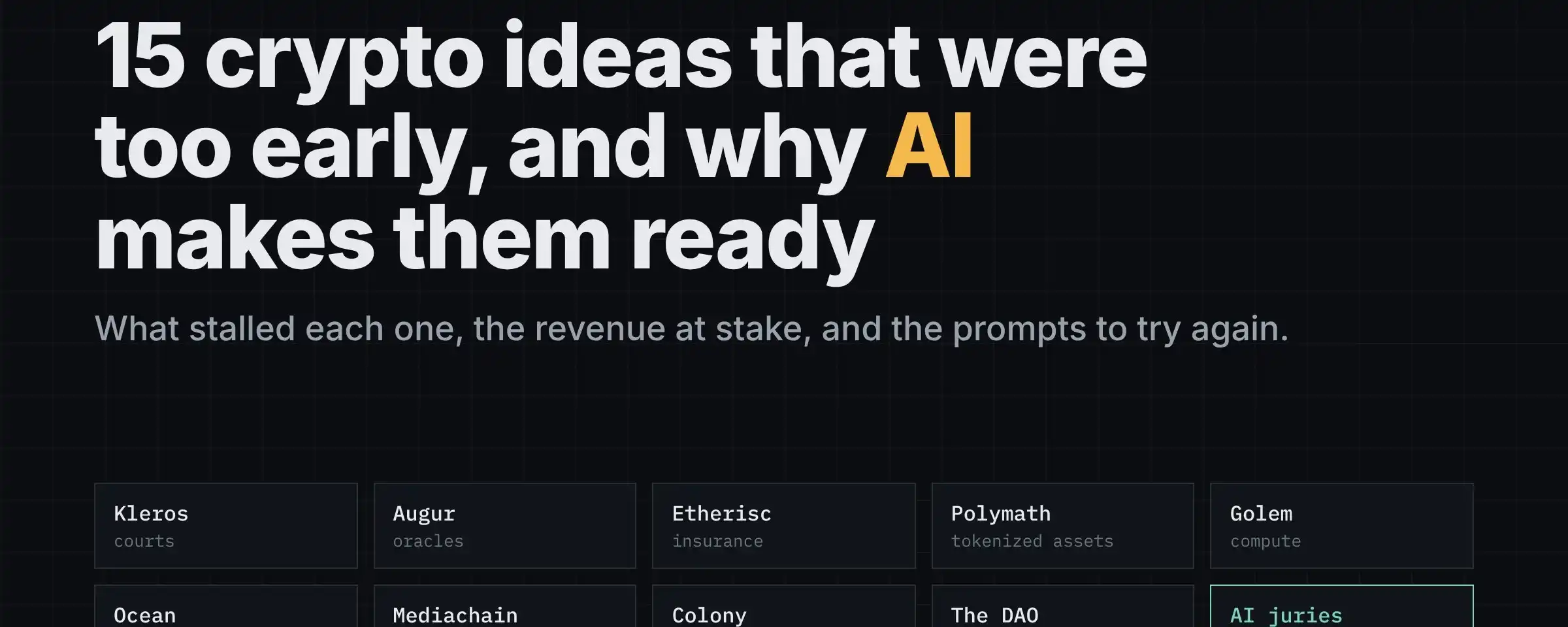
15 Crypto Ideas That Were 'Ahead of Their Time'—Why They're Worth Rebuilding in the AI Era

Between 2014 and 2019, crypto projects like Kleros, Augur, Etherisc, and Golem tried to bring commercial arbitration, prediction markets, mutual insurance, and decentralized compute on-chain, but failed because judgment of real-world outcomes depended on slow, bribe-prone human voting, governance tokens were volatile, and settlement was expensive. After 2023, three bottlenecks broke at once: multi-model AI juries cut the cost of real-world judgment to cents, AI agents became high-frequency on-chain transactors, and stablecoins (~$310B) plus sub-second chains like Solana made micro-settlement viable. The article ranks 15 ideas worth rebuilding by revenue potential and readiness: e-commerce arbitration courts, real-world prediction market oracles for questions lacking APIs, automatic-payout insurance without claims adjusters, escrowed task labor markets, data and media licensing, machine micropayments (x402), reputation-and-bond lending, proof of personhood, constitution-enforced DAOs, curated registries, content provenance, supply chain tracking, legally binding tokenized assets, compute and infrastructure markets, and IP with real legal contracts. Top candidates combine billion-dollar markets with components buildable in a quarter using existing AI models, stablecoins, and Solana. The article also provides a general validation prompt plus per-idea prompts, and warns of four risks: AI juries may share blind spots and err collectively, evidence can be forged, regulated sectors still require licenses, and real paid demand for micropayments and DePIN remains thin.

marsbit2h ago

15 Crypto Ideas That Were 'Ahead of Their Time'—Why They're Worth Rebuilding in the AI Era

marsbit2h ago

Trading

Spot

Hot Articles

How to Buy DATA

Welcome to HTX.com! We've made purchasing DATA Network (DATA) simple and convenient. Follow our step-by-step guide to embark on your crypto journey.Step 1: Create Your HTX AccountUse your email or phone number to sign up for a free account on HTX. Experience a hassle-free registration journey and unlock all features.Get My AccountStep 2: Go to Buy Crypto and Choose Your Payment MethodCredit/Debit Card: Use your Visa or Mastercard to buy DATA Network (DATA) instantly.Balance: Use funds from your HTX account balance to trade seamlessly.Third Parties: We've added popular payment methods such as Google Pay and Apple Pay to enhance convenience.P2P: Trade directly with other users on HTX.Over-the-Counter (OTC): We offer tailor-made services and competitive exchange rates for traders.Step 3: Store Your DATA Network (DATA)After purchasing your DATA Network (DATA), store it in your HTX account. Alternatively, you can send it elsewhere via blockchain transfer or use it to trade other cryptocurrencies.Step 4: Trade DATA Network (DATA)Easily trade DATA Network (DATA) on HTX's spot market. Simply access your account, select your trading pair, execute your trades, and monitor in real-time. We offer a user-friendly experience for both beginners and seasoned traders.

3.7k Total ViewsPublished 2026.07.01Updated 2026.07.01

How to Buy DATA

Discussions

Welcome to the HTX Community. Here, you can stay informed about the latest platform developments and gain access to professional market insights. Users' opinions on the price of DATA (DATA) are presented below.

活动图片