Moore Threads Plunges 20% to Limit Down in Early Trading, Company Responds

marsbitPublished on 2026-09-07Last updated on 2026-09-07

Abstract

On September 7th, China's domestic GPU maker Moore Threads' stock price hit the 20% daily limit-down during morning trading on the Sci-Tech Innovation Board (STAR Market). This marked the first such steep decline since its listing in December 2025. The immediate trigger was a large-scale unlocking of restricted shares. A total of 25.77 million IPO-related shares became tradable, representing 5.48% of the total shares and an estimated market value of approximately 13.39 billion yuan. This nearly doubled the company's tradable share count, placing significant short-term selling pressure on the market. In response, the company's securities affairs representative stated that the unlocking was a normal post-IPO event, with the shares primarily held by institutional investors from the initial offering. The company emphasized its operations remain normal with no major changes to its fundamentals, urging investors to view the price volatility rationally. Financially, Moore Threads' latest half-year report showed strong growth. Revenue for the first half of 2026 reached 1.74 billion yuan, a 147.42% year-on-year increase, surpassing its full-year 2025 revenue. While still reporting a net loss, the loss narrowed significantly compared to the same period last year. As a key player in China's domestic GPU sector, the company continues to advance its product lines for desktops and data centers. Market analysts note that while share unlockings cause short-term volatility, long-term stoc...

On September 7th, domestic GPU company Moore Threads hit the 20% limit down in early trading on the STAR Market. This marks the first time the company has experienced a 20% limit down since its listing on the STAR Market in December 2025.

As of the midday close, the company's stock price stood at 415.48 yuan, down 103.87 yuan or 20.00% from the previous trading day. Its total market capitalization fell below the 200 billion yuan mark, settling at approximately 195.3 billion yuan.
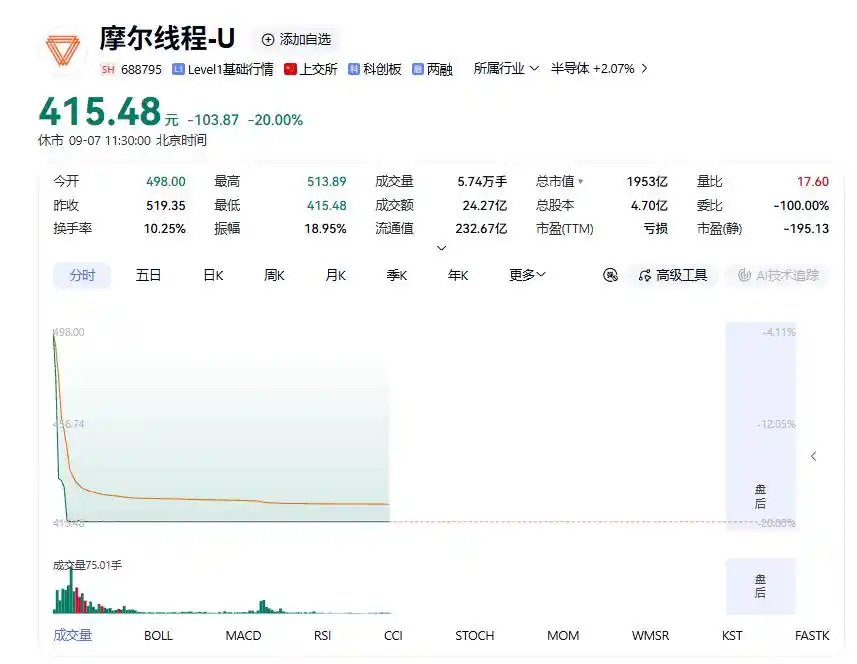
The direct trigger for this sharp stock price movement was the large-scale lifting of sales restrictions on shares. According to the company's previous announcement, on September 7th, a total of 25.7745 million shares of IPO offline placement shares became tradable upon the lifting of their sales restrictions. These shares account for 5.48% of the company's total share capital and were subject to a lock-up period of 9 months from the listing date. Based on the closing price of 519.35 yuan per share on September 4th, the market value corresponding to this batch of shares is approximately 13.386 billion yuan.

Prior to this lifting, Moore Threads had only 30.2255 million shares in public circulation. After the restriction lift, the number of publicly traded shares will increase to 56 million, nearly doubling the public float. For STAR Market stocks, which are often newly listed and have a relatively small public float, such a concentrated release of a large volume of tradable shares created significant selling pressure in the secondary market in the short term, serving as the core driver behind the stock price hitting the limit down.

From a broader market perspective, according to Wind data, a total of 16 listed companies had restricted shares becoming tradable on September 7th, with a combined volume of 521 million shares and a corresponding market value of approximately 27.785 billion yuan. Moore Threads' lifted shares were among the largest in terms of value on that day.

In response to the limit-down incident, Moore Threads quickly issued an official statement.

The company's securities affairs representative stated in an interview with the media that the day marked the lifting of restrictions on a large volume of shares from the offline placement during the IPO, which is a normal post-listing capital market event. The shares becoming tradable mainly belong to mutual fund institutions and offline investors who participated in the IPO subscription. The representative also emphasized that the company's current production and operations are normal, with no significant changes in its fundamentals. The company called on investors to rationally view the stock price fluctuations caused by the lifting and make rational investment decisions.

Other company personnel also told the media that this lifting of restrictions represents the normal expiration of the lock-up period for IPO shares, and the market does not need to overinterpret it.

From an operational perspective, the company's latest interim report data supports the assessment of stable fundamentals.

In the first half of 2026, Moore Threads achieved operating revenue of 1.736 billion yuan, a significant year-on-year increase of 147.42%, with revenue scale already surpassing the full-year 2025 level. Gross profit reached 989 million yuan, up 103.78% year-on-year, indicating synchronized improvement in profitability. On the profit front, the company's net profit attributable to shareholders and net profit attributable to shareholders after deducting non-recurring items narrowed by 95.73% and 52.37% year-on-year, respectively, showing significant reduction in losses and continuous improvement in profitability.

As a core player in the domestic GPU sector, Moore Threads continues to advance its product line layout in areas such as desktop graphics cards and data center GPUs. The industry logic of import substitution remains a long-term focus for the market.

It is worth noting that this lifting of restrictions is not the largest one for Moore Threads post-listing.

According to the IPO prospectus schedule, on December 7th, 2026, the company will face an even larger wave of lifted restrictions, with 185.9064 million restricted shares becoming tradable, accounting for 39.55% of the total share capital, leading to a more substantial expansion of the public float.

Some market analysts point out that short-term stock price volatility caused by the lifting of share restrictions is a normal market phenomenon. The medium- to long-term trend of a stock ultimately depends on the company's fundamentals and industry growth logic. Future developments in domestic GPU technology iteration and commercialization progress will be the core variables affecting the company's valuation.

Source: Galaxy Business Observation

This article is from "ZAKER Finance"

Related Questions

QWhat directly triggered the 20% drop in MTT's stock price?

AThe direct trigger was the large-scale lifting of trading restrictions (解禁) on locked-up shares from the initial public offering's offline placement. Approximately 25.7745 million shares, accounting for 5.48% of the total shares, became tradable.

QAccording to the company, what is the current status of its fundamental operations?

AAccording to the company's official response, its production and operations are normal, and there have been no significant changes to its fundamentals. Its latest semi-annual report also shows a significant year-on-year increase in revenue and a notable narrowing of losses.

QWhat major shareholder event is expected for Moore Threads in December 2026?

AAccording to the company's prospectus, a much larger-scale lifting of trading restrictions on locked-up shares is expected on December 7, 2026. Approximately 185.9064 million shares, representing 39.55% of the total shares, will become tradable, significantly increasing the free float.

QHow did the lifting of trading restrictions on September 7th affect Moore Threads' free float of shares?

APrior to the lifting, Moore Threads' free float was 30.2255 million shares. After the 25.7745 million shares were added, the free float increased to approximately 56 million shares, nearly doubling in size.

QWhat are the key factors mentioned in the article that will influence Moore Threads' valuation in the long run?

AThe article states that the company's long-term valuation will ultimately depend on its fundamental performance and industry growth logic. Specifically, the progress in technological iteration and the commercial adoption of its domestic (Chinese) GPU products are highlighted as the core variables.

Related Reads

Tech Veteran: Anthropic IPO Will Be the Peak of the US AI Rally, Will "Go Big on China AI" If Conditions Allow

Veteran tech investor Jack Selby, head of Copper Sky and managing partner of Peter Thiel's family office, warns that Anthropic's planned IPO—aiming to raise up to $100 billion—could mark the peak of the AI market rally. He cautions that if the highly anticipated IPO prices well below expectations, the expiry of lock-up periods could trigger significant selling pressure and a large-scale AI market correction. Selby names SoftBank and Oracle as "canaries in the coal mine," flagging Oracle's higher debt ratio as a bigger risk, and suggests investors needing AI exposure consider Google instead. Selby also questions Anthropic's fundamentals: over 80% of its revenue is non-recurring and vulnerable to competitors closing the technology gap within six to nine months. He notes the business is extremely capital-intensive—requiring costly data, energy, data centers, and chips—and that with interest rates no longer near zero, calling it a trillion-dollar company seems far-fetched. He further highlights Chinese competition, saying DeepSeek and other Chinese AI models trail Anthropic by only about six months, posing a direct threat. Selby says he would "aggressively go long on Chinese AI" if conditions allow, arguing that Anthropic cannot claim all its business must rely on U.S. models, since most AI use cases resemble basic tool applications, leaving room for Chinese alternatives.

marsbit1h ago

Tech Veteran: Anthropic IPO Will Be the Peak of the US AI Rally, Will "Go Big on China AI" If Conditions Allow

marsbit1h ago

Grayscale's $1 Million Sponsorship Can't Save It: Why ZEC, Once Hyped as the Belle of the Ball, Crashed Again?

Grayscale announced a $1 million ecosystem sponsorship for Zcash on November 10, pledging to return all first-year management fees from its Zcash ETF (ZCSH) to network development and marketing, with the first $100,000 distributed to four nonprofit organizations. Yet the same day, ZEC plunged 11.3% to around $1,043, extending its 30-day decline to nearly 20%. After two months of hype from overseas KOLs and institutions touting ZEC as a "second spring for old coins," the token quickly turned into a slow bleed under the weight of $2.3 billion in open interest. The article argues that Wall Street's narrative halo and Grayscale's PR subsidy have been exhausted, and ZEC—lacking fundamental support—has once again become an ATM for highly leveraged speculators to cash out on good news. Grayscale's pledge, while seemingly generous, is voluntary and can be modified or terminated at any time; only $400,000 of the $1 million has actually been paid, making it more brand marketing for its own ETF than genuine ecosystem donation. The sum is negligible relative to Zcash's market cap, and the Zcash ETF has not attracted sustained institutional capital the way Bitcoin or Ethereum ETFs did. Without new external liquidity, the inflated narrative cannot hold. The core problem is market structure: ZEC perpetual futures open interest stands at roughly $2.3 billion, dominated by high-volatility leveraged gamblers. The article contends that the earlier social media hype was a precise harvest of derivatives liquidity—promoters used the "first privacy ETF" theme to lure retail into leveraged longs, then exited as open interest peaked and the sponsorship news landed. Compounding this, Zcash's privacy pool suffered a critical vulnerability about three months before the ETF listing, halving the price and shattering conservative investors' confidence despite a July fix. The piece concludes that "old coin re-hype" follows a familiar script: find a traditional-finance-approved angle, package a grand revaluation narrative, use KOLs to drive retail buying, then distribute chips at peak liquidity. Those who hyped ZEC have largely cashed out, leaving behind a broken price and $2.3 billion in unsettled leverage. Grayscale's advertising cannot save Zcash; a real revival requires far more than Wall Street's charity.

marsbit2h ago

Grayscale's $1 Million Sponsorship Can't Save It: Why ZEC, Once Hyped as the Belle of the Ball, Crashed Again?

marsbit2h ago

Trading

Spot
活动图片