Micron and SanDisk Lead the Decline, Storage Sector Continues Adjustments: What's Happening?

marsbitPublished on 2026-10-13Last updated on 2026-10-13

Abstract

U.S. and Asian memory chip stocks, led by Micron and SanDisk, are undergoing a sharp correction. Micron closed down 3.88%, nearing a technical bear market from its June high, while SanDisk fell 5.97%. The sell-off was triggered by a triple impact: South Korean markets' post-holiday catch-up decline, the early termination of Samsung and SK Hynix's massive buyback programs, and news that China's ChangXin Memory Technologies (CXMT) made a key breakthrough in its next-generation 4F² DRAM architecture, planning to launch server memory products by year-end. Despite exceptionally strong current fundamentals—exemplified by Nanya Tech's soaring Q3 results—investors are already pricing in peak earnings and focusing on longer-term risks. The core market concern is a potential supply-demand reversal around 2027-2028, driven by simultaneous capacity expansions from Chinese manufacturers and new South Korean fabs. Analysts note that while memory stocks now appear cheap as value plays, the market's growth-focused momentum has shifted, leading to concentrated selling in the sector. Key upcoming events from TSMC, ASML, and SEMICON West may provide further directional signals.

Author: Dong Jing


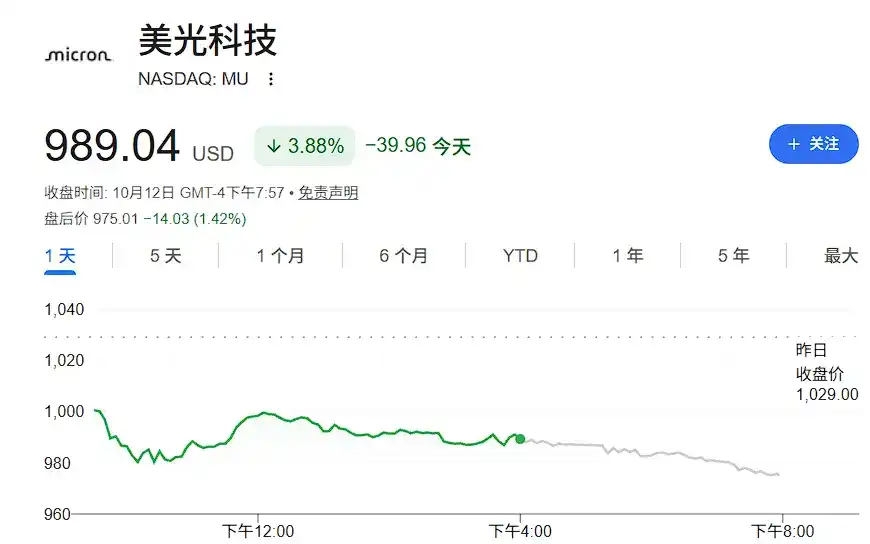
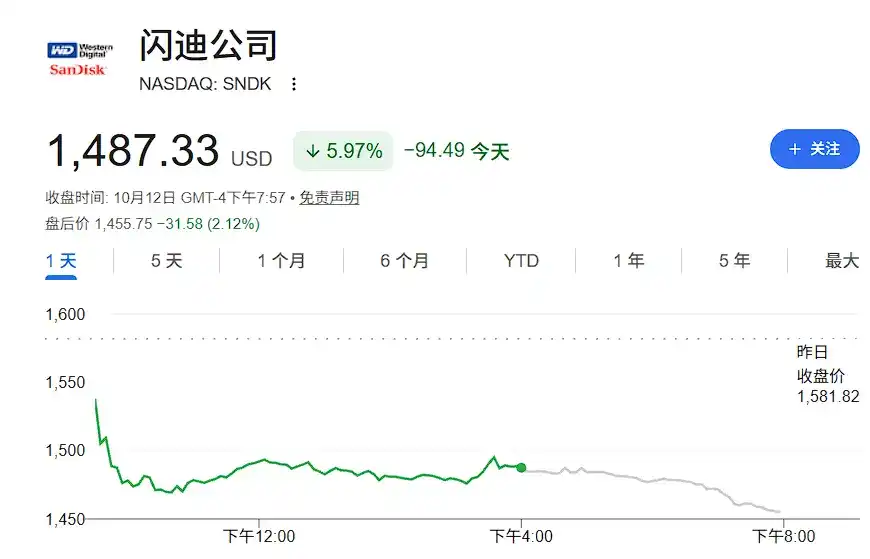
The storage sector is experiencing a concentrated sell-off triggered by multiple overlapping pressures. Micron closed down 3.88% on Monday, while SanDisk fell deeper by 5.97%. These two bellwether stocks have declined in six out of the last seven trading sessions. Micron is down nearly 20% from its June peak, approaching a technical bear market.
The trigger for this round of adjustment comes from three shocks: a catch-up decline in the South Korean market post-holiday, the early termination of the historically largest share buyback plans by Samsung and SK Hynix, and the key progress announced by Changxin Memory Technologies (CXMT) in Shanghai regarding its new 4F² DRAM architecture with plans to launch server memory products by year-end. Goldman Sachs EMEA Trading Head Rich Privorotsky summarized this situation as "storage remains the epicenter," pointing directly to the market's core concern: despite the extremely strong recent fundamentals, fears about peak earnings are suppressing valuations.

However, the market's paradox lies in the fact that the fundamentals of the storage industry have never been stronger, yet investors have already turned their gaze to 2027-2028: when the continued expansion of Chinese storage capacity and the simultaneous production of new Korean wafer fabs may reverse the supply-demand balance. As Pictet's Jon Withaar puts it, storage stocks "have become value stocks, cheaply valued based on current earnings," but "retail investors and fast-money hedge funds are chasing growth, not value."

South Korean Market Catch-up Decline, Buyback Support Disappears

The Korea Composite Stock Price Index (KOSPI) plunged 3.65% on Monday, closing at 6384.2 points, just above the 200-day moving average support at 6376 points. The tech-heavy KOSDAQ fell 4.8%, and the semiconductor index KRXSEMI dropped 5.2%. SK Hynix and Samsung each fell about 4.5%. According to Goldman Sachs' Seoul trading desk, the day's movement was "a one-way decline from the opening bell."
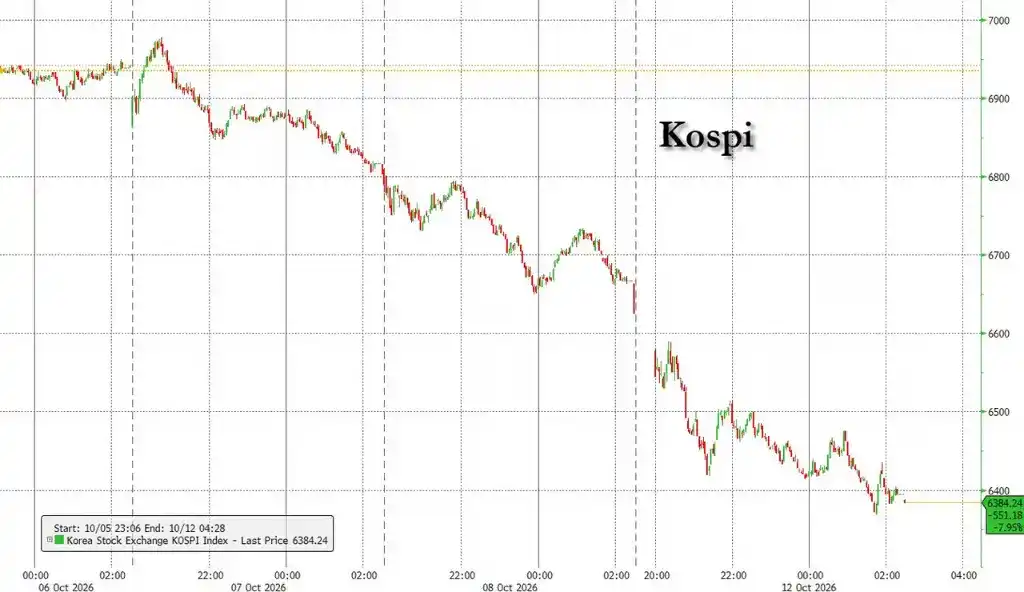
The direct cause of this catch-up decline was the South Korean market needing to digest the losses of U.S. chip stocks from the previous two trading days after being closed for the Hangul Day holiday. Foreign capital was a net seller for the fifth consecutive day, with net selling in the tech sector reaching $1.3 billion in a single day, including $782 million from SK Hynix and $415 million from Samsung. Retail investors bought on the dip, net buying $710 million in Samsung, but Goldman Sachs notes that the scale of net buying by retail investors is showing a declining trend.

A deeper structural issue is the disappearance of buyback support. As previously reported, the combined buyback plans of Samsung and SK Hynix totaling approximately 55 trillion won (about $400 billion) – the largest in South Korean history – ended weeks earlier than planned, with Samsung's buyback effectively ceasing on October 6. In the three trading days since the buyback ended, the KOSPI has fallen about 8%. The KOSPI is now down about 30% from its historical high on June 22, with SK Hynix falling even deeper by 45%.
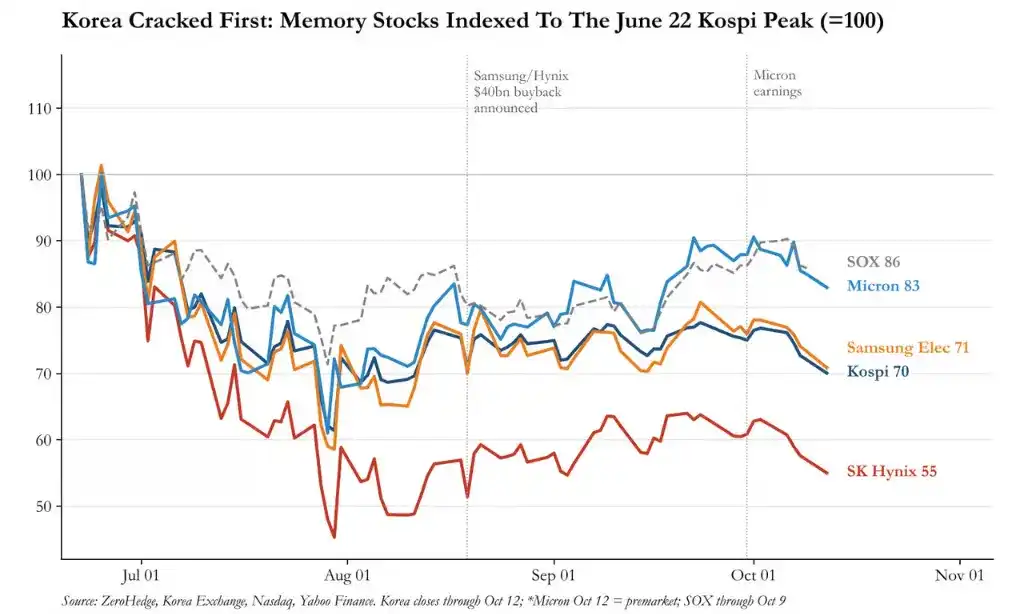
Analysis suggests that the South Korean market, which led the rally during the storage upcycle, is now breaking down first in the downcycle, potentially playing the role of a leading indicator once again.

Changxin's 4F² Breakthrough Heats Up Long-term Supply-Side Concerns

News from Shanghai over the weekend became a significant catalyst for this round of selling. According to a report by the Shanghai Securities News, at the 4th Integrated Chips and Chiplets Conference held from October 9-10, Changxin Memory Technologies (CXMT) President Cao Kanyu announced that the company had made key progress in its 4F² architecture development and officially stated it expects to launch a new generation of DDR5 RDIMM products integrating the 4F² architecture and hybrid bonding by the end of the year, directly targeting the server memory market.

The core significance of the 4F² architecture lies in its density leap. The current mainstream in the DRAM industry is the 6F² architecture, where each memory cell occupies an area six times the square of the minimum feature size. 4F² means the area per cell is reduced by about one-third, theoretically enabling about a 50% increase in storage density on the same wafer area and at the same process node. The core innovation of Changxin's 4F² architecture is its self-developed VSG (Vertical Surrounded Gate) transistor, which enhances gate control through a vertical surrounding channel structure, addressing both leakage and short-channel effects, while achieving area scaling through the transistor's vertical layout.

The transition from 6F² to 4F² is essentially a fundamental change from a horizontal to a vertical transistor channel layout, requiring integration of entirely new process flows and cannot rely on the design and manufacturing systems of the 6F² era. Changxin has also decoupled DRAM from CMOS processes, achieving high-speed interconnects through wafer-level hybrid bonding, which is seen as a key turning point for DRAM technology moving from 2D scaling to 3D integration.

It is reported that Changxin initiated 4F² research and patent layout upon its establishment, with over 300 disclosed patent families, reportedly leading peers both domestically and internationally. The company published papers related to the 4F² architecture in 2021 and continued to disclose R&D progress in 2023 and 2025. In 2025, Changxin also presented a paper at IEDM, reporting the successful experimental verification of DRAM and CMOS wafer-level bonding on a 12-inch wafer platform.

For Samsung and SK Hynix, this timeline presents direct pressure. SK Hynix only announced its 4F² roadmap in 2025. According to reports by Korean media The Elec, Samsung's target is to achieve mass production of sub-10nm DRAM based on this architecture in 2028. If Changxin successfully delivers 4F² DDR5 RDIMM products by year-end as planned, it will lead the two Korean giants by about two years at the cell architecture level.

Recent Fundamentals Strong, But Market Already Pricing the Peak

The fundamental data for the storage industry remains exceptionally strong, which is precisely the market's dilemma – the robust numbers are already fully priced in, and investors are beginning to discount longer-term risks.

Taiwan's Nanya Technology's third-quarter results were described by Goldman Sachs' Taipei trading desk as "another stunning quarter": revenue reached NT$133.6 billion, up 62% quarter-on-quarter and soaring 612% year-on-year; gross margin was 85.7%, up 6.2 percentage points quarter-on-quarter; operating profit margin was 80%; blended average selling price increased over 60% quarter-on-quarter, with more than half of the increase coming from contract resets on long-term agreements expiring in 2025. Management expects that contract prices in 2027 can still achieve double-digit increases, and maintaining a gross margin above 80% is "expected."

However, Goldman Sachs' Taipei trading desk was blunt in its commentary: "There are insufficient near-term catalysts to drive further re-rating." Samsung's near nine-fold growth in third-quarter operating profit should have restarted the storage rally, but instead triggered selling – this itself illustrates where market expectations currently stand.

Goldman Sachs Prime Book data shows that last week, the U.S. Information Technology sector abruptly shifted from being the sector with the largest net buying in four out of the previous five weeks to the sector with the largest net selling, marking the fastest selling pace in seven weeks. Technology hardware, storage & peripherals, and semiconductors were the most heavily sold sub-sectors.

The pressure on storage stocks does not come from deteriorating fundamentals, but from the market's premature pricing of the cycle peak.

Simultaneously, the market's core narrative has shifted from "how strong are the near-term fundamentals" to "what will the supply-demand landscape be like in 2028." Goldman Sachs Korea research team listed six key points for Samsung's earnings call on October 29, with the top one being: whether the company will explicitly state, like Micron, that storage supply will become tight in 2028.

Furthermore, Acer CEO Jason Chen previously stated publicly that "the supply shortage issue has completely disappeared" and expects storage prices to peak around mid-2027. Acer, HP, and Asus have already adopted Changxin chips in their PC products. ASML reportedly raised spare parts prices for Korean customers by about 10%, which Samsung and SK Hynix have accepted, effective from January 2027.

The market will also face several important milestones this week: TSMC will report earnings on Thursday, ASML will release its report on Wednesday, and SEMICON West will also be held – these events will provide new directional signals for the chip sector.


Related Questions

QWhat are the three main triggers that led to the recent sell-off in the memory stock sector, as mentioned in the article?

AThe three main triggers are: 1) A catch-up decline in the South Korean market after a holiday. 2) The early termination of Samsung and SK Hynix's massive share buyback programs, which removed a key market support. 3) Longsheng Technology's (CXMT) announcement of a key breakthrough in its next-generation 4F² DRAM architecture and its plan to launch server memory products by year-end.

QWhat is the core paradox or dilemma facing memory stocks according to the article's analysis?

AThe paradox is that the memory industry's current fundamentals are extremely strong, yet investors are already looking ahead and discounting future risks, fearing a peak in profitability. As a result, stocks are priced as value stocks despite strong earnings, but the market's speculative capital chases growth, not value.

QWhat significant technological advancement did Longsheng Technology (CXMT) announce, and why is it a concern for competitors like Samsung and SK Hynix?

ALongsheng Technology announced a key breakthrough in developing a 4F² DRAM architecture and plans to launch new DDR5 RDIMM products for the server memory market by year-end. This is a concern because the 4F² architecture reduces the cell area by about one-third compared to the mainstream 6F², theoretically boosting density by about 50%. If successful, CXMT could gain a roughly two-year lead over Samsung and SK Hynix in this fundamental architecture shift.

QAccording to the article, why did the strong third-quarter earnings of companies like Nanya Tech and Samsung fail to boost memory stock prices?

AThe strong earnings failed to boost prices because the market had already priced in the robust near-term fundamentals. The focus has shifted from 'how strong are current fundamentals' to 'what will the supply-demand landscape look like in 2028.' Investors are now preemptively pricing in the peak of the cycle and future risks of oversupply.

QWhat role did the end of share buyback programs in South Korea play in the market decline?

AThe end of Samsung and SK Hynix's combined approximately 55 trillion won (about $40 billion) buyback programs—the largest in South Korean history—removed a significant artificial support that had been propping up stock prices. The KOSPI index fell about 8% in the three trading days following the actual end of the buybacks.

Related Reads

Luxor CEO warns of AI ‘dark forest’ following Bitcoin miner hijack

Luxor, a Bitcoin mining services provider, suffered a cyberattack over the weekend in which attackers compromised its Commander mining-management platform and redirected customers' computing power to another mining pool. CEO Nick Hansen said the attack came through a "sophisticated AI-enabled vector" and warned that AI-enabled attacks on businesses, especially in crypto, are becoming more frequent and harder to defend against as models improve and more attackers enter the arena. He said Luxor paused most feature work to harden its cybersecurity and acquired GPUs to run unrestricted open-weight AI models, urging similar services to do the same, calling it "your only defense in this new AI-powered dark forest." Initial reports suggested about 64,000 mining machines representing 13 exahashes per second were redirected to the OCEAN mining pool on Saturday, though Luxor did not confirm those figures, saying just over a dozen customer accounts using Commander were affected. Luxor said it patched Commander within two hours, began restoring affected machines to their original pool settings, and pledged to fully compensate customers and publish a post-mortem. The issue was isolated to Commander, with other services including Luxor Pool and LuxOS unaffected. Initial reports suggested attackers received no mining rewards, but a Bitcoin address identified by CoreX as linked to the incident later received two OCEAN payouts totaling about 0.162 BTC, worth roughly $10,500. Hansen's warning follows other reported AI-assisted intrusions targeting crypto businesses, including India's cybersecurity agency warning that a group called Crafty Falcon used AI-powered tools to attack financial companies and crypto exchanges, Chainalysis disclosing an attacker used "offensive agentic techniques" to access its systems, and Anthropic reporting that multiple groups had developed "automated exploit foundries" with AI to accelerate vulnerability research and exploit design.

cointelegraph9m ago

Luxor CEO warns of AI ‘dark forest’ following Bitcoin miner hijack

cointelegraph9m ago

Systemic Risk Breaks Through Multiple Supports, BTC and HYPE Temporarily Flat and Observing | Guest Analyst

BTC closed the week around $74,900, effectively breaking below its 52-week moving average (~$76,100) with a 13.98% weekly loss, ending the bull-bear transition and returning the market to bearish territory. A systemic risk event drove a high-volume selloff through multiple supports, including the rising trendline (~$72,000), the 0.5 Fibonacci retracement ($72,610), and the proprietary "Trend Ribbon" zone ($72,510–73,120). On the weekly chart, a five-leg corrective structure (0-1 through 4-5) has formed since the October 2025 high of $126,200, with a descending central zone between roughly $82,850 and $60,000. Two paths are outlined: either the decline ends near $57,820–60,000 and the market ranges, or a new low forms—though momentum models suggest limited downside due to large-scale bottom divergence. On the daily chart, the proprietary "Reversal Monitoring System" has issued its fourth signal (yellow background, depth index -18 to -18.8), with the prior three signals showing roughly a 70% success rate. Key BTC support levels are $60,000–62,000, $57,820, and $54,500; resistance sits at $67,300–69,000, $72,500–73,000, and $75,500–76,000. Both mid-term and short-term strategies remain in cash. HYPE fell 8.61% weekly with 27.92% amplitude, touching $60 before closing at $68.11, just above its long-term rising trendline—the last line of defense. A long lower shadow signals buying support but does not confirm stabilization; a retest of $60 is possible. HYPE resistance is $71, $74–75, and $82.5; support is $68, $60, and $50–52. The key focus is whether the long-term trendline holds; the short-term stance is to stay in cash.

marsbit33m ago

Systemic Risk Breaks Through Multiple Supports, BTC and HYPE Temporarily Flat and Observing | Guest Analyst

marsbit33m ago

Systemic Risk Breaks Through Multiple Supports, BTC and HYPE Temporarily in Cash and Observing | Guest Analyst

Bitcoin's weekly close near $74,900 fell just below the 52-week moving average (~$76,100), ending an eight-week run above it. A systemic risk event drove a high-volume bearish candle through multiple supports (ascending trendline ~$72,000, 0.5 Fibonacci retracement at $72,610, and the "Trend Ribbon" zone of $72,510–73,120), followed by three days of sharp decline. The weekly candle dropped 13.98%, invalidating the bull-bear transition and returning the market to a bear phase. HYPE fell 8.61% for the week with 27.92% volatility, touching $60 before closing at $68.11, holding just above its long-term ascending trendline. On the weekly chart, a five-leg corrective structure (0-1 through 4-5) has formed since the October 2025 high of $126,200, with a descending central zone between ~$82,850 and ~$60,000. Two scenarios are outlined: either the decline ends near $57,820–60,000 (failed breakout, range-bound), or a new low forms with significant bottom divergence, limiting downside. The proprietary "Daily Turning Point Monitoring System" has issued its fourth signal (yellow background, depth index -18 to -18.8) near $62,000, after three prior validated turning points with roughly 70% success. Key levels: resistance at $67,300–69,000, $72,500–73,000, and $75,500–76,000; support at $60,000–62,000, $57,820, and $54,500. The recommended strategy is to stay in cash for both medium- and short-term positions until direction is confirmed. For HYPE, the long-term trendline near $68 is the last defense; a weekly close below it would end the rally from the January low of $20.14. Resistance sits at $71, $74–75, and $82.5; support at $68, $60, and $50–52. The stance is also to remain flat and watch whether the trendline holds.

Odaily星球日报43m ago

Systemic Risk Breaks Through Multiple Supports, BTC and HYPE Temporarily in Cash and Observing | Guest Analyst

Odaily星球日报43m ago

Trading

Spot
活动图片