Ledger’s early implant warnings deserved more action, Karpelès says

cointelegraphPublished on 2026-10-17Last updated on 2026-10-17

Abstract

Former Mt. Gox CEO Mark Karpelès says Ledger received multiple reports of malicious hardware implants months before its latest security crisis, but issued no public warning. Security researcher Joe Grand alerted Ledger on March 4, 2026, about an implant in a Nano X bought via Lazada Thailand in August 2025; Ledger acknowledged and investigated internally but did not proactively warn customers. Karpelès said at least two people had contacted Ledger about tampered devices since December 2025. Ledger's crisis surfaced October 9, when losses were linked to wallets sold through Southeast Asian reseller CryptoBilis; Ledger confirmed one device had an unauthorized implant. The tampered device's Lazada seller, "LedgerXXX," was not an authorized Thai reseller. OneKey's sales head Archie noted marketplaces host many independent sellers, making authorized stores hard to identify; OneKey removed reseller listings pending stricter checks. Grand also alerted Trezor in August 2026 about tampered wallets from unauthorized TikTok and Facebook sellers. Trezor said counterfeit devices occasionally appear via unauthorized sellers and treats such reports as early warnings, while its no-compromise claim applies only to authorized resellers.

French hardware wallet maker Ledger received multiple reports of malicious hardware implants months before its latest security crisis, according to Mark Karpelès, former CEO of the collapsed Bitcoin exchange Mt. Gox.

Karpelès told Cointelegraph he was aware of at least two people who contacted Ledger about tampered devices dating back to December 2025. Karpelès said he hasn’t encountered any public warning Ledger issued in response.

Joe Grand, a security researcher, told Cointelegraph he alerted Ledger on March 4, 2026, about a malicious implant in a Nano X purchased through online marketplace Lazada Thailand in August 2025.

Grand said Ledger acknowledged his findings and said it was investigating internally, but he criticized the company for not proactively warning customers about the threat.
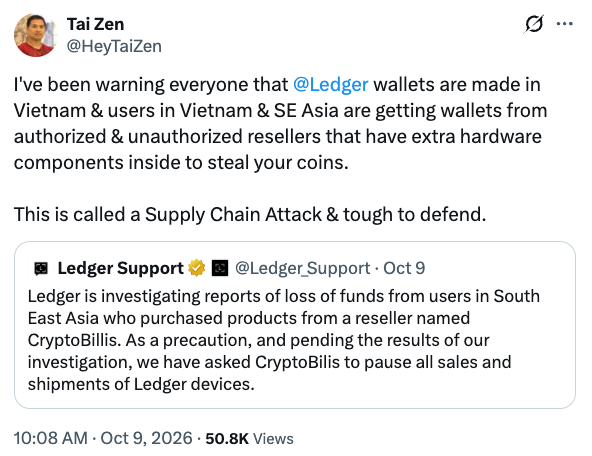
Vietnamese crypto educator Tai Zen contacted Ledger about a suspected hardware wallet implant in December 2025, according to Mark Karpelès. Source: Tai Zen

Ledger’s ongoing security crisis surfaced Oct. 9, when crypto losses were reported involving wallets sold through CryptoBilis, a reseller authorized in Southeast Asia. Ledger has confirmed that one affected device contained an unauthorized implant.

Ledger declined to comment when asked about its handling of Grand’s disclosure, and referred Cointelegraph to its public statements on X.

“Maybe Ledger not responding to a single event of an implant found on a Ledger purchased from a shady dealer is normal,” Karpelès said. He added:

However the increasing number of reports they must have received, and the increasing quality/technology used should have alerted them enough to act, and at least remind customers to be careful.”

Marketplace listings expose reseller verification gaps

In a presentation shared with Cointelegraph, Grand identified the seller of the tampered Ledger as “LedgerXXX” on Lazada. At the time of writing, LedgerXXX is not listed as an authorized reseller in Thailand, though Lazada’s Ledger storefront is.

Cointelegraph sought clarification from both Grand and Ledger on the seller’s identity and authorization status when the device was purchased.

OneKey’s head of sales, Archie, told Cointelegraph that marketplaces such as Lazada host numerous independent sellers, making it difficult for customers to distinguish authorized stores from other listings.
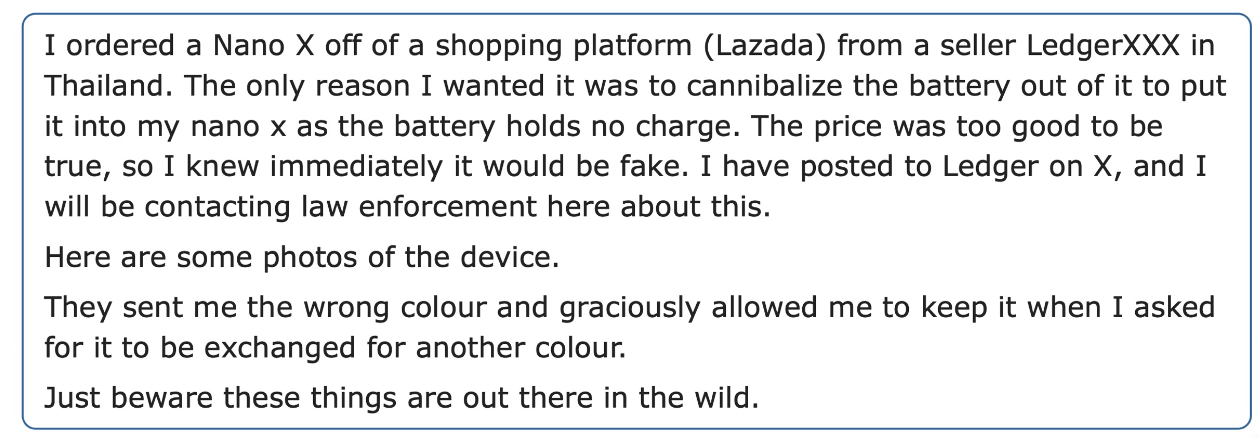
Source: Grand Idea Studio (Joe Grand)

Following the recent incidents, OneKey removed its reseller listings pending stricter checks, saying manufacturers must take responsibility for protecting customers rather than relying solely on buyers to identify trustworthy sellers.

Unauthorized wallet sales still raise security concerns

Grand’s findings were not limited to Ledger. In August 2026, he also alerted Trezor about tampered Trezor One and Model T wallets purchased from unauthorized sellers on TikTok and Facebook.

Trezor told Cointelegraph that counterfeit wallets occasionally appear through unauthorized sellers, as it had warned in 2022 about modified devices sold on Russian marketplaces. The company said that its recent claim of no evidence of compromised devices applied only to new wallets sold through authorized resellers.

Related: Trezor reduces resellers as a ‘preventative step’ amid Ledger tampering reports

Still, Trezor said it treats reports involving unauthorized sellers as early warnings and uses researchers’ findings to improve security checks.

“What changes the picture is a new technique, or a first case coming through an authorised channel,” Trezor said. “Either one means the problem has moved closer to ordinary buyers, and that’s when we’d move fastest, including warning customers directly.”

Magazine: Scammer Loses $4.8M Stored On Tampered Ledgers: Asia Express

Related Questions

QWhat did Mark Karpelès claim about Ledger's early implant warnings?

AKarpelès claimed Ledger received multiple reports of malicious hardware implants months before its latest security crisis, including at least two people contacting Ledger about tampered devices as far back as December 2025, and that he had not seen any public warning issued by Ledger in response.

QWho alerted Ledger about a malicious implant in a Nano X, and when?

ASecurity researcher Joe Grand alerted Ledger on March 4, 2026, about a malicious implant in a Nano X purchased through Lazada Thailand in August 2025.

QHow did Ledger respond to Joe Grand's disclosure according to the article?

ALedger acknowledged Grand's findings and said it was investigating internally, but Grand criticized the company for not proactively warning customers about the threat. Ledger declined to comment on its handling of Grand's disclosure and referred Cointelegraph to its public statements on X.

QWhat concerns about marketplace reseller verification gaps are highlighted in the article?

AThe article highlights that marketplaces like Lazada host numerous independent sellers, making it difficult for customers to distinguish authorized stores from other listings. Grand identified the seller of the tampered Ledger as 'LedgerXXX' on Lazada, which was not listed as an authorized reseller in Thailand at the time of writing.

QWhat did Trezor say about tampered devices from unauthorized sellers and how it handles such reports?

ATrezor said counterfeit wallets occasionally appear through unauthorized sellers, as it warned in 2022 about modified devices sold on Russian marketplaces, and that its recent claim of no evidence of compromised devices applied only to new wallets sold through authorized resellers. It also said it treats reports involving unauthorized sellers as early warnings and uses researchers' findings to improve security checks.

Related Reads

The real estate company that went bankrupt and pivoted to chips is now preparing to hand over its hotels to Huazhu?

A bankrupt Chinese property developer that pivoted to semiconductors is quietly returning to the hotel business through a joint venture with Huazhu Group. The new company, Huaying New Hotel Management (Guangzhou), was registered with 5 million yuan in capital, split 70/30 between Huazhu and Yingxin Development, formerly New Hualian Cultural Tourism. Its address matches the building housing the Guangzhou Tianhe Sports Center Mercure and Ji Hotel—both underlying assets of the recently closed Huatai Zijin Huazhu Anzhu REIT. Huazhu's former deputy CFO Ye Fei has also returned as CIO, overseeing asset securitization and real estate investment and operations. New Hualian once invested nearly 30 billion yuan in cultural tourism and operated 16 hotels with 5,339 rooms at its 2022 peak, but excessive diversification and heavy asset exposure led to a liquidity crisis. It entered judicial restructuring in 2022, completed a plan resolving 87.7 billion yuan in debt by June 2025, changed its name to Yingxin Development, shed property assets, and acquired a semiconductor packaging and testing firm. Its hotel management arm was even renamed as a semiconductor technology company in July, dropping "hotel management" from its name entirely. Several hotel assets have since been sold off or closed, including the Yinchuan Ruijing and Shanghai Sofitel, the latter failing twice at auction after its price dropped from 1.8 billion to 798 million yuan. The joint venture likely serves as a light-asset management platform to revitalize Yingxin's remaining hotel and tourism properties using Huazhu's brands, systems, supply chain, and membership channels, while preserving a path to exit via REITs. It echoes Huazhu's 2021 venture with Sunac, which took over management of 22 hotels, though Huazhu now holds a larger 70% stake and is expected to have more say. Huazhu operates 13,539 hotels across 21 countries with over 1.33 million rooms, but lacks well-located, bulk-available quality existing properties. Franchise expansion is slow and new builds are increasingly uneconomical, making aging hotels, idle offices, and scenic-area properties held by developers and local SOEs attractive targets. Huazhu has partnered with several developers and, half a year ago, agreed with Guangzhou state capital to build 300 hotels, covering asset revitalization, cultural tourism, hotel management, and securitization. Its Huazhu Anzhu REIT, the Shenzhen Stock Exchange's first hotel commercial property REIT and China's first sponsored by a private hotel group, raised about 1.1645 billion yuan. In the first half of 2026, Huazhu's management and franchise revenue exceeded 50% of total revenue for the first time, becoming its largest income source, marking its shift from heavy-asset self-operation to an asset-light model. As hotel property REITs scale up—with offerings from Huazhu, Jinjiang, New Century, and Fosun—developers burdened by high debt and low or negative operating cash flow are increasingly turning to established hotel managers. The next competitive frontier will be operating complex existing assets, matching the right operating capability to each asset type, and generating sustainable cash flow that enables exit and value appreciation.

marsbit30m ago

The real estate company that went bankrupt and pivoted to chips is now preparing to hand over its hotels to Huazhu?

marsbit30m ago

MSCI Officially Removes Strategy: Up to $2.8 Billion in Passive Selling Pressure Looms, 850,000 BTC Accumulation Flywheel Under Strain

MSCI has officially removed Strategy (MSTR) Class A shares from the MSCI US Index as part of its November index review, based on data as of the October 20 price cutoff, effective after the close on November 30. Strategy also lost its seats in the MSCI Global and ACWI indices, culminating a nearly year-long review. The removal stems from MSCI's new rules on non-operating entities finalized October 15: issuers lacking substantial operating assets must pass five financial ratio screens, and failing four or more disqualifies them; existing constituents failing for two consecutive annual reporting periods are removed. Five reserve companies under observation were all dropped, including Japan's Metaplanet from the Japan Small Cap Index, the UK's Yellow Cake from the UK Small Cap Index, and Iceland's Skel and the US's Upexi from their respective indices, with Strategy accounting for over 90% of the combined affected market value. Market reaction was restrained: MSTR closed up 1.06% at $122.35 on November 11, slipping 1.51% to $120.50 after hours once the list was published. JPMorgan estimated up to $2.8 billion in passive selling, while Strategy disclosed passive MSCI-tracking funds hold about 13 million shares, roughly 3.1% of basic shares outstanding, worth about $1.59 billion at the closing price. The removal coincides with a valuation shift: as of November 8, Strategy held 850,364 BTC at a total cost of $64.16 billion, averaging $75,456 per coin, and MSTR now trades at a discount to its Bitcoin net asset value. Its premium-based share-issuance flywheel was already under pressure, and concentrated passive selling will further constrain equity refinancing. Executive Chairman Michael Saylor and CEO Phong Le have criticized the rules as discriminatory, while Metaplanet CEO Simon Gerovich said the change won't alter its accumulation plan. Mechanically, index removal only forces passive equity funds to cut MSTR holdings, not the company to sell Bitcoin; index funds must complete rebalancing by the November 30 close, and MSTR must absorb the selling during its discount period.

marsbit41m ago

MSCI Officially Removes Strategy: Up to $2.8 Billion in Passive Selling Pressure Looms, 850,000 BTC Accumulation Flywheel Under Strain

marsbit41m ago

Trading

Spot
活动图片