Justin Sun Prize’s new round honors human–AI collaboration on Erdős problems

cointelegraphPublished on 2026-10-06Last updated on 2026-10-06

Abstract

On October 5, 2026, the Justin Sun Prize announced new recipients for contributions to solving Erdős problems: independent researcher Wouter van Doorn, Ph.D. student Quanyu Tang, and researcher Yanyang Li. Their collaborative work resolved multiple long-standing mathematical questions from a catalog of over 1,200 problems. Notably, they solved Erdős Problem #650, a project that exemplified human-AI collaboration, utilizing ChatGPT for proof strategy and the Aristotle AI system to assist in formal verification with the Lean software. Van Doorn also produced computer-checkable proofs for problems #369, #457, and #469, while Tang resolved #1044 and contributed to #1196. The prize emphasizes rigorous, verifiable proof and supports advances in mathematics, formal verification, and AI-assisted discovery. Awards are distributed in cryptocurrency.

Geneva, Switzerland, October 5, 2026 — The Office of Justin Sun today announced the newest recipients of the Justin Sun Prize: independent researcher Wouter van Doorn, mathematics Ph.D. student Quanyu Tang, and mathematics researcher Yanyang Li from Nanjing’s Southeast University, recognized for contributions spanning six Erdős problems.

Wouter van Doorn is an independent number theorist who began researching mathematics as an undergraduate in 2010 and continued collaborating and publishing after leaving academia following his master’s degree. Quanyu Tang (汤泉宇) is a mathematics Ph.D. student at the University of Science and Technology of China whose research spans number theory, combinatorics and AI-assisted mathematical discovery.

Erdős problems are mathematical questions posed or popularized by Hungarian mathematician Paul Erdős about numbers, patterns and other mathematical structures. Often simple to state but difficult to solve, they have helped shape research in number theory and combinatorics, with some remaining open for decades. The Erdős catalog, compiled and maintained by Thomas Bloom, a mathematician and Royal Society University Research Fellow at the University of Manchester, has more than 1200 problems.

Van Doorn and Tang worked with Yanyang Li, from Southeast University’s School of Mathematics in Nanjing, to solve Erdős Problem #650, determining exactly how many integers can always be matched to distinct multiples within a specified interval. Van Doorn also produced computer-checkable proofs in Lean, software for verifying mathematical reasoning, for #369, concerning consecutive integers with restricted prime factors; #457, about whether a short run of consecutive integers can collectively contain every prime in a given range; and #469, concerning whether the reciprocals of a special class of numbers expressible as sums of their divisors add to a finite total.

Tang separately resolved #1044, establishing a sharp lower limit for boundary lengths of regions defined by polynomials, and contributed alongside Li to a wider team’s solution of #1196, bounding weighted sums over sets of integers in which no member divides another.

Their work on #650 offers a concrete example of how human judgment and AI can complement each other. ChatGPT helped develop the proof strategy, while Aristotle, an AI system for mathematical reasoning, repaired a gap during Lean formalization. The researchers then simplified the argument and wrote the final proofs and exposition.

“This experience taught me how public feedback can sharpen a research question, and how AI-assisted discovery can combine mathematical judgment, collaboration and rigorous verification,” Tang said.

These are the program’s first confirmed awards, recognizing both mathematical discovery and the work needed to make proofs independently checkable. Information about the Justin Sun Prize, its problem catalog and recipient contributions is available through the program’s public GitHub repository.

The prizes will be paid out in either USDT on TRON (TRC-20) or USDC on Ethereum (ERC-20) based on the recipient’s choice. For more information, please visit www.hejustinsun.com/prize.

About the Office of Justin Sun

The Office of Justin Sun supports Justin Sun’s global business, philanthropic and public initiatives across technology, blockchain, artificial intelligence, scientific research, investment, art and space exploration.

Justin Sun is the Ambassador and former Permanent Representative of Grenada to the World Trade Organization and the Founder of TRON. TRON is the leading blockchain for the stablecoin revolution, processing over $13 trillion in volume since its inception. In the world’s emerging markets, people rely on USDT on TRON to access the global financial system.

A protégé of Alibaba founder Jack Ma, Sun has been recognized internationally for his work in the digital asset industry, including a Forbes cover profile in April 2025 and multiple appearances on the Forbes 30 Under 30 list. In August 2025, he flew aboard Blue Origin’s NS-34 mission, becoming the 712th person in history to travel to space. His broader interests span technology, investment, philanthropy, art, gaming, and space exploration.

Office of Justin Sun Contact:

info@hejustinsun.com

About Justin Sun Prize

The Justin Sun Prize is an academic initiative established by Justin Sun to support advances in mathematics, formal verification, and AI-assisted scientific discovery. The prize is decentralized and built around the principle that mathematical work should be judged by the strength, rigor, and verifiability of the proof itself, not the prestige or reputation of those submitting it.

Justin Sun established the prize in his own name as a long-term commitment to return wealth created through mathematics and technology back to mathematics itself. Its legacy is intended to be defined by the body of work it recognizes and the laureates whose discoveries stand the test of time. The prize links clearly defined mathematical challenges to machine-verifiable proof. Its guiding principles are openness, public benefit and open-source access.

Visit https://www.hejustinsun.com/prize for more information.

Media contact

thejustinsunprize@hejustinsun.com
Trending Cryptos

Related Questions

QWho are the recipients of the latest round of the Justin Sun Prize and what is a key aspect of their recognized work?

AThe recipients are independent researcher Wouter van Doorn, mathematics Ph.D. student Quanyu Tang, and mathematics researcher Yanyang Li. A key aspect of their work is their contributions to solving multiple Erdős problems, with their work on problem #650 highlighting human-AI collaboration.

QWhat is an Erdős problem and who maintains a major catalog of these problems?

AErdős problems are mathematical questions posed or popularized by Hungarian mathematician Paul Erdős. They are often simple to state but difficult to solve. A major catalog of over 1200 such problems is compiled and maintained by Thomas Bloom, a mathematician and Royal Society University Research Fellow at the University of Manchester.

QIn the solution to Erdős Problem #650, what specific roles did AI tools ChatGPT and Aristotle play according to the article?

AIn the solution to Erdős Problem #650, ChatGPT helped develop the proof strategy, while the AI system Aristotle repaired a gap during the Lean formalization process. The researchers then simplified the argument and wrote the final proofs and exposition.

QWhat are the stated guiding principles of the Justin Sun Prize as described in the article?

AThe stated guiding principles of the Justin Sun Prize are openness, public benefit, and open-source access. It is built around the principle that mathematical work should be judged by the strength, rigor, and verifiability of the proof itself.

QHow are the Justin Sun Prize payments made to recipients?

AThe prize payments are made in the form of either USDT on the TRON network (TRC-20) or USDC on the Ethereum network (ERC-20), based on the recipient's choice.

Related Reads

Backed by $80 Million, Alta is Building the Infrastructure to Bring Global Banking Onchain

Alta, a financial infrastructure company building institutional-grade blockchain infrastructure for global finance, has announced $80 million in total funding, including a $47.5 million Series A led by Index Ventures with participation from GV, Blackbird Ventures, Square Peg, and Capital 49, plus $32.5 million in prior seed financing. Unlike blockchains built mainly for crypto-native applications, Alta is designed to meet the privacy, compliance, neutrality, and operational needs of regulated financial institutions while supporting transactions across assets, chains, and jurisdictions. Its architecture is built on recursive zero-knowledge cryptography, keeping balances, transactions, identities, and compliance policies private while verifying that transactions meet required rules. CEO Loong Wang said existing blockchains aren't designed for institutional privacy and compliance requirements, and Alta builds these features directly into the chain. President Catherine Porter noted that as AI agents increasingly make financial decisions and execute transactions, trust becomes even more critical. Airwallex has chosen to build on Alta, connecting its global payments infrastructure to Alta's blockchain technology, supporting stablecoin pay-ins and pay-outs plus connectivity to local fiat payment networks across 200 countries and 90 currencies. Alta's first product will help businesses manage liquidity more efficiently, reducing cash buffers tied up in prefunded accounts—an estimated $4 trillion globally—through tokenized assets, just-in-time funding, more efficient foreign exchange, and instant movement in and out of yield-bearing tokenized assets. Investors praised the founding team's deep-tech blockchain engineering, institutional go-to-market knowledge, and track record of scaling multi-billion-dollar businesses. The new funding will support continued development of Alta's blockchain infrastructure, expansion of institutional partnerships and global financial connectivity, and growth of its engineering and compliance teams.

TheNewsCrypto7h ago

Backed by $80 Million, Alta is Building the Infrastructure to Bring Global Banking Onchain

TheNewsCrypto7h ago

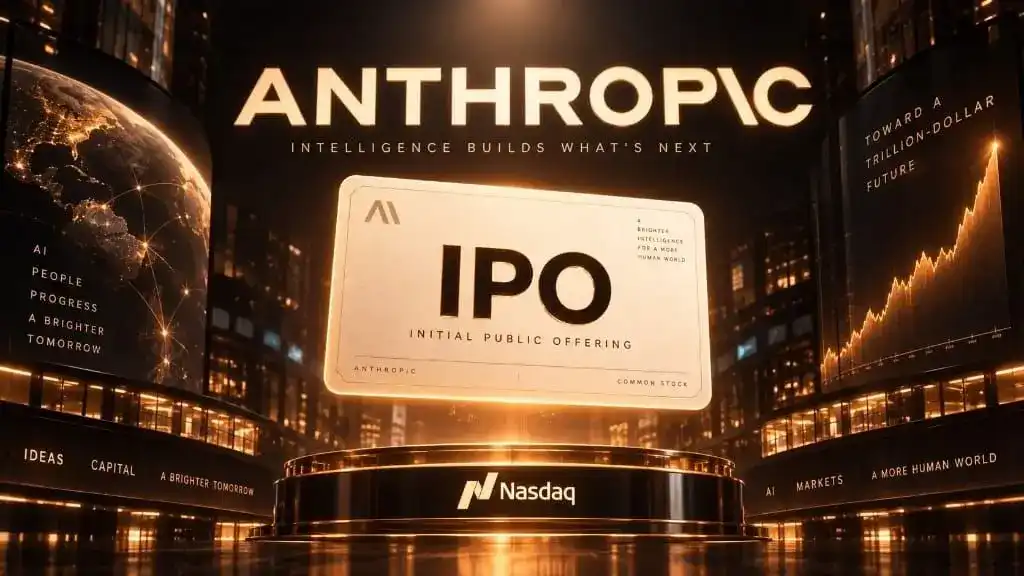
Hitting a Record for U.S. Tech IPO Fundraising, Anthropic to Raise Up to $90.4 Billion, Fully Diluted Valuation of $1.4 Trillion

Anthropic is pursuing what would be the largest tech IPO in U.S. history, targeting a fully diluted valuation of $1.4 trillion and aiming to become the first publicly listed frontier AI lab. According to its SEC filing, Anthropic seeks to raise up to $90.4 billion through an IPO and private placement—a base IPO of up to $64.4 billion plus $26 billion from seven tech giants (Alphabet, Nvidia, AMD, Broadcom, Micron, Microsoft and TSMC). Shares are priced at $70–78; at the top end the valuation is about $1.02 trillion, slightly above its $965 billion private valuation. The stock will list on Nasdaq under ANT, with Goldman Sachs and Morgan Stanley as lead underwriters, pricing on Nov 18. Including the greenshoe, proceeds could approach $100 billion, surpassing SpaceX's $86.5 billion record. The filing reveals rapid growth: Q3 revenue neared $17 billion versus $1.4 billion a year earlier, with annualized revenue around $81 billion as of Oct 31 and over 11,900 customers spending more than $100,000 annually. Profitability remains unstable—Q3 operating expenses jumped 292% to $17.5 billion, producing a $567 million operating loss after a brief Q2 profit, hit by $5 billion in short-term compute contracts and $2 billion in non-cash charitable matching costs. Price cuts trimmed Q3 revenue growth by about $600 million. Costs are enormous: total committed spending is $895 billion, mostly for compute and chips, with about $70 billion due within a year. Revenue depends almost entirely on AI services. Anthropic is embedding Claude in healthcare, life sciences, legal and accounting work, with over 90% of its codebase now contributed by Claude. It lists as a public benefit corporation with a Long-Term Benefit Trust controlling board elections, and warns AI could pose catastrophic or existential risks. Rival OpenAI targets a 2027 IPO at a $1.25 trillion valuation. Each of Anthropic's seven co-founders holds about 1.4%.

marsbit7h ago

Hitting a Record for U.S. Tech IPO Fundraising, Anthropic to Raise Up to $90.4 Billion, Fully Diluted Valuation of $1.4 Trillion

marsbit7h ago

Trading

Spot

Hot Articles

How to Buy SUN

Welcome to HTX.com! We've made purchasing SUN (SUN) simple and convenient. Follow our step-by-step guide to embark on your crypto journey.Step 1: Create Your HTX AccountUse your email or phone number to sign up for a free account on HTX. Experience a hassle-free registration journey and unlock all features.Get My AccountStep 2: Go to Buy Crypto and Choose Your Payment MethodCredit/Debit Card: Use your Visa or Mastercard to buy SUN (SUN) instantly.Balance: Use funds from your HTX account balance to trade seamlessly.Third Parties: We've added popular payment methods such as Google Pay and Apple Pay to enhance convenience.P2P: Trade directly with other users on HTX.Over-the-Counter (OTC): We offer tailor-made services and competitive exchange rates for traders.Step 3: Store Your SUN (SUN)After purchasing your SUN (SUN), store it in your HTX account. Alternatively, you can send it elsewhere via blockchain transfer or use it to trade other cryptocurrencies.Step 4: Trade SUN (SUN)Easily trade SUN (SUN) on HTX's spot market. Simply access your account, select your trading pair, execute your trades, and monitor in real-time. We offer a user-friendly experience for both beginners and seasoned traders.

10.9k Total ViewsPublished 2024.03.29Updated 2026.06.02

How to Buy SUN

Discussions

Welcome to the HTX Community. Here, you can stay informed about the latest platform developments and gain access to professional market insights. Users' opinions on the price of SUN (SUN) are presented below.

活动图片