Just Now, GPT-6 Astra Collaborates with Non-Professional Mathematicians to Prove 57-Year-Old "Circle Packing" Problem

marsbitPublished on 2026-10-12Last updated on 2026-10-12

Abstract

AI has made another breakthrough in mathematical proofs, with a mathematical enthusiast using GPT-6 Astra to significantly advance a 57-year-old geometry problem. The problem is known as "circle packing in a circle": given N unit circles, what is the smallest radius R of a larger containing circle that can hold them all without overlap? While optimal arrangements for small N have been known since 1969, providing rigorous mathematical proof of their optimality has remained a major challenge. Before this work, only cases up to N=14 and N=19 had been definitively proven. The enthusiast, known as nor, employed GPT-6 Astra to rigorously prove optimality for the remaining cases of N=15, 16, 17, 18, and 20. According to nor, the model's core strategy shifted from direct optimization to a constraint-based approach: first, establishing that outer disks can be moved to the boundary; then, using angular relations to eliminate vast numbers of potential arrangements; finally, employing computational enumeration and geometric rigidity arguments to prove that no arrangement can fit into a smaller containing circle than the known classic pattern. The proof process was iterative and complex, with nor contributing key guidance, verification, and refinement alongside the AI. The results, shared online, sparked interest from others exploring similar AI-assisted mathematical research, highlighting a growing community leveraging new tools for problem-solving. This work demonstrates the expandi...

AI is really entering a math proof sweep mode now.

Just now, a math enthusiast used GPT-6 Astra to take a major step forward on a 57-year-old math problem.

The problem sounds not very complicated:

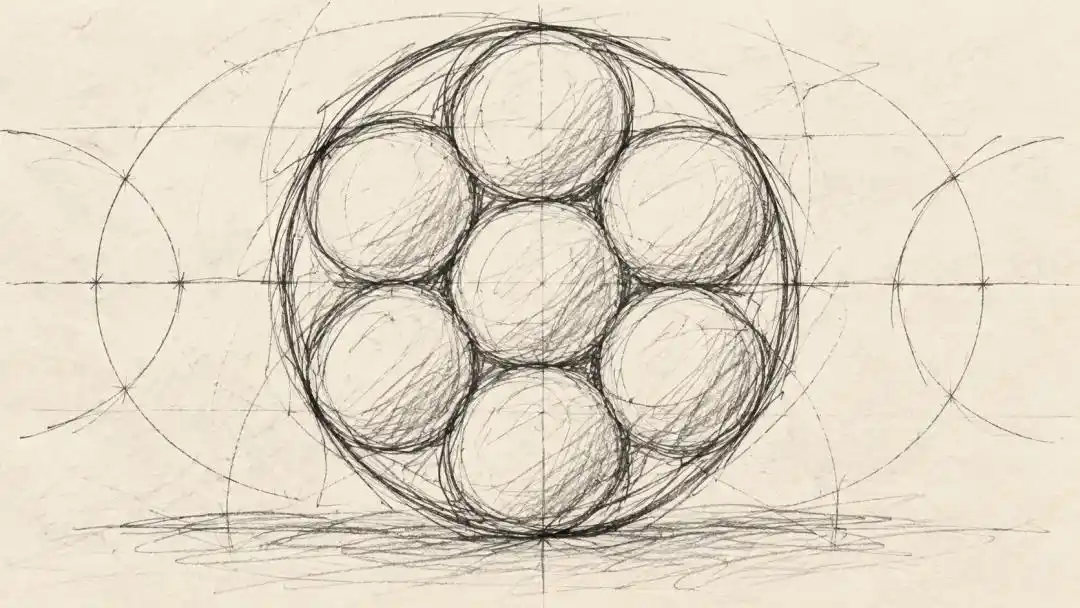
Given N disks of radius 1, how do you pack them into a large circle so that the radius of the large circle is as small as possible?
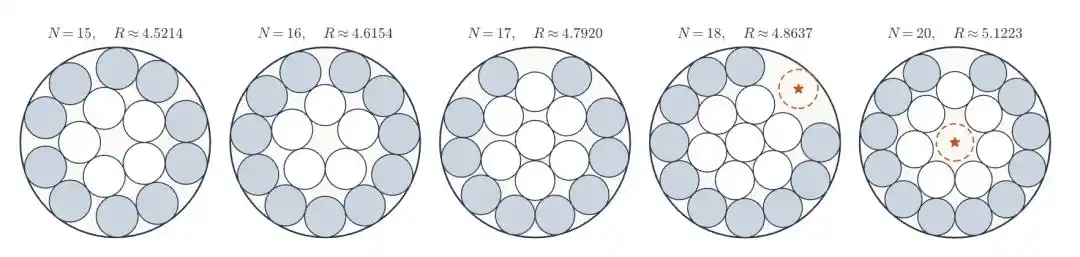
In fact, mathematicians did come up with beautiful packing arrangements back in 1969, but...... for 57 years, no one has been able to rigorously prove that they are the optimal solutions.

So this time, math enthusiast "nor" pulled out GPT-6 Astra...... and in one go, provided rigorous proofs for the 5 remaining cases for N≤20: namely N=15, 16, 17, 18, and 20......

Previously, only cases for N≤14 and N=19 had been verified.

Oh, and reaching N=20 is not the AI's limit; it's just that nor didn't intend to prove further cases......

A Proof Stalled for Half a Century

Let's first formalize this problem in a more mathematical way.

Assume there are N disks, each of radius 1, and a large circle of radius R.

Requirements:

All small disks must lie entirely inside the large circle; they can be tangent to the large circle's boundary but cannot extend beyond it.

Any two small disks cannot overlap internally, but they are allowed to be tangent to each other.

The small disks can be moved and arranged arbitrarily within the large circle, with no restrictions on the arrangement.

The question is: For a given positive integer N, what is the smallest possible radius R for the large circle?

It looks like a simple olympiad-style problem, but in reality, finding the optimal arrangement is just the first layer. The true difficulty lies in rigorously proving mathematically that the arrangement has reached its limit and that no better packing exists.

In 1968, American mathematician Ronald Graham proved the cases for N≤7.

In 1969, researcher Udo Pirl pushed the proven range to 10 disks and further studied packing schemes for 11-19 disks.

But it wasn't until around 2003 that cases for N≤14 and N=19 were rigorously proven.
nor is a technical writer who has long been involved in research on mathematics, machine learning, and optimization algorithms, and has frequently participated publicly in AI-assisted mathematics research.

He personally started following this problem over a decade ago, and indeed, there hasn't been much progress on it in the past ten-plus years......

So what else is there to say? Might as well toss it to GPT-6 Astra (bushi).

nor took a step-by-step approach: first had GPT-6 Astra handle the N=15 case; after the model solved it, he had it extend the same method to 16, 17, as well as 18 and 20...... GPT-6 Astra successfully provided proof results for all of them.

It's just that......

The proof process is, as always, obscure and difficult to understand.

Simply put, the core idea of GPT-6 Astra is:

Instead of directly searching for the optimal solution, it uses geometric constraints to reduce the infinite number of possible arrangements to a finite set of cases, then uses a computer to eliminate them one by one, ultimately rigorously proving that the classic arrangement is optimal.

The proof process consists of 5 steps:

Push outer disks towards the boundary. Proves that under specific conditions, disks near the outer circle can be pushed outward without causing overlap. This divides the disks into a group on the boundary and a group in the interior.

Use angular relations to eliminate many arrangements. Since disks cannot overlap, they must maintain a certain angular separation. If a certain arrangement requires a total angular sum exceeding 360°, it can be directly eliminated.

Let the computer enumerate remaining possibilities. Instead of searching for the specific coordinates of each disk, it checks the distance intervals of the disks from the center and their cyclic order.

Use geometric rigidity to prove precise optimality. The previous search can only prove that all feasible arrangements are very close to the known classic arrangement. Next, using contact constraints between disks, it proves that these arrangements cannot undergo permissible tiny deformations, thus elevating "very close" to "strictly identical". The case for 15 disks uses another odd-cycle argument.

Restore the original arrangement. Finally, it proves that in the original arrangement, at least one disk must be in contact with the outer circle's boundary. This means it's impossible to pack all disks into an outer circle with a smaller radius, thus completing the optimality proof.

It's worth emphasizing that it's not like nor gave a single prompt and Astra immediately proved everything in one go.

In his blog post, nor writes that his contributions as a human in this work included:

Determining problem feasibility, guiding the model, battling the buggy web user interface, enduring poor copywriting, fixing subtle issues, repeatedly refining explanations, manually verifying validity, and re-checking everything using Astra and Opus 5.5.

One More Thing

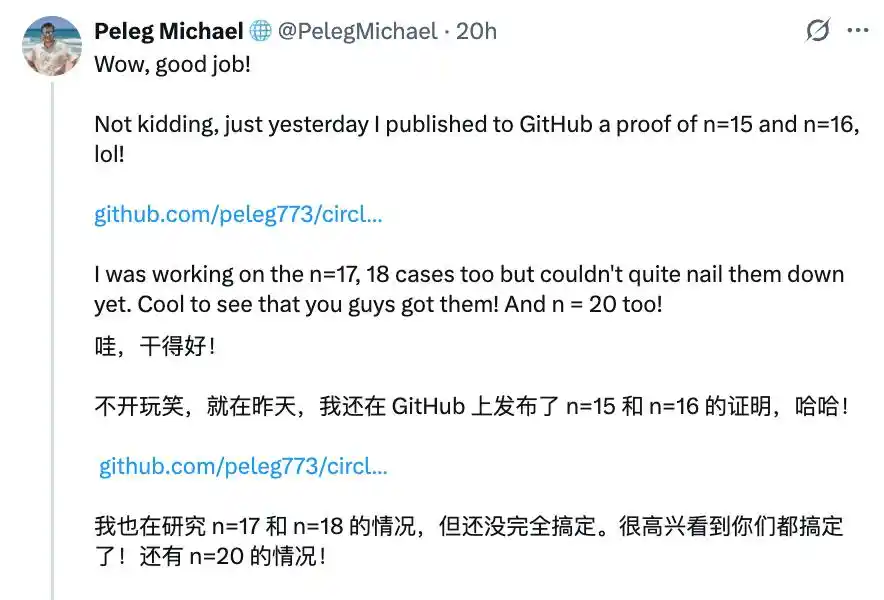
A rather interesting thing is that once nor posted the results, he found quite a few fellow travelers using AI to research the same problem.

Some netizens also commented that AI's breakthroughs are making mathematics easier to understand, "I had no idea the math community could have such a strong exploratory atmosphere."
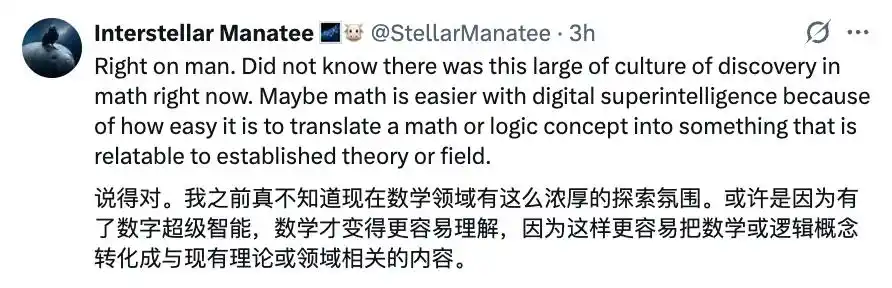
From the perspective of math enthusiasts, it's also a new phenomenon in the era of Mathematics 2.0.

Original links:

[1]https://nor-blog.pages.dev/posts/2026-10-11-circle-in-circle-packing-15-20/

[2]https://x.com/norxornor/status/2109078411251454017

This article is from the WeChat public account "QbitAI", author: Focus on Frontier Technology

Related Questions

QWhat is the main achievement described in the article regarding the use of GPT-6 Astra?

AThe article describes that a math enthusiast, using GPT-6 Astra, has successfully provided rigorous mathematical proofs for the optimal packing of N unit circles into a larger circle for the previously unproven cases of N = 15, 16, 17, 18, and 20, thereby advancing a 57-year-old mathematical problem.

QWhat is the 'circle packing' problem mentioned in the article?

AThe problem involves packing N unit circles (radius 1) into a larger circle of radius R. The goal is to find the smallest possible R such that all small circles lie completely inside the large circle without overlapping each other, though they can be tangent. The challenge is not only to find good arrangements but to mathematically prove they are optimal.

QWhat was the state of the problem before this AI-assisted proof?

ABefore this work, rigorous proofs existed only for N ≤ 14 and N = 19. The optimal arrangements for N = 15, 16, 17, 18, and 20, though conjectured, had not been formally proven to be the best possible for over five decades.

QWhat core strategy did GPT-6 Astra employ in its proof, according to the article?

AThe core strategy was to avoid a direct search for the optimal solution. Instead, GPT-6 Astra used geometric constraints to reduce the infinite set of possible arrangements to a finite number of cases. These remaining cases were then systematically eliminated using computer enumeration and geometric rigidity arguments to show the known classic arrangement must be optimal.

QWhat role did the human researcher 'nor' play in this project, as stated in the article?

AAccording to the article, 'nor' contributed by assessing the problem's feasibility, guiding the AI model, battling a buggy web interface, fixing subtle issues, repeatedly refining explanations, manually verifying the AI's output, and using both Astra and Opus 5.5 to double-check all the results.

Related Reads

CPI and AI Earnings Dominate Market Rhythm: This Week's Hot Assets Preview | WEEX VIP Weekly Report (November 2 – November 8, 2026)

The article discusses market developments for the week of November 2–8, 2026, highlighting how CPI data and AI earnings dominate market节奏. Last week, Democratic midterm election gains triggered concerns over tighter AI regulation and data center policies, causing a sharp tech selloff—the Nasdaq fell over 5% in a single day and entered technical correction. Crypto markets moved in tandem with cross-asset risk aversion: Bitcoin briefly dropped below $76,000 before showing resilience, with BTC and ETH posting weekly losses of about 4.5% and 6.5% respectively. Spot ETFs saw significant outflows, and the Fear & Greed Index stayed in "fear" territory for six days. Total crypto market cap fell from about $2.7 trillion to $2.54 trillion. In traditional markets, the 10-year Treasury yield hovered at 4.84%–4.95%, gold rebounded above $4,000, while oil plunged over 11%. Tech and semiconductor stocks were hit hard—the Philadelphia Semiconductor Index fell 12% in one day, with AMD down over 17% and Nvidia down over 9%. Defensive sectors outperformed. This week's focus is Tuesday's October CPI release, with headline CPI expected at 3.3%–3.5% and core CPI at 3.1%–3.2%. PPI, Fed speakers, and earnings from AMAT and CSCO are also key. Crypto token unlocks include RAIN (~$121 million), ALLO, JCT, and AZTEC. Investors are advised to maintain defensive positioning, reduce high-beta tech exposure, and wait for inflation data and AI earnings signals before adjusting risk allocations.

marsbit6m ago

CPI and AI Earnings Dominate Market Rhythm: This Week's Hot Assets Preview | WEEX VIP Weekly Report (November 2 – November 8, 2026)

marsbit6m ago

SEC Greenlights On-Chain US Stocks: Five-Year Regulatory Exemption, Uniswap v4 Targets $79 Trillion Market

The SEC's innovation exemption, effective September 17, 2026, creates a new category called Tokenized Securities Venues (TSVs), granting qualifying venues a five-year exemption from registration as exchanges or ATSs, provided they trade tokenized NMS stocks through permissioned liquidity pools on public blockchains. Liquidity providers meeting the order's conditions would also avoid dealer registration. Over $20 billion in tokenized stocks has already traded on Uniswap, and the US equity market represents $79 trillion. AMMs automate much of the work of professional market makers, letting anyone supply liquidity via smart contracts, broadening participation and competition. Pools run 24/7, support trading pairs beyond USD (e.g., NVIDIA paired with tokenized S&P 500 funds), and reach global distribution through thousands of frontends. On TSVs, trading and settlement occur atomically on-chain without a central counterparty, and listed companies must receive 30-day notice with an opportunity to object. To meet compliance requirements such as fee disclosure, access controls, listing and volume limits, and trading halts, Uniswap v4 hooks—especially Permissioned Pools—provide the infrastructure. Uniswap has processed over $4.5 trillion across 30+ chains without core contract exploits. Uniswap Labs invites TSV operators, asset issuers, and LPs to collaborate, while noting it does not operate any TSV and that the exemption is temporary and conditional.

marsbit16m ago

SEC Greenlights On-Chain US Stocks: Five-Year Regulatory Exemption, Uniswap v4 Targets $79 Trillion Market

marsbit16m ago

Polkadot’s first batch of parachain champions can’t hold on either: Acala and Karura plan to halt their chains in February next year

Acala, the flagship DeFi parachain on Polkadot, has submitted governance referendum Acala #195 proposing to shut down the network, with sister chain Karura launching Karura #137 in parallel. If passed, both chains will stop producing blocks on February 10, 2027. In a letter to the community, the team said Polkadot's multi-parachain architecture has deeply fragmented ecosystem funds, leaving DeFi liquidity severely insufficient, with node and network maintenance costs persistently exceeding actual revenue. The exit of a flagship network after seven years of building and operation raises direct questions about application sustainability under the multi-chain vision. The shutdown plan sets clear cross-chain withdrawal deadlines. Holders must move DOT, KSM, and bridged assets such as USDT and USDC to other networks before February 10, 2027. Native assets ACA and KAR cannot be exported cross-chain and will remain permanently in their respective ledgers after the shutdown. Liquid staking products have staggered unbonding deadlines: Polkadot's standard unbonding takes 28 days, and LDOT bound to specific validators requires an additional 28 days, so applications must be filed by December 16, 2026; the unbonding deadlines for regular LDOT and LKSM are January 12 and February 2, 2027, respectively. The early clearing window is driven by technical security concerns: after the shutdown, network code and historical state ledgers will be public, and any third party could recompile and restart the chain. With AI-assisted code audit tools becoming widespread, legacy systems lacking ongoing maintenance are prone to exposing governance vulnerabilities, so clearing retained assets early can block potential theft of stranded funds. Looking back at Polkadot's first parachain auction in November 2021, Acala won the network's first slot, attracting over 81,000 on-chain addresses to participate in the crowdloan and locking more than 32.5 million DOT. The 96-week lease term secured shared security from the relay chain but also caused massive funds to sit idle for long periods, constraining capital turnover efficiency. Five years later, most of the first batch of winning projects have exited or stalled. Moonbeam stopped producing blocks around July 31, 2026 and migrated GLMR to Base; Parallel Finance closed its products after a security incident; Clover also left its original parachain identity, leaving only Astar still actively maintained and upgraded. The multi-chain structure and separate cross-chain wallet interactions worsen the fragmented experience, and scarce on-chain liquidity is continually diluted. Although Polkadot has now shifted to the elastic coretime model described in its Agile Coretime documentation and is advancing the parallel computing upgrade outlined in the JAM protocol gray paper, early ecosystem funds that flowed out are unlikely to return in the short term. The shutdown plan is currently at the signaling vote stage. Subsquare on-chain data shows Acala Referendum #195 has about 23.1 million ACA in favor and Karura Referendum #137 about 1.28 million KAR in favor, with zero opposing votes so far. After the signaling vote passes, the team will initiate an on-chain execution proposal to implement the shutdown. The team pledges to maintain node operation and coretime availability before the shutdown; external assets not withdrawn by the deadline will be returned to the corresponding Asset Hub addresses on a best-effort basis without a full guarantee, while treasury external assets are planned to be donated to the corresponding relay chain treasury.

marsbit31m ago

Polkadot’s first batch of parachain champions can’t hold on either: Acala and Karura plan to halt their chains in February next year

marsbit31m ago

Trading

Spot
活动图片