Just Now, Claude 5.1 Released! The World's Most Powerful Model Is Here

marsbitPublished on 2026-09-02Last updated on 2026-09-02

Abstract

Anthropic has launched two new AI models: Claude Fable 5.1 and Claude Mythos 5.1. Fable 5.1 is described as one of the most powerful publicly available models, optimized for complex reasoning, long-term tasks, and agent workflows. It offers significantly improved performance over its predecessor, Fable 5, across various benchmarks—notably more than doubling scores in scientific research agent tests. Despite these gains, costs have been reduced by lowering cache read prices by 75%, leading to an estimated 25-45% cost reduction for typical and highly agentic workloads, respectively. The model demonstrates enhanced capabilities in debugging, scientific research (e.g., protein design, processing NASA data), and business automation. Mythos 5.1 shares the same base capabilities but operates under stricter safety controls and is available only to vetted partners for higher-risk domains like advanced cybersecurity and life sciences. Both models feature improved safety mechanisms with reduced false block rates. Fable 5.1 is now accessible via Anthropic's platforms and major cloud providers, while new anti-distillation measures and invisible watermarking for EU compliance have been introduced.

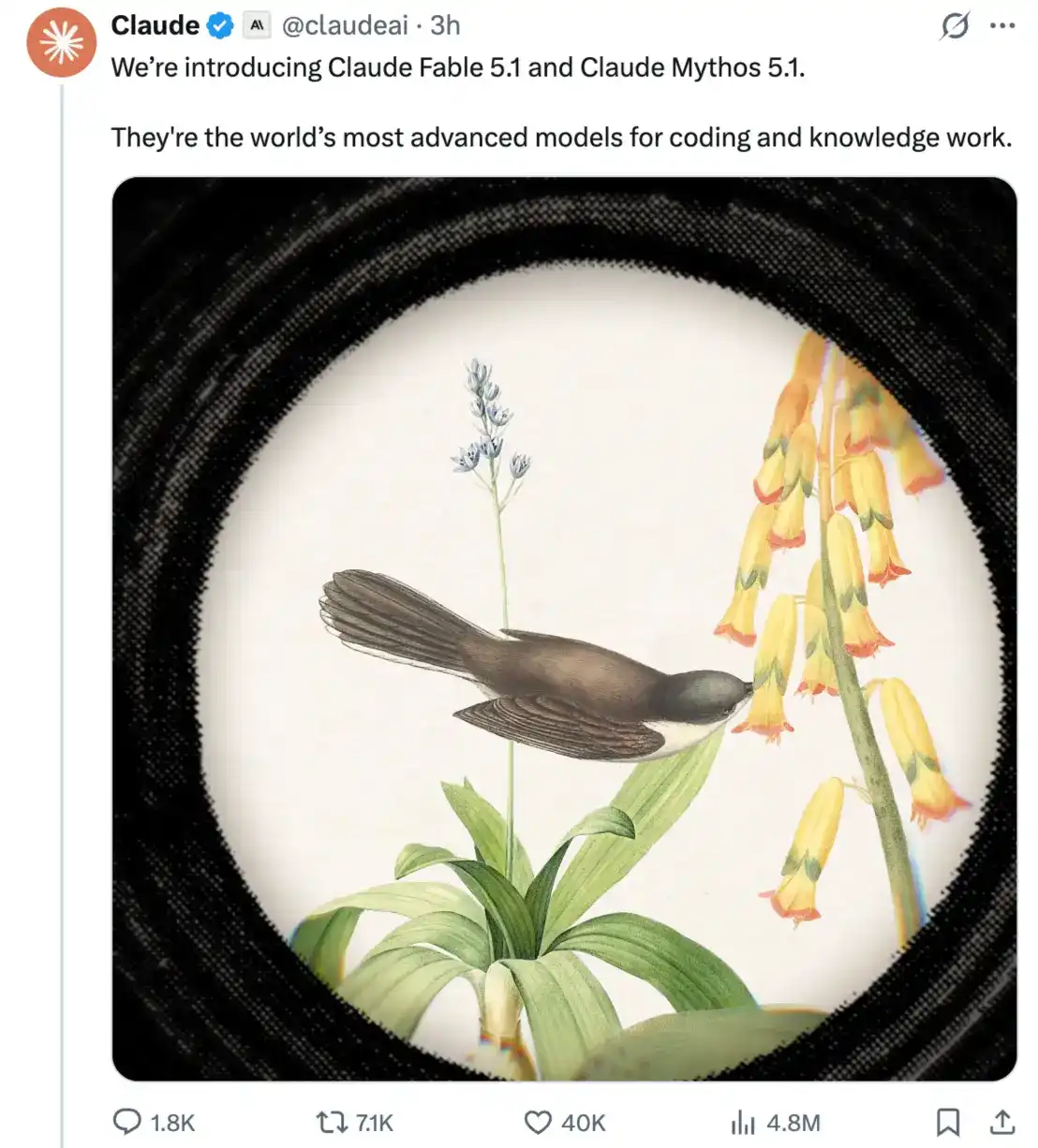
Just now, Anthropic has launched the new generation models Claude Fable 5.1 and Claude Mythos 5.1.

Anthropic claims that Claude Fable 5.1 is currently one of the most powerful publicly available models, designed for complex reasoning, long-cycle tasks, and Agent workflows. Claude Mythos 5.1, on the other hand, represents the higher boundary of their exploration.

It is important to note that while both share the same foundational model capabilities, they employ different safety measures tailored for different usage scenarios.

Fable 5.1 is open to general users, developers, and enterprises. Mythos 5.1 is available to vetted partners in high-risk fields, maintaining stricter access controls.

In other words, one is tasked with entering the real world to work, while the other is kept in a more strictly controlled environment. This might also be Anthropic's exploration of a future AI product form: the most powerful model may not be provided to everyone in the same form.

Officially, they state that these two models represent significant progress in the Claude series' capabilities and demonstrate how they continue to advance safe deployment while enhancing model performance.
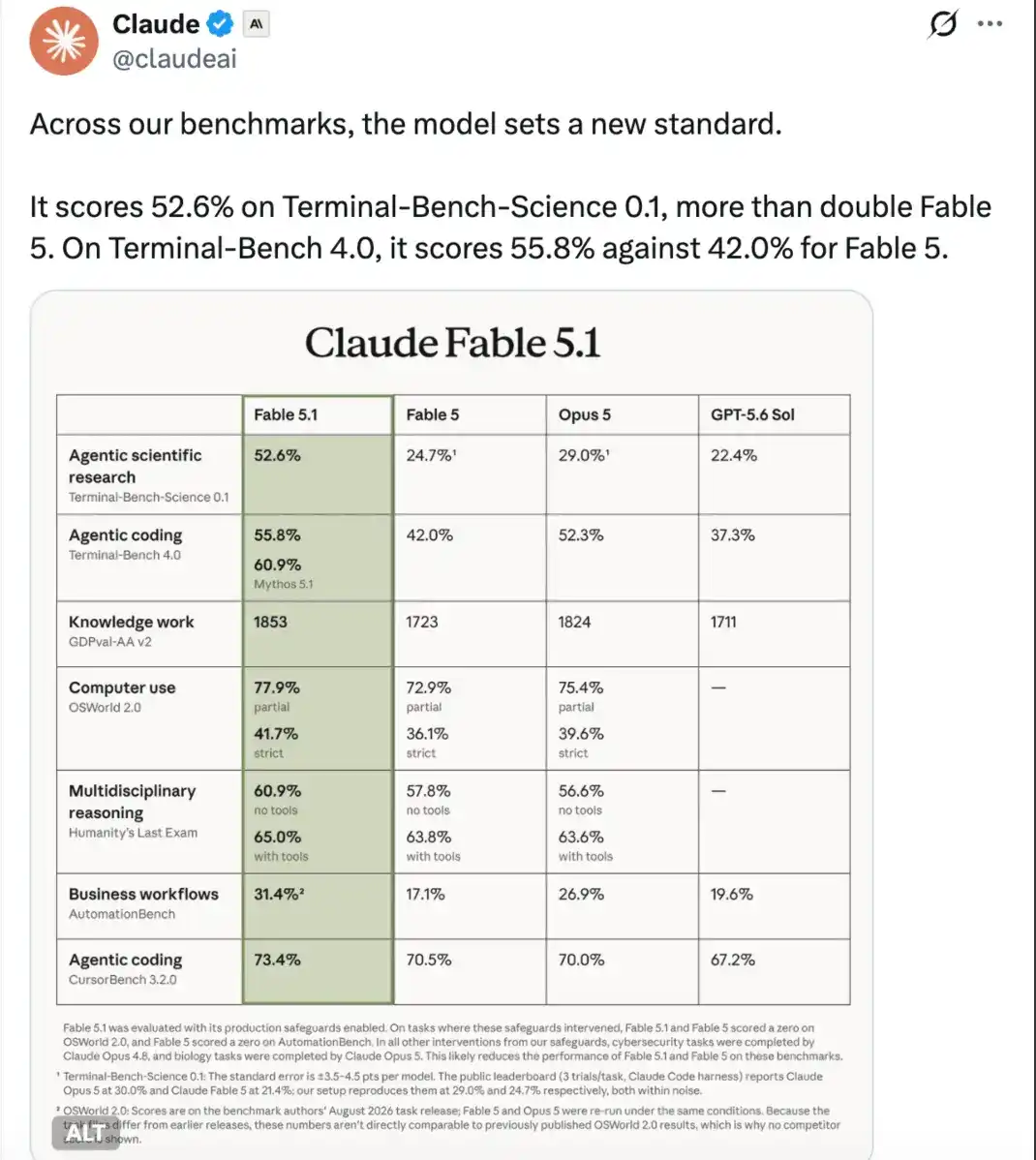
As the "world's most powerful" model, Fable 5.1's performance remains impressive. Official data shows that Fable 5.1 outperforms the previous flagship Fable 5 in multiple benchmark tests.
But with greater power comes a cheaper price. Anthropic states that Fable 5.1 maintains the same base price, while cache read costs are reduced by 75% compared to Fable 5. In practical use, this reduces the overall cost of the model by about 25% for typical workloads; for highly agentic workloads, costs can be reduced by up to 45%.
It seems even the most powerful models are now emphasizing cost-effectiveness.

Let's take a closer look.

Lower Tiers Match the Previous Generation, Fable 5.1 Focuses on "Cost-effectiveness"

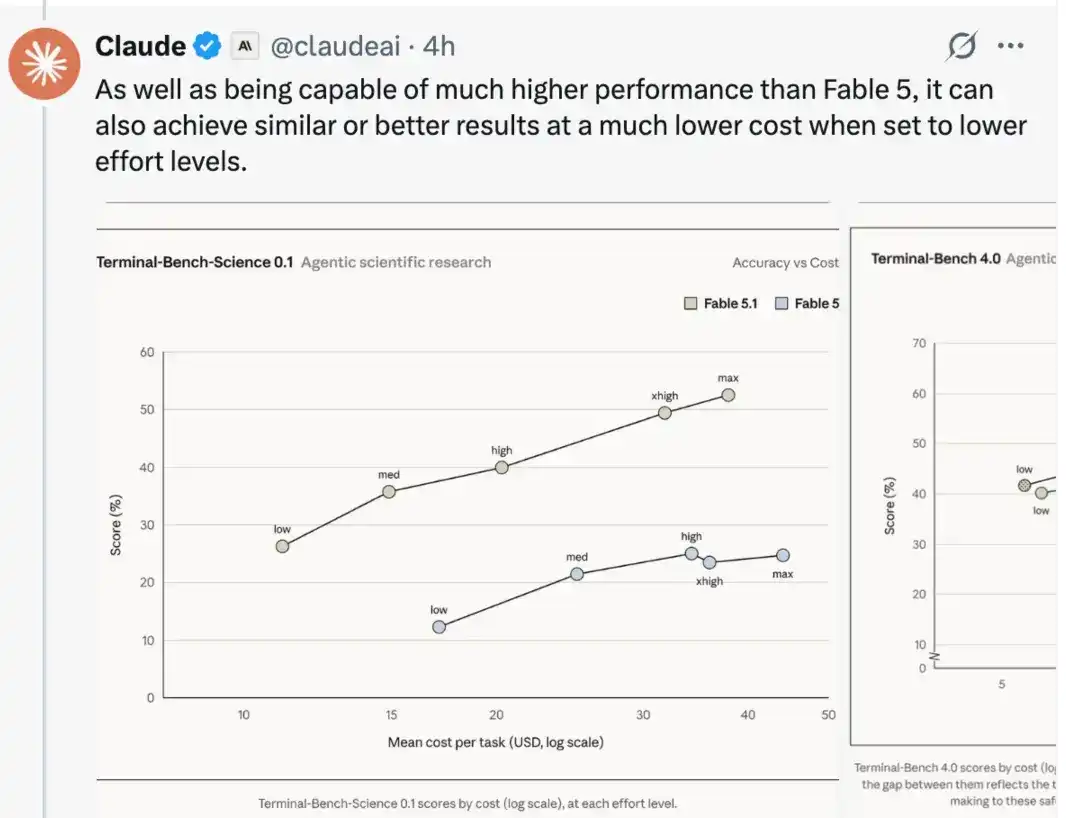
Compared to simply topping the leaderboards, Anthropic this time emphasizes more: Fable 5.1 can complete tasks that previously required Fable 5's higher inference tiers at lower inference costs.

According to official tests, Fable 5.1 at low and medium inference strengths can already achieve performance close to or even surpassing Fable 5. Claude Code defaults to high inference strength, while Claude Cowork and Claude . ai default to medium strength. Users can also adjust between speed, cost, and effectiveness based on task complexity.

Specifically, Fable 5.1 achieved 52.6% on the scientific research-oriented Agent benchmark Terminal-Bench-Science 0.1, more than double the 24.7% of Fable 5; on Terminal-Bench 4.0, Fable 5.1 reached 55.8%, and Mythos 5.1 with more capabilities unlocked further reached 60.9%.

In knowledge work, computer operations, and business process tests, the new models also show improvements. AutomationBench scores increased from 17.1% for Fable 5 to 31.4%, and CursorBench 3.2.0 improved from 70.5% to 73.4%.
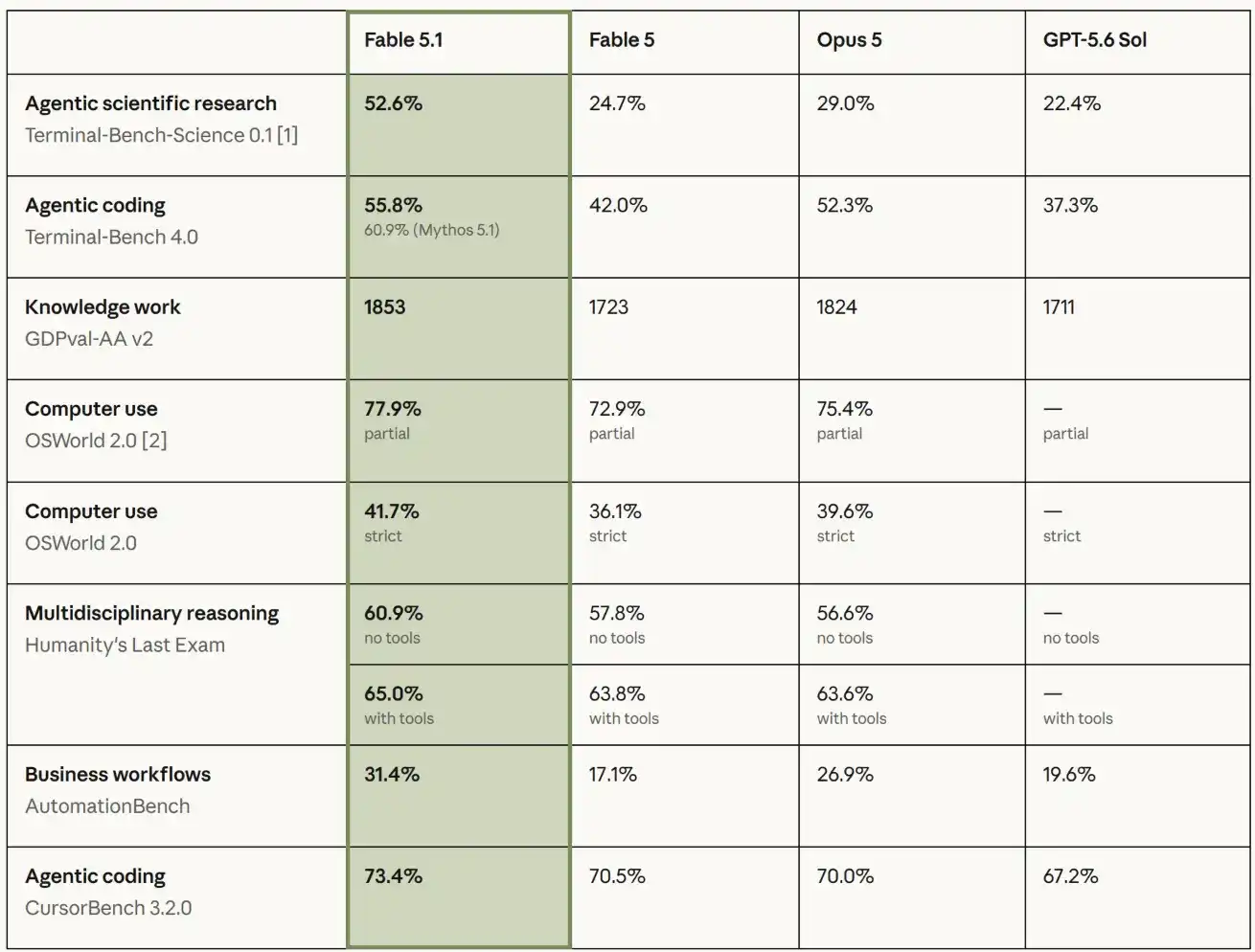
In multiple benchmark tests, Fable 5.1's scores surpassed Fable 5, with the most significant improvements in scientific research Agent and business workflow capabilities.
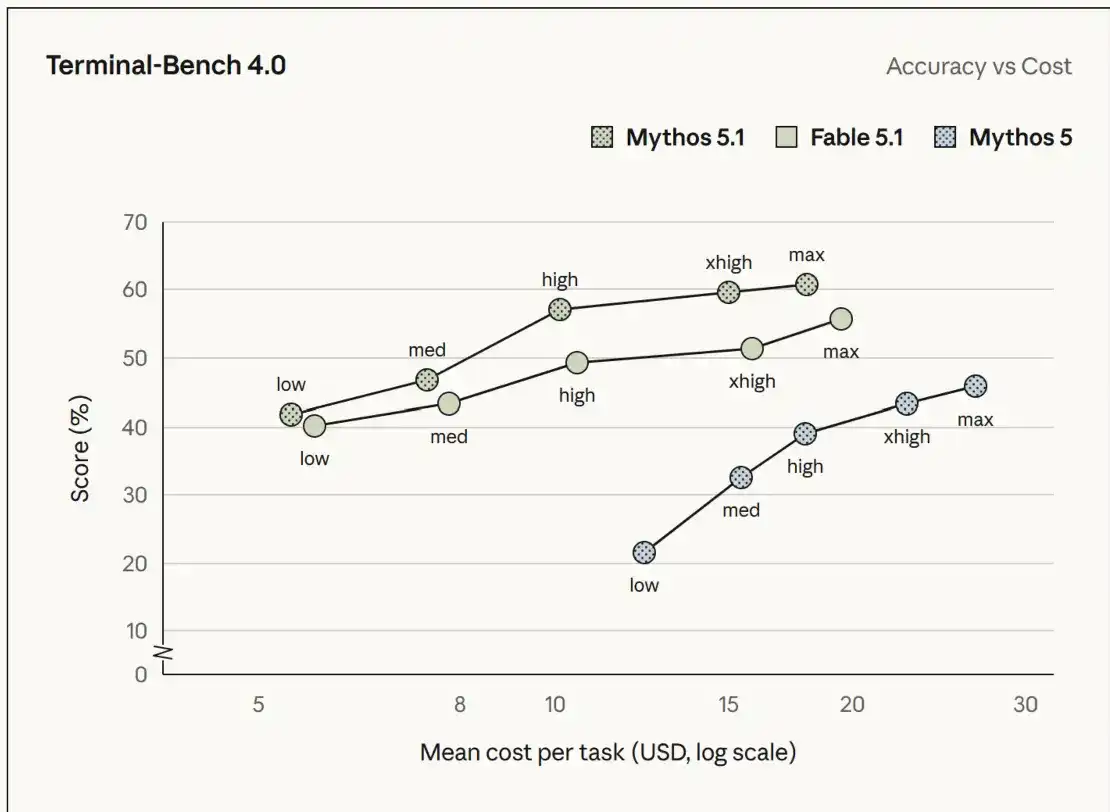
In the Terminal-Bench 4.0 test, both Fable 5.1 and Mythos 5.1 exceeded the previous generation Mythos 5 at different inference strengths.
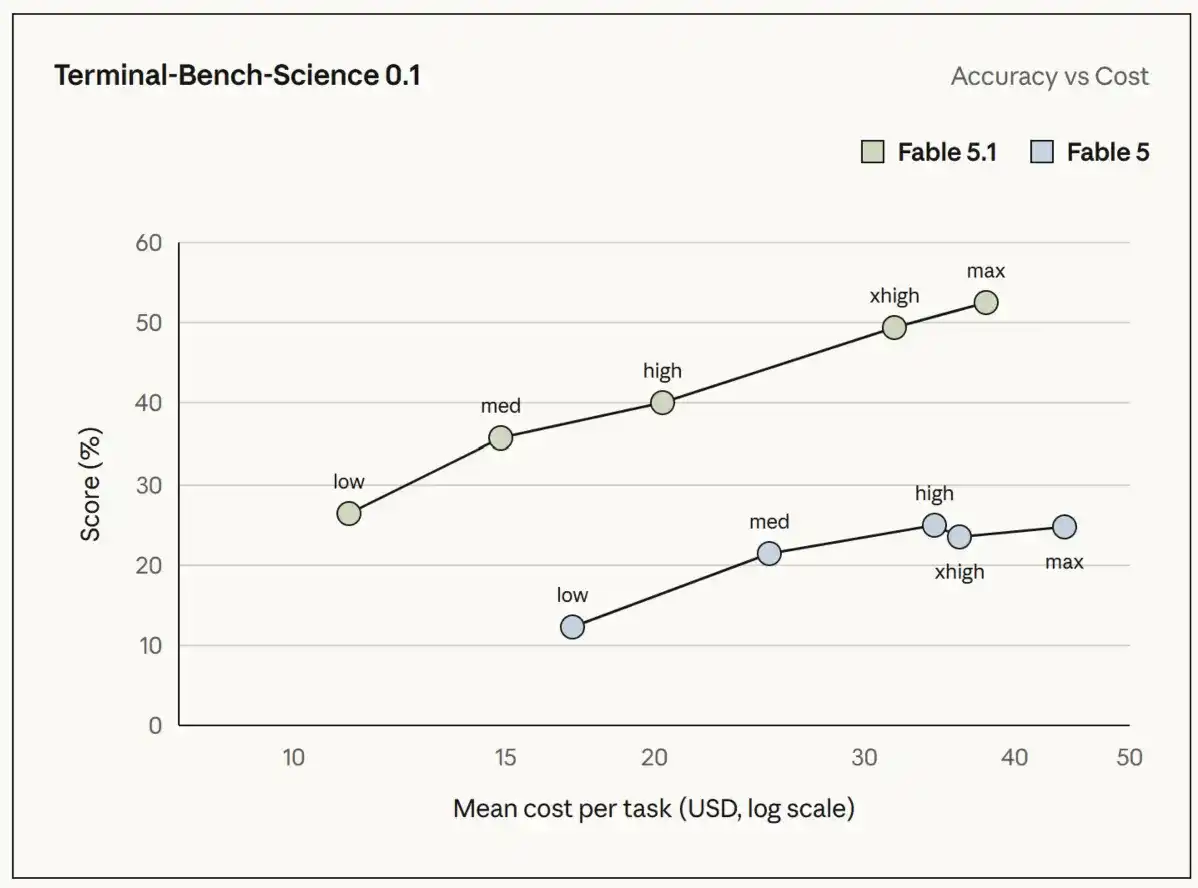
In the Terminal-Bench-Science 0.1 test, Fable 5.1's highest score reached 52.6%, more than double that of Fable 5.

Anthropic believes an important change in Fable 5.1 is its greater willingness to track the root causes of problems, making it more suitable for executing complex tasks lasting hours or even tens of hours.

Investment firm Millennium discovered during testing that an internal piece of code would crash about once every million runs. This problem had troubled the engineering team for four or five years, and other models couldn't find the cause. Fable 5.1, however, by disassembling an external vendor's library and comparing core dump files, ultimately pinpointed the issue to a bug in the third-party library.

Ramp also had Fable 5.1 run continuously for 38 hours. After discovering that original machine learning results were affected by labeling errors, the model corrected the problem, launched six sets of experiments, and finally compiled new results and follow-up recommendations.

From Writing Code to Conducting Scientific Research

In this release, Anthropic dedicates considerable space to introducing the performance of Fable 5.1 and Mythos 5.1 in scientific research.

In a protein design experiment, researchers had Mythos 5.1 call open-source protein design and folding tools, then sent the generated designs to two external institutions for experimental validation.

On three target proteins, the affinity of the binders designed by Mythos 5.1 was 10 times that of the best solutions in the Adaptyv Bio related protein design competition. When targeting 12 proteins, the model's effective binder hit rate approached 50%, while Anthropic cites the common industry level as 10% to 15%.

Fable 5.1 also used radar images collected over 30 years ago by NASA's Magellan probe to generate a new high-resolution elevation map for about one-third of Venus's surface.
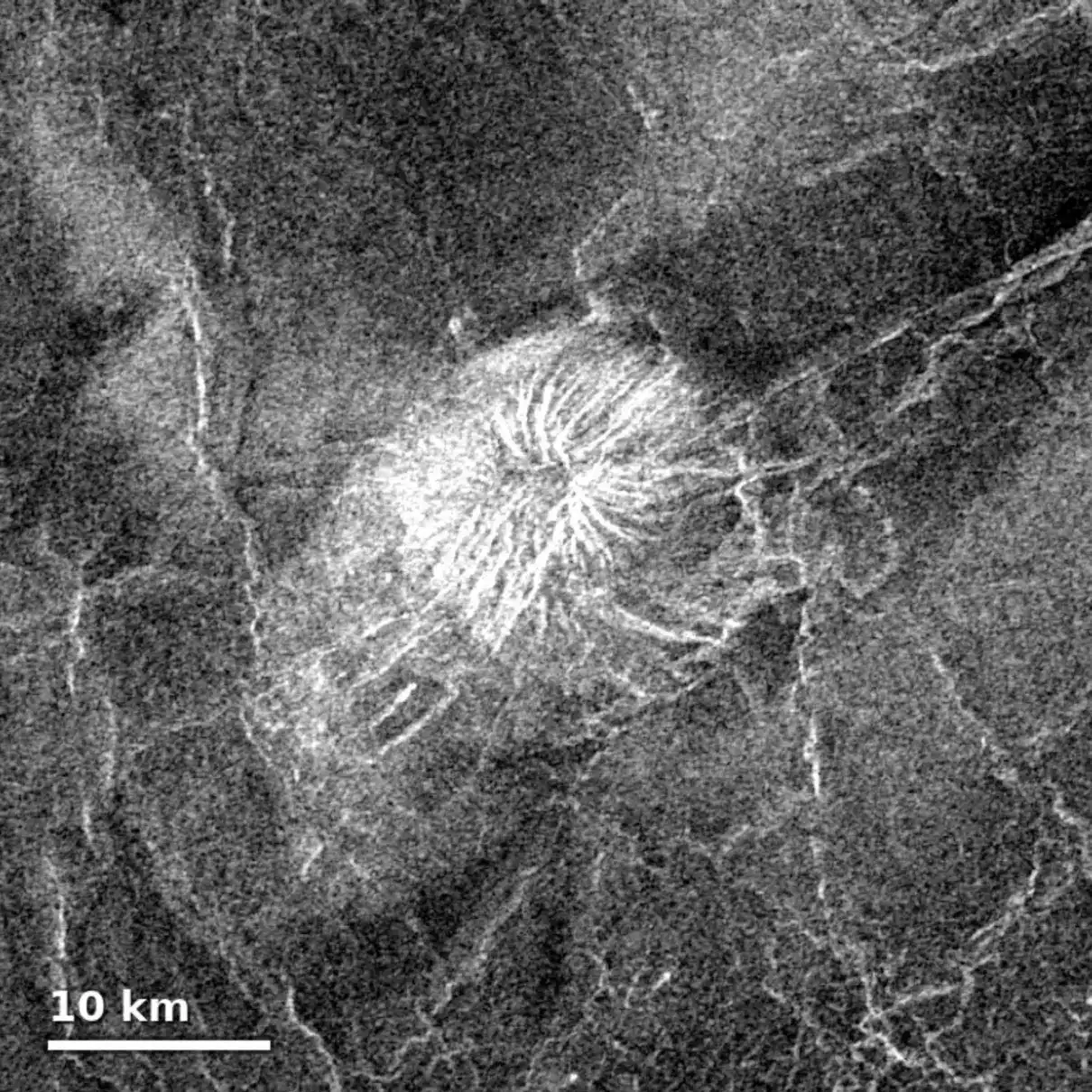
NASA Magellan probe radar image of Venus, showing a small shield volcano about 15 km in diameter at the center.

The original map could only show details at a scale of 10 to 20 kilometers. The new map improves the resolution capability to 2 to 3 kilometers, with elevation measurement accuracy improved by up to 25%. Anthropic plans to release this map under a Creative Commons license for reference by follow-up missions like NASA's VERITAS and the European Space Agency's EnVision.

In computational biology, Mythos 5.1 increased the runtime speed of 7 open-source protein and genome deep learning models by up to 2.5 times by writing custom GPU kernels and caching intermediate results, while maintaining consistent output. For some whole-genome analysis tasks, GPU costs are projected to be reduced by 30% to 60%.
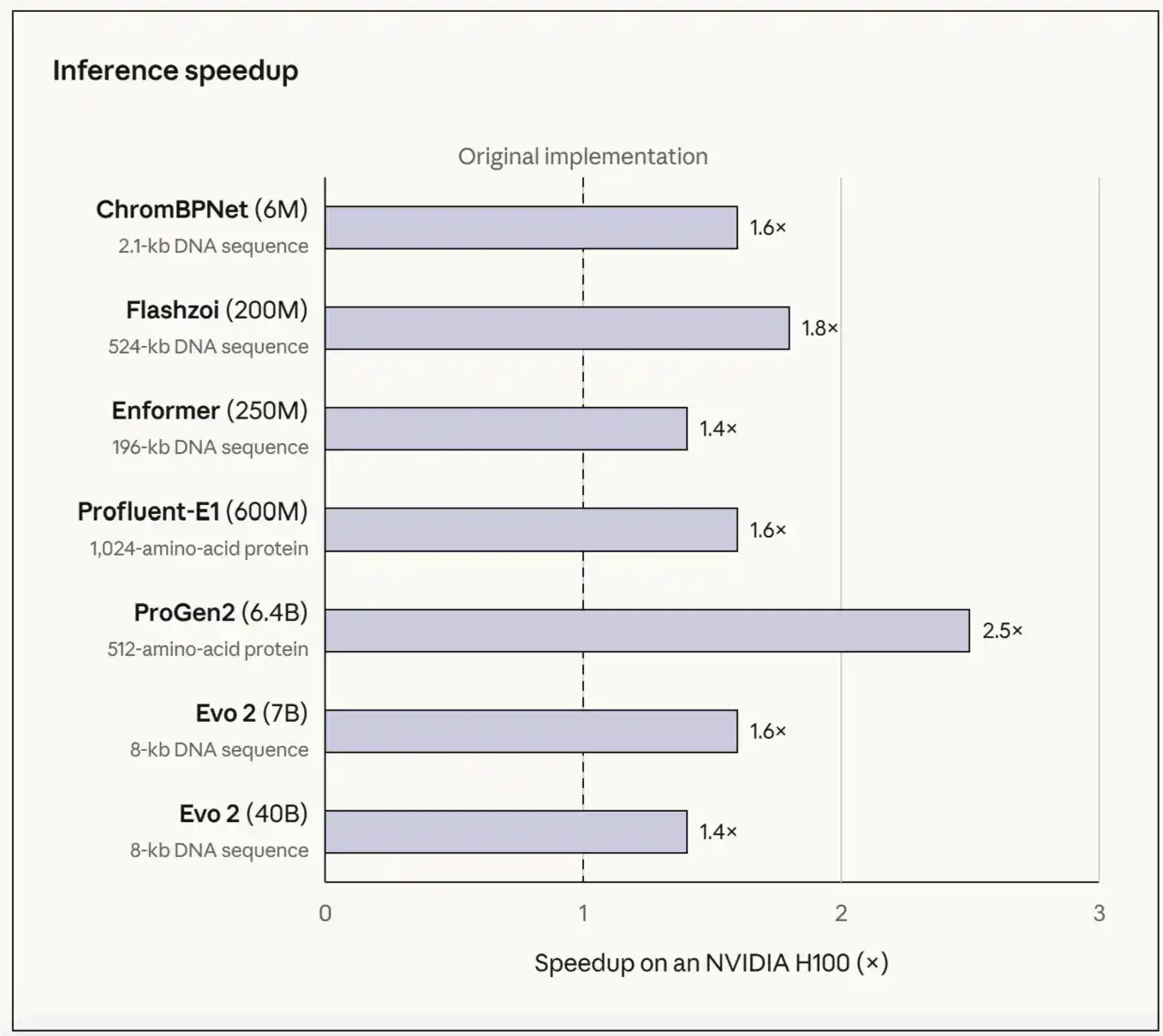
After Mythos 5.1 optimized 7 open-source protein and genome models, inference speed increased by 1.4 to 2.5 times.

Anthropic wants to use these cases to demonstrate that models are moving from organizing materials and writing code to proposing solutions, running tools, and delivering scientific results ready for experimental validation.

Cache Prices Drop 75%, Agent Tasks Up to 45% Cheaper

Beyond performance, pricing is the most direct change for Fable 5.1.

The input and output prices for Fable 5.1 remain unchanged at $10 and $50 per million tokens, respectively. However, the cache read price has been reduced by 75% from previous levels to $0.25 per million tokens.

Cache reading refers to the model reusing already processed context. Its proportion might be limited in simple Q&A, but in Agent tasks that require repeatedly reading codebases, conversation history, and tool results, cache often constitutes the main cost.

Based on Anthropic's calculations from actual usage data in August 2026, the overall cost of running typical tasks with Fable 5.1 is about 25% lower than with Fable 5; for complex Agent tasks with long contexts and frequent tool calls, the cost reduction can reach up to about 45%.
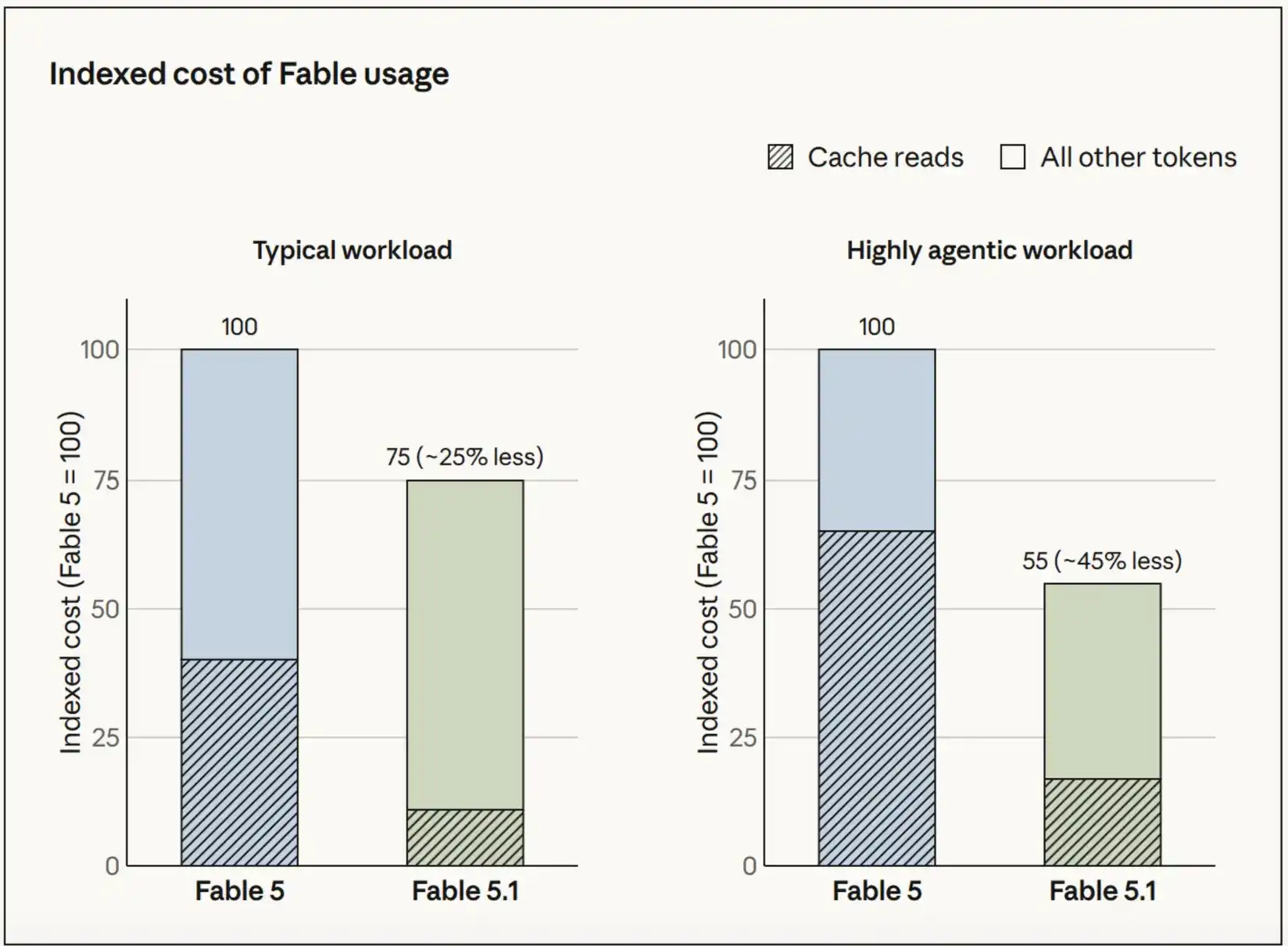
After the cache read price reduction, typical task costs for Fable 5.1 decreased by about 25%, with highly agentic task costs reduced by up to about 45%.

Fable 5.1 is now available on Claude . ai, Claude Code, and the Claude API, and is also offered through AWS, Google Cloud, and Microsoft Azure. Developers can call the new model via claude-fable-5-1.

Anti-Distillation Mechanisms Strengthened

Fable 5.1 and Mythos 5.1 actually use the same underlying model. Their main difference lies in safety restrictions.

Fable 5.1 is fully open to general users and enterprises. Mythos 5.1 has looser cybersecurity and life sciences restrictions and is currently only available to vetted individuals and institutions.

In cybersecurity, Fable 5.1 can already help users discover software vulnerabilities but still cannot directly generate exploit code. Dual-use tasks like penetration testing, exploit generation, and vulnerability scanning based on binary files may still be handed over to more restricted models.

After adjustments, the new cybersecurity protection mechanism's false positive rate is reduced by about 60% compared to Fable 5. The biosafety mechanism's false positive rate for basic biology and medical questions is also reduced by 85%, while advanced capabilities involving life sciences R&D are mainly opened through Mythos 5.1's vetting program.

Anthropic has also introduced Enterprise Frontier Safeguards. Enterprises can keep data in their own controlled cloud infrastructure, with the enterprise responsible for default human review, thereby achieving privacy effects close to "zero data retention" while retaining safety monitoring capabilities. This mechanism is planned to roll out in phases starting this fall.

For large-scale model distillation, Fable 5.1 has also added new restrictions. For API accounts created after today, it will no longer be possible to retain Claude's historical thinking records while manually modifying previous context in multi-turn conversations. Anthropic states this change primarily aims to block a publicly known capability extraction method.

Furthermore, to meet the requirements of the EU AI Act, Fable 5.1's text output will contain invisible watermarks. Anthropic has also begun small-scale testing of a detection API, initially open to regulators, media, fact-checking organizations, and research institutions.

Finally, as netizens say, the early bird gets to use 5.1.

Related Questions

QWhat are the two new models announced by Anthropic, and what are their primary purposes?

AAnthropic announced Claude Fable 5.1 and Claude Mythos 5.1. Claude Fable 5.1 is designed for complex reasoning, long-horizon tasks, and Agent workflows, and is available to general users, developers, and businesses. Claude Mythos 5.1 represents a higher capability frontier and is offered to vetted partners in higher-risk domains under stricter access controls.

QWhat are the key performance and cost improvements of Claude Fable 5.1 compared to its predecessor, Fable 5?

AClaude Fable 5.1 shows significant performance gains in benchmarks like Terminal-Bench-Science 0.1 (52.6% vs 24.7%) and Terminal-Bench 4.0 (55.8% vs lower scores for Fable 5). Crucially, while maintaining the same base price, its cache read cost is reduced by 75%, leading to an overall cost reduction of about 25% for typical workloads and up to 45% for highly agentic workloads.

QHow does the new model demonstrate capabilities in scientific research, according to the article?

AThe models show advanced scientific research capabilities. Mythos 5.1 designed protein binders with 10x higher affinity than competition winners and achieved a near 50% hit rate. Fable 5.1 created a new high-resolution elevation map of Venus from old NASA data, improving resolution from 10-20 km to 2-3 km. Mythos 5.1 also optimized seven open-source bioinformatics models, speeding them up by 1.4x to 2.5x.

QWhat are the main differences in safety and access between Claude Fable 5.1 and Claude Mythos 5.1?

ABoth models share the same base capabilities but differ in safety measures. Fable 5.1 is broadly available with standard safety restrictions. Mythos 5.1 has looser restrictions in areas like cybersecurity and life sciences, allowing tasks like exploit generation or advanced bio-research, but access is strictly controlled and granted only to vetted partners after review.

QWhat new security and compliance features are introduced with the Fable 5.1 release?

AKey new features include: 1) Enhanced anti-distillation measures preventing manual context modification in multi-turn conversations for new API accounts. 2) 'Enterprise Frontier Safeguards' for data control and near-zero data retention. 3) Reduced false positive rates for cybersecurity (by ~60%) and biosafety (by 85%) mechanisms. 4) Inclusion of invisible watermarks in text outputs for EU AI Act compliance, alongside a detection API for authorized entities.

Related Reads

Anthropic: Many Internal Products Were Never Released

Anthropic recently filed its S-1 with the SEC, highlighting strong enterprise retention and monetization as customers embed Claude into critical business processes. Dianne Na Penn, product lead for Anthropic's Research and Labs team, discussed on The Skip podcast how the research-driven company plans products. Rather than spending three months on an annual plan that becomes obsolete in two weeks, Anthropic plans monthly, grounded in high-level assumptions about the next 6–12 months, avoiding reactive feature-chasing. Claude Code emerged not suddenly but through long experimentation by API customers and internal/external users; the command-line interaction paradigm plus a harness enabling more agent loops created the real chemistry. The team debated offering a fine-tuning API but concluded core models iterate too fast—enterprises risk being two or three generations behind by the time they finish post-training and deployment. Prioritization between research and user feedback relies on ongoing discussion with research leads; PMs articulate user impact rather than dictating training parameters. Many internal prototypes are never released, serving to spark ideas or validate technology. The company focuses on To B and enterprise markets for stability. Culture emphasizes diverse backgrounds, growth mindset, extreme transparency, and first-principles thinking; employees are encouraged to question assumptions, even to senior scientists, with curiosity and mutual trust. Onboarding is intentionally intense—new PMs complete user research, evals, and roadmaps within two to three weeks—to force execution. Small teams mean each person covers multiple areas, driving cross-functional communication and rapid learning. An annual bootcamp teaches building products that ride exponential model capability gains. Anthropic also employs forward-deployed engineers to help enterprises scale deployments, and some have transitioned into PM roles, bringing deep customer context back to research and engineering teams.

marsbit10m ago

Anthropic: Many Internal Products Were Never Released

marsbit10m ago

Democrats Plan to Investigate Apple, Meta and Musk, Trump's Silicon Valley Allies Face 'Reckoning'

Democrats, after winning majorities in both chambers of Congress, are rapidly setting investigative priorities targeting Trump's Silicon Valley allies. The House is preparing to examine Trump's use of Musk's AI chatbot Grok in planning a military operation to abduct Venezuelan President Maduro; Apple and Meta are under scrutiny over an ICE tracking app and local government data center agreements, respectively. The probe scope may extend well beyond these three companies, reviewing major corporations' most controversial business activities over the past two years and their ties to the Trump administration. Since Trump's second term, tech billionaires and executives have frequently attended White House events, donated to his ballroom project, and given gifts, while companies backed by Trump family members and Wall Street executives received billions in government funding. Groundwork Collaborative labeled Big Tech, private prison operators, and natural gas firms as "high-value" targets. Even before formal investigations begin, companies are preparing: Washington law firms are holding emergency meetings to advise founders and executives on congressional inquiries, and many are seeking to become Musk's personal counsel, anticipating subpoenas and high-profile legal work. Some VCs advise startups to close financing before year-end in case executives are called to testify or Pentagon spending shifts. Incoming House Oversight Committee Chairman Robert Garcia warned companies to "hire lawyers," and Senator Ed Markey said tech executives will need plenty of paper for subpoenas. Lawyers expect Democratic control of Congress to accelerate and intensify investigations, with detailed corporate inquiries potentially more effective than letters to Trump agencies since companies are more likely to respond and disclose dealings with officials. Apple, Meta, X, and Musk did not immediately respond to requests for comment. Covington & Burling lawyer Robert Kelner said the investigative wave is all but certain: "We've been telling clients, winter is coming. Now, winter is here."

marsbit1h ago

Democrats Plan to Investigate Apple, Meta and Musk, Trump's Silicon Valley Allies Face 'Reckoning'

marsbit1h ago

Anthropic's Strongest Model 4 Revealed for the First Time: RSI Soars at 2x Speed

Anthropic's unreleased "Model 4," reportedly trained between September and October, has surfaced via a third-party METR evaluation, scoring 178.6 on Anthropic's internal Aggregate Evaluation Capability Index (AECI)—outpacing public models Opus 5.5 (174.5) and Mythos 5.1 (172.5). Model 4 passed all 15 benchmarks at above 50% accuracy, a first compared with Opus 4.6 nine months earlier; removing three flawed benchmarks would push its score to 179.7. METR's 11-week investigation of internal data concludes Anthropic's model improvement has roughly doubled, with an inflection point in October 2025: AECI growth accelerated from about 15 points per year to 29 points per year (1.9x), meaning one year now covers what previously took two. Notably, METR estimates about 80% of this acceleration stems from AI assisting its own R&D rather than increased training compute, researcher headcount, or inference scaling—Claude is effectively helping build a stronger Claude. Internal employee surveys report self-assessed productivity gains rising from 1.3–1.4x in spring 2025 to about 5x by June and roughly 12x by October with Model 4, as researchers shift from using Claude as autocomplete to orchestrating many parallel agents, cutting idea-to-experiment time by up to 80%. METR researcher Ryan Greenblatt calls the report a signal pointing toward ASI within one to two years. Roughly 100 pages were submitted to Anthropic, but much of the most sensitive evidence—including a table forecasting future model capability scores—was redacted in the public version. METR sees no obvious bottleneck in algorithms, compute, or data over the next 12 months, and no brake in sight.

marsbit1h ago

Anthropic's Strongest Model 4 Revealed for the First Time: RSI Soars at 2x Speed

marsbit1h ago

US 401(k) proposal leaves door open to altcoins, but hurdles remain

A proposed US Labor Department rule could allow smaller cryptocurrencies (altcoins) in 401(k) retirement plans, but experts say they face more hurdles than Bitcoin and Ether. The rule, now under White House final review, aims to ease offering alternative investments like crypto while giving employers and plan managers more legal protection. It doesn't specify which digital assets qualify or set a minimum market cap, but directs plan managers to weigh six factors: performance, fees, liquidity, valuation, benchmarks and complexity. Experts expect Bitcoin and Ether to be offered first given their established markets and investment products. Teresa Goody Guillén of Bellementis PLLC said altcoins aren't automatically excluded, but plan managers must show their choices are prudent, noting "big doesn't mean suitable, and small doesn't mean disqualified." Bernardo Brites of Trace Finance said most tokens fail on track record or benchmark, and the practical test is whether a plan committee can document a reliable daily price from a regulated wrapper. ETFs and managed funds will likely precede direct crypto holdings, fitting existing custody and recordkeeping systems. Brites expects some crypto options by 2027, ETFs at larger employers later that year, and wider availability by 2028, noting the rule changes legal risk, not infrastructure. Legal uncertainty remains: the proposal offers some lawsuit protection but doesn't prevent suits, and future administrations could reverse the rule, potentially making employers hesitant.

cointelegraph5h ago

US 401(k) proposal leaves door open to altcoins, but hurdles remain

cointelegraph5h ago

Russia finalizes crypto trading rules ahead of Nov. 17 rollout

Russia’s central bank has finalized rules allowing exchanges to offer Bitcoin, Ether and Tether USDt to retail investors starting Nov. 17. Non-qualified investors can buy up to 300,000 rubles (about $3,700) in crypto annually through each intermediary, including brokers, asset managers and crypto exchange providers. Qualified investors face no purchase limits, but all investors must pass a mandatory test before trading. The directive builds on legislation signed by President Vladimir Putin on Aug. 4 establishing a regulated crypto market under central bank oversight. On Aug. 11, the Bank of Russia published draft regulations identifying BTC, ETH and USDT as eligible for public trading based on market capitalization, average daily trading volume and at least five years of price history on foreign exchanges. The law took effect Sept. 1, and the Bank of Russia later authorized Sberbank, the country’s largest bank, to offer crypto exchange services in October. Moscow Exchange, Russia’s largest securities exchange and a publicly traded company, is preparing to launch crypto trading on Dec. 1, initially offering the three cryptocurrencies through pilot transactions. While expanding regulated access, Russia is also tightening restrictions outside those channels. Direct peer-to-peer crypto trading will be prohibited starting July 1, 2027, transfers from regulated digital accounts to self-custody wallets are already banned, and cryptocurrency cannot be used to pay for goods and services.

cointelegraph7h ago

Russia finalizes crypto trading rules ahead of Nov. 17 rollout

cointelegraph7h ago

Trading

Spot
活动图片