Hunter Biden denies profiting from memecoin after his LAPTOP crashes

cointelegraphPublished on 2026-09-10Last updated on 2026-09-10

Abstract

Hunter Biden denied making any profit from the "LAPTOP" memecoin after its value crashed over 95% on its first trading day, stating neither he nor his team sold tokens. He attributed the crash to insufficient liquidity and automated trading "snipers." The token's name references a laptop he left at a repair shop in 2019. The LAPTOP team defended the launch, claiming no presale or insider allocations, and announced plans to add liquidity incentives and burn tokens. Data from Nansen showed significant losses for some holders, while analytics platform Bubblemaps noted that many top holders were new wallets created around the launch.

Hunter Biden has denied profiting from his LAPTOP memecoin after its launch-day price crash, adding that neither he nor his team had sold tokens.

Several X users accused the LAPTOP project of a “rug pull” after the memecoin lost more than 95% of its value in the first hour of trading on Wednesday. At the time of writing, the new token traded at $0.8562, according to CoinGecko data.

“The team’s allocation is locked. Nobody on our side sold, and nobody could have,” Biden said in an X post Wednesday. “I, personally, have not made a single dollar.”

Biden blamed the price action on insufficient liquidity and “snipers,” which are trading bots that quickly swoop up tokens when trading opens.

The Base memecoin takes its name from a MacBook Hunter Biden reportedly left at a repair shop in 2019. Trump allies used the New York Post’s reporting on files purportedly from the device against him and his father, former US President Joe Biden, during the 2020 election.

Before launching his own memecoin, Biden slammed the Trump family’s crypto ventures. In an Aug. 21 post, Biden said World Liberty Financial used political influence and leverage to benefit its founders.

Biden did not respond to Cointelegraph’s request for comment.

Related: Joe Biden’s son to launch memecoin, will send to TRUMP holders: WSJ

LAPTOP team announces liquidity incentives and token burns

The LAPTOP team defended the launch in a community update by claiming it held no token presale and made no allocations to investors or influencers. It said the contract address, token allocations, a Hacken security audit and a white paper were published before trading began.

“There was no stealth deployment, no hidden supply, and no surprise to benefit insiders,” the team said in a Medium post.

It claimed the initial pool launched at $0.05 per token, but the market maker’s liquidity was insufficient to meet demand.

LAPTOP added it would deploy 4 million tokens, or 0.4% of the total supply, as liquidity incentives for Aerodrome pools, starting at midnight UTC on Thursday. It also announced plans to burn 10 million tokens within the first week of launch through its predictions program, equivalent to 1% of the original total supply.

Related: California Senate passes bill to ban memecoin issuance by public officials

According to the project’s disclosures, founders are allocated 300 million tokens, or 30% of the 1 billion token supply. Those tokens are locked for six months and then vest monthly over the following 24 months.

Another 30% is allocated to predictions tied to political, cultural and crypto events. Tokens are burned when specified outcomes occur and allocated to charity otherwise. The disclosures say prediction-related burns affect unvested tokens.

The disclosures reserve 2% of the total supply for wallets that lost money on the TRUMP memecoin and 8% for eligible subscribers to Biden’s “Where’s Hunter” Substack newsletter. A separate 10% is allocated to future airdrops at the foundation’s discretion.

Nansen tracks wallet losses as Bubblemaps flags fresh holders

Nansen data shared with Cointelegraph on Thursday showed one LAPTOP wallet with an unrealized loss of $117,800 and another with a paper loss of $12,300.

Two other wallets showed unrealized gains of $13,100 and $1,800. None of those four addresses had sold LAPTOP at the time of the snapshot. The analysis covered five selected wallets.

Nansen also recorded 46,675 buy transactions and 16,038 sell transactions during the 24-hour period covered by its data, involving 20,085 unique buyers and 8,714 unique sellers.

Meanwhile, blockchain analytics platform Bubblemaps said Wednesday that 60% of LAPTOP’s top-holder wallets had no prior activity.

In a follow-up post, it defined “fresh” wallets as those funded within the previous 10 days and said most had been funded on launch day.

Magazine: Is Bitcoin too volatile to risk your retirement on?

Related Questions

QWhat is the main reason Hunter Biden denies profiting from the LAPTOP memecoin?

AHunter Biden denies profiting from the LAPTOP memecoin by stating that neither he nor his team sold any tokens and that his personal allocation was locked, preventing anyone on his side from selling.

QWhat did the LAPTOP team announce to address the launch issues and improve the token's situation?

AThe LAPTOP team announced it would deploy 4 million tokens (0.4% of supply) as liquidity incentives for Aerodrome pools and burn 10 million tokens (1% of supply) within the first week through its predictions program.

QAccording to the article, what did blockchain analytics platform Bubblemaps report about LAPTOP's top-holder wallets?

ABubblemaps reported that 60% of LAPTOP's top-holder wallets had no prior activity, with most of these 'fresh' wallets being funded on the launch day.

QWhat does the project's disclosure say about the allocation of tokens for founders and for predictions?

AAccording to the disclosures, founders are allocated 300 million tokens (30% of supply), locked for six months then vested monthly over 24 months. Another 30% is allocated to predictions tied to events, where tokens are burned if outcomes occur or given to charity otherwise.

QWhat was the initial price per token for LAPTOP and what reason did the team give for the subsequent price crash?

AThe LAPTOP team claimed the initial pool launched at $0.05 per token. They blamed the price crash on insufficient liquidity from the market maker and 'snipers' (trading bots that quickly buy tokens when trading opens).

Related Reads

Changing Gas Metering Could Break Smart Contracts? Ethereum Urgently Halts Hoodi Fork to Investigate Eight Major Security Risks

Ethereum core developers have paused the Hoodi testnet upgrade after security auditors found that two upcoming Gas improvement proposals could invalidate long-standing assumptions underpinning many deployed smart contracts. The proposals, EIP-8037 and EIP-8038, part of the Glamsterdam upgrade, aim to reprice state storage by decoupling state creation from state access and setting dynamic weights for certain opcodes, in order to curb unchecked growth of Ethereum's state data. However, this overhaul disrupts static Gas constants that developers have relied on as fixed system parameters. ChainSecurity identified eight invariant risks. Many contracts and off-chain infrastructure depend on hardcoded Gas limits, for example to prevent reentrancy or bound execution scope; higher costs could cause cross-contract calls to run out of Gas and revert. Other risks lie in error-handling logic that relies on precise prediction of inner execution costs, and in proxy contracts that forward Gas based on fixed ratios, potentially distorting execution paths or locking funds in incomplete state-machine branches. To avoid systemic compatibility failures and cascading disruptions across multisig wallets, bridges, and lending protocols, developers agreed at an ACD meeting not to hard-fork Hoodi until the affected contracts are fully mapped and compatibility guidance is issued. Because much logic lives off-chain in proprietary routing, settlement scripts, and liquidation bots, the Ethereum Foundation acknowledged it cannot audit the entire ecosystem alone. It has published a public repository detailing the eight affected invariants, sample problem code, and prompt templates for audit and scanning tools, so teams can check their own logic. Findings will be reviewed at next week's ACD meeting, when Hoodi activation conditions will be reassessed.

marsbit1h ago

Changing Gas Metering Could Break Smart Contracts? Ethereum Urgently Halts Hoodi Fork to Investigate Eight Major Security Risks

marsbit1h ago

What Exactly Drives the Value of Layer 1?

This analysis by Marc Arjoon, CFA, examines what actually drives Layer 1 valuation through time-series regression on major L1 assets. Short-term, all L1 price movements remain dominated by Bitcoin beta. Over longer horizons, Ethereum's market cap has fully decoupled from its own protocol revenue—a deliberate policy outcome of Dencun and higher gas limits rather than a demand collapse—with its 2025 rally driven instead by spot ETF and corporate treasury demand. Solana, by contrast, shows revenue and market cap moving in tandem, both rising ~15x since January 2023 and peaking the same week. Active addresses and DEX volumes show weak weekly correlations and large divergences despite long-cycle drift. Testing Metcalfe's Law, the fitted elasticity of market cap to active addresses is only 0.56 for Ethereum and 0.62 for Solana and BNB—closer to the square root of addresses than the square. None of six valuation multiples reliably mean-reverts; Mcap/REV is the only one that predicts positive 13-week returns from low valuation quantiles on Ethereum and TRON. No L1 has Bitcoin's deep holder base: only 4% of Solana and 10% of Ethereum supply has been dormant over three years versus 42% for Bitcoin. Ethereum's pricing anchors to peer capital share—59% of L1 market cap, 70% of DeFi TVL, 75% of tokenized RWA—rather than on-chain activity, where it holds just 5% of active addresses. Across chains, market cap rank correlates strongly with TVL (Spearman 0.87) and stablecoin supply (0.63) but weakly with transactions (0.17). The core conclusion: L1s are valued less as fee-generating businesses and more as monetary assets competing for capital settlement and liquidity share.

marsbit1h ago

What Exactly Drives the Value of Layer 1?

marsbit1h ago

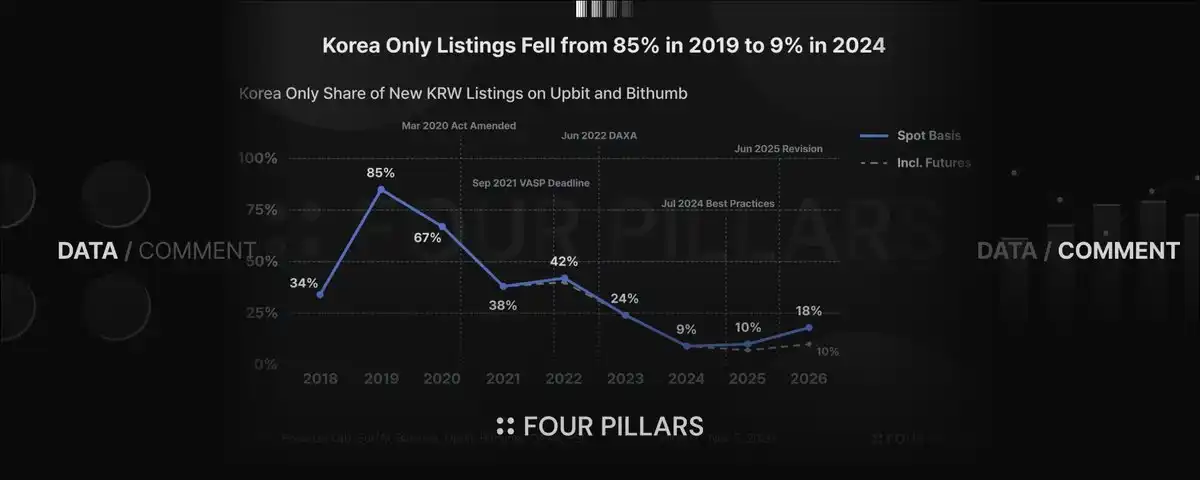
From 85% to 9%: The Dramatic Shift in Korean Exchange Listing Logic—Tokens Are Safer, but Is the Business Harder?

South Korea’s KRW crypto exchanges have fundamentally changed their listing logic. According to Bonanza Lab data across Upbit, Bithumb, Coinone, Korbit, and Gopax, the share of Korea-only token listings fell from 85% in 2019 to 9% in 2024, with a slight rebound to 18% in 2026 that drops back to about 10% when excluding assets first traded on overseas futures markets. The shift began with the 2021 Specific Financial Information Act, which required real-name bank accounts and traditional-finance-level AML compliance, and was reinforced by DAXA’s unified listing review guidelines effective July 2024, under which assets with two or more years of trading history on compliant overseas exchanges can automatically satisfy baseline disclosure and whitepaper requirements. Despite the collapse in local-first listings, total listings have grown: Upbit and Bithumb added 43 KRW-market tokens in 2022, 116 in 2023, 125 in 2024, and 238 in 2025. Listing timing remains cyclical—in the 2025 bitcoin high, 111 assets (47%) were brought to Korea within 30 days of overseas listing, while in 2026 mature assets with over a year of overseas trading became the mainstay (52 assets, 31%), including older tokens such as CRV and RSR. The consequences are clear. The share of assets hit by investment warnings or delisting within two years fell from 24% for the 2020 cohort to 10% for 2024. Among 2020–2024 listings, 44 of 148 Korea-only tokens (30%) faced warnings or delisting within two years, versus only 26 of 279 overseas-first tokens (9%). Overseas seasoning also reduces post-listing drawdowns: assets listed in Korea within 30 days of overseas launch saw a median 30-day price decline of 39%, compared with just 7% for assets with over a year of overseas trading history. The trade-off is revenue. Heavily traded overseas assets generate limited first-day speculative volume, and since Korean exchanges rely overwhelmingly on spot trading fees, weaker listing-day surges can hurt earnings. A renewed bull market could temporarily revive listings of newly launched overseas assets, but exchanges cannot build a durable, cycle-resistant business on listing structure alone. Their core challenge is to create new trading demand and diversify revenue beyond listing-driven fees.

marsbit1h ago

From 85% to 9%: The Dramatic Shift in Korean Exchange Listing Logic—Tokens Are Safer, but Is the Business Harder?

marsbit1h ago

Trading

Spot
活动图片