Goldman Sachs Analysis: Interest Rate Cuts Expected Only in the Second Half of 2027. How Long Will High Interest Rates Last?

marsbitPublished on 2026-10-15Last updated on 2026-10-15

Abstract

Goldman Sachs Analysis: Higher Interest Rates to Persist Until Late 2027 Following hotter-than-expected US inflation data, Goldman Sachs provides a baseline scenario for the Federal Reserve's path. The firm expects one more rate hike in December 2023, followed by three rate cuts starting in September 2027. A key assumption is that long-term market interest rates will decline from their current levels in the coming months. Under this projected path, higher interest rates are estimated to drag US GDP growth in 2027 by approximately 0.2 percentage points. However, the analysis warns that if interest rates remain at current levels, the growth drag could more than double. The report highlights the persistent nature of inflation pressures. While rising gasoline prices drove the September CPI increase, core CPI—excluding food and energy—remained unchanged at a 0.3% monthly increase, indicating underlying price pressures have not eased further. This suggests the Fed may need to maintain a restrictive stance for an extended period. The critical distinction for economic impact lies between the Fed's policy rate and long-term market rates. Even if the Fed stops hiking, continued high long-term borrowing costs would keep pressure on housing demand, business investment, and credit activity. Therefore, future growth pressure depends not only on the Fed's actions but also on whether market financing costs subsequently fall. Goldman's baseline scenario hinges on two conditions: 1) Core ...

Editor's Note: With US inflation heating up again, the Federal Reserve's rate hike issue has once again become the focus of market attention. Data released on October 14th showed that the US CPI rose 0.6% month-on-month and 3.7% year-on-year in September. Gasoline prices contributed more than half of the monthly increase, but even after excluding food and energy, the core CPI still rose 0.3% month-on-month, unchanged from August. Underlying price pressures have not eased further.

Inflation stickiness provides a reason for continued tightening, but high financing costs are also accumulating pressure on growth. For the market, whether there will be another rate hike is just an immediate question. The longer-term variables are how long interest rates will stay high and for how long businesses and households will have to endure high financing costs.

The baseline scenario proposed by Goldman Sachs in its macroeconomic research brief is one more Fed rate hike in December, followed by three rate cuts starting from September 2027, with long-term interest rates falling back in the coming months. Under this scenario, Goldman Sachs estimates that higher interest rates will drag down US GDP growth by about 0.2 percentage points in 2027. If interest rates remain at current levels, the drag would be more than double that figure.

This means Goldman Sachs's relatively limited judgment on the growth cost depends on subsequent interest rate declines. If inflation is slow to recede and long-term financing costs remain persistently high, what the market needs to reassess will not only be how much more the Fed will hike, but also how long the US economy can withstand.

The following is a translation of the original text:

After inflation exceeded expectations, the market is re-examining the Federal Reserve's rate hike path. But Goldman Sachs's scenario analysis pushes the question further towards the growth side: Interest rates have already risen to high levels, and how long they are maintained next may significantly alter the economic cost of tightening.

According to the provided report content, Goldman Sachs still expects the Federal Reserve to hike rates once more in December, followed by three rate cuts starting from September 2027. Meanwhile, its baseline assumption is that long-term interest rates will fall back from current levels in the coming months.

Under this path, Goldman Sachs estimates that higher interest rates will drag down US GDP growth by about 0.2 percentage points in 2027. If interest rates maintain current levels, the drag would expand to more than double the baseline estimate.

The gap between the two scenarios reveals the most important judgment of this report: Future growth pressure depends both on the Federal Reserve's next moves and on whether market financing costs can subsequently decline.

Core Inflation Has Not Cooled, Fed Still Faces Difficulty in Easing

US inflation rose in September, with energy being the main driver. Gasoline prices rose 9.1% month-on-month, pushing the overall CPI monthly increase from 0.4% in August to 0.6%.

But price pressures were not all concentrated in energy. The core CPI rose 0.3% month-on-month for two consecutive months, while housing price increases rose from 0.3% in August to 0.4%. This makes it difficult for the market to explain this inflation performance solely by gasoline price fluctuations.

For the Federal Reserve, the key is whether price increases can persist. Energy prices can quickly push up overall inflation, and their subsequent impact depends on price trends and cost transmission. Whether core inflation can steadily slow down relates to policymakers' judgment on underlying price pressures.

This data alone is insufficient to determine the subsequent policy path, but the lack of further cooling in core inflation means more evidence is needed to judge a sustained decline in inflation.

The baseline given by Goldman Sachs in the report still includes one more rate hike in December. However, the existing excerpt does not disclose the complete process of forecast adjustment, so it cannot be concluded that the bank has changed the timing or number of rate hikes because of this CPI data.

Growth Drag Could Double; Key is When Rates Fall

Goldman Sachs's growth calculation is based on a clear interest rate path: one more hike within the year, followed by a decline in long-term rates, and the start of rate cuts in late 2027.

This means its estimated 0.2-percentage-point growth drag already includes the condition of a gradual easing in the financing environment in the future. If this condition fails to materialize, the pressure on the economy will also increase accordingly.

Goldman Sachs estimates that if interest rates maintain current levels, the drag on US GDP growth in 2027 would exceed twice that of the baseline scenario. Compared to a single rate hike, the persistence of high financing costs may bring greater cumulative impact.

Understanding this difference requires distinguishing between policy rates and long-term market rates. The Federal Reserve directly influences short-term funding costs, while the costs of housing loans, long-term corporate financing, and investment projects are also affected by long-term market rates.

Therefore, even if the Federal Reserve ends rate hikes, businesses and households may not immediately get relief from lower financing costs. If long-term interest rates remain persistently high, housing demand, corporate investment, and credit activity may still face pressure.

It must be clarified that the 0.2 percentage points is the growth drag estimated by Goldman Sachs's model, not a forecast for US GDP growth rate, nor does it mean the total economic output will decline by 0.2%. The provided material does not disclose the complete model settings, so specific losses in various industries cannot be further deduced.
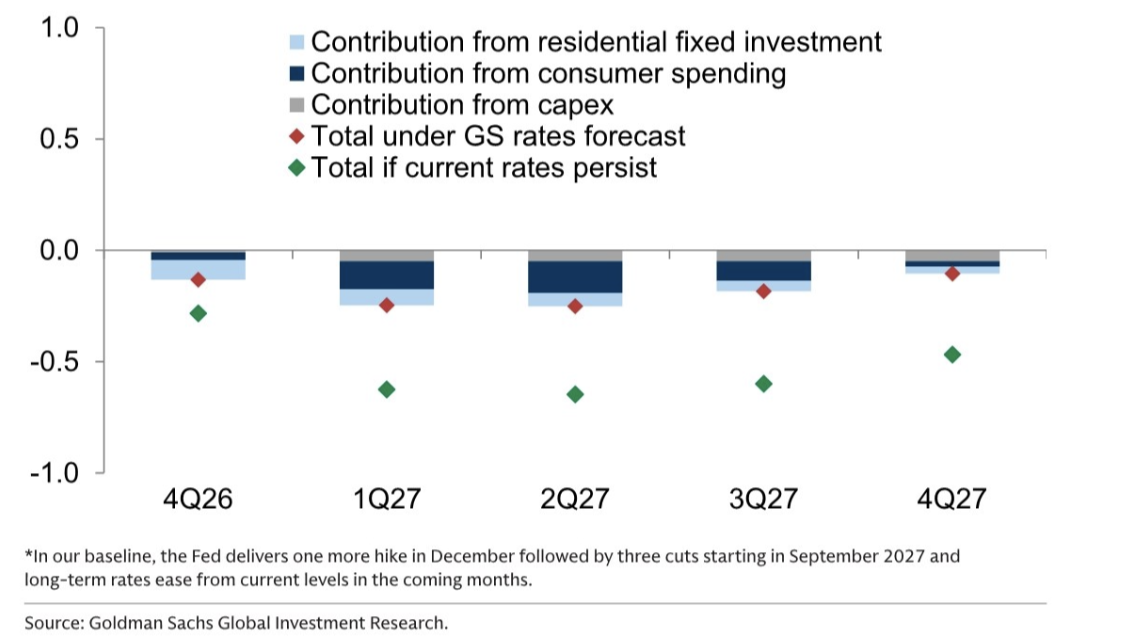
Caption: Goldman Sachs's baseline assumption: The Fed will hike rates once more in December, followed by three rate cuts starting from September 2027, with long-term interest rates falling back from current levels in the coming months. The figure shows model estimates under different interest rate paths.

Whether Goldman Sachs's Baseline Holds Depends on Two Conditions

Goldman Sachs's simultaneous expectation of another rate hike this year and rate cuts next year reflects a conditional policy path: Short-term inflation still needs to be constrained, and subsequently, economic and price conditions gradually allow for policy adjustment.

But this judgment requires the cooperation of two conditions.

First, core inflation must show more sustained easing. If price increases remain slow to decline, or if energy costs are further transmitted to other goods and services, the duration of maintaining tightening may be extended. The timing of rate cuts expected by Goldman Sachs would also face reassessment.

Second, long-term interest rates need to fall back from current levels. This is a key assumption in Goldman Sachs's estimate of a relatively mild growth drag. If long-term interest rates remain high, even if policy rates stop rising consecutively, financing costs may still persistently suppress demand.

From an asset pricing perspective, this requires investors to separately assess policy pivots and improvements in the financing environment. Halting rate hikes can alleviate concerns about further tightening, but whether growth pressure can be reduced also depends on whether actual borrowing costs decline.

Subsequent variables to watch have therefore become clearer: whether core inflation slows down consecutively, whether long-term interest rates fall, and whether housing, investment, and employment begin to show more obvious pressure.

The 0.2-percentage-point growth drag estimated by Goldman Sachs is the result under the scenario where interest rates subsequently fall back. If inflation stickiness forces financing costs to stay high for longer, the cost the US economy needs to bear could be significantly higher than this baseline.


Related Questions

QAccording to Goldman Sachs, what is their baseline forecast for the next steps in Federal Reserve interest rate policy?

AGoldman Sachs's baseline forecast is that the Federal Reserve will implement one more rate hike in December, and then begin cutting rates three times starting in September 2027. They also assume long-term interest rates will retreat from current levels in the coming months.

QWhat is the estimated drag on US GDP growth in 2027 under Goldman Sachs's baseline scenario, and how does this change if rates remain at current levels?

AUnder Goldman Sachs's baseline scenario (which includes future rate declines), higher interest rates are estimated to drag US GDP growth by about 0.2 percentage points in 2027. If interest rates remain at current levels, the drag is estimated to more than double, exceeding the baseline estimate.

QWhat were the key components driving the September US CPI increase, and why does this present a challenge for the Fed?

AThe September US CPI increase was primarily driven by energy prices, specifically a 9.1% monthly rise in gasoline prices. The core CPI, which excludes food and energy, rose 0.3% for the second consecutive month, with shelter prices accelerating. This presents a challenge because the persistence in core inflation, not just volatile energy prices, suggests underlying price pressures haven't eased further, requiring more evidence before the Fed can conclude inflation is on a sustained downward path.

QWhat two key conditions must be met for Goldman Sachs's baseline interest rate forecast to hold true?

ATwo key conditions must be met: First, core inflation must show more sustained moderation. Second, long-term market interest rates need to decline from their current levels. The latter is crucial for the estimated milder growth drag, as persistently high long-term rates would keep real borrowing costs elevated even if the Fed stops hiking.

QWhat is the distinction highlighted in the article between Federal Reserve policy rates and long-term market rates regarding economic impact?

AThe article highlights that the Federal Reserve directly influences short-term policy rates, but the cost of long-term financing for housing, corporate investment, and other projects is driven by long-term market rates. Therefore, even if the Fed stops raising policy rates, the economy may not see relief if long-term market interest rates remain high, continuing to pressure housing demand, business investment, and credit activity.

Related Reads

OpenAI launches AI payments in ChatGPT with Visa, Mastercard and Amex

OpenAI launched a feature letting AI agents make purchases for users directly within ChatGPT through existing payment networks, in partnership with American Express, Mastercard, and Visa. The wallet uses biometric verification like facial recognition or fingerprints to authorize transactions, and payment networks generate tokenized card credentials for each approved purchase, keeping users' actual card details from merchants and AI agents. The service is rolling out to ChatGPT Pro subscribers in the US with eligible US-issued cards, with plans to eventually support purchases within preset spending limits and other restrictions without requiring approval for each transaction. The launch reflects AI companies moving beyond product recommendations into executing transactions, potentially changing how consumers interact with online merchants. OpenAI is working with payment processors and fraud prevention firms to support AI purchases through existing checkout systems. It joins a growing field: Google introduced its Agent Payments Protocol in 2025, Visa and Mastercard have launched AI transaction initiatives, and crypto companies like Coinbase (x402 protocol), Circle (Agent Stack), and Crossmint are building payment infrastructure for AI agents. Global agentic commerce transaction value is expected to reach $1.5 trillion by 2030, up from an estimated $8 billion in 2026, according to Juniper Research.

cointelegraph50m ago

OpenAI launches AI payments in ChatGPT with Visa, Mastercard and Amex

cointelegraph50m ago

Kraken parent Payward gains market share as slower trading weighs on earnings

Kraken parent Payward nearly doubled its share of global crypto spot trading to 6.5% in September from 3.3% a year earlier, even as weaker trading activity weighed on earnings. The market-share gain reflects a larger portion of spot trading relative to competitors rather than increased activity; the company handled $353 billion in transactions in Q3, down 30% year over year. Adjusted EBITDA fell to $60 million from $178.6 million a year earlier, and total platform margin fell 12% to $487 million. Payward has spent two years expanding beyond its core exchange through acquisitions in derivatives, proprietary trading, tokenized assets and payments, including NinjaTrader, Breakout, Bitnomial and Reap. Derivatives contracts with per-contract fees rose 84% to 66 million, and margin from subscriptions and other paid services rose 59% to $125 million. Results improved from Q2, with total transaction volume up 22% and platform margin up 12% to $487 million from $436 million. Margin from customer-held assets, including staking, rose 26% to $128 million, accounting for roughly half the quarterly increase. Adjusted EBITDA climbed to $60 million from $23 million, though it remained down 66% year over year. Asset- and access-based services accounted for 52% of total platform margin, up from 46%. Payward confidentially filed for a US IPO in November 2025 but paused plans in March; the earliest potential listing window under consideration was Q2 2027.

cointelegraph1h ago

Kraken parent Payward gains market share as slower trading weighs on earnings

cointelegraph1h ago

Metaplanet swings to $170M loss as Bitcoin sale hits earnings

Metaplanet, the world's second-largest publicly traded corporate Bitcoin holder, reported a net loss of 27.16 billion yen (about $170 million) in the first nine months of 2026, compared with a profit of 13.53 billion yen ($84.6 million) a year earlier. The loss was driven by a 19.17 billion yen ($119.8 million) loss on the sale of 10,000 BTC and an 8.04 billion yen ($50.3 million) loss from a decline in the value of its Bitcoin holdings, which outweighed gains in its operating business. During the quarter, Metaplanet sold 10,000 BTC for 124.7 billion yen, temporarily held the proceeds in cash, stablecoins and other liquid assets, then spent 149.9 billion yen to buy 11,000 BTC at an average price 9.3% higher per coin. The company said the sale was intended to demonstrate to rating agencies and bond investors that it could convert Bitcoin into cash to meet financing obligations. Holdings ended September at 44,000 BTC, a net increase of 1,000 coins. Metaplanet borrowed against its Bitcoin during the quarter, raising its credit line debt to $649.5 million at the end of September from $414 million at the end of June. It funded purchases from the second quarter onward with borrowed funds, bond proceeds, exercised stock acquisition rights and revenue from its Bitcoin options business. Interest expense rose 56% quarter over quarter to 1.36 billion yen ($8.5 million), and short-term borrowings and bonds payable totaled 110.5 billion yen ($691 million). For the nine months through September, revenue rose 30.5% to 5.9 billion yen ($36.9 million) and operating profit increased 26.5% to 3.48 billion yen ($21.8 million). The company cut its full-year revenue forecast to 6.5 billion yen ($40.6 million) from 16 billion yen ($100 million). The results come as Bitcoin treasury companies face pressure from falling prices and index removals; MSCI confirmed Strategy, Metaplanet and Upexi will be removed from its equity indexes at the Nov. 30 market close. Bitcoin fell below $70,000 on Friday, trading around $68,600, down about 9% over the previous week.

cointelegraph4h ago

Metaplanet swings to $170M loss as Bitcoin sale hits earnings

cointelegraph4h ago

From Near Bankruptcy to Five Trillion: Jensen Huang and His Thirty-Three Years at NVIDIA

In November, at NVIDIA's Santa Clara headquarters, a two-page press release announced CEO Jensen Huang's immediate resignation as president, CEO, and director, following his admission of marital infidelity and a board investigation into related conduct. CFO Colette Kress became interim CEO, and Harvey Jones was named board chairman. Huang, who had just overseen NVIDIA's rise to become the first company worth $5 trillion, retained only his roughly 3% stake and no operational role. The article traces NVIDIA's 33-year history from its 1993 founding at a Denny's in East San Jose, where Huang and two engineers bet on making graphics chips for PCs. Their first chip, NV1, failed, but a pivotal meeting with Sega's Shoichiro Irimajiri converted a $5 million contract payment into an investment, saving the company. After layoffs and self-teaching from Silicon Graphics textbooks, NVIDIA's RIVA 128 succeeded in 1997. The company went public in 1999 and weathered crises including defects, financial downturns, and industry consolidation. Huang's long-term bet on CUDA, initially met with silence and skepticism, positioned NVIDIA for the AI boom. After AlexNet in 2012, he committed the company to deep learning, personally delivering the first DGX-1 to OpenAI in 2016. ChatGPT's 2022 launch triggered explosive growth, with revenue reaching $215.9 billion. Despite surviving decades of near-collapse, it was personal scandal—not business failure—that ended his tenure. As the article notes, for 33 years he woke believing the company was 30 days from collapse; this time, the 30th day was his own.

marsbit6h ago

From Near Bankruptcy to Five Trillion: Jensen Huang and His Thirty-Three Years at NVIDIA

marsbit6h ago

Trading

Spot
活动图片