Galaxy General: 34 Months Since Establishment, 6 Rounds of Financing Totaling 7 Billion: The Confidence and Concerns of the "Capital Harvester" in the Embodied AI Track

marsbitPublished on 2026-09-11Last updated on 2026-09-11

Abstract

Galaxy General Intelligence, founded by Peking University researcher Wang He in May 2023, has emerged as a top-funded player in China's Embodied AI sector, raising approximately 70 billion yuan across six funding rounds in just 34 months, with a valuation exceeding 200 billion yuan. The company's leadership features a "capital + industry" governance structure, with founder/CTO Wang He, AI model expert Zhang Zhizheng, and Chairman Yin Fangming. It adopts a "heavy brain, light body" strategy, focusing on its core AstraBrain embodied AI model while utilizing third-party hardware like Unitree's. Key products include the industrial Galbot S1, service-oriented Galbot G1, and the home-use ET1 robot. Commercial deployments include partnerships with CATL for factory automation and expansion of "Galaxy Space Pod" convenience stores. Its funding evolution mirrors the sector's shift: early VC backing from firms like Matrix Partners transitioned to heavy participation from state-owned capital (e.g., National AI Industry Investment Fund, CNOOC Capital) and strategic industrial investors (e.g., CATL, SAIC, China Mobile). This reflects the market's view of Embodied AI as a strategic national priority. However, concerns persist. The rapid fundraising pace creates pressure to continuously justify valuation with milestones. Heavy state capital involvement brings strategic support but may constrain governance and complicate future public market valuation logic. Questions remain about whether ...

In May 2023, Peking University researcher Wang He founded a robotics company named "Galaxy General." At that time, embodied AI in China was still a seed in the making. Three years later, this company has cumulatively raised approximately 7 billion RMB in financing, with its valuation surpassing 20 billion RMB, making it the company with the highest financing in China's embodied AI field.

This is not merely a simple story of "technological entrepreneurship"; it resembles more of a multi-layered game revolving around technological narratives, capital strategies, and industry expectations.

Who is at the Helm?

In public accounts, the central figure of Galaxy General is founder and CTO Wang He. He holds a Stanford Ph.D. and is currently a researcher at Peking University, a Boya Young Scholar, and a national-level high-caliber overseas talent. Before entrepreneurship, Wang He had long been deeply involved in the fields of embodied AI and robotic manipulation, making him one of the few founders in this track with both top-tier academic credentials and industrial ambition.

Co-founder Zhang Zhizheng is responsible for the large model direction. He led the construction of the "Galaxy Star Data" ultra-large-scale embodied AI dataset and is also the deputy director of the Beijing Key Laboratory of Embodied AI Large Models.

Notably, there has been a change in the Chairman position.

In July 2026, Galaxy General underwent a management change: 10 management personnel, including former Chairman Guo Xiaoliang, exited, while 9 new members joined, with Yin Fangming taking over as Chairman.

According to public information, Yin Fangming's career spans MediaTek, Sogou, and 360. He founded the robotics company ROOBO, turned to investment after exiting, with his most notable investment being the angel round of Unitree.

This personnel arrangement itself is a signal—Galaxy General is transitioning from a "founder-driven" structure to a "capital + industry" hybrid governance model.

The academic committee is led by Chinese Academy of Engineering academician Gao Wen, with members covering top-tier scholars in China's embodied AI field such as Zhang Jianwei, Zeng Wenjun, Wang Tianmiao, and Chen Baoquan. This lineup carries substantial weight at the academic level.

Product Strategy: Prioritize the Brain, Lightweight Body

Galaxy General has chosen a route distinctly different from Unitree's—"Prioritize the Brain, Lightweight Body."

The company's technological core is its self-developed end-to-end embodied large model, "Galaxy Star Brain" (AstraBrain), constructing a complete closed loop of "Brain—Cerebellum—Neural Control."

At the cognitive level, it launched the world's first general-purpose brain base model, AstraBrain WAM 0.5, unifying the Vision-Language-Action and World Model pathways. At the motion control level, AstraBrain-WBC 0.5 reached the scale of GPT-1, for the first time validating the Scaling Law in the field of motion control.

In March 2026, the team achieved the world's first instance of a humanoid robot playing tennis autonomously—the robot could autonomously complete ball recognition, trajectory prediction, full-body balance control, and continuous hitting. Elon Musk called it the "AlphaGo moment for embodied AI."

At the hardware level, Galaxy General is not fixated on developing the robot body from scratch, but instead uses mature hardware solutions from companies like Unitree as carriers.

In 2025, Galaxy General contributed over 18 million RMB in sales to Unitree.

The advantage of this strategy is concentrating resources on algorithms and data, avoiding the long cycles of hardware R&D that can hinder iteration speed. The trade-off is the lack of proprietary barriers at the hardware body level, with core competitiveness highly dependent on the actual generalization capabilities of the large models.

Galaxy's current product line includes three models: the heavy-duty industrial robot Galbot S1 (priced around 1.05 million RMB on JD.com), the wheeled dual-arm robot for general services Galbot G1 (around 700,000 RMB), and the bipedal robot for home scenarios "Galaxy Star Kid" ET1 (in pre-sale stage) released in August 2026.

Among these, the G1 appeared on the stage of the CCTV Spring Festival Gala in 2026, partnering with Shen Teng and Ma Li, and overnight became the "Spring Festival Gala Robot."

In terms of commercial deployment, the S1 has entered CATL's battery factory achieving 7×24 hours of normalized operation. The G1 is being deployed in retail, pharmacy, and medical scenarios, with "Galaxy Space Capsule" convenience stores having landed in over 40 cities with more than 170 outlets. Furthermore, Galaxy General signed a global strategic cooperation agreement with Ningjia Service, a subsidiary of CATL, where its 1300+ service stations will undertake the installation, deployment, operation, maintenance, and repair of Galaxy General's robots.

Financing Journey: A "Relay Race" from VC to State Capital

The financing journey of Galaxy General itself serves as a microcosm of the capital evolution in the embodied AI track.
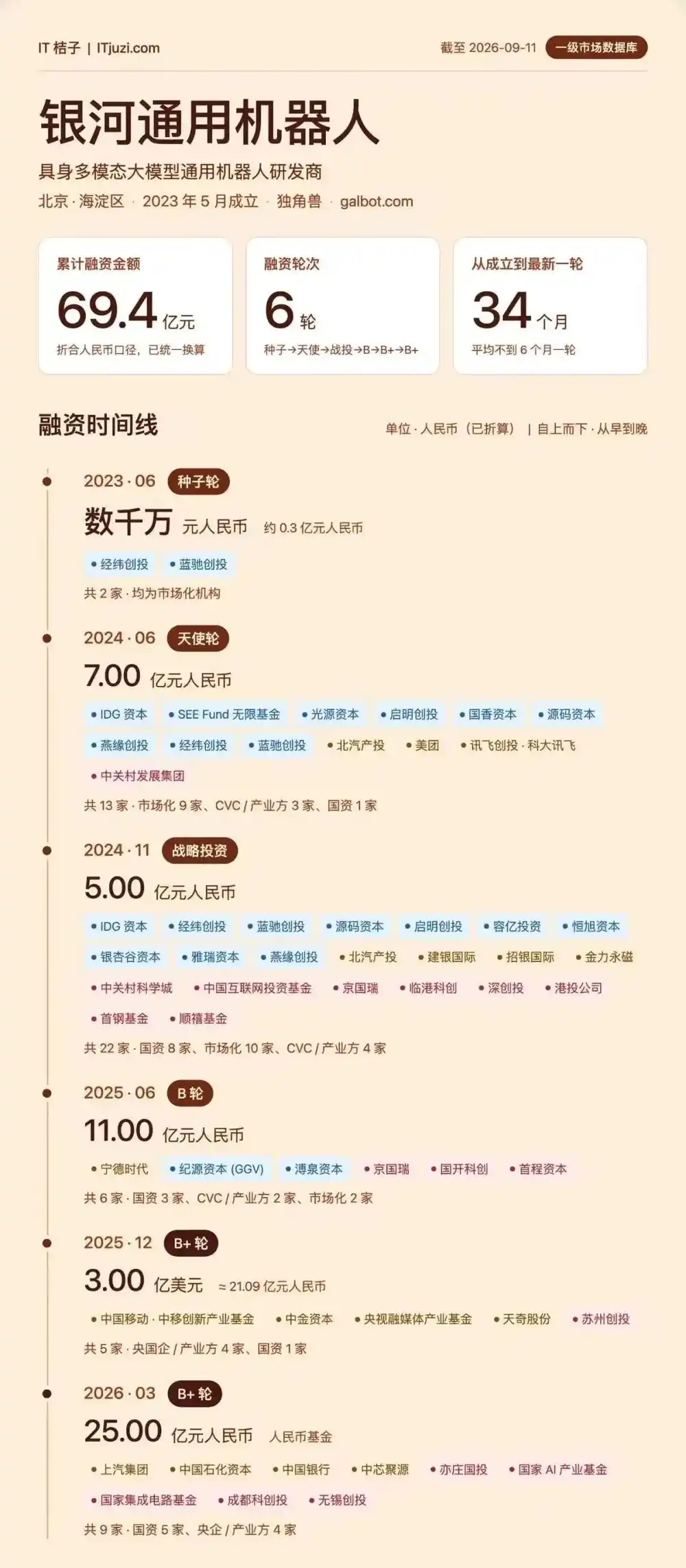
June 2023, Seed Round—tens of millions of RMB, with two market-oriented institutions, Matrix Partners China and Lanchi Ventures, joining. This represents the most classic early-stage VC logic: betting on founder background and technical direction.

June 2024, Angel Round—700 million RMB, with the investor lineup expanding dramatically. Nine market-oriented institutions including IDG Capital, SEE Fund, Lighthouse Capital, Qiming Venture Partners, Guoxiang Capital, Source Code Capital, and Yanyuan Capital joined. Simultaneously, three industrial strategic investors—Meituan, iFlytek Capital, and BAIC Group's industrial investment arm—participated, along with Zhongguancun Development Group as the first state-owned capital entity. The 700 million scale was already at the top tier in the robotics sector at the time.

November 2024, Strategic Investment—500 million RMB, with 22 investors rushing in. The key change in this round was the concentrated entry of state-owned capital: eight state-owned institutions including Shenzhen Capital Group, Zhongguancun Science City, China Internet Investment Fund, Jing Guorui, Lingang Science & Technology Venture Capital, Port Investment Company, Shougang Fund, and Shunxi Fund entered. Coupled with industrial strategic investors like CCB International, CMBI, and JL Mag Rare-Earth, along with existing shareholders continuing to invest, state-owned and quasi-state-owned investors already constituted over half of the investor composition in this round.

June 2025, Series B—1.1 billion RMB. CATL and GGV Capital joined, with Jing Guorui and CDB Capital continuing to invest. CATL's first-time entry was particularly crucial—it not only acted as a financial investor but also directly brought thousand-unit level robot orders and subsequent global after-sales service cooperation.

December 2025, Series B+—over 300 million USD (approximately 2.1 billion RMB). China Mobile, CICC Capital, CCTV Media Convergence Industry Fund, Tianqi Shares, and Suzhou Venture Capital entered. The leading role of central and state-owned enterprises and national-level funds further increased.

March 2026, Series B++—2.5 billion RMB. Nine investors including the National AI Industry Investment Fund, Sinopec Capital, CITIC Group, Bank of China, SAIC Motor, and SMIC Capital participated. State-owned capital and central state-owned enterprises dominated this round—five state-owned funds (National AI Industry Fund, National Integrated Circuit Industry Fund, Yizhuang State-Owned Capital Operation, Chengdu Science and Technology Innovation Investment Group, Wuxi Venture Capital), plus four central state-owned enterprises/industrial strategic investors.

34 months, 6 financing rounds, cumulatively approximately 7 billion RMB. After deduplication across all rounds, there are about 47 investors: around 15 market-oriented institutions, around 17 state-owned/government-guided funds, and around 15 industrial strategic investors/CVCs.
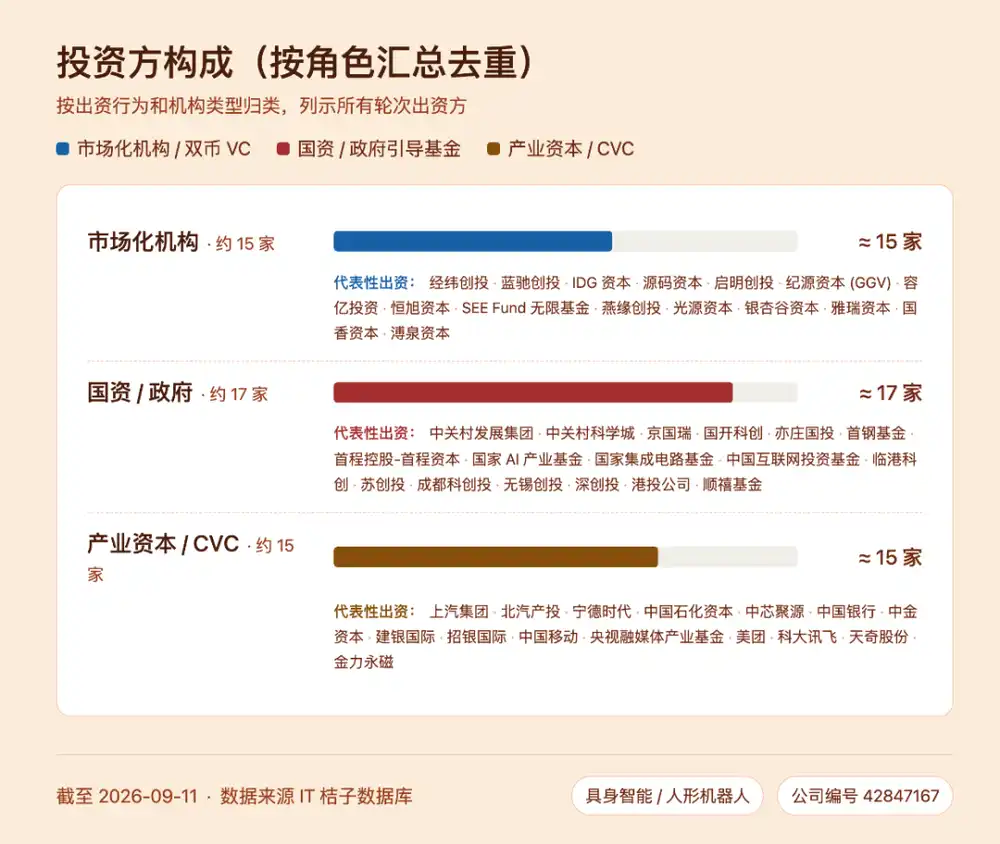
From being led by early-stage market-oriented VCs, to a massive influx of state-owned capital in the mid-phase, to recent national-level industry funds and central state-owned enterprises becoming the main force—this path clearly reflects the evolving judgment of the capital market on China's embodied AI track: from a "technological direction worth betting on" to a "strategic high ground that needs to be captured."

Cold Reflection: Amid Confidence, Where Lie the Concerns?

First, high-frequency financing implies sustained pressure to deliver.

With an average of less than six months between financing rounds, each round requires delivering new milestones to support the valuation leap. From the team and direction in the seed round, to the product prototype in the angel round, to industrial customers in the strategic round, and on to the national-level laboratory in the Series B round—Galaxy General has indeed managed to have a "new story to tell" for each round.

But after the stories are told, the next question to answer is even more brutal: can revenue scale match a valuation exceeding 20 billion RMB?

Second, the "state-ownership" shift in the investor structure is a double-edged sword.

The substantial entry of state-owned capital provides Galaxy General with credit endorsements, scenario resources (such as order synergy from CATL and China Mobile), and policy support.

However, state-owned capital's requirements for exit certainty, asset security, and audit compliance will also impose constraints on corporate governance and strategic choices. More importantly, when a company's financing body shifts from being dominated by "market-oriented VC investment" to "state-owned capital + national-level funds," the valuation logic has already begun to change—from "venture capital return expectations" to "national strategic asset allocation." The convergence of these two valuation systems will face tests when the company goes public in the future.

Third, the "investment-driven order" model of industrial capital needs validation.

The entry of industrial strategic investors like CATL, SAIC, China Mobile, and Sinopec could theoretically bring orders and customers to Galaxy General.

However, currently verifiable, scaled commercial revenue remains limited—the G1 sells for about 700,000 RMB, the S1 for about 1.05 million RMB. Even with cumulative deliveries in the hundreds of units, the multiple relationship with the 20 billion RMB valuation remains staggering.

Whether industrial capital investment truly translates into sustainable commercial revenue, rather than merely serving as a valuation endorsement, is a point requiring continuous tracking.

Fourth, industry controversy has already emerged.

On September 10, 2026, Shao Tianlan, founder of Hong Kong-listed company Mech-Mind, publicly questioned the business models of some embodied AI companies on his WeChat Moments, stating that some "high-profile, high-valuation companies that appeared on the Spring Festival Gala" create revenue through methods like "data collection centers" and related-party transactions, and promote IPOs with the help of local governments and state-owned capital investments, directly pointing to Galaxy General.

Galaxy General subsequently issued a statement in response, emphasizing the company's adherence to genuine R&D, real scenarios, and authentic commercial closed loops. The merits of this controversy await the test of time, but it reflects an industry-wide issue: when embodied AI moves from high valuations in the primary market to public scrutiny in the secondary market, commercialization capability will become the watershed.

Galaxy General is not an isolated case; it is a typical sample of the capital frenzy in China's embodied AI track from 2023 to 2026. The pace of raising 7 billion RMB in 34 months reflects not just market recognition of this particular company, but the overheated state of the entire track driven jointly by policy expectations, technological narratives, and capital momentum. When the fever subsides and commercialization becomes the hard metric, those who can truly stand firm will find the answer not in financing rounds, but in every real operation on production lines, in pharmacies, and in convenience stores.

This article is from WeChat public account: IT Juzi , Author: Judy, Original Title: "Galaxy General: 34 Months Since Establishment, 6 Rounds of Financing Totaling 7 Billion—The Confidence and Concerns of the 'Capital Harvester' in the Embodied AI Track"


Related Questions

QWho is the core founding team of Galaxy Universal, and what are their backgrounds?

AThe core founding team includes Founder and CTO Wang He, a researcher at Peking University with a Stanford Ph.D. background, specializing in embodied intelligence and robotics. Co-founder Zhang Zhizheng leads the large model direction and the development of the "Galaxy Star Data" dataset. Chairman Yin Fangming, who took over in July 2026, has a career spanning companies like MediaTek, Sogou, and 360, and previously founded the robotics company ROOBO. The academic committee is led by academician Gao Wen.

QWhat is Galaxy Universal's core product strategy, and how does it differ from companies like Unitree?

AGalaxy Universal's strategy is "heavy on the brain, light on the body." It focuses on developing its core "AstraBrain" end-to-end embodied large model, forming a complete "brain-cerebellum-neural control" closed loop. Instead of developing hardware from scratch, it uses mature hardware solutions from partners like Unitree as carriers. This allows it to concentrate resources on algorithms and data, avoiding the long cycles of hardware R&D.

QDescribe the evolution of Galaxy Universal's funding sources over its 6 financing rounds.

AGalaxy Universal's funding evolved from market-driven VCs to a dominance of state capital. The early seed and angel rounds were led by venture capital firms like Matrix Partners and IDG Capital. From the strategic investment round onward, state-owned capital and government guidance funds (e.g., Shenzhen Capital Group, China Internet Investment Fund) began pouring in. The later B+ and B++ rounds were dominated by national-level industrial funds (e.g., National AI Industry Investment Fund) and central state-owned enterprises (e.g., China Petrochemical Capital, SAIC Motor).

QWhat are the main concerns or potential risks highlighted for Galaxy Universal in the article?

AKey concerns include: 1) The pressure to continuously deliver new milestones to justify rapid valuation increases. 2) The double-edged nature of heavy state capital involvement, which provides support but also imposes governance constraints and shifts valuation logic. 3) The need to verify whether investments from industrial partners (like CATL) translate into sustainable commercial revenue, not just valuation support. 4) Industry controversy over business model authenticity and commercialization capabilities, as exemplified by public criticism from a competitor's founder.

QWhat significant technical achievement did Galaxy Universal accomplish in March 2026, and how was it recognized?

AIn March 2026, Galaxy Universal's team achieved the world's first instance of a humanoid robot autonomously playing tennis. The robot could independently complete ball recognition, trajectory prediction, whole-body balance control, and continuous hitting. Elon Musk referred to this achievement as the "AlphaGo moment for embodied intelligence."

Related Reads

OpenAI and Meta Join Forces, Bridging the "Last Mile" of Agent Commerce

On November 13, 2026, two major announcements landed the same day, together addressing the "last mile" of agent commerce: how AI assistants get through the door, and how they pay. Sierra and Meta released Poppy v1.0, a Personal Agent Protocol built on OAuth, HTTPS, OpenAPI, and the Model Context Protocol. Poppy lets businesses cryptographically verify three things: which assistant is making a request, which user it represents, and what permissions it holds. Companies publish a discovery file at /.well-known/poppy describing endpoints and allowed actions, while both user and business must consent to each interaction via two-way authorization. Shopify automatically enabled Poppy discovery files for merchants in 175+ countries, giving the protocol immediate scale, with over 100 design partners including Delta, 1Password, Okta, and Cloudflare. Separately, OpenAI launched ChatGPT Wallet for its personal assistant dots. The assistant can search, compare, and fill a cart, but must stop at checkout—users confirm via biometric authentication. Neither the assistant nor the merchant ever sees the real card number; card networks issue a one-time payment credential instead. Built with Amex, Mastercard, and Visa, the wallet runs entirely on traditional fiat rails—explicitly not crypto or stablecoins. It initially opens only to US Pro subscribers aged 18+. Notably, Visa and Mastercard span both initiatives, and OpenAI itself appears among Poppy's design partners—despite dots and Meta's Muse competing for the consumer entry point. The shared logic: consumer-facing competition, but shared infrastructure on the business side. The common bottom line is "human in the loop"—agent autonomy stops at the shopping cart. Open questions remain: liability when an assistant errs or is manipulated by malicious prompts, coverage beyond Shopify and US Pro users, and whether mandatory biometric confirmation for every small purchase will become friction that undermines the convenience promise.

marsbit1m ago

OpenAI and Meta Join Forces, Bridging the "Last Mile" of Agent Commerce

marsbit1m ago

Has the Time Come to Buy the Dip on Nvidia?

Nvidia announced on November 12 that Jensen Huang resigned as President, CEO, and Director, effective immediately. Shares fell as much as 14% intraday to $148.8, down nearly 40% from October highs, with over $600 billion in market value briefly erased. The founder's departure triggered the selloff, but the market is repricing the entire company rather than reacting to a single risk. Nvidia now trades at roughly 12x forward PE, its lowest in 15 years and below the S&P 500's ~18x, despite strong fundamentals: FY2026 revenue of $215.9 billion (+65%), data center revenue of $62.3 billion in a single quarter, ~75% gross margins, and Q2 FY2027 revenue of $96.2 billion with $21.3 billion free cash flow. Most investment banks cut targets but maintained Buy/Overweight ratings (Barclays $210, Goldman $220, Citi $225, RBC $230), implying ~20% upside, while Truist downgraded to Hold at $174. The consensus: the business is intact, but its valuation multiple needed resetting. Supporting demand, Huang forecast at GTC 2026 that Blackwell and Rubin AI chip demand would reach at least $1 trillion by 2027, double the prior 2026 estimate. However, risks remain beyond CEO succession. CUDA's lock-in effect is eroding on the inference side—Anthropic disclosed that its Claude Mythos Preview autonomously ported core GPU kernels to AMD flagship GPUs in three days with minimal human intervention, prompting investor Marcelo P. Lima's widely cited claim that "Nvidia's CUDA moat no longer exists." Supply bottlenecks lie in HBM and packaging, not wafers: TSMC can cut over 400 million GPU dies annually, but Nvidia ships only ~10 million GPUs yearly, constrained by HBM capacity (~3.75EB globally, ~70% allocated to Nvidia, ~260GB per GPU) and tight packaging, with HBM4 adjustments possibly delaying Rubin. Huang also leaves behind highly personalized assets—strategic technology judgment, supply chain negotiation with TSMC and SK Hynix, and direct channels to customers and governments—that interim CEO Colette Kress, the long-time CFO, may not fully replace. In short, the business remains, but the "faith premium" is being systematically stripped away. At 12x forward PE, much pessimism is priced in, offering a favorable risk-reward window if AI capex holds and demand materializes. Yet cheapness alone isn't sufficient: CUDA's erosion is slow but irreversible, HBM and packaging limit revenue upside, and succession uncertainty means the founder premium may not be fully removed. As Bernstein noted, "if you see two ants in the kitchen, there are more than two," warning that chains from scandal to governance vacuum to government probes could trigger further selloffs. Until the dust settles, what a Jensen-less Nvidia is worth remains an open question.

marsbit46m ago

Has the Time Come to Buy the Dip on Nvidia?

marsbit46m ago

AI Bull Market Trap? The Big Short Seller Strikes Again

Recent signals from Goldman Sachs, the Federal Reserve, and prominent short-seller Michael Burry are converging on concerns about the AI trade. Goldman warns that AI capital expenditure growth will likely peak in early 2027, with the boost to S&P 500 earnings falling from a 12-point peak in 2026 to a 5-point drag by 2028, shifting the market from a one-way rally to two-way volatility. The Fed has flagged AI as a potential threat to asset valuations and financial stability. Burry has doubled his Nasdaq 100 put options and rebuilt short positions in a semiconductor ETF, calling this a "bull market trap" analogous to the 2000 dot-com bubble, with Nvidia's influence a key worry. Four pressures weigh on the AI narrative: peaking capex growth, high interest rates that hit long-duration AI assets and leveraged GPU cloud providers like CoreWeave and Nebius, circular financing risks among interconnected tech firms, and tighter regulation under Democrats affecting data center energy, land, and permitting. Nvidia-related turmoil has shaken the pricing anchor for the entire supply chain. However, a valuation bubble bursting does not mean the AI industry is declining. Goldman notes US cloud giants trade at just 19.7x forward P/E, below their 20-year historical range and even below defensive staples, suggesting much pessimism is already priced in. Opportunities are shifting from upstream hardware "shovel sellers" toward fairly valued cloud giants with improving free cash flow, AI application companies delivering real ROI, and deeply discounted cyclical names like Korean memory. Conversely, GPU cloud providers dependent on Nvidia orders and cash-burning startups without products are most vulnerable. Investors should diversify, hedge, and focus on assets that convert spending into stable returns.

marsbit51m ago

AI Bull Market Trap? The Big Short Seller Strikes Again

marsbit51m ago

Just Offered 3.3 Million Yuan Salaries to Poach Talent, OpenAI Suddenly Dissolves Robotics Team—Is the Industry About to Change!

OpenAI has disbanded its standalone robotics research team, confirmed shortly after booking booth 208 at the CoRL robotics conference in Austin went empty on November 13. The move surprised many, given that just months earlier OpenAI was aggressively hiring robotics talent—some roles paying up to $500,000 base salary—and had expanded its San Francisco data-collection lab to about 100 workers across three shifts, with a second lab planned in Richmond, California. Researchers from the robotics team are now folded into Chief Research Officer Mark Chen's core research division, while robotics applications and hardware staff move to President Greg Brockman's Applied division. OpenAI says robotics remains part of its long-term vision and the reshuffle is meant to accelerate progress. This is not OpenAI's first robotics retreat: it ended its first independent robotics effort in 2020 to focus on large language models, which produced ChatGPT, and only rebuilt a team in 2024. OpenAI explains the latest pivot technically—researchers initially believed video-generation models like Sora could teach robots physics, but general models such as GPT-6 Astra proved capable of directly controlling robots, so robotics work is being merged into the general foundation-model team. The broader industry context supports this shift. Unitree's Wang Xingxing said his biggest mistake over the past decade was not trusting AI enough, noting GPT-6 integration exceeded expectations and that humanoid intelligence's tipping point may arrive within one to two years. Anthropic's Claude Fable 5.2 scored 64.9% on the RoboDojo Sim benchmark versus 29.8% for GPT-6 Astra, and Nvidia's Astranomy study showed GPT-6 Astra controlling simulated robots with 74.8% success using an agentic approach, beating the prior specialized-model best of 51.0%. Yet challenges remain: general models are costly and slow—GPT-6 Astra averaged 18.56 seconds per inference and about 30.9 million tokens (roughly $36.40 in API fees) per successful task—problematic for real factories where conveyor belts don't pause. Google DeepMind, Nvidia, Unitree and AgiBot continue training specialized robotics models; Google's Apollo 2 achieved 96% success sorting parts in Mercedes factories using paired reasoning and action models, while Nvidia's GR00T 2 reached 95% success after brief fine-tuning. Analysts suggest OpenAI now treats robotics as a downstream application of general intelligence, leveraging core model advances while using its data-collection and hardware capabilities to validate models on real robots.

marsbit51m ago

Just Offered 3.3 Million Yuan Salaries to Poach Talent, OpenAI Suddenly Dissolves Robotics Team—Is the Industry About to Change!

marsbit51m ago

Trading

Spot
活动图片