French Hill highlights CLARITY Act, with 15% probability of passage in 2026

cryptonews.ruPublished on 2026-09-03Last updated on 2026-09-03

Abstract

The CLARITY Act (H.R. 3633), a U.S. bill to establish federal crypto market rules, faces low odds of becoming law in 2026, according to prediction markets. While the House has passed it, the bill's progress in the Senate is uncertain. Prediction markets on Polymarket gave it just a 15% chance of full enactment by year-end, despite public support from lawmakers like Rep. French Hill. A key procedural vote (cloture) is scheduled for September 15th, requiring 60 Senate votes to advance; failure would likely doom its 2026 prospects. Traders see a higher probability (30-50%) of similar legislation passing by 2027 or 2028. The revised bill addresses SEC/CFTC jurisdiction, consumer protection, and oversight of crypto intermediaries.

Washington's efforts to establish national rules for cryptocurrency trading, custody, and market oversight are currently focused on the CLARITY Act. The bill, which passed the House of Representatives, allocates federal authority between the Securities and Exchange Commission (SEC) and the Commodity Futures Trading Commission (CFTC), and establishes requirements for exchanges, brokers, dealers, disclosure, and customer asset protection.

Traders on prediction markets remain skeptical that the Crypto Asset Market Structure Act will complete the legislative process this year. A Polymarket contract on the law taking effect in 2026 showed on September 2 that the probability of the CLARITY Act (H.R. 3633) being passed by both chambers and signed by the president by December 31 is 15%. Trading volume reached approximately $11.62 million.
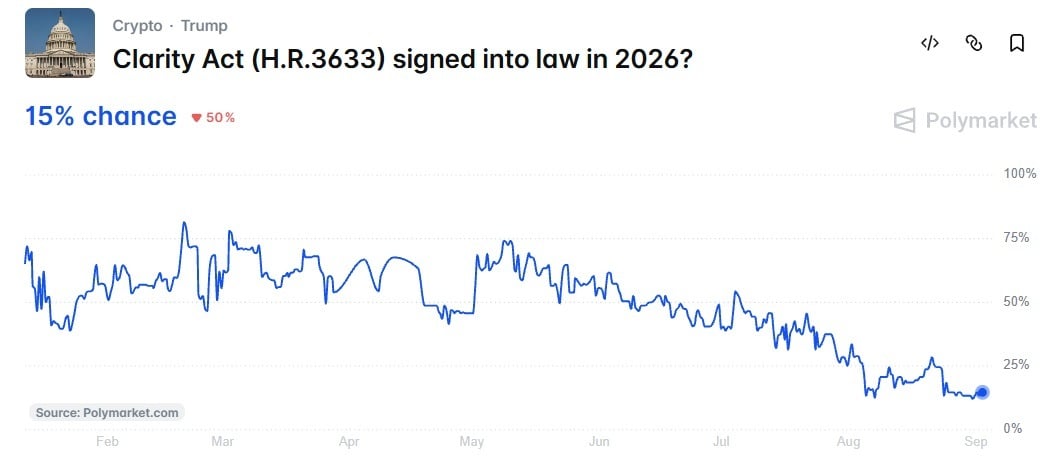
Polymarket traders estimated the probability of the CLARITY Act becoming law by December 31 at 15%. Source: Polymarket, September 2, 2026.

This low probability contrasted with House Financial Services Committee Chairman French Hill's renewed mention of the bill during September 2 hearings on growth, affordability, innovation, and capital access. In his prepared remarks, the Arkansas Republican listed the CLARITY Act's House passage among the committee's accomplishments and called for permanent, predictable financial rules.

Long-term Kalshi contracts showed higher probabilities, although they assess a broader range of possible outcomes and cannot be directly compared to the 2026 Polymarket contract. Kalshi estimated the probability that the CLARITY Act or another relevant crypto market structure bill becomes law by July 1, 2027 at 30%, and by January 1, 2028 at 50%. Trading volume was approximately $6.85 million.
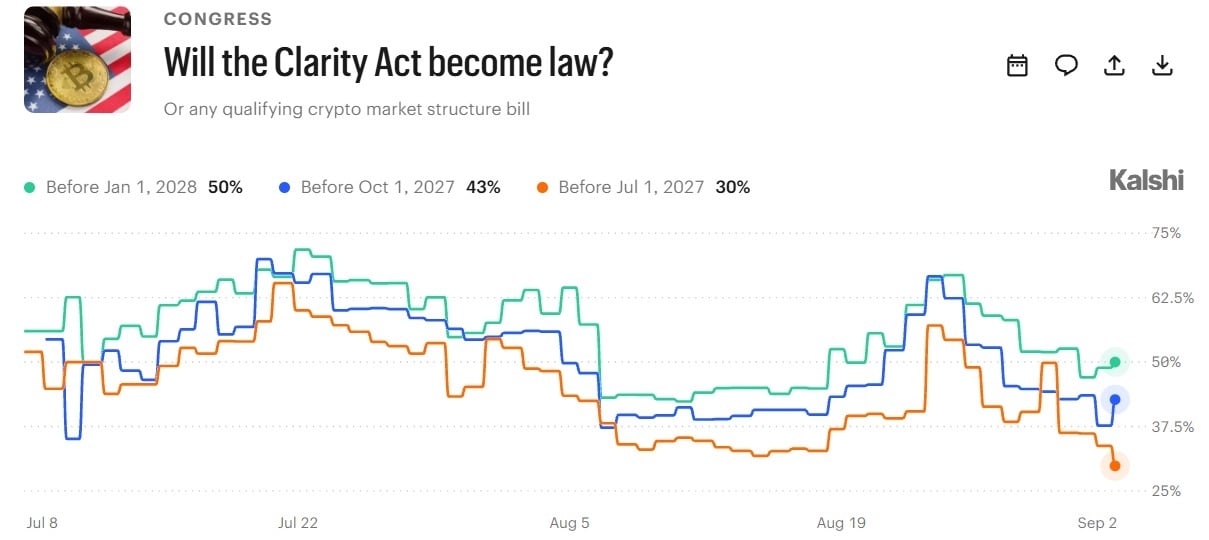
Kalshi traders estimated the probability of a relevant crypto market structure bill passing as 30% by July 1, 2027 and 50% by January 1, 2028. Source: Kalshi, September 2, 2026.

The latest data shows traders are distinguishing between an upcoming Senate vote and final enactment. By August 31, the market had already separated procedural progress from final passage: traders assessed the probability of a Senate vote as high, but the probability of the bill becoming law during 2026 as much lower. The latest Polymarket figure of 15% rose from 13%, but still largely signalled against passage.

September 15 cloture motion will be the next test

The next significant step will be a procedural vote on the bill, which senators could hold as early as September 15. According to the official Senate schedule, a motion to invoke cloture on H.R. 3633 will be voted on at 2:15 PM. Passing a cloture motion typically requires 60 votes, so the bill's future depends on its ability to maintain bipartisan support.

In earlier stages, the bill already received bipartisan support. On May 14, the Senate Banking Committee approved H.R. 3633 by a vote of 15 to 9, sending it to the full floor. Democratic Senators Ruben Gallego and Angela Alsobrooks joined Republicans in supporting the bill's advancement, though the committee's approval did not guarantee sufficient support for cloture or final passage.

Subsequently, Senate negotiators unveiled a revised bill merging the work of the Banking and Agriculture Committees. The updated CLARITY Act framework addresses SEC and CFTC jurisdiction, consumer protection, illicit financing, decentralized finance (DeFi), intermediary oversight, disclosure requirements, and certain network tokens.

The revised language creates another factor affecting the timeline, reflected in the low odds for 2026 passage. Senate approval of provisions differing from the House-passed bill may require additional action before the bill reaches the president's desk. The Polymarket contract will pay out only if H.R. 3633 clears all remaining steps by the end of 2026.

Hill's regulatory initiative faces legislative calendar constraints

Hill included the CLARITY Act within a broader economic agenda covering capital markets, housing, community financial institutions, and regulatory modernization. He stated, "Republicans on the committee are working diligently to codify these reforms into law to make them permanent and predictable." Prediction market probabilities indicate traders view the remaining congressional schedule as a significant obstacle to this goal.

In his September 2 statement, the lawmaker did not provide extensive arguments for digital assets, but had previously explained why he considers CLARITY critical. During July field hearings marking the one-year anniversary of the bill's House passage, Hill compared passing stablecoin legislation without a crypto market framework to an unfinished communication system, with the CLARITY bill remaining stalled in the Senate.

Hill stated:

"We need to get CLARITY done because of one key point I always emphasize: if you have the GENIUS Act and a dollar-backed stablecoin that President Trump signed in July of last year, but you don't have a market structure bill, it's like getting permission to own a cell phone but not having a cellular network."

The bill could impact centralized exchanges, decentralized platforms, brokers, dealers, token issuers, and customers. Centralized and decentralized crypto exchange structures raise different issues related to asset custody, regulatory compliance, and consumer protection, which the proposed framework aims to address.

If senators agree to take up the cloture motion on September 15, the vote will become the next direct test for market skepticism. Overcoming this procedural hurdle could improve forecasts for Senate consideration, while failure would reinforce the current 85% probability assessed for H.R. 3633 not becoming law during 2026.

end-content

Related Questions

QWhat is the CLARITY Act (H.R. 3633) and what are its main provisions according to the article?

AThe CLARITY Act (H.R. 3633) is legislation focused on establishing national rules for cryptocurrency trading, custody, and market oversight in the US. Its main provisions, as passed by the House of Representatives, include allocating federal authority between the Securities and Exchange Commission (SEC) and the Commodity Futures Trading Commission (CFTC), and setting requirements for exchanges, brokers, dealers, disclosure, and client asset protection.

QAccording to the Polymarket prediction contract, what is the perceived probability of the CLARITY Act becoming law by the end of 2026?

AAccording to the Polymarket prediction contract as of September 2, 2026, the perceived probability of the CLARITY Act passing both congressional chambers and being signed by the president before December 31, 2026, is 15%.

QWhat is the significance of the cloture motion scheduled for September 15 for the future of the CLARITY Act?

AThe cloture motion scheduled for a vote on September 15 is a key procedural step for the CLARITY Act. Passing cloture typically requires 60 votes in the Senate. Success would allow the bill to proceed to a final vote, while failure would represent a major setback, confirming market skepticism about its passage in 2026.

QHow do the market prediction probabilities from Kalshi for the CLARITY Act differ from those on Polymarket, and why are they not directly comparable?

AKalshi's long-term contracts show higher probabilities: 30% for a relevant crypto market structure bill (like CLARITY) becoming law by July 1, 2027, and 50% by January 1, 2028. They are not directly comparable to Polymarket's 2026 contract because they assess a broader range of possible outcomes over different, longer timeframes.

QWhat analogy did French Hill use to argue for the necessity of passing the CLARITY Act alongside stablecoin legislation?

AFrench Hill used an analogy comparing stablecoin legislation without a crypto market structure framework to 'having permission to own a mobile phone but not having a cellular network.' He argued that the CLARITY Act is needed to complete the regulatory framework, just as a network is needed for a phone to function.

Related Reads

Materials Science Agent MatOS Officially Open-Sourced, Significantly Improving the Success Rate of Materials R&D Tasks

MatOS is an open-source agent operating system for materials research developed by the Beijing Zhongguancun Academy and Zhongguancun Institute of AI. It addresses key challenges in autonomous materials research: integrating new databases and software without rebuilding pipelines, maintaining state over multi-day tasks, and reusing accumulated experience across studies. MatOS organizes data, knowledge, tools, skills, roles, and workflows into six types of scientific assets connected through typed relationships, allowing both researchers and the system itself to build new capabilities on existing assets. Its stateful adaptive workflows use execution graphs with explicit steps and check conditions to keep long tasks on target, support mid-task adjustments after structural, policy, and compilation checks, and preserve snapshots independent of model sessions. An evidence-driven evolution mechanism converts user corrections, tool failures, and workflow results into candidate asset revisions, which are adopted only after structural and semantic review. The asset library currently includes 3,135 datasets, 386 skills, 104 workflows, 51 expert roles, and 48 materials computation tools. On the ResearchClawBench benchmark, MatOS scored 33.6% higher than Codex CLI on average and 80.8% higher on materials tasks; on MatTools it achieved 97.96% full-problem success. Case studies include screening 97 solid-state electrolyte candidates from over 30 million structures, alloy design with melting scores improved from 0.534 to 0.927, and developing DuoCompNet with a mean absolute error of 3.18°C. Next steps include integrating instruments and experimental workflows.

marsbit30m ago

Materials Science Agent MatOS Officially Open-Sourced, Significantly Improving the Success Rate of Materials R&D Tasks

marsbit30m ago

Gemini's New Model is Ready to Launch, Netizens: Going Through the Periodic Table of Elements?

Google's Gemini 4 series has adopted an element-themed naming scheme, and developers have now spotted a new model identifier, gemini-4-neon, in the Gemini web app code, alongside a matching subscription tier labeled TIER_NEON (displayed as "Gemini Ultra" but treated separately internally). Neon is element No. 10, which has amused and confused users, since Hydrogen (No. 1) was followed by Argon (18) and Carbon (6), with no obvious order. The series so far includes Gemini 4 Argon (complex software engineering, deep reasoning, cybersecurity), Gemini 4 Carbon (long-horizon agent tasks, coding, security), and Gemini 4 Hydrogen (speed and efficiency for everyday coding and agent workflows). Rumors of a Krypton model turned out to be a higher-reasoning Gemini 4 Hydrogen. Commenters joke that Google is picking elements at random, that naming is like Starbucks cup sizes, and that at this rate Google will need to discover new elements (with calls for Oganesson, No. 118). Some suggest the names do carry meaning: Argon means "lazy/inactive," fitting stable security work; Carbon is the basis of life and complex structures; Hydrogen is the lightest element, fitting speed; and Neon derives from "neos" (new). Beyond naming, Google's subscription tiers and six Gemini access points are also confusing users, with some Pro subscribers not seeing new models and accounts showing different model access.

marsbit31m ago

Gemini's New Model is Ready to Launch, Netizens: Going Through the Periodic Table of Elements?

marsbit31m ago

Trading

Spot
活动图片