France is world’s most dangerous place for Bitcoiners: 90 attacks in 7 months

cointelegraphPublished on 2026-10-09Last updated on 2026-10-09

Abstract

In just over seven months (Jan. 1 to mid-August 2026), French authorities recorded 90 violent crypto-related crimes—including kidnappings, extortion, and theft—averaging one incident every 2.5 days, with 223 arrests. Security firm Gart.io ranks France as the world's top country for such "wrench attacks," ahead of the USA and UK. Analysts suggest the surge is likely linked to major data breaches, such as the 2024 French tax authority leak and a 2026 breach at crypto tax firm Waltio, which exposed personal and financial details of crypto holders. Over 90% of known victims were French residents, and attacks have spread beyond Paris to multiple cities. Notably, more than 40% of recent attacks in France targeted victims' relatives or acquaintances, indicating criminals are conducting detailed reconnaissance using leaked data, social media, or blockchain analysis. High-profile cases include attempted abductions of family members of crypto executives. French authorities are treating the wave as organized crime. The situation underscores a key vulnerability: while cryptography secures digital assets, it cannot prevent physical attacks when personal data is already exposed.

French authorities have recorded 90 cases involving kidnapping, abduction, extortion, threats, and violent theft related to cryptocurrencies in just over seven months.

The figures, provided to Cointelegraph by the French Interior Ministry, are from Jan. 1 to mid-August 2026. Authorities also recorded 223 arrests, and 126 people were imprisoned from January to July.

The figures equate to a new case every two and a half days, although there is no official year-on-year comparison to understand if the problem has become suddenly worse: “We do not have the statistics on these items for 2025, as the recording of events began on Jan. 1, 2026,” the ministry says.

What makes the new numbers even more striking is they are much higher than other public trackers of meatspace attacks.

Chainalysis counted 30 publicly known violent crypto incidents in France through mid-2026, but noted that the scale was “almost certainly larger.” Security firm Gart.io has tracked 73 attacks in France in the year to date, which puts France in the number one spot ahead of the USA on 66 real world attacks, and the UK on 27.

The rise in physical attacks — known as “wrench attacks” — on crypto holders in France points to something bigger than a rash of isolated incidents. Leaked personal data may be the culprit.

So, why France?

Wrench attacks are far from a new phenomenon. Bitcoin security advocate Jameson Lopp’s long-running directory of known physical attacks has documented 365 cases across 60 countries between 2014 and 2026, with France topping the leaderboard.

Related: Home invasions became most common crypto wrench attack in H1 2026: CertiK

What seems to be new, however, is the speed at which violent crypto crimes are spreading throughout the country. Attacks have gone beyond Paris to places including Strasbourg, Marseille, Grenoble, Toulouse and Nantes, according to Chainalysis.
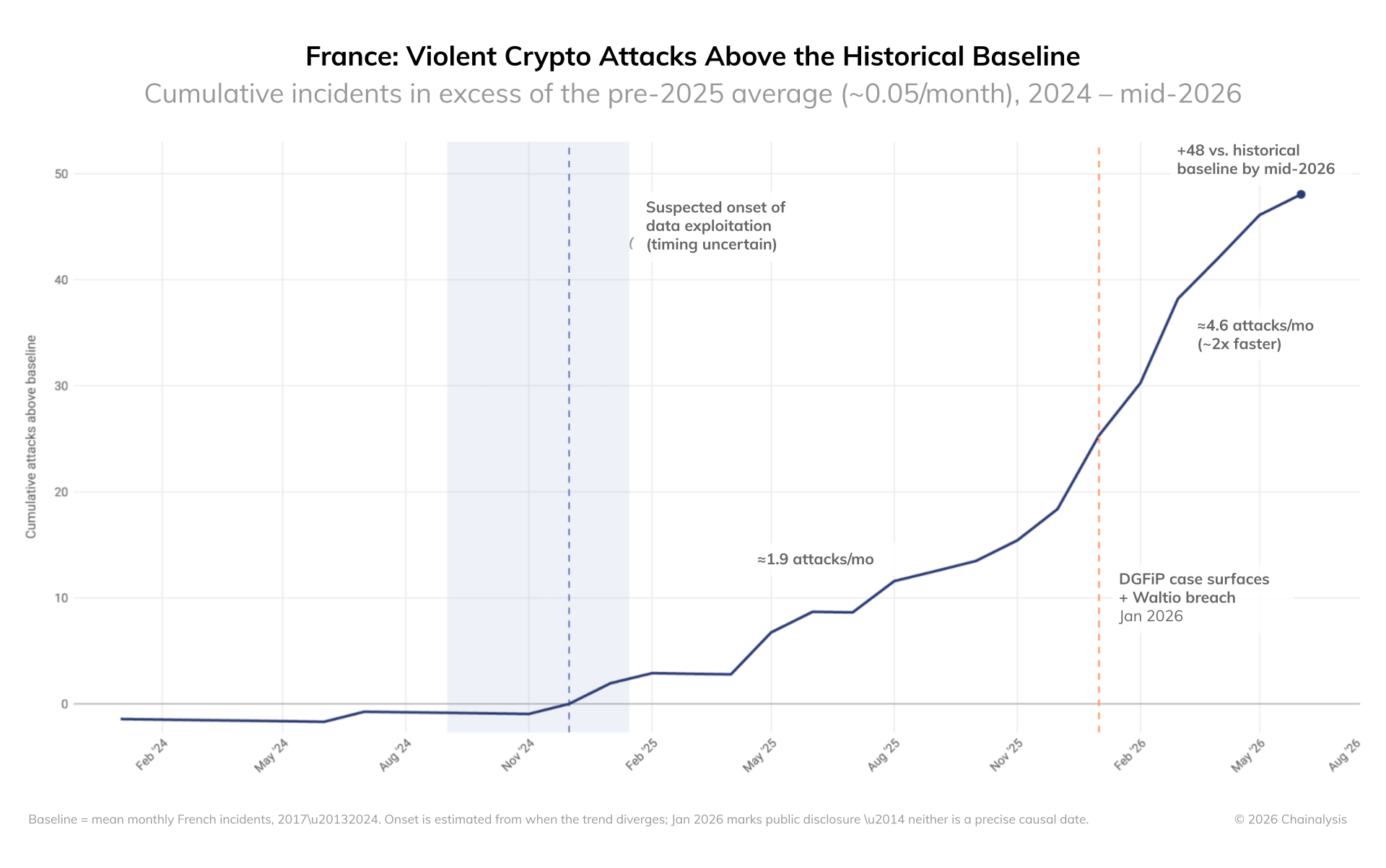
Violent attacks above the historical baseline. Source: Chainalysis.

Criminals aren’t targeting crypto rich tourists, and of the victims with known residency, 93% were French.

Chainalysis head researcher Eric Jardine tells Cointelegraph the surge is “very likely” due to a “significant data breach.”

“These sort of breaches expose more than financial information; they reveal who holds crypto, where they live, and how to find them.”

That makes physical attacks against crypto holders particularly insidious because they can begin long before a thug shows up with a wrench demanding your seed phrase or a crypto transfer. The assailants first need to know who has something worth stealing, where they live and how to reach them.

Jardine says the French tax authority compromise in 2024, where a tax official in the Paris area “leaked PII, financial and crypto holding information on French taxpayers,” may have been the accelerant. Chainalysis records show attacks surged from late November of the same year.

Chainalysis also points to a further incident in January 2026, with crypto tax reporting firm Waltio disclosing a breach affecting some 50,000 users, creating yet more useful data for attackers to mark their targets.

Francis Pouliot, founder of Canadian Bitcoin exchange Bull Bitcoin, has repeatedly challenged Europe’s DAC8 crypto reporting rules in France, which expand tax reporting and information-sharing requirements for crypto users across the European Union.

“DAC8 has transformed the concept of Know Your Customer into Kill Your Customer,” he said, along with describing France as the “crypto kidnapping capital of the world.”
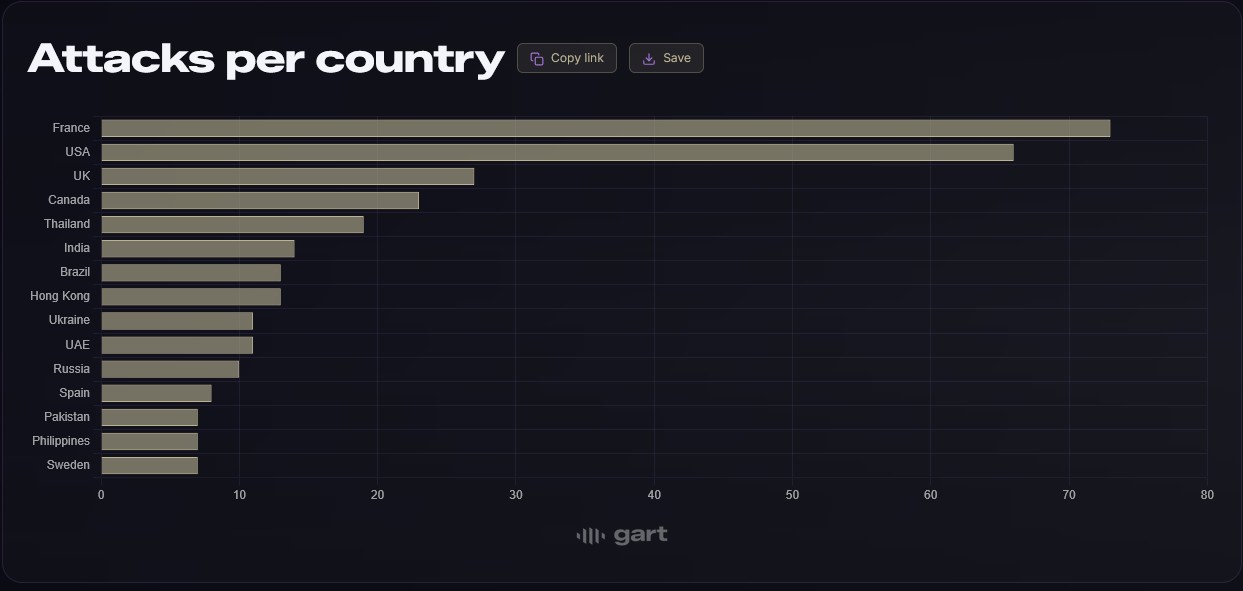
The world of physical attacks. Source: Gart.io

When the target isn’t the Bitcoiner

According to Chainalysis, one of the most revealing changes may be who is being attacked. Globally, relatives and acquaintances accounted for around 25% to 30% of violent crypto incidents by early 2026, and in France, the proportion was more than 40%.

In May 2026, six men allegedly tried to abduct the wife of The Sandbox co-founder Sébastien Borget from the couple’s home in Villenoy, France, with one attacker posing as a delivery driver to get her to open the gate.

In August, a couple in rural France reportedly endured three separate attempts to break into their home after buying a property previously occupied by crypto millionaires, after the previous owners’ tax information and address were leaked onto the dark web.

A similar tactic was used in 2025, when the father of a crypto entrepreneur was abducted in Paris and held for two days, with the kidnappers reportedly cutting off part of his finger and sending it to his son while demanding $5.6 million in cryptocurrency.

Jardine says the targeting of relatives and associates “suggests criminals are doing reconnaissance before they act,” whether by “monitoring social media, analyzing blockchain data, using leaked information, or receiving tips from insiders.”

That turns the usual idea of a crypto target on its head, since the person with the wallet may not be the person standing in front of the attacker.

French authorities are responding by treating the attacks as organized crime, coordinating investigations through JUNALCO, the country’s specialized organized crime jurisdiction.

The $5 wrench conundrum

Most crypto holders have learned how to protect their seed phrases, set up hardware wallets, test their environments and avoid clicking on phishing links.

While those things are still important, none of them will help if a bad actor already knows who they are, where they live and that they have something worth stealing in the first place.

Cryptography can protect a wallet, but it can’t stop an attacker with a $5 wrench.

Related: Revolut ID thefts highlight KYC’s dangers: Here’s how to fix it

Related Questions

QAccording to the article, how many violent crypto-related incidents were recorded in France from January to mid-August 2026, and what types of crimes were included?

AFrench authorities recorded 90 cases involving kidnapping, abduction, extortion, threats, and violent theft related to cryptocurrencies from January 1 to mid-August 2026.

QWhat are the two main potential data breaches mentioned as likely accelerants for the surge in physical attacks on crypto holders in France?

AThe two main potential data breaches are the 2024 French tax authority compromise where a tax official leaked PII and financial/crypto holding information, and the January 2026 breach of crypto tax reporting firm Waltio which affected around 50,000 users.

QWhat significant change in targeting tactics for violent crypto crimes does the article highlight, particularly in France?

AThe article highlights that criminals are increasingly targeting the relatives and acquaintances of crypto holders. In France, this group accounted for more than 40% of attacks by early 2026, suggesting criminals conduct reconnaissance on their victims' social circles.

QWhat is the term 'wrench attack' used to describe in the context of cryptocurrency, and what is the '$5 wrench conundrum' mentioned at the end?

AA 'wrench attack' refers to a physical, violent attack on a person to coerce them into giving up access to their cryptocurrency holdings. The '$5 wrench conundrum' refers to the idea that while cryptography can protect digital wallets, it is ineffective against a physical attacker using simple, cheap tools (like a wrench) to threaten the holder in person.

QHow does the article describe France's position in global rankings for real-world crypto attacks according to different security firms?

AAccording to the security firm Gart.io, France is ranked number one in the world for real-world crypto attacks in the year to date, with 73 attacks, ahead of the USA (66 attacks) and the UK (27 attacks).

Related Reads

Nobel Laureate Hassabis Delivers Another Masterpiece: AlphaGenome 2 Deciphers 98% of Human DNA 'Dark Matter'

DeepMind has unveiled AlphaGenome 2, a next-generation DNA foundation model led by Nobel laureate Demis Hassabis. While AlphaFold decoded only the 2% of the human genome that encodes proteins, AlphaGenome 2 targets the remaining 98% of non-coding "dark matter," which harbors gene-regulatory switches and over 90% of disease-causing mutations. Released alongside a 78-page technical report, the model delivers four major breakthroughs. First, it achieves single-cell resolution, trained on over 107 million single cells across 68 human tissues, doubling the rate at which it identifies pathogenic mutations—raising detection from 16% to 30% and directional accuracy from 23% to 43% on the TenK10K immune-cell benchmark. Second, it reproduces years of Nature-published research purely through computation: with zero wet-lab experiments, it correctly identified a distant regulatory mutation that over-activates ETS2 across 290,000 bases to cause inflammatory bowel disease, and precisely located the regulatory site and GATAA core sequence targeted by approved sickle-cell CRISPR therapy. Third, a new cell encoder lets the model interpret previously unseen diseases from just dozens of patient cells without retraining—identifying 41% of pathogenic mutations in unseen Parkinson's brain samples versus 17% for a specialized model, and uncovering a hidden severe-COVID mutation active only in immune-activated T cells. Finally, DeepMind released free databases covering 640 real human cell types and impact scores for nearly 7 million genetic variants across 510 cell states, with APIs and Colab tutorials open for non-commercial research. The model will soon be packaged as Skills and integrated into Google Antigravity for direct use by Gemini 4, promising to dramatically shorten the cycle of disease investigation and drug discovery.

marsbit32m ago

Nobel Laureate Hassabis Delivers Another Masterpiece: AlphaGenome 2 Deciphers 98% of Human DNA 'Dark Matter'

marsbit32m ago

Midterm Elections Settled, What Lies Ahead for the CLARITY Act?

The CLARITY Act (Digital Asset Market Clarity Act), which had already struggled before the election, now faces dim prospects after Democrats swept both chambers in the midterms. On September 15, a Senate cloture motion on the House-passed bill failed 49-50, eleven votes short of the 60-vote threshold. All 49 yes votes came from Republicans; the opposition included all Democrats present, two independents, and four Republicans (Collins, Hawley, Moran, Tillis). Even if absentee Democrat Coons had voted yes and the four Republicans had flipped, the tally would have reached only 54—still short. The bill's core compromise would make the CFTC the primary regulator for digital commodities and trading platforms while preserving clear SEC authority; jurisdictional division and added ethics provisions are the main disputes. Democrats will control both chambers when the new Congress opens January 3, 2027, leaving little incentive to cooperate during the lame-duck session. Only two theoretical paths remain before the 119th Congress ends: renegotiate the text and hold another cloture vote via Tillis's reconsideration motion, or attach crypto market structure provisions to must-pass December legislation such as government funding (expiring December 11) or the NDAA. Both are unlikely, given the tight legislative calendar and Democratic leverage. Stablecoin oversight continues separately under the GENIUS Act and OCC rulemaking. If the bill dies, it must be reintroduced in the 120th Congress, where Democrats—likely led by Elizabeth Warren and Maxine Waters—are expected to draft a very different framework expanding SEC authority and narrowing the CFTC's role. Key things to watch before January 3: any new cloture vote or revised text, any attempt to attach provisions to funding or defense bills, outstanding vote counts in Alaska, Mississippi, and House districts, and the incoming committee chair selections. Absent such developments, the CLARITY Act is effectively finished as a 2026 legislative project.

marsbit32m ago

Midterm Elections Settled, What Lies Ahead for the CLARITY Act?

marsbit32m ago

4.8 Billion Dollars: Tether's Hand Has Reached Into 13 U.S. Public Companies

Tether, the world's largest stablecoin issuer, holds roughly $4.8 billion in public-market exposure across 13 U.S.-listed companies, according to a Protos review of regulatory filings. Its holdings span a controversial video platform, gold royalty companies, a satellite firm, bitcoin miners, and a bitcoin treasury project. Key positions include a 50.3% stake (including warrants) in Rumble (RUM), though voting power is capped below 9.9%; Rumble has also acquired Tether's Northern Data and counts Tether as its most important advertising client, committed to $50 million annually for two years. Tether and Bitfinex are controlling shareholders of Twenty One Capital (XXI), with rights to nominate four of seven directors, including Tether CEO Paolo Ardoino; the company trades at about 60% of its bitcoin value. In gold, Tether holds about 27% of Elemental Royalty (ELE), 12.6% of Gold.com (GOLD), 12.6% of Versamet Royalties (VMET), 14.6% of Metalla (MTA), 14.4% of Gold Royalty (GROY), 12% of Aurelion (AURE), and about 8% of Antalpha (ANTA). It also holds 19.7% of Bitdeer (BTDR) and a stake in Adecoagro (AGRO), plus shares in Satellogic (SATL), 9.9% of SDEV (down about 99%), and a stake in VCI Global (VCIG) via Oobit. Powerlaw Corp (PWRL) claims roughly $20 million in Tether equity. The exposure is concentrated in a few large holdings—Twenty One, Rumble, and Adecoagro—showing Tether's growing role as a multi-sector financial institution that also places executives in key positions.

marsbit57m ago

4.8 Billion Dollars: Tether's Hand Has Reached Into 13 U.S. Public Companies

marsbit57m ago

Trading

Spot
活动图片