Experts criticize Drake's call to move bitcoins to new addresses due to AI threat

cryptonews.ruPublished on 2026-10-15Last updated on 2026-10-15

Abstract

Experts have criticized Ethereum Foundation researcher Justin Drake's call for cryptocurrency holders to move their assets to new, unused addresses in preparation for a potential AI-driven breach of the ECDSA cryptographic algorithm. Drake warned such an attack could happen within "months, not years," even before powerful quantum computers emerge. Haseeb Qureshi of Dragonfly labeled the advice "cryptographic doomering," arguing that moving funds offers only temporary safety and wouldn't protect their value if a network-wide attack occurred. Instead, he proposed networks implement a proactive "cryptographic recovery mode" for emergencies. Other industry figures, including Coinbase's Yehuda Lindell and MetaMask's Taylor Monahan, also criticized the warning, stating there is no published evidence that AI currently threatens the mathematical foundations of elliptic curve cryptography. Lucien Bourdon of Trezor suggested Drake's warning also served to promote Ethereum's own roadmap for hash-based cryptography. Further criticism highlighted practical flaws in the "bunker" strategy. Moving funds may not help if a wallet's extended public key (xpub) was already shared, allowing derivation of future addresses. Experts also warned that a successful ECDSA breach would compromise consensus mechanisms and infrastructure, making individual wallet security irrelevant. Responses varied by network. Analysts noted Bitcoin's SegWit addresses offer some protection until first use, while Solan...

Dragonfly managing partner Haseeb Qureshi labeled the call by Ethereum Foundation researcher Justin Drake to prepare for "bunker mode" as "cryptographic doomerism". In his opinion, moving funds to new addresses will not protect them if AI helps break ECDSA.

Hiding your coins in a bunker won’t save your blockchain. Given the risks AI poses to fundamental cryptography, I propose every chain implement a "cryptographic recovery mode": https://t.co/3qXwrQLvFu

— Haseeb Qureshi >|< (@hosseeb) October 8, 2026

Other industry participants also criticized the call, including Coinbase Head of Cryptography Yehuda Lindell and MetaMask Lead Security Researcher Taylor Monahan.

On October 7, Drake suggested that the ECDSA digital signature algorithm could be broken using AI before sufficiently powerful quantum computers appear. In the worst case, this could happen "in months, not years".

He advised holders to gradually move funds to addresses whose public keys have not yet appeared on the blockchain.

Qureshi pointed out that coins on new addresses would remain safe only until they are moved. Moreover, they would become worthless if other tokens in the network were mass-stolen and sold off.

Instead of migration, he proposed that networks pre-implement a "cryptographic recovery mode". Users could attach a hash-based backup signature to their addresses, and validators could forcibly restore access to funds in case of a breach.

Johns Hopkins University cryptography professor Matthew Green, on the contrary, shared Drake's concerns.

"I think we could lose public-key cryptography," he wrote.

No evidence of threat found

Lindell stated that he was not aware of any evidence weakening the mathematical assumptions on which elliptic curve cryptography is built.

Trezor analyst Lucien Bourdon agreed. In a comment to Cointelegraph, he noted that no credible published research undermining the mathematical foundation of ECDSA had emerged — neither with AI nor without it.

None of the recently published OpenAI mathematical papers contained an attack on ECDSA, Bourdon noted. Drake, however, saw this as a reason for suspicion. He pointed out that among the 722 company papers, there are almost no results in cryptography, and suggested that such discoveries might not have been published due to behind-the-scenes interference.

According to the researcher, he personally saw the US government censor academic papers on quantum cryptanalysis.

Bourdon considered Drake's argument that elliptic curves are more vulnerable than hash functions due to their more complex mathematical structure to be unsupported.

"He doesn't explain how exactly [they can be broken]. He also calls his timeline a worst-case scenario and urges not to rush," the expert noted.

Bourdon pointed out that Drake's warning was accompanied by a story about Ethereum's transition to hash-based cryptography, which the researcher also recommended.

"Therefore, the warning about an unproven threat also serves as an advertisement for the Ethereum roadmap," he stated.

Quantum & After. Question No. 4: Is a quantum computer the killer of Bitcoin?

New addresses won't save

Foundation hardware wallet maker co-founder and CEO Zach Herbert warned in a conversation with Cointelegraph that moving funds to a new address might not help if the extended public key (xpub) has already been given to a wallet application or a third party.

Using xpub, wallets generate public keys for all account addresses, including unused ones.

"They already have the data to calculate the public keys you are trying to hide," Herbert explained.

If ECDSA becomes practically vulnerable, a malicious actor could recover private keys without even gaining access to the hardware wallet, he added.

StarkWare co-founder and CEO Eli Ben-Sasson also called such protection insufficient. To use coins again, holders will in any case have to switch to a new type of wallet, he believes.

StarkWare reduced the estimated cost of a quantum-resistant Bitcoin transaction by 79%

A breach would affect not only wallet signatures, Ben-Sasson emphasized. Signatures, the consensus mechanism at the Ethereum infrastructure level, and the KZG polynomial commitment scheme used for data in BLOB objects would also need updating.

Furthermore, due to network disruptions, gas costs would likely spike sharply.

Monahan indicated that in such a scenario, the safety of individual wallets would become meaningless.

"If elliptic curves are broken in such a way that any revealed public key leads to compromise, and it's done by a hacker whose main goal is to steal cryptocurrency, the whole damn world will zero out. 'Bunker mode' for your magic internet coins won't help," she wrote.

Each network has its own scenario

In the Bitcoin network, SegWit v0 addresses starting with bc1q hide the public key until the first spend. Trezor wallets also generate a new address for each receipt of funds, Bourdon noted.

"Right now, nothing needs to be done. Those rushing to move funds are making mistakes, and scammers use such stories to get to them," the analyst warned.

However, with each spend, the public key still enters the mempool, and in Taproot addresses, it is visible on-chain from the very beginning.

In Solana, public keys are visible by default, so changing addresses will not help users. Solana Foundation Vice President of Technology Jacob Creech stated that the network would not need "bunker mode".

Unlike many networks, Solana users don’t need to go into "bunker mode" ahead of an accelerated quantum timeline or classical attack provided by AI. Solana uses Ed25519, where each signing key is derived by hashing a secret seed. Breaking the curve, whether by a quantum computer or a classical attack, would expose the derived key, but not the seed, and seeds are never exposed onchain. With a one-time network upgrade, rightful owners could prove knowledge of their seed using a hash-based proof and move their accounts to a safe signature scheme. A working proof of concept already exists: https://t.co/am2ErkkomT. Solana remains secure today and has a defined path forward.

— Jacob Creech (@jacobvcreech) October 8, 2026

If the signature scheme is broken, a network upgrade would allow transferring accounts to a more secure scheme. For this, users would confirm ownership of the secret seed from which the key is derived using a hash-based proof. A prototype of such a solution is already ready, but it has not yet been implemented in the network, Creech clarified.

In Starknet, thanks to account abstraction, users can change the signature scheme without moving funds, Ben-Sasson explained. However, the network's state tree would need refinement, and Starknet itself still depends on Ethereum's security.

For Ethereum, there is an emergency scenario: in March 2024, Vitalik Buterin described a hard fork that would roll back blocks after the start of mass thefts and disable regular transactions. Users could recover funds by proving knowledge of their seed phrase using a zero-knowledge proof.

Bitwise Europe senior analyst Max Shannon noted that the proposal has no implementation timeline.

No one has demonstrated a working attack yet, but in the long term, users should switch to quantum-resistant signatures, Shannon believes. According to him, Bitwise is not currently worried about this theoretical risk, but it makes sense to be cautious.

Recall that on October 13, Coinbase called for preparing Bitcoin in advance for post-quantum migration.
Trending Cryptos

Related Questions

QAccording to Haseeb Qureshi, why is Justin Drake's recommendation to move funds to new addresses a flawed strategy against a potential AI attack?

AHaseeb Qureshi criticizes the strategy as 'cryptographic doomerism' and a 'bunker mode.' He argues that coins moved to new addresses are only safe until their first spend. Furthermore, the value of those coins would collapse if attackers could mass-steal and dump all other tokens in the network due to a fundamental breach of the underlying cryptography (ECDSA).

QWhat alternative solution to the 'bunker mode' does Haseeb Qureshi propose for blockchain networks?

AHaseeb Qureshi proposes that networks should preemptively implement a 'cryptographic recovery mode.' This would allow users to attach a backup hash-based signature to their addresses. In the event of a cryptographic breach, network validators could then forcibly restore access to the funds using this backup mechanism.

QWhat are the main counter-arguments from industry experts against the existence of an imminent AI threat to ECDSA cryptography?

AExperts like Yehuda Lindell (Coinbase) and Lucien Bourdon (Trezor) argue there is no current evidence that AI is weakening the mathematical assumptions underlying elliptic curve cryptography (ECDSA). Bourdon notes there are no credible published research papers, including from OpenAI, that successfully attack ECDSA. They view Drake's warning as unsubstantiated speculation.

QAccording to critics, what are the practical limitations and risks of moving crypto assets to new addresses as a defensive measure?

ACritics point out several limitations: 1) If an extended public key (xpub) has been shared with a wallet app or third party, they can already derive the public keys for all future addresses, negating the hiding attempt. 2) If the network itself is compromised, the value of individual 'safe' coins becomes meaningless. 3) To spend the funds later, users would still need to migrate to a new type of wallet, requiring an on-chain transaction that exposes the new key.

QHow do the post-quantum preparedness strategies differ for networks like Bitcoin, Solana, and Ethereum according to the article?

AStrategies vary: *Bitcoin:* SegWit v0 addresses hide public keys until first spend, but Taproot addresses don't. Trezor generates new addresses per receipt, but spending still exposes the key. *Solana:* Uses Ed25519 where the secret seed is never exposed on-chain. A planned network upgrade would let users prove seed knowledge via a hash-based proof to migrate accounts securely. *Ethereum:* Has a theoretical emergency hardfork plan (described by Vitalik Buterin) to roll back blocks after mass theft, allowing users to recover funds by proving knowledge of their seed phrase via a zero-knowledge proof. No firm timeline exists for its implementation.

Related Reads

Midterm Elections Settled, What Lies Ahead for the CLARITY Act?

The CLARITY Act (Digital Asset Market Clarity Act), which had already struggled before the election, now faces dim prospects after Democrats swept both chambers in the midterms. On September 15, a Senate cloture motion on the House-passed bill failed 49-50, eleven votes short of the 60-vote threshold. All 49 yes votes came from Republicans; the opposition included all Democrats present, two independents, and four Republicans (Collins, Hawley, Moran, Tillis). Even if absentee Democrat Coons had voted yes and the four Republicans had flipped, the tally would have reached only 54—still short. The bill's core compromise would make the CFTC the primary regulator for digital commodities and trading platforms while preserving clear SEC authority; jurisdictional division and added ethics provisions are the main disputes. Democrats will control both chambers when the new Congress opens January 3, 2027, leaving little incentive to cooperate during the lame-duck session. Only two theoretical paths remain before the 119th Congress ends: renegotiate the text and hold another cloture vote via Tillis's reconsideration motion, or attach crypto market structure provisions to must-pass December legislation such as government funding (expiring December 11) or the NDAA. Both are unlikely, given the tight legislative calendar and Democratic leverage. Stablecoin oversight continues separately under the GENIUS Act and OCC rulemaking. If the bill dies, it must be reintroduced in the 120th Congress, where Democrats—likely led by Elizabeth Warren and Maxine Waters—are expected to draft a very different framework expanding SEC authority and narrowing the CFTC's role. Key things to watch before January 3: any new cloture vote or revised text, any attempt to attach provisions to funding or defense bills, outstanding vote counts in Alaska, Mississippi, and House districts, and the incoming committee chair selections. Absent such developments, the CLARITY Act is effectively finished as a 2026 legislative project.

marsbit1m ago

Midterm Elections Settled, What Lies Ahead for the CLARITY Act?

marsbit1m ago

4.8 Billion Dollars: Tether's Hand Has Reached Into 13 U.S. Public Companies

Tether, the world's largest stablecoin issuer, holds roughly $4.8 billion in public-market exposure across 13 U.S.-listed companies, according to a Protos review of regulatory filings. Its holdings span a controversial video platform, gold royalty companies, a satellite firm, bitcoin miners, and a bitcoin treasury project. Key positions include a 50.3% stake (including warrants) in Rumble (RUM), though voting power is capped below 9.9%; Rumble has also acquired Tether's Northern Data and counts Tether as its most important advertising client, committed to $50 million annually for two years. Tether and Bitfinex are controlling shareholders of Twenty One Capital (XXI), with rights to nominate four of seven directors, including Tether CEO Paolo Ardoino; the company trades at about 60% of its bitcoin value. In gold, Tether holds about 27% of Elemental Royalty (ELE), 12.6% of Gold.com (GOLD), 12.6% of Versamet Royalties (VMET), 14.6% of Metalla (MTA), 14.4% of Gold Royalty (GROY), 12% of Aurelion (AURE), and about 8% of Antalpha (ANTA). It also holds 19.7% of Bitdeer (BTDR) and a stake in Adecoagro (AGRO), plus shares in Satellogic (SATL), 9.9% of SDEV (down about 99%), and a stake in VCI Global (VCIG) via Oobit. Powerlaw Corp (PWRL) claims roughly $20 million in Tether equity. The exposure is concentrated in a few large holdings—Twenty One, Rumble, and Adecoagro—showing Tether's growing role as a multi-sector financial institution that also places executives in key positions.

marsbit26m ago

4.8 Billion Dollars: Tether's Hand Has Reached Into 13 U.S. Public Companies

marsbit26m ago

Tesla and SpaceX Merger Accelerates: A $3.47 Trillion Giant, Deal Could Be Announced as Early as December

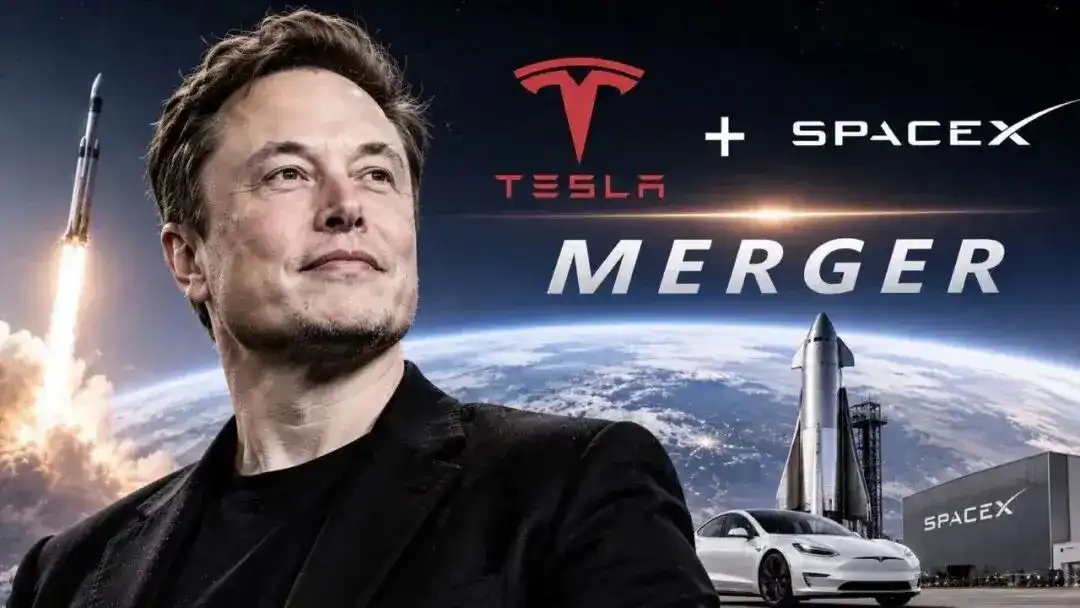
Tesla and SpaceX are reportedly advancing merger talks, with a deal potentially announced as early as December, though complex corporate structure and regulatory issues could delay it to early 2027. Based on recent market values—SpaceX at about $1.90 trillion and Tesla at about $1.57 trillion—the combined entity would be worth roughly $3.47 trillion, making it one of the largest corporate integrations in history and bringing rocket launch, satellite internet, EVs, energy storage, AI, and robotics under one roof. In October, Musk called a merger "a good idea" and confirmed both companies had formed independent director special committees. The strategic logic centers on AI infrastructure—chips, compute, and energy—with the Terafab chip manufacturing joint venture as a concrete example, expected to produce first test chips in mid-2027 and reach mass production in Q3 2028. Shareholder impact is significant: Musk holds about 40-45% economic interest in SpaceX with over 80% voting power via dual-class shares, versus nearly 20% of Tesla with equal voting rights, raising questions about control and whether Tesla shareholders would accept a new structure. Regulatory hurdles may be the hardest obstacle, given SpaceX's sensitive U.S. defense contracts and Tesla's major China operations, implicating CFIUS and Chinese regulators. The merger reflects Musk's ambition to unify his business empire around a shared technology base spanning Earth and space.

marsbit1h ago

Tesla and SpaceX Merger Accelerates: A $3.47 Trillion Giant, Deal Could Be Announced as Early as December

marsbit1h ago

10-Second 4K Image Generation: MiniMax Once Again Delivers Open-Source SOTA

MiniMax has released MiniMax H3 Image, an open-source image generation model that has quickly claimed state-of-the-art status among open-weight models. It natively outputs 4K images (around 16 million pixels) in roughly 10 seconds with the fast version, supports up to 16 reference images, and ranks first among open-weight models on Artificial Analysis for both text-to-image and image editing. The model is available via web, API, and local deployment on GitHub and HuggingFace. In hands-on tests, H3 Image produced highly realistic WeChat chat screenshots with accurate iPhone status bar details, rendered complex graffiti-style text ("MiniMax H3 Image") with 3D lettering and spray-paint effects, and generated convincing Victoria's Secret backstage photos, cinematic street portraits, and Y2K-style retro portraits. It also handled image-to-image tasks well: turning a photo into a hand-drawn sticker, adding CCTV-style face bounding boxes and zoom-ins, and converting realistic images into anime collage styles. The model further demonstrated understanding of physical structure by generating a labeled exploded-view diagram of a 35mm camera, producing accurate outfit try-on images, e-commerce product posters, and typography-heavy Eastern botanical posters, and following complex multi-reference editing instructions. Architecturally, H3 Image derives from MiniMax's full-modal video model H3, retaining its backbone and text encoder (a 32-billion-parameter multimodal language model) while dropping the audio branch. Its core is a 33.1-billion-parameter diffusion Transformer using 3D multimodal rotary position encoding, with text and reference-image tokens processed in a single stream and decoded by a VAE. Native generation avoids external super-resolution. The video-first lineage is credited with giving the model strong visual world knowledge, including viewpoint, material, lighting, and motion understanding. The release has energized the global AI community: derivatives such as Pruna's P-H3-Image, Nvidia's Sol-H3, and Pika H3 Flex have appeared, with roughly 220 H3-based entries on Hugging Face. Chinese open-source technology is increasingly the foundation for overseas teams, and MiniMax is building a commercial loop around free weights plus paid hosted APIs and subscriptions. The article argues competition is shifting from raw model capability to ecosystem strength.

marsbit1h ago

10-Second 4K Image Generation: MiniMax Once Again Delivers Open-Source SOTA

marsbit1h ago

Trading

Spot

Hot Articles

What is $BITCOIN

DIGITAL GOLD ($BITCOIN): A Comprehensive Analysis Introduction to DIGITAL GOLD ($BITCOIN) DIGITAL GOLD ($BITCOIN) is a blockchain-based project operating on the Solana network, which aims to combine the characteristics of traditional precious metals with the innovation of decentralized technologies. While it shares a name with Bitcoin, often referred to as “digital gold” due to its perception as a store of value, DIGITAL GOLD is a separate token designed to create a unique ecosystem within the Web3 landscape. Its goal is to position itself as a viable alternative digital asset, although specifics regarding its applications and functionalities are still developing. What is DIGITAL GOLD ($BITCOIN)? DIGITAL GOLD ($BITCOIN) is a cryptocurrency token explicitly designed for use on the Solana blockchain. In contrast to Bitcoin, which provides a widely recognized value storage role, this token appears to focus on broader applications and characteristics. Notable aspects include: Blockchain Infrastructure: The token is built on the Solana blockchain, known for its capacity to handle high-speed and low-cost transactions. Supply Dynamics: DIGITAL GOLD has a maximum supply capped at 100 quadrillion tokens (100P $BITCOIN), although details regarding its circulating supply are currently undisclosed. Utility: While precise functionalities are not explicitly outlined, there are indications that the token could be utilized for various applications, potentially involving decentralized applications (dApps) or asset tokenization strategies. Who is the Creator of DIGITAL GOLD ($BITCOIN)? At present, the identity of the creators and development team behind DIGITAL GOLD ($BITCOIN) remains unknown. This situation is typical among many innovative projects within the blockchain space, particularly those aligning with decentralized finance and meme coin phenomena. While such anonymity may foster a community-driven culture, it intensifies concerns about governance and accountability. Who are the Investors of DIGITAL GOLD ($BITCOIN)? The available information indicates that DIGITAL GOLD ($BITCOIN) does not have any known institutional backers or prominent venture capital investments. The project seems to operate on a peer-to-peer model focused on community support and adoption rather than traditional funding routes. Its activity and liquidity are primarily situated on decentralized exchanges (DEXs), such as PumpSwap, rather than established centralized trading platforms, further highlighting its grassroots approach. How DIGITAL GOLD ($BITCOIN) Works The operational mechanics of DIGITAL GOLD ($BITCOIN) can be elaborated on based on its blockchain design and network attributes: Consensus Mechanism: By leveraging Solana’s unique proof-of-history (PoH) combined with a proof-of-stake (PoS) model, the project ensures efficient transaction validation contributing to the network's high performance. Tokenomics: While specific deflationary mechanisms have not been extensively detailed, the vast maximum token supply implies that it may cater to microtransactions or niche use cases that are still to be defined. Interoperability: There exists the potential for integration with Solana’s broader ecosystem, including various decentralized finance (DeFi) platforms. However, the details regarding specific integrations remain unspecified. Timeline of Key Events Here is a timeline that highlights significant milestones concerning DIGITAL GOLD ($BITCOIN): 2023: The initial deployment of the token occurs on the Solana blockchain, marked by its contract address. 2024: DIGITAL GOLD gains visibility as it becomes available for trading on decentralized exchanges like PumpSwap, allowing users to trade it against SOL. 2025: The project witnesses sporadic trading activity and potential interest in community-led engagements, although no noteworthy partnerships or technical advancements have been documented as of yet. Critical Analysis Strengths Scalability: The underlying Solana infrastructure supports high transaction volumes, which could enhance the utility of $BITCOIN in various transaction scenarios. Accessibility: The potential low trading price per token could attract retail investors, facilitating wider participation due to fractional ownership opportunities. Risks Lack of Transparency: The absence of publicly known backers, developers, or an audit process may yield skepticism regarding the project's sustainability and trustworthiness. Market Volatility: The trading activity is heavily reliant on speculative behavior, which can result in significant price volatility and uncertainty for investors. Conclusion DIGITAL GOLD ($BITCOIN) emerges as an intriguing yet ambiguous project within the rapidly evolving Solana ecosystem. While it attempts to leverage the “digital gold” narrative, its departure from Bitcoin's established role as a store of value underscores the need for a clearer differentiation of its intended utility and governance structure. Future acceptance and adoption will likely depend on addressing the current opacity and defining its operational and economic strategies more explicitly. Note: This report encompasses synthesised information available as of October 2023, and developments may have transpired beyond the research period.

5.1k Total ViewsPublished 2025.05.14Updated 2025.05.14

What is $BITCOIN

Discussions

Welcome to the HTX Community. Here, you can stay informed about the latest platform developments and gain access to professional market insights. Users' opinions on the price of BTC (BTC) are presented below.

活动图片