DarkSword learned to hunt for cryptocurrency on iOS, Chrome was hacked in six days with GPT-5.6 Sol and other cybersecurity events

cryptonews.ruPublished on 2026-10-17Last updated on 2026-10-17

Abstract

Cybersecurity weekly roundup: US authorities dismantled a crypto scam infrastructure targeting Brighton Beach's Russian-speaking community, seizing 241 domains and 112 servers used in "pig butchering" schemes with tens of millions in estimated losses. A GTA VI leaker known as CyberLeek promised to release the full game build if his Solana memecoin CYBERLEEK reached $30 million market cap, but the token dropped over 40% the next day, prompting him to pause and threaten a "dead man's switch" revealing plot spoilers. A new DarkSword iOS exploit variant called P7 now targets crypto wallets, stealing data from imToken and iCloud Keychain on iPhones running iOS 18.4–18.7, delivered via a re-registered analytics domain. Microsoft and TRM Labs disrupted Chinese phishing operations CoGUI, Haozi, and Iron Man System, which sent over a billion emails targeting 75,000+ organizations since early 2026, with operators earning tens of millions. XBOW researchers used GPT-5.6 Sol AI agents to chain three zero-day Chrome bugs (V8, WebP decoder, Crashpad) in six days, earning a $250,000 maximum Google bounty. Texas authorities charged 14 people over North Korean "laptop farm" schemes, raiding 40+ locations and seizing 187 computers; over 70 US companies were affected since 2019.

We have gathered the most important news from the world of cybersecurity for the week.

  • In the US, the infrastructure of a crypto scam targeting Brighton Beach was dismantled.
  • A GTA VI leaker promised to release the game if his memecoin rises to $30 million.
  • The iOS exploit DarkSword learned to hunt for cryptocurrency.
  • Microsoft and TRM Labs struck at the Chinese phishing market.

In the US, the infrastructure of a crypto scam targeting Brighton Beach was dismantled

On October 14, Brooklyn District Attorney Eric Gonzalez announced the dismantling of an international fraud network whose main targets were Russian-speaking residents of New York.

According to the department, law enforcement seized or disabled 241 domains and 112 servers. The machines were hosted with hosting providers in Eastern Europe and the US.

The scammers operated using the "pig butchering" scheme. Victims were lured through Russian-language investment ads placed on Facebook. Those who responded were called by "financial consultants" and helped open an account on a fake crypto platform. A few weeks later, the attackers contacted the victims again and promised to return what was lost for a fee.

The investigation began three years ago after appeals from the Russian-speaking community of Brooklyn. Over two years, the department blocked about 400 domains linked to investment crypto fraud, but new ones quickly appeared in their place.

This time, law enforcement targeted the technical infrastructure — the servers: they stored information about victims and working software.

The prosecutor's office estimated the damage at tens of millions of dollars. So far, about $300,000 has been seized.

Steal the key, not the money: how the economy of vibe hacking works

GTA VI leaker promised to release the game if his memecoin rises to $30 million

Leaker CyberLeek set a condition: the full build of GTA VI with the story "through the final credits" will appear online when the market capitalization of his memecoin CYBERLEEK on Solana reaches $30 million. Starting in August, he has been publishing stolen videos demonstrating, among other things, gameplay from the new installment of the cult franchise.

From Take-Two Interactive, the blackmailer demanded the release of the game on physical media and a public apology for the decision to distribute the product only via an activation code instead of the usual disc.

According to CoinGecko, on the day the ultimatum was announced, October 13, the capitalization of CYBERLEEK was about $3.8 million after a daily peak of $5.7 million. Already the next day, the token fell by more than 40%.
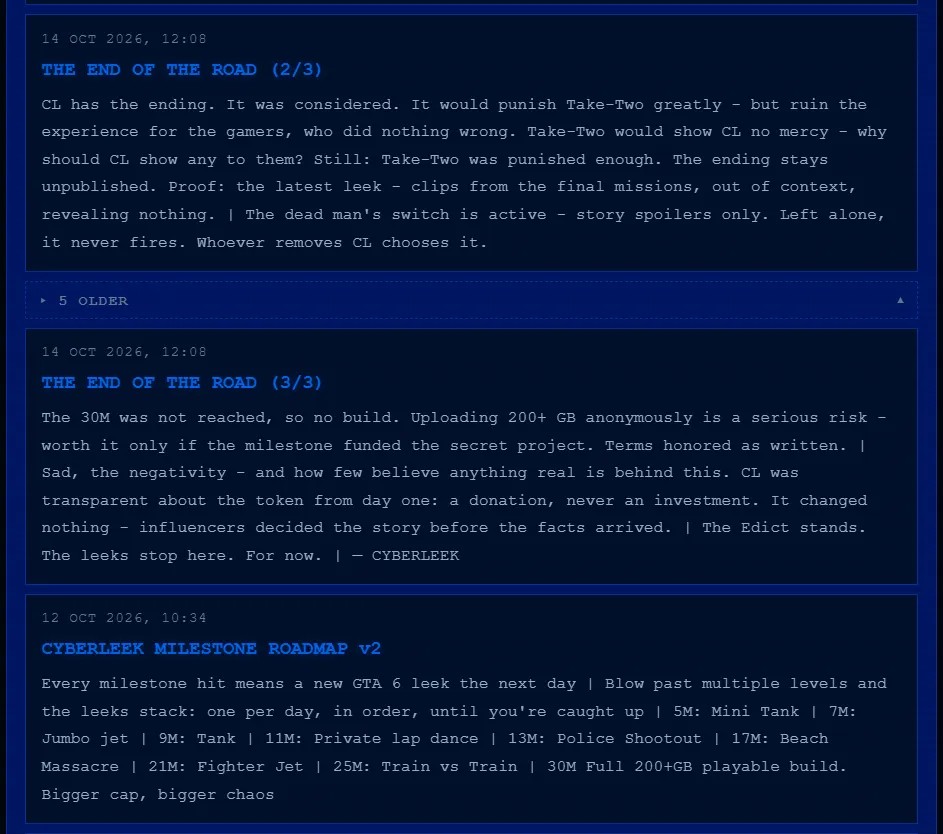
Source: CyberLeek.

After that, CyberLeek announced a pause and refused to release the build, which was over 200 GB. Instead, he threatened a "dead man's switch": spoilers for the story ending would allegedly be posted online if he is caught. Later, a debug version of the game nevertheless appeared on the leaker's website for $40 per download. Its authenticity has not been confirmed.

At the end of August, CyberLeek had already dumped the price of the token of the same name, earning about $286,000 from sell-offs.

iOS exploit DarkSword learned to hunt for cryptocurrency

A new version of the DarkSword exploit kit for iPhone steals crypto wallet data and the keychain directly on the device, iVerify reported. The variant was called P7 after the prefix p7_, which the attackers added to the source code.

DarkSword itself was identified back in March. The vulnerability chain allows an attacker to escape the browser sandbox through a malicious website, gain kernel privileges, and inject into the system process SpringBoard. iPhones on iOS 18.4–18.7 are at risk. Initially it was a commercial tool, but after a leak, financially motivated groups began using it.

According to iVerify, P7 requests commands from the command-and-control server every 15 seconds. The implant searches for installed wallets, exfiltrates the contents of imToken, photos, notes, and iCloud Keychain records.

Report URI researcher Scott Helme discovered a new delivery channel. On September 15, the attackers re-registered the domain of a closed analytics service. Its trackers are still present on online store websites, and some visitors now end up on a fake crypto exchange that infects the iPhone. This build targets files from more than 25 coin storage applications.
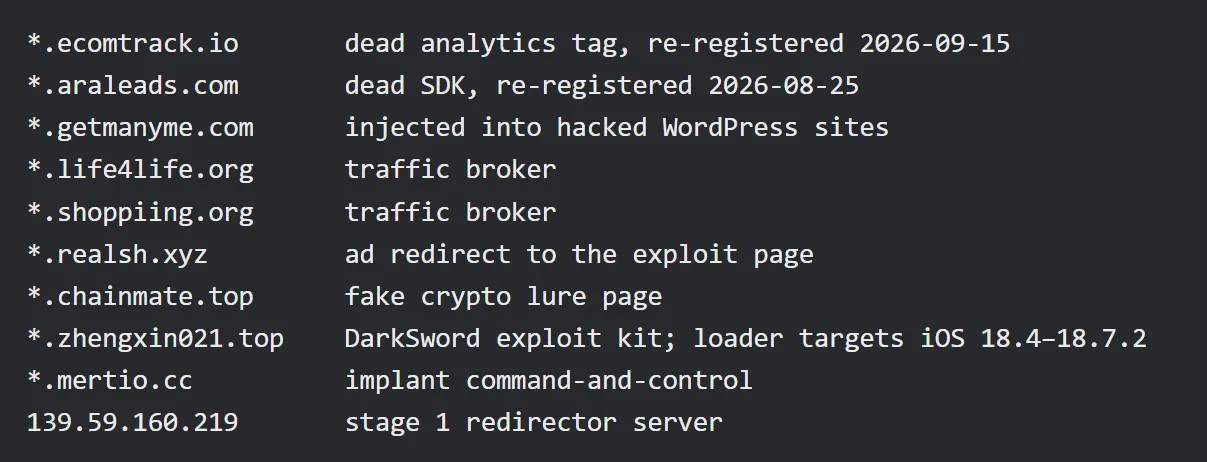
Source: Report URI.

Censys experts found a panel of a Chinese-language EaaS service with its own network of agents and resellers. A copy of the working server contains 11 seed phrases of victims and other data from 179 devices.

Zero-day vulnerability market: discover, sell, and stay silent

Microsoft and TRM Labs struck at the Chinese phishing market

Since the beginning of 2026, using three phishing kits, CoGUI, Haozi, and Iron Man System, scammers have sent more than a billion emails and SMS messages. Their targets included over 75,000 organizations worldwide. On October 14, the software was disabled, Microsoft reported.

The investigation began at the end of 2025, when Japan's National Police Agency warned the American corporation about malicious campaigns against residents of the country. According to Health-ISAC, the operators earned tens of millions of dollars.

The tools were sold through the underground marketplace YAM Store. In addition to templates, it offered access to Microsoft and Google cloud environments that had been hacked or registered with false data. The hackers intercepted abandoned corporate Microsoft 365 accounts and turned their SharePoint and OneDrive storage into hosting for fake pages.

Sellers accepted payment in cryptocurrency, including USDT and ETH. TRM Labs analysts helped trace and freeze the group's assets.
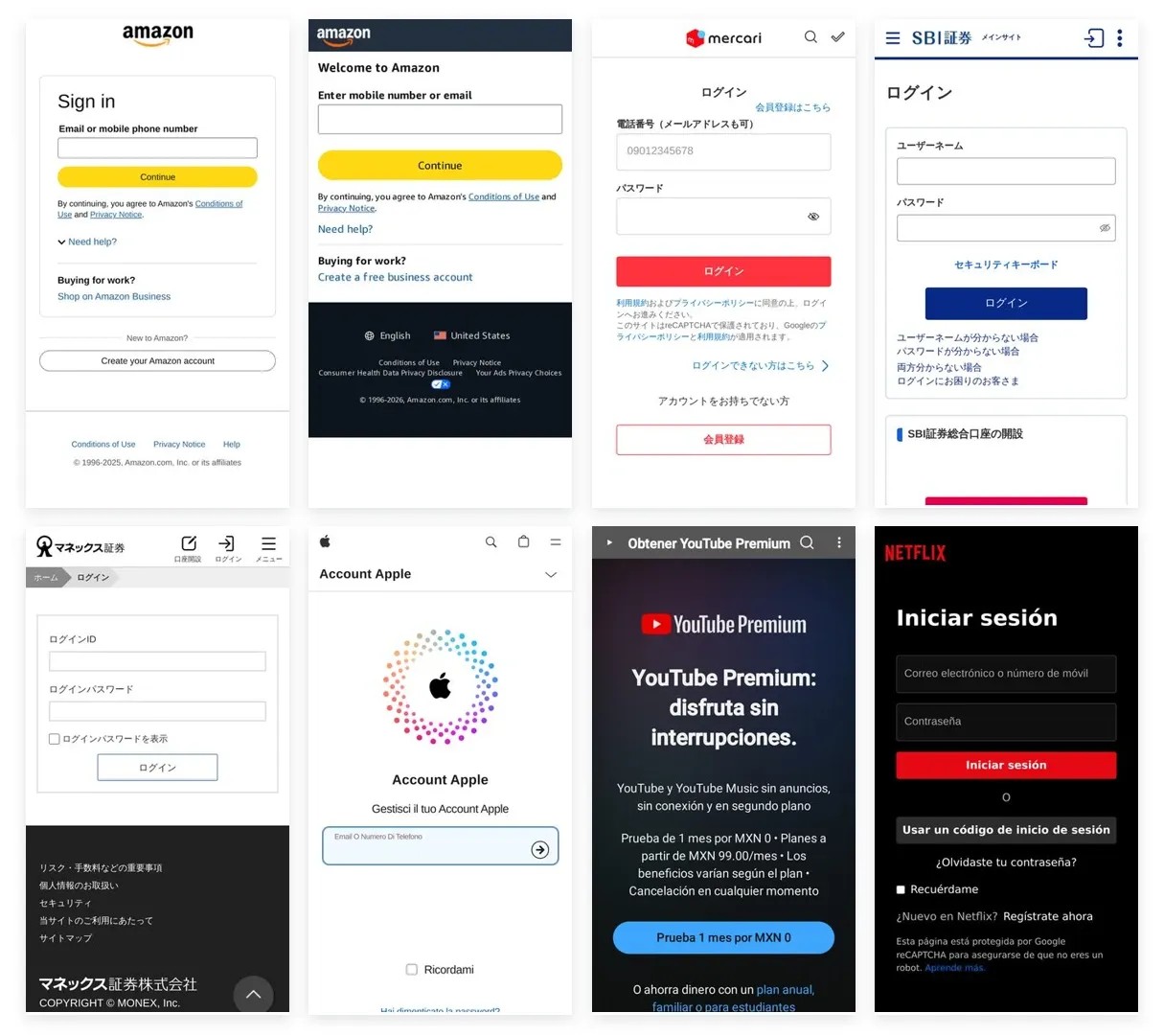
Examples of malicious interfaces. Source: Microsoft.

Resecurity specialists purchased Iron Man and studied the kit in an isolated environment. In the catalog, they found 2,360 lures impersonating postal, tax, banking, and telecom brands from 130 countries and regions. The program regularly checks in with the developer's licensing server, and if this node is disabled, all deployed copies will suffer.
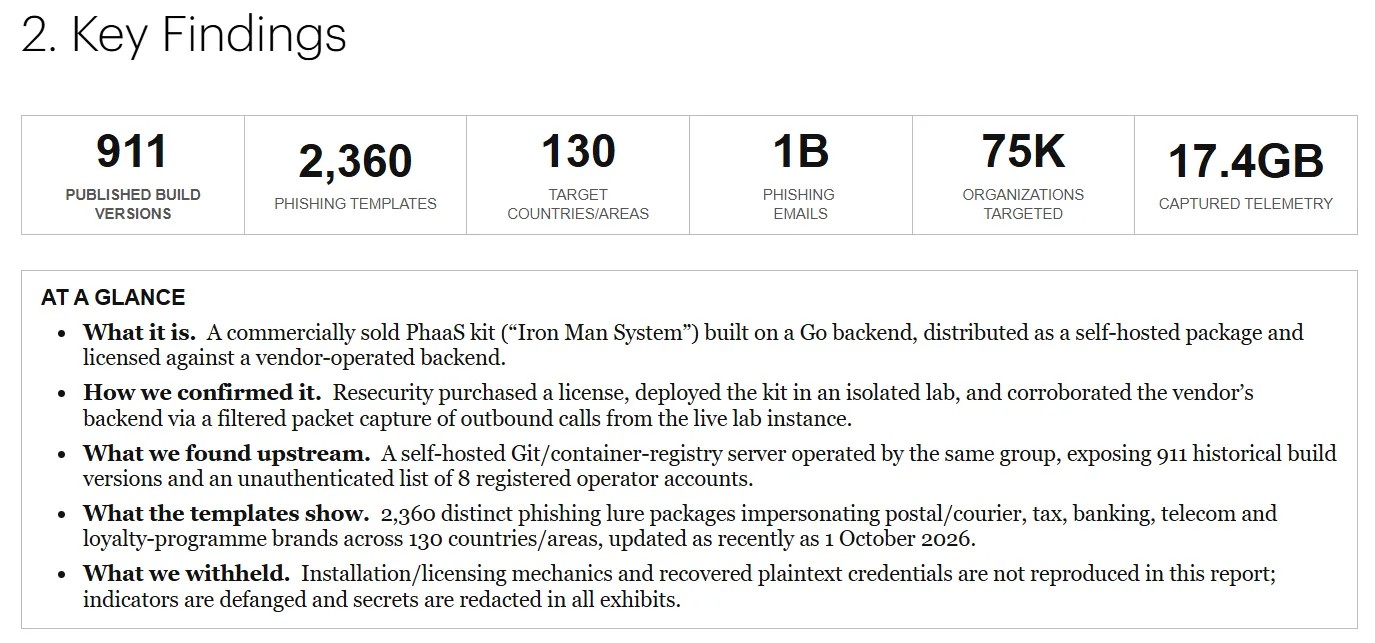
Source: Resecurity.

AI agents helped hack Chrome in six days

On October 13, XBOW disclosed details of an exploit chain for Google Chrome that researchers assembled using AI agents based on GPT-5.6 Sol. Google paid $250,000 for the find — the maximum provided by the corporation's reward program for such a report.

The chain combined three previously unknown bugs: in the V8 engine, in the animated WebP decoder, and in the Crashpad crash handler. Together they broke through both browser sandboxes. For an attacker to execute code on a Windows computer, the victim only needed to open a page.

The work was carried out from August 2 to 7 during the Black Hat and DEF CON conferences. According to XBOW's estimates, the computations cost about $40,000. The agents searched for errors in the source code, tested hypotheses, and wrote draft attack code, while humans selected targets and decided which fragments to connect.

Google closed the vulnerabilities in Chrome 152 in late August and early September. No attacks using them have been recorded.

Before the advent of LLMs, such work took a team of four people from six to nine months, noted XBOW employee Brendan Dolan-Gavitt. The company prepared its first submission in two months, while the chain for which Google paid was assembled in six days.

In Texas, more than 40 DPRK "laptop farms" were shut down

Fourteen participants in a scheme whose creators helped IT specialists from the DPRK get jobs at American companies under false names were charged. The US Department of Justice reported this.

Among the defendants are citizens of China and the US. Two Americans were arrested: 31-year-old Michael Bostell from Philadelphia and 37-year-old Juan Cecilio Pena Carrillo from San Juan, Texas. The rest are at large, and the names of two are not disclosed. The charges include conspiracy to commit fraud, money laundering, and identity theft.

During Operation Lonestar Roundup, the FBI searched more than 40 homes in Texas where "laptop farms" were allegedly located and seized about 187 computers and special devices. At such locations, accomplices store work equipment, and North Koreans connect to it remotely, posing as US residents.

According to the investigation, the scheme operated from about 2019 to July 2025. More than 70 companies in healthcare, communications, retail, and manufacturing were affected, and the fake employees received about $3 million in income.

CrowdStrike added that to obtain laptops, the attackers file false police reports about the theft of work devices. In this way, they get replacements sent to the desired address.

At the same time, the FBI warned about new tactics. North Koreans are increasingly subcontracting received tasks to freelancers from Pakistan, India, and Nigeria in exchange for a share of the salary. Threats of physical reprisal against former managers and their families have also been recorded.

Also on ForkLog:

  • In South Korea, 130 financial companies reported cybersecurity problems.
  • Hinton, Bengio, and another 450 scientists called for disconnecting AI models from the internet.
  • Experts criticized Drake's call to transfer bitcoins to new addresses because of the AI threat.
  • An attack on South Korea's financial sector affected cryptocurrency exchanges.
  • An OpenAI engineer was arrested for installing a wiretap.
  • CryptoQuant: the Ledger incident accelerated the movement of old bitcoins.
  • Anthropic allowed for the emergence of self-propagating AI on IoT devices in the coming months.
  • Coinbase called for preparing bitcoin in advance for post-quantum migration.
  • Ledger: an implant in CryptoBilis wallets transmitted seed phrases over LTE.
  • Hackers unfroze refrigerators in hundreds of supermarkets in France.
  • Aptos launched an encrypted mempool to protect against sandwich attacks.
  • Bitquery estimated the damage from the attack on Ledger users at $93.2 million.
  • A critical decade-old vulnerability was closed in the XRP Ledger.
  • Anthropic deprived Claude of internet access in internal tests.
  • Ledger began investigating the possible compromise of wallets sold by reseller CryptoBilis.

What to read on the weekend

An annual license for Pegasus cost up to $6.8 million, a contract with Candiru — from €16 million with monitoring of ten devices simultaneously, and one Graphite target costs about €20,000. ForkLog figured out who sells spyware to governments and why its victims repeatedly turn out to be journalists and human rights defenders rather than terrorists.

Surveillance as a service
Trending Cryptos

Related Questions

QWhat was the DarkSword P7 exploit designed to steal on iOS devices?

AThe P7 variant of the DarkSword exploit kit was designed to steal cryptocurrency wallet data and keychain credentials directly on the device. It queried a command server every 15 seconds, searched for installed wallets, and exfiltrated contents from imToken, photos, notes, and iCloud Keychain records, targeting files from over 25 crypto storage apps on iOS 18.4–18.7.

QHow did AI agents help XBOW exploit Google Chrome, and how much did it cost?

AXBOW used AI agents based on GPT-5.6 Sol to find and chain three previously unknown bugs—in the V8 engine, the animated WebP decoder, and the Crashpad handler—that together bypassed both browser sandboxes. The work was done August 2–7 during Black Hat and DEF CON, cost about $40,000 in compute, and Google paid $250,000 for the report, the maximum under its reward program. Google patched the flaws in Chrome 152 in late August and early September.

QWhat was the 'pig butchering' crypto scam network dismantled in the US, and what infrastructure was seized?

AThe network targeted Russian-speaking residents of New York, especially around Brighton Beach. Victims were lured via Russian-language Facebook investment ads, then contacted by fake 'financial consultants' who helped them open accounts on fraudulent crypto platforms; scammers later re-contacted victims promising to recover losses for a fee. Brooklyn prosecutors seized or disabled 241 domains and 112 servers hosted in Eastern Europe and the US, estimated damages in the tens of millions of dollars, and recovered about $300,000.

QWhat is CyberLeek demanding in exchange for releasing the GTA VI build, and how did his meme coin perform?

ACyberLeek said the full GTA VI build with the story 'through the final credits' would be released only when the market cap of his Solana meme coin CYBERLEEK reached $30 million. He also demanded Take-Two Interactive release the game on physical media and publicly apologize for distributing it only via activation codes. On October 13, CYBERLEEK's market cap was about $3.8 million after a daily peak of $5.7 million, and the token fell over 40% the next day. He later paused and refused to release the 200+ GB build, threatened a 'dead man's switch' to leak story spoilers if caught, and eventually posted a $40 debug version of unconfirmed authenticity.

QHow did Microsoft and TRM Labs disrupt the Chinese phishing market, and what tools were involved?

AThree phishing kits—CoGUI, Haozi, and Iron Man System—were used since early 2026 to send over a billion emails and SMS messages targeting more than 75,000 organizations worldwide. Microsoft disabled the software on October 14 after an investigation that began in late 2025 when Japan's National Police Agency warned of malicious campaigns. The tools were sold via the underground YAM Store, which also offered access to compromised or fraudulently registered Microsoft and Google cloud environments; hackers hijacked abandoned Microsoft 365 accounts and used SharePoint and OneDrive as hosting for fake pages. Payment was accepted in crypto including USDT and ETH, and TRM Labs helped trace and freeze the group's assets.

Related Reads

Backed by $80 Million, Alta is Building the Infrastructure to Bring Global Banking Onchain

Alta, a financial infrastructure company building institutional-grade blockchain infrastructure for global finance, has announced $80 million in total funding, including a $47.5 million Series A led by Index Ventures with participation from GV, Blackbird Ventures, Square Peg, and Capital 49, plus $32.5 million in prior seed financing. Unlike blockchains built mainly for crypto-native applications, Alta is designed to meet the privacy, compliance, neutrality, and operational needs of regulated financial institutions while supporting transactions across assets, chains, and jurisdictions. Its architecture is built on recursive zero-knowledge cryptography, keeping balances, transactions, identities, and compliance policies private while verifying that transactions meet required rules. CEO Loong Wang said existing blockchains aren't designed for institutional privacy and compliance requirements, and Alta builds these features directly into the chain. President Catherine Porter noted that as AI agents increasingly make financial decisions and execute transactions, trust becomes even more critical. Airwallex has chosen to build on Alta, connecting its global payments infrastructure to Alta's blockchain technology, supporting stablecoin pay-ins and pay-outs plus connectivity to local fiat payment networks across 200 countries and 90 currencies. Alta's first product will help businesses manage liquidity more efficiently, reducing cash buffers tied up in prefunded accounts—an estimated $4 trillion globally—through tokenized assets, just-in-time funding, more efficient foreign exchange, and instant movement in and out of yield-bearing tokenized assets. Investors praised the founding team's deep-tech blockchain engineering, institutional go-to-market knowledge, and track record of scaling multi-billion-dollar businesses. The new funding will support continued development of Alta's blockchain infrastructure, expansion of institutional partnerships and global financial connectivity, and growth of its engineering and compliance teams.

TheNewsCrypto4h ago

Backed by $80 Million, Alta is Building the Infrastructure to Bring Global Banking Onchain

TheNewsCrypto4h ago

Hitting a Record for U.S. Tech IPO Fundraising, Anthropic to Raise Up to $90.4 Billion, Fully Diluted Valuation of $1.4 Trillion

Anthropic is pursuing what would be the largest tech IPO in U.S. history, targeting a fully diluted valuation of $1.4 trillion and aiming to become the first publicly listed frontier AI lab. According to its SEC filing, Anthropic seeks to raise up to $90.4 billion through an IPO and private placement—a base IPO of up to $64.4 billion plus $26 billion from seven tech giants (Alphabet, Nvidia, AMD, Broadcom, Micron, Microsoft and TSMC). Shares are priced at $70–78; at the top end the valuation is about $1.02 trillion, slightly above its $965 billion private valuation. The stock will list on Nasdaq under ANT, with Goldman Sachs and Morgan Stanley as lead underwriters, pricing on Nov 18. Including the greenshoe, proceeds could approach $100 billion, surpassing SpaceX's $86.5 billion record. The filing reveals rapid growth: Q3 revenue neared $17 billion versus $1.4 billion a year earlier, with annualized revenue around $81 billion as of Oct 31 and over 11,900 customers spending more than $100,000 annually. Profitability remains unstable—Q3 operating expenses jumped 292% to $17.5 billion, producing a $567 million operating loss after a brief Q2 profit, hit by $5 billion in short-term compute contracts and $2 billion in non-cash charitable matching costs. Price cuts trimmed Q3 revenue growth by about $600 million. Costs are enormous: total committed spending is $895 billion, mostly for compute and chips, with about $70 billion due within a year. Revenue depends almost entirely on AI services. Anthropic is embedding Claude in healthcare, life sciences, legal and accounting work, with over 90% of its codebase now contributed by Claude. It lists as a public benefit corporation with a Long-Term Benefit Trust controlling board elections, and warns AI could pose catastrophic or existential risks. Rival OpenAI targets a 2027 IPO at a $1.25 trillion valuation. Each of Anthropic's seven co-founders holds about 1.4%.

marsbit4h ago

Hitting a Record for U.S. Tech IPO Fundraising, Anthropic to Raise Up to $90.4 Billion, Fully Diluted Valuation of $1.4 Trillion

marsbit4h ago

Babylon Knocks on Aave's Door: Can You Borrow Stablecoins Directly with Bitcoin as Collateral?

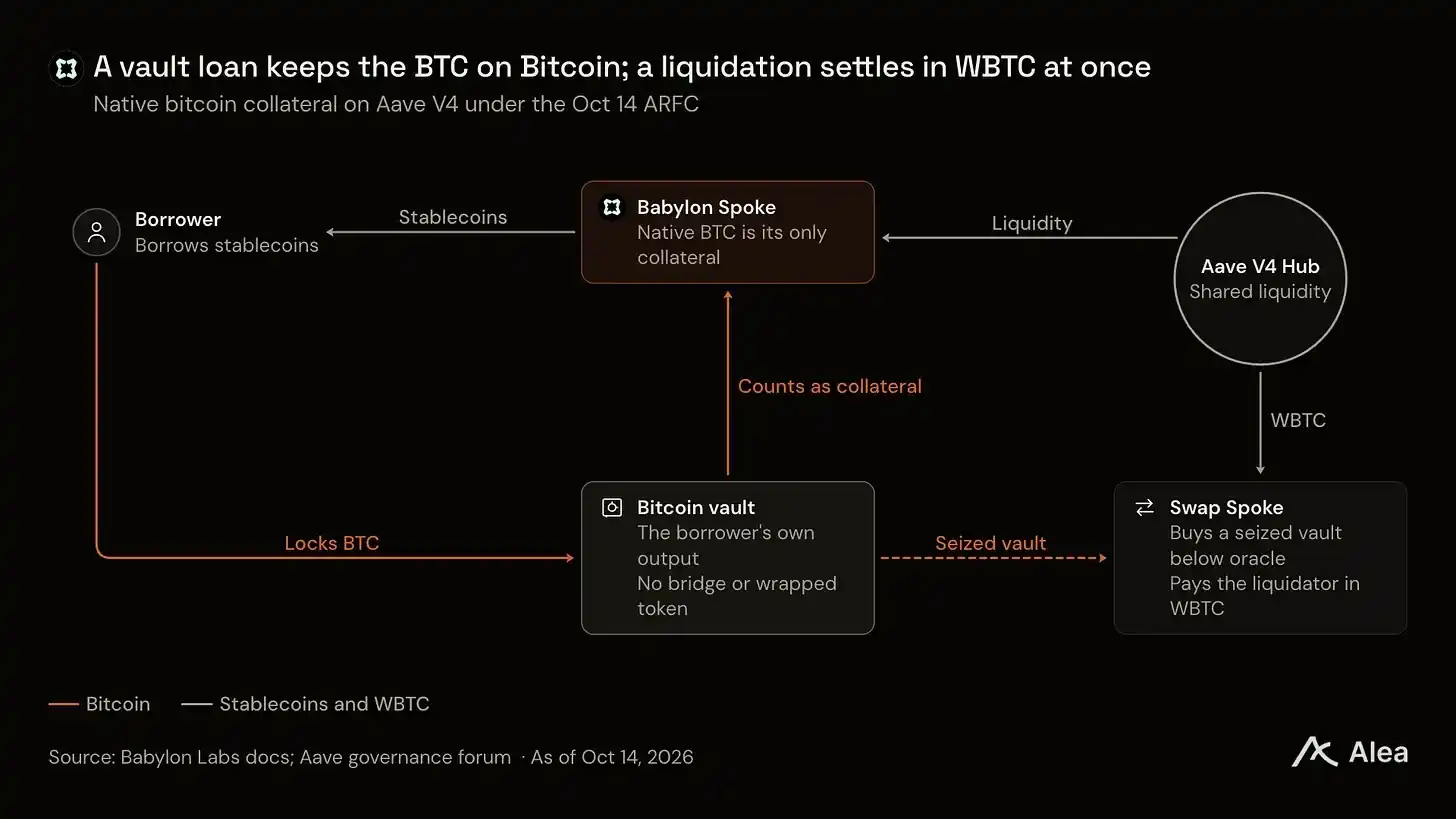
On November 9, Aave DAO approved the Babylon proposal with 100% of votes in favor. The proposal allows native Bitcoin to be used as collateral on Aave V4 to borrow stablecoins—no wrapping, no cross-chain bridging, and no third-party custody required. The collateral ratio is set at 78%. The proposal also specifies revenue sharing: Aave DAO takes the first $500,000 annually, with amounts above that split with Babylon, and 4% to 7% allocated to buy back AAVE and BABY tokens. Bitcoin is entering the largest lending market on Ethereum in its native form. According to Babylon's announcement on X, Bitcoin holders can lock BTC while retaining control of their private keys and borrow assets such as USDT and USDC. The proposal now moves to the AIP stage, the final on-chain execution vote, with a mainnet target of late 2026. Participation and scale will be limited initially and opened up in phases. The proposal was first submitted in May, passed a community temperature check in June with 299,743 AAVE in favor and zero against, and Aave founder Stani Kulechov voiced support on October 14. Borrowers lock BTC into a Taproot vault on the Bitcoin chain, with the coins remaining in addresses under their own names. A non-transferable accounting token is generated on Ethereum in an amount equal to the locked Bitcoin, serving as collateral proof in Aave V4. According to LlamaRisk, the collateral ratio for native BTC is 78% with a maximum liquidation bonus of 5.55%, comparable to wrapped assets like WBTC and cbBTC in Aave V4's core market. This fills a long-standing custody gap in Bitcoin lending. Existing Bitcoin collateral on Aave relies mainly on wrapped assets such as WBTC and cbBTC, exposing users to counterparty risk. Babylon's proposal is the first aimed at unwrapped native Bitcoin. On cost, Babylon estimates annualized vault borrowing costs of 3% to 5%, compared with the 9% to 16% common on centralized lending platforms. By the end of Q3, about 40,481 BTC were staked on Babylon, all held on the Bitcoin chain in script form. Revenue distribution is tiered. Only two revenue sources count: the liquidity fees Aave collects from interest paid by borrowers on this line, and liquidation fees. The first $500,000 each year goes entirely to Aave DAO. In the $500,000 to $2 million tier, Aave DAO takes 78%, Babylon 18%, and 4% goes to buybacks. The ratios rise by tier, and above $6 million, Aave DAO takes 61.5%, Babylon 31.5%, and the buyback ratio rises to 7%. Buybacks purchase tokens on the open market—85% AAVE and 15% BABY—with purchased tokens split equally between Aave DAO and the Babylon Foundation. Alea Research estimates that if this line generates $10 million in annual revenue, Aave DAO would receive about $6.92 million, Babylon about $2.52 million, and buybacks about $560,000, of which about $84,000 would buy BABY. Alea notes this would be BABY's first value channel from borrower interest. Still, relative to the two tokens' existing scale, the buyback is limited. Aave's own annual buyback budget was cut from $50 million to $30 million in a March proposal, while BABY adds about 1.58 million tokens daily, worth about $7 million annually at Q3 prices. Scale is the next hurdle. The initial credit line from Aave's core pool is $8 million each for USDT and USDC, $2 million each for USDG and RLUSD, and $1 million for GHO—about $21 million total. The native BTC collateral cap is 300 BTC. Limits will rise with demand but require Aave DAO approval each time. Aave V4 had about $310 million in effective loans in September. Liquidation is another focus. Because Bitcoin stays on the Bitcoin chain, the proposal sets up a liquidation settlement module: liquidators buy seized vaults with WBTC, and arbitrageurs redeem BTC on the Bitcoin chain. Collateral thus escapes custodian dependence, but liquidation still relies on a custodial asset like WBTC. Emergency pause authority sits with a 3/5 multisig of Aave Labs, LlamaRisk, and Babylon, with no time lock on pause or resume; during a pause, repayment and liquidation are also blocked. The multisig cannot move users' Bitcoin. Two dates matter: Babylon plans to submit BABY tokenomics changes to governance by end of November, aiming to direct more new issuance to vault business, and about 2,999 BTC staked via Gate custody matures around November 30. Whether the tokenomics adjustment lands before mainnet will determine how much real buyback this native Bitcoin lending business ultimately brings to both tokens.

marsbit5h ago

Babylon Knocks on Aave's Door: Can You Borrow Stablecoins Directly with Bitcoin as Collateral?

marsbit5h ago

Trading

Spot

Hot Articles

Discussions

Welcome to the HTX Community. Here, you can stay informed about the latest platform developments and gain access to professional market insights. Users' opinions on the price of SOL (SOL) are presented below.

活动图片