CryptoQuant’s 3 charts keeping Bitcoin’s ‘Uptober’ thesis valid

cointelegraphPublished on 2026-10-14Last updated on 2026-10-14

Abstract

CryptoQuant's analysis suggests Bitcoin (BTC) may still achieve a strong performance in October, traditionally known as "Uptober," as on-chain data points to a potential local price bottom forming. Key indicators show cautious optimism: Bitcoin exchange reserves have decreased by 1.7% since mid-September, reducing selling pressure, while whale holdings remain stable above 3 million BTC despite recent price drops. The "apparent demand" metric, which had been negative for most of 2026, is nearing positive territory again, indicating recovering demand. Analysts note that cooling expectations for U.S. interest rate hikes and reduced political uncertainty post-midterm elections could further support risk assets like Bitcoin. However, confirmation of a sustained bottom requires continued ETF inflows and stronger spot buying. The report emphasizes that an "Uptober" rally does not preclude corrections, which can build a foundation for future advances.

Bitcoin (BTC) can still preserve its traditionally strong October performance, as onchain data points to a local BTC price bottom forming.

Key points:

  • Onchain data suggested that Bitcoin could still end October strong, following historical patterns.
  • Bitcoin exchange reserves remained 1.7% lower than in mid-September, while whales avoided selling.
  • Apparent demand neared a transition to positive readings for the second time in 2026.

BTC price analysis flags “potential bottom” signals

New analysis published on crypto analytics platform CryptoQuant Monday show onchain conditions in a state of “cautious optimism.”

Bitcoin continues to weather mixed macroeconomic and geopolitical headwinds, which include 24-year highs in US bond yields, rising oil prices and cooling capital inflows to exchange-traded products. These conditions have dampened optimism over Bitcoin delivering a strong performance in October.

“Now, signs of a potential bottom are emerging,” CryptoQuant contributor XWIN Research Japan wrote.

Since the start of October, conditions have changed to increasingly benefit crypto and risk assets. XWIN points to cooling expectations of interest-rate hikes by the Federal Reserve into 2027, boosting the odds of inflows improving. At the same time, markets expect more clarity over the US domestic political situation after the approaching Midterm Elections.

“Less political uncertainty after the vote could help investors reassess allocations,” XWIN continued.

Bitcoin exchange reserves, apparent demand and whale holdings give XWIN reasons to believe that October’s local low may have already occurred.

The BTC supply on exchanges has fallen from 2.726 million on Sept. 20 to 2.68 million as of Tuesday, a decrease of 1.7%, despite a modest increase over the past week.
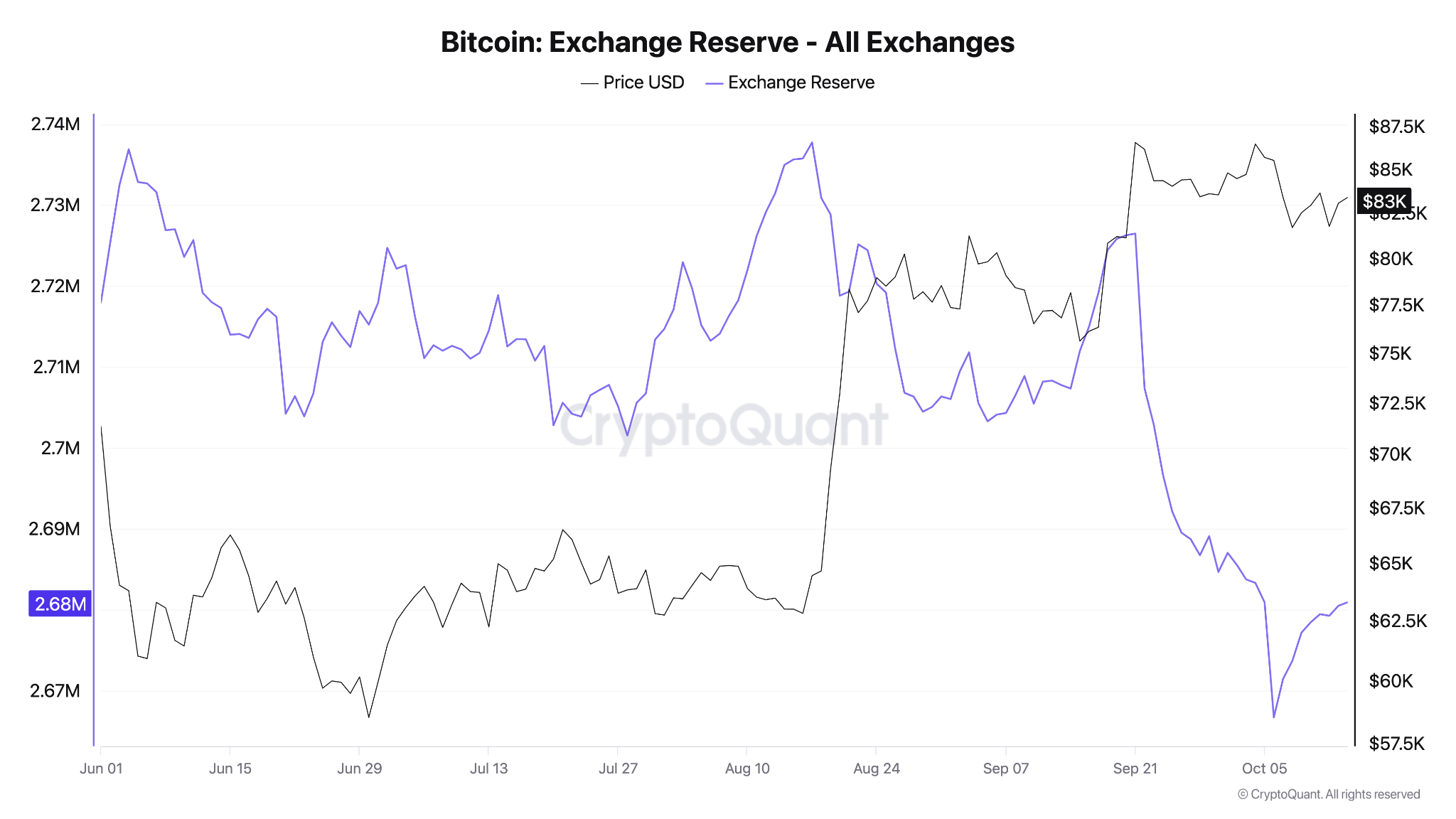
Bitcoin exchange BTC reserves. Source: CryptoQuant

At the same time, the combined holdings owned by large-volume investors, or whales, remain above 3 million BTC. The cohort’s urge to reduce exposure has survived BTC/USD dropping from $87,000 on Oct. 2 to near $80,000 on Oct. 8.
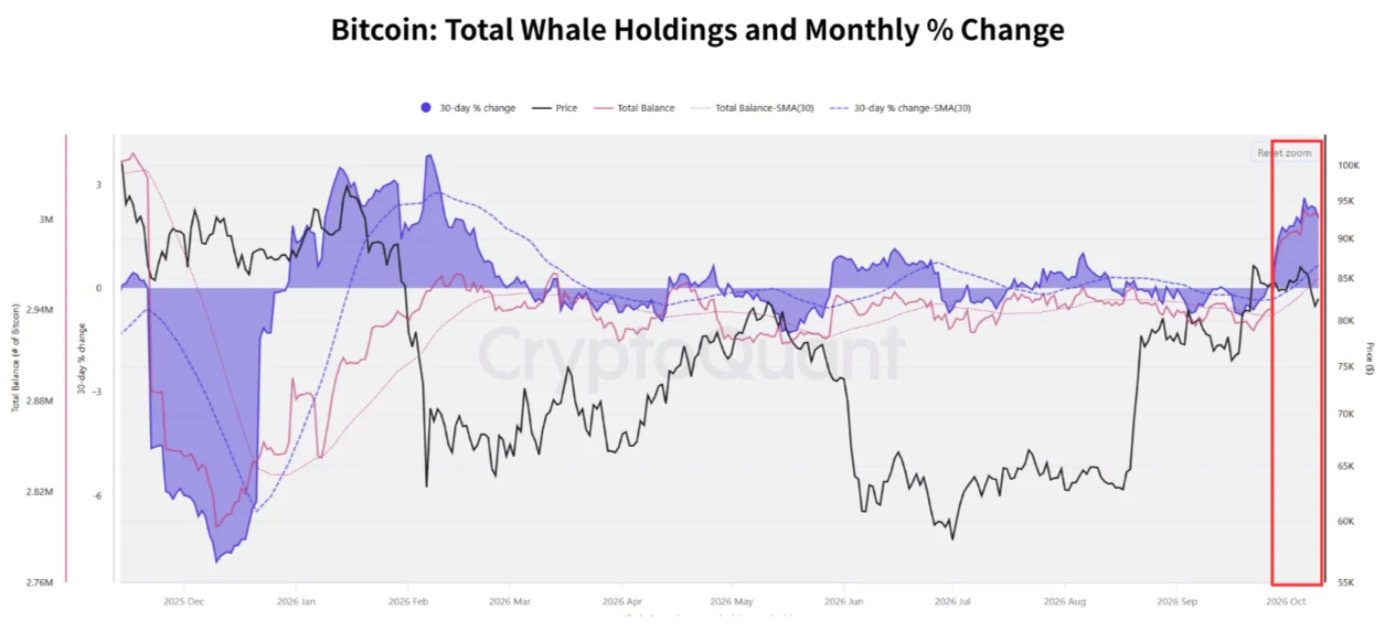
Bitcoin whale holdings (screenshot). Source: CryptoQuant

Bitcoin demand data stays bullish in October

Apparent demand, a measure that compares newly mined BTC with changes in dormant supply, shows overall demand remains supportive.

Related: Bitcoin keeps up pressure on $84K as US stocks skirt Korea tech sell-off

The metric has been negative throughout 2026, with a brief period of positive 30-day readings in the second half of August. Since then, demand has been negative, but has recovered to near-neutral levels as of this week.

“These developments suggest conditions for a bottom are improving. Confirmation requires sustained ETF inflows, stronger US spot buying and continued demand recovery,” XWIN said.

“‘Uptober’ need not mean uninterrupted gains: a correction can build the foundation for the next advance.”
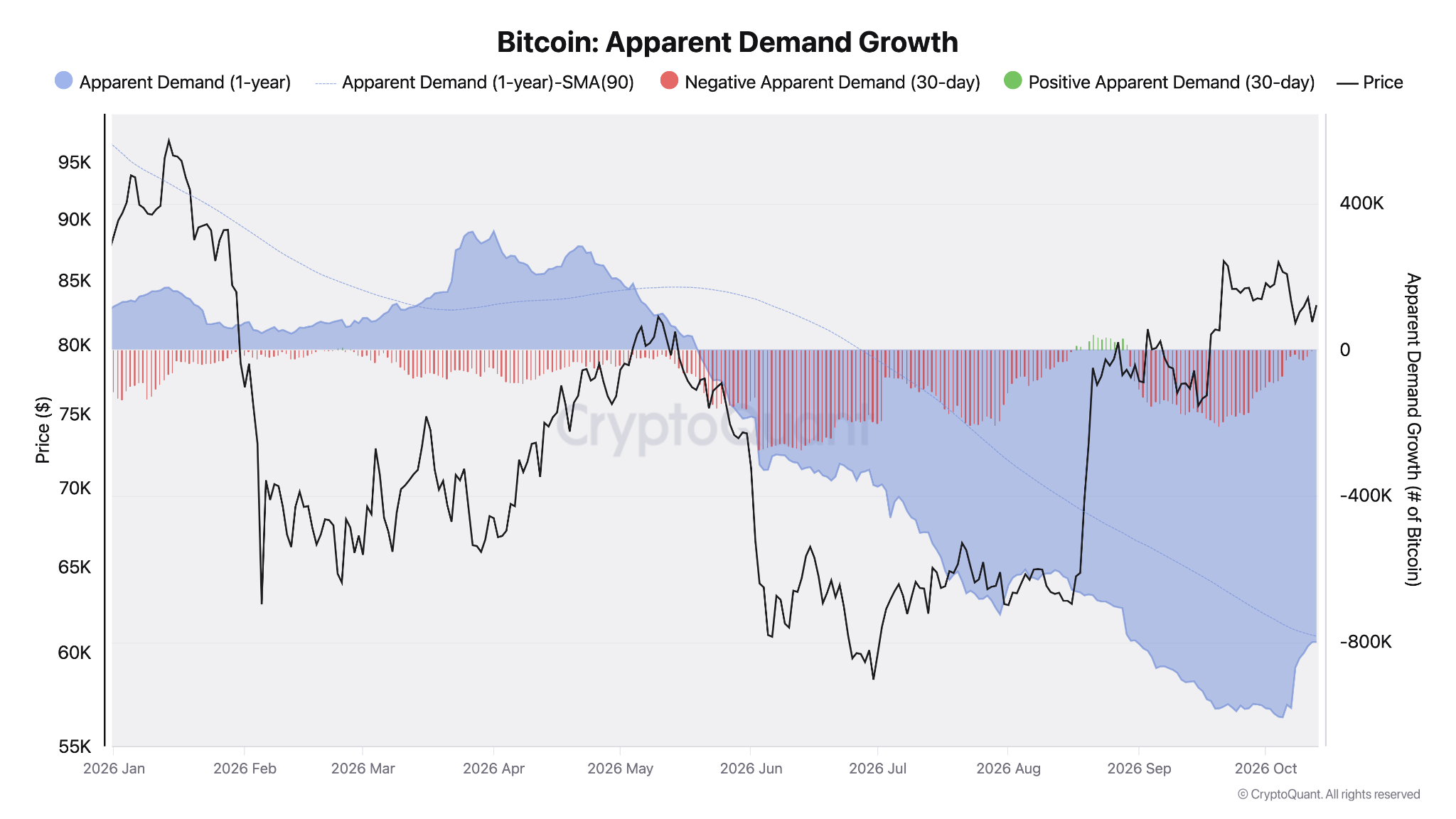
Bitcoin apparent demand growth. Source: CryptoQuant

This week, crypto asset manager Bitwise said that Q3 onchain data pointed to “crypto spring” after historically significant performance. CryptoQuant CEO Ki Young Ju, meanwhile, announced what he saw as the start of a new crypto bull market in late August, calling the bear market “over.”

Trending Cryptos

Related Questions

QWhat is the main argument presented by CryptoQuant for Bitcoin's 'Uptober' thesis remaining valid?

ACryptoQuant argues that on-chain data points to a potential local price bottom forming for Bitcoin, suggesting the traditionally strong October performance could still occur. Key signals include decreasing exchange reserves, whales avoiding selling, and apparent demand nearing positive territory.

QAccording to the article, what are the three specific on-chain metrics that XWIN Research highlights as reasons for optimism?

AThe three specific on-chain metrics are: 1) Bitcoin exchange reserves falling by 1.7% since mid-September, 2) whale holdings remaining above 3 million BTC despite price drops, and 3) apparent demand (comparing newly mined BTC to dormant supply changes) recovering to near-neutral levels.

QWhat macroeconomic and geopolitical factors were mentioned as headwinds for Bitcoin's price?

AThe headwinds mentioned include 24-year highs in US bond yields, rising oil prices, and cooling capital inflows to Bitcoin exchange-traded products (ETFs).

QWhat conditions does XWIN say are needed to confirm a market bottom for Bitcoin?

AXWIN states that confirmation of a market bottom requires sustained ETF inflows, stronger spot buying in the US, and a continued recovery in demand metrics.

QHow does the article characterize the overall state of the cryptocurrency market based on Q3 data and CEO comments?

ABased on Q3 on-chain data, asset manager Bitwise pointed to a 'crypto spring.' Furthermore, CryptoQuant CEO Ki Young Ju announced in late August what he saw as the start of a new crypto bull market, declaring the bear market 'over.'

Related Reads

How Various Assets Have Performed So Far This Year: Bitcoin at -22% Return, Dead Last

As of November 13, 2026, Bitcoin has posted a -22.0% year-to-date return, ranking last among major asset classes. In contrast, the Philadelphia Semiconductor Index gained 43.2% despite a sharp pullback from its mid-year peak of 106.6%, while the S&P 500 and Nasdaq Composite held steady gains of roughly 8% to 10%. Even the CSI 300 (-13.3%) and gold GLD (-10.3%) outperformed Bitcoin. The article argues the key difference lies in the presence of real buying support. Semiconductors are backed by massive capital expenditure and order backlogs from major tech companies, giving them an earnings floor even after steep corrections. Bitcoin, by contrast, lacks such support. After spot ETFs helped Wall Street finish building core positions in 2024–2025, 2026 brought neither broad macro liquidity nor a new narrative capable of drawing fresh capital. ETF inflows slowed from a flood to a seasonal trickle. Without sustained new buyers, Bitcoin's high beta works only to the downside: in a stock-picking, zero-sum market it becomes the asset everyone wants to sell into strength. The article further notes that Bitcoin's positioning is losing focus. It has failed to act as either a "digital gold" hedge or a high-beta proxy for tech stocks. It lagged the Nasdaq and S&P 500 during the tech rally, and fell harder than gold when global assets contracted in November. The conclusion: Wall Street treats Bitcoin not as a safe haven but as a highly liquid, 24/7 liquidation tool—the first asset sold when institutions need to meet margin calls or lock in yearly profits. Crypto has been admitted to the table, but often as the one picked to pay the bill.

marsbit41m ago

How Various Assets Have Performed So Far This Year: Bitcoin at -22% Return, Dead Last

marsbit41m ago

From QR Codes to Physical Goods: How Consumer RWA Verifies Products and Rights

A single QR code can be printed on two bottles and scanned twice to open the same page, so verifying a physical item requires confirming the binding between the bottle in hand and its listed number. Consumer RWA verification has two parts: whether the goods or services are real, and whether the rights recorded in the digital credential are valid. For rights provenance, take a co-branded gift box: authorization documents define the term and scope in which a brand may use the co-branded mark, production and warehousing records show whether the box was stocked by batch, and rights registration states what holders can redeem and who delivers it. Linking all three lets consumers check authorization scope, supply, and their own eligibility. Identifiers, events, and evidence must work together. High-value items can use unique serial numbers, uniform-spec goods can use batch numbers, and courses or events can use session numbers. Events such as warehousing, sampling, outbound shipment, receipt, and redemption should be tied to the corresponding object, with operation time and responsible party retained. Test reports correspond to submitted samples; linking results to specific goods also requires checking the sample, batch, and inbound/outbound records. Ordinary batch goods can combine serialized QR codes with abnormal-scan records, while high-value items may add tamper-evident labels or independent authentication. Trusted records must also reflect current status. If a coffee batch has 500 bags at warehousing, 10 used for sampling, and 100 reserved for other channels, then absent other changes, 390 bags remain available for new rights. The warehousing record shows historical quantity; current redeemable quantity must be updated based on actual occupancy. A query page should at minimum state the goods or service, evidence source, last update time, and whether the credential is currently usable.

marsbit1h ago

From QR Codes to Physical Goods: How Consumer RWA Verifies Products and Rights

marsbit1h ago

10 Years Is Too Slow: Gu Quanquan's Team Challenges Dario, Compressing Cancer Cure to 4 Years

A UCLA professor, Quanquan Gu, has founded Geodesic Intelligence, a 15-person startup that after only five months has released NovaAtom-Lite, an all-atom structure prediction model that outperforms DeepMind's Isomorphic Labs flagship IsoDDE on FoldBench, the toughest biomolecular benchmark. The model predicts the 3D coordinates of every heavy atom in protein, DNA, RNA, and ligand complexes with near-experimental precision. NovaAtom-Lite posted top scores on two core pharma tests: antibody-antigen binding (79.07% success, 31 points above AlphaFold 3 and 3.5 above IsoDDE, with 2.2x AlphaFold 3's accuracy at high-precision thresholds) and protein-ligand binding (top 1 on both RMSD and contact metrics). On the Runs N' Poses benchmark, which separates memorization from genuine physics understanding, NovaAtom-Lite's lead grows on the most novel, out-of-distribution ligands (47.6% vs AlphaFold 3's 24%), showing it learns transferable physical rules rather than memorizing structures. The model also supports test-time scaling—raising sampling from 1 to 100 seeds lifts antibody success from 74.3% to 83.1%—and condition constraints, where a single contact-pair hint boosts success to 91.28% and full pocket hints lift hard-case ligand accuracy by nearly 16 points. It solved two nightmare cases: a wildly flexible 22-residue MERS nanobody loop (0.56 Å error, all 25 samples correct) and the KRAS G13D hidden switch-II pocket (0.98 Å ligand RMSD vs OpenDDE's 17.74 Å). Gu previously led ByteDance's SeedFold, the first model to beat AlphaFold 3 on FoldBench, forcing Isomorphic Labs to respond with IsoDDE. A stronger NovaAtom-Pro is coming. Days after launch, a16z cited NovaAtom-Lite in a report arguing pharma is entering its "GPT-3 moment," naming Geodesic as the sole company highlighted in its industry map. Geodesic's closed loop spans structure prediction, scientific reasoning, and wet-lab validation—aiming to compress drug discovery from a decade to four years.

marsbit1h ago

10 Years Is Too Slow: Gu Quanquan's Team Challenges Dario, Compressing Cancer Cure to 4 Years

marsbit1h ago

Trading

Spot

Hot Articles

What is $BITCOIN

DIGITAL GOLD ($BITCOIN): A Comprehensive Analysis Introduction to DIGITAL GOLD ($BITCOIN) DIGITAL GOLD ($BITCOIN) is a blockchain-based project operating on the Solana network, which aims to combine the characteristics of traditional precious metals with the innovation of decentralized technologies. While it shares a name with Bitcoin, often referred to as “digital gold” due to its perception as a store of value, DIGITAL GOLD is a separate token designed to create a unique ecosystem within the Web3 landscape. Its goal is to position itself as a viable alternative digital asset, although specifics regarding its applications and functionalities are still developing. What is DIGITAL GOLD ($BITCOIN)? DIGITAL GOLD ($BITCOIN) is a cryptocurrency token explicitly designed for use on the Solana blockchain. In contrast to Bitcoin, which provides a widely recognized value storage role, this token appears to focus on broader applications and characteristics. Notable aspects include: Blockchain Infrastructure: The token is built on the Solana blockchain, known for its capacity to handle high-speed and low-cost transactions. Supply Dynamics: DIGITAL GOLD has a maximum supply capped at 100 quadrillion tokens (100P $BITCOIN), although details regarding its circulating supply are currently undisclosed. Utility: While precise functionalities are not explicitly outlined, there are indications that the token could be utilized for various applications, potentially involving decentralized applications (dApps) or asset tokenization strategies. Who is the Creator of DIGITAL GOLD ($BITCOIN)? At present, the identity of the creators and development team behind DIGITAL GOLD ($BITCOIN) remains unknown. This situation is typical among many innovative projects within the blockchain space, particularly those aligning with decentralized finance and meme coin phenomena. While such anonymity may foster a community-driven culture, it intensifies concerns about governance and accountability. Who are the Investors of DIGITAL GOLD ($BITCOIN)? The available information indicates that DIGITAL GOLD ($BITCOIN) does not have any known institutional backers or prominent venture capital investments. The project seems to operate on a peer-to-peer model focused on community support and adoption rather than traditional funding routes. Its activity and liquidity are primarily situated on decentralized exchanges (DEXs), such as PumpSwap, rather than established centralized trading platforms, further highlighting its grassroots approach. How DIGITAL GOLD ($BITCOIN) Works The operational mechanics of DIGITAL GOLD ($BITCOIN) can be elaborated on based on its blockchain design and network attributes: Consensus Mechanism: By leveraging Solana’s unique proof-of-history (PoH) combined with a proof-of-stake (PoS) model, the project ensures efficient transaction validation contributing to the network's high performance. Tokenomics: While specific deflationary mechanisms have not been extensively detailed, the vast maximum token supply implies that it may cater to microtransactions or niche use cases that are still to be defined. Interoperability: There exists the potential for integration with Solana’s broader ecosystem, including various decentralized finance (DeFi) platforms. However, the details regarding specific integrations remain unspecified. Timeline of Key Events Here is a timeline that highlights significant milestones concerning DIGITAL GOLD ($BITCOIN): 2023: The initial deployment of the token occurs on the Solana blockchain, marked by its contract address. 2024: DIGITAL GOLD gains visibility as it becomes available for trading on decentralized exchanges like PumpSwap, allowing users to trade it against SOL. 2025: The project witnesses sporadic trading activity and potential interest in community-led engagements, although no noteworthy partnerships or technical advancements have been documented as of yet. Critical Analysis Strengths Scalability: The underlying Solana infrastructure supports high transaction volumes, which could enhance the utility of $BITCOIN in various transaction scenarios. Accessibility: The potential low trading price per token could attract retail investors, facilitating wider participation due to fractional ownership opportunities. Risks Lack of Transparency: The absence of publicly known backers, developers, or an audit process may yield skepticism regarding the project's sustainability and trustworthiness. Market Volatility: The trading activity is heavily reliant on speculative behavior, which can result in significant price volatility and uncertainty for investors. Conclusion DIGITAL GOLD ($BITCOIN) emerges as an intriguing yet ambiguous project within the rapidly evolving Solana ecosystem. While it attempts to leverage the “digital gold” narrative, its departure from Bitcoin's established role as a store of value underscores the need for a clearer differentiation of its intended utility and governance structure. Future acceptance and adoption will likely depend on addressing the current opacity and defining its operational and economic strategies more explicitly. Note: This report encompasses synthesised information available as of October 2023, and developments may have transpired beyond the research period.

5.4k Total ViewsPublished 2025.05.14Updated 2025.05.14

What is $BITCOIN

Discussions

Welcome to the HTX Community. Here, you can stay informed about the latest platform developments and gain access to professional market insights. Users' opinions on the price of BTC (BTC) are presented below.

活动图片