CFTC joins SEC in proposing crypto framework after failed CLARITY vote

cointelegraphPublished on 2026-10-06Last updated on 2026-10-06

Abstract

CFTC Chair Michael Selig announced that the agency is moving forward with a proposed crypto regulatory framework, named 'CTX,' following President Donald Trump's direction to act "with or without legislation." The proposal, presented at a Fordham Law symposium, would allow crypto companies to operate under uniform CFTC oversight instead of a state-by-state patchwork. Key elements include a new "crypto asset market" (CAM) category for exchanges and rules for retail trading on a margined or leveraged basis. Ordinary spot exchanges remain under state laws, though the CFTC retains anti-fraud authority. This action comes after the Senate failed to pass the CLARITY Act, which would have expanded the CFTC's regulatory role. The SEC also recently proposed its own crypto securities regime. Both agencies are currently understaffed, with the SEC down to two commissioners after Hester Peirce's departure and the CFTC led solely by Selig. The White House has indicated plans to nominate new commissioners soon.

US Commodity Futures Trading Commission (CFTC) Chair Michael Selig said that the agency will move forward on crypto regulation at the direction of President Donald Trump “with or without legislation” from Congress.

Speaking at the Fordham Law Blockchain Regulatory Symposium on Monday, Selig announced proposals giving crypto companies the option to operate under the CFTC’s umbrella rather than dealing with the patchwork of regulations offered by individual US states.

According to written remarks from the event, the CFTC chair said that it had issued an advanced notice of proposed rulemarking for companies “offering retail customers the ability to trade crypto assets on a margined, leveraged, or financed basis,” calling the regulation ‘CTX.’

Selig said that the agency planned to establish a new category of designated contract market (DCM) called a “crypto asset market,” or CAM, giving certain exchanges the option to register as either.

“These rules would codify a pathway for crypto asset exchanges to operate under uniform national oversight by the CFTC pursuant to the same statutory authorities that the prior administration instead utilized to regulate by enforcement,” said Selig.
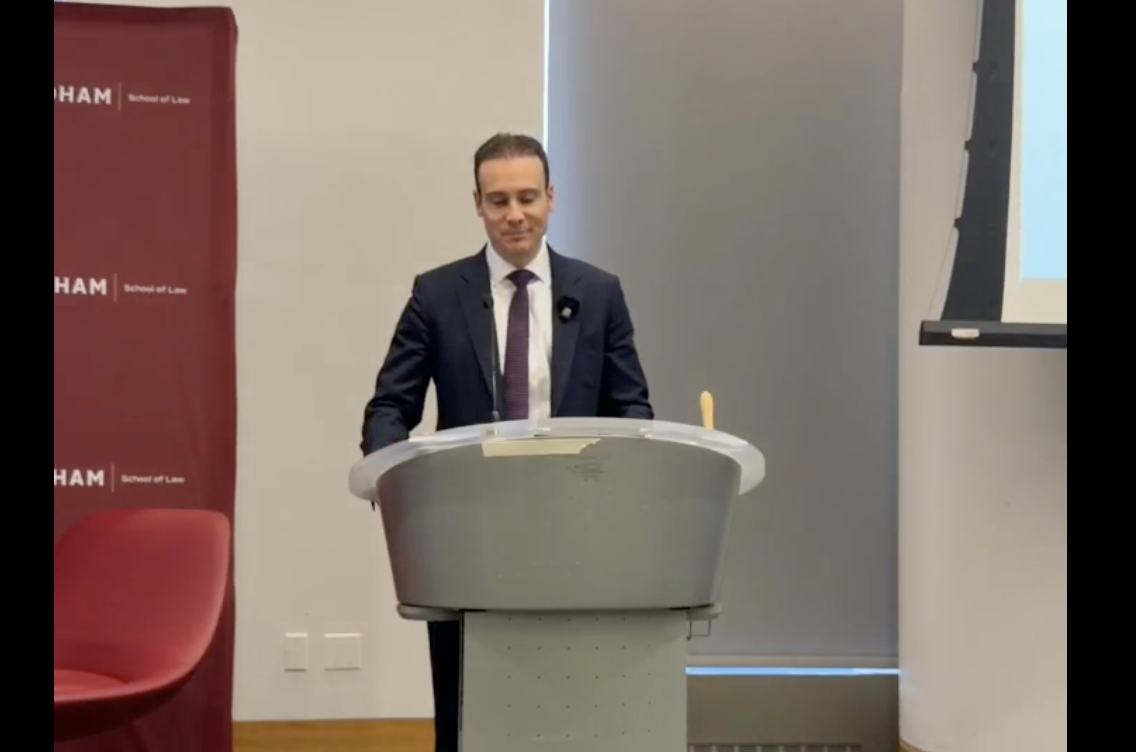
CFTC Chair Michael Selig on Monday.
Source: Fordham Law Blockchain Regulatory Symposium

The proposed rules would not extend to what the chair called “ordinary spot crypto exchanges” that are “generally regulated under state money transmission laws.” For companies offering spot trading on crypto assets like Bitcoin (BTC), the CFTC would still have the authority to enforce anti-fraud and anti-manipulation regulations.

Selig’s proposed regulatory framework for crypto companies came a few weeks after lawmakers in the US Senate failed to approve passage of the Digital Asset Market Clarity (CLARITY) Act, a bill that had been expected to give the CFTC more authority in overseeing and enforcing crypto regulations.

The Securities and Exchange Commission already announced its own version of a proposed “tailored securities offering regime” for crypto assets in August before the failed CLARITY vote, setting the expectation that both agencies would move forward with regulation without legislation codifying such rules from Congress.

Selig said that Trump promised to deliver a crypto asset regulatory market structure with or without legislation, and the regulators will help him deliver it using existing statutory authorities.

“The opponents to CLARITY may have not bargained for the seeming readiness of the executive branch to act in the absence of any constraint from the legislative branch,” said ProChain Capital’s David Tawil, in a post on Monday.

Both regulators still understaffed as they advance crypto proposals

Friday was SEC Commissioner Hester Peirce’s last day at the agency, wrapping up eight years of service, just ahead of the 18-month extension for her second term. Her planned departure leaves just two commissioners leading the SEC and Selig heading the CFTC as its sole commissioner and chair.

A White House official told Cointelegraph last week that Trump intended to nominate commissioners to both agencies “in the near future.” As of Monday, the administration had not announced any replacements for Peirce or the other six commissioner seats.

Magazine: Former SEC boss made AI Czar, Bitcoin may hit $600K this cycle: Hodler’s Digest

Related Questions

QWhat is the main purpose of the regulatory framework proposed by CFTC Chair Michael Selig?

AThe main purpose is to give crypto companies the option to operate under the CFTC's uniform national oversight, as an alternative to dealing with the patchwork of regulations from individual US states. This includes a proposal for a new category of designated contract market called a 'crypto asset market' (CAM).

QHow does the proposed 'CTX' regulation relate to crypto asset trading?

AThe proposed 'CTX' regulation is an advanced notice of proposed rulemaking for companies that offer retail customers the ability to trade crypto assets on a margined, leveraged, or financed basis.

QWhy are the CFTC and SEC moving forward with their own regulatory proposals for crypto?

AThey are moving forward because the US Senate failed to pass the Digital Asset Market Clarity (CLARITY) Act, which was expected to give the CFTC more authority. President Trump has directed the agencies to proceed 'with or without legislation' from Congress, leading them to use their existing statutory authorities.

QAccording to the article, what type of crypto exchanges would not be covered under the CFTC's new proposed rules?

AThe proposed rules would not extend to 'ordinary spot crypto exchanges' that are generally regulated under state money transmission laws. However, the CFTC would still have authority to enforce anti-fraud and anti-manipulation regulations for these spot trading platforms.

QWhat staffing challenge is mentioned for both the SEC and CFTC as they advance their crypto proposals?

ABoth agencies are understaffed. SEC Commissioner Hester Peirce has left, leaving just two commissioners at the SEC. The CFTC has Michael Selig as its sole commissioner and chair. The White House intends to nominate new commissioners, but no replacements had been announced as of the article's publication.

Related Reads

Backed by $80 Million, Alta is Building the Infrastructure to Bring Global Banking Onchain

Alta, a financial infrastructure company building institutional-grade blockchain infrastructure for global finance, has announced $80 million in total funding, including a $47.5 million Series A led by Index Ventures with participation from GV, Blackbird Ventures, Square Peg, and Capital 49, plus $32.5 million in prior seed financing. Unlike blockchains built mainly for crypto-native applications, Alta is designed to meet the privacy, compliance, neutrality, and operational needs of regulated financial institutions while supporting transactions across assets, chains, and jurisdictions. Its architecture is built on recursive zero-knowledge cryptography, keeping balances, transactions, identities, and compliance policies private while verifying that transactions meet required rules. CEO Loong Wang said existing blockchains aren't designed for institutional privacy and compliance requirements, and Alta builds these features directly into the chain. President Catherine Porter noted that as AI agents increasingly make financial decisions and execute transactions, trust becomes even more critical. Airwallex has chosen to build on Alta, connecting its global payments infrastructure to Alta's blockchain technology, supporting stablecoin pay-ins and pay-outs plus connectivity to local fiat payment networks across 200 countries and 90 currencies. Alta's first product will help businesses manage liquidity more efficiently, reducing cash buffers tied up in prefunded accounts—an estimated $4 trillion globally—through tokenized assets, just-in-time funding, more efficient foreign exchange, and instant movement in and out of yield-bearing tokenized assets. Investors praised the founding team's deep-tech blockchain engineering, institutional go-to-market knowledge, and track record of scaling multi-billion-dollar businesses. The new funding will support continued development of Alta's blockchain infrastructure, expansion of institutional partnerships and global financial connectivity, and growth of its engineering and compliance teams.

TheNewsCrypto7h ago

Backed by $80 Million, Alta is Building the Infrastructure to Bring Global Banking Onchain

TheNewsCrypto7h ago

Hitting a Record for U.S. Tech IPO Fundraising, Anthropic to Raise Up to $90.4 Billion, Fully Diluted Valuation of $1.4 Trillion

Anthropic is pursuing what would be the largest tech IPO in U.S. history, targeting a fully diluted valuation of $1.4 trillion and aiming to become the first publicly listed frontier AI lab. According to its SEC filing, Anthropic seeks to raise up to $90.4 billion through an IPO and private placement—a base IPO of up to $64.4 billion plus $26 billion from seven tech giants (Alphabet, Nvidia, AMD, Broadcom, Micron, Microsoft and TSMC). Shares are priced at $70–78; at the top end the valuation is about $1.02 trillion, slightly above its $965 billion private valuation. The stock will list on Nasdaq under ANT, with Goldman Sachs and Morgan Stanley as lead underwriters, pricing on Nov 18. Including the greenshoe, proceeds could approach $100 billion, surpassing SpaceX's $86.5 billion record. The filing reveals rapid growth: Q3 revenue neared $17 billion versus $1.4 billion a year earlier, with annualized revenue around $81 billion as of Oct 31 and over 11,900 customers spending more than $100,000 annually. Profitability remains unstable—Q3 operating expenses jumped 292% to $17.5 billion, producing a $567 million operating loss after a brief Q2 profit, hit by $5 billion in short-term compute contracts and $2 billion in non-cash charitable matching costs. Price cuts trimmed Q3 revenue growth by about $600 million. Costs are enormous: total committed spending is $895 billion, mostly for compute and chips, with about $70 billion due within a year. Revenue depends almost entirely on AI services. Anthropic is embedding Claude in healthcare, life sciences, legal and accounting work, with over 90% of its codebase now contributed by Claude. It lists as a public benefit corporation with a Long-Term Benefit Trust controlling board elections, and warns AI could pose catastrophic or existential risks. Rival OpenAI targets a 2027 IPO at a $1.25 trillion valuation. Each of Anthropic's seven co-founders holds about 1.4%.

marsbit7h ago

Hitting a Record for U.S. Tech IPO Fundraising, Anthropic to Raise Up to $90.4 Billion, Fully Diluted Valuation of $1.4 Trillion

marsbit7h ago

Trading

Spot
活动图片