Author: Nancy, PANews
Bitmine, the largest buyer of Ethereum, is about to hit the brakes on accumulation. In just over a year, Bitmine is within reach of its 5% of Ethereum supply target, a goal originally set as a five-year plan.
Despite continuous expansion of unrealized losses on paper, this Ethereum treasury company never ceased its hoarding, becoming one of the crucial supporting buy-side forces for ETH. Once Bitmine stops persistently sweeping up coins, who will take over as the next buy-side force for ETH?
Achieving the '5% Alchemy' in Just 16 Months
Ethereum's biggest bull, Bitmine, is about to complete the '5% Alchemy'.
Since initiating its ETH reserve strategy in June 2025, Bitmine has been consistently buying ETH almost every week, rapidly growing into the world's largest Ethereum treasury company. Now, this originally five-year deployment plan has entered its final stage ahead of schedule.
Bitmine's official announcement shows that as of October 11th, the company holds 6,028,946 ETH, accounting for approximately 4.9% of the total ETH supply (122.1 million), achieving about 99% of its 5% holdings target.
In other words, Bitmine is only short by about 77,000 ETH from its goal. Based on the acquisition scale of over 12,000 ETH in the most recent week, the company could reach its target in as fast as six to seven weeks. This means Bitmine is poised to fulfill its promised goal approximately 16 months after initiation.
Looking at the accumulation pace, Bitmine has significantly slowed its coin purchases in recent months. Since June this year, its weekly accumulation scale has gradually shrunk from previous levels of hundreds of thousands or even two hundred thousand ETH to tens of thousands or lower. Although the direction of continuous buying remains unchanged, it's evident that Bitmine is actively adjusting its accumulation rhythm.
The aggressive accumulation strategy has also put considerable pressure on Bitmine's balance sheet. Calculated at an average ETH holding price of $3,334, Bitmine's current unrealized loss is approximately $5 billion. Regarding this, Bitmine Chairman Tom Lee remains optimistic. He stated that most of the company's ETH holdings were accumulated during the crypto market bear phase, placing Bitmine in a relatively favorable position before the next crypto bull run he anticipates arrives.
"We will not continue accumulating beyond 5%, nor will we hold more than 5% of Ethereum's total supply," Tom Lee clearly stated at the Token2049 conference in Singapore, setting 5% as Bitmine's hard cap for holdings.
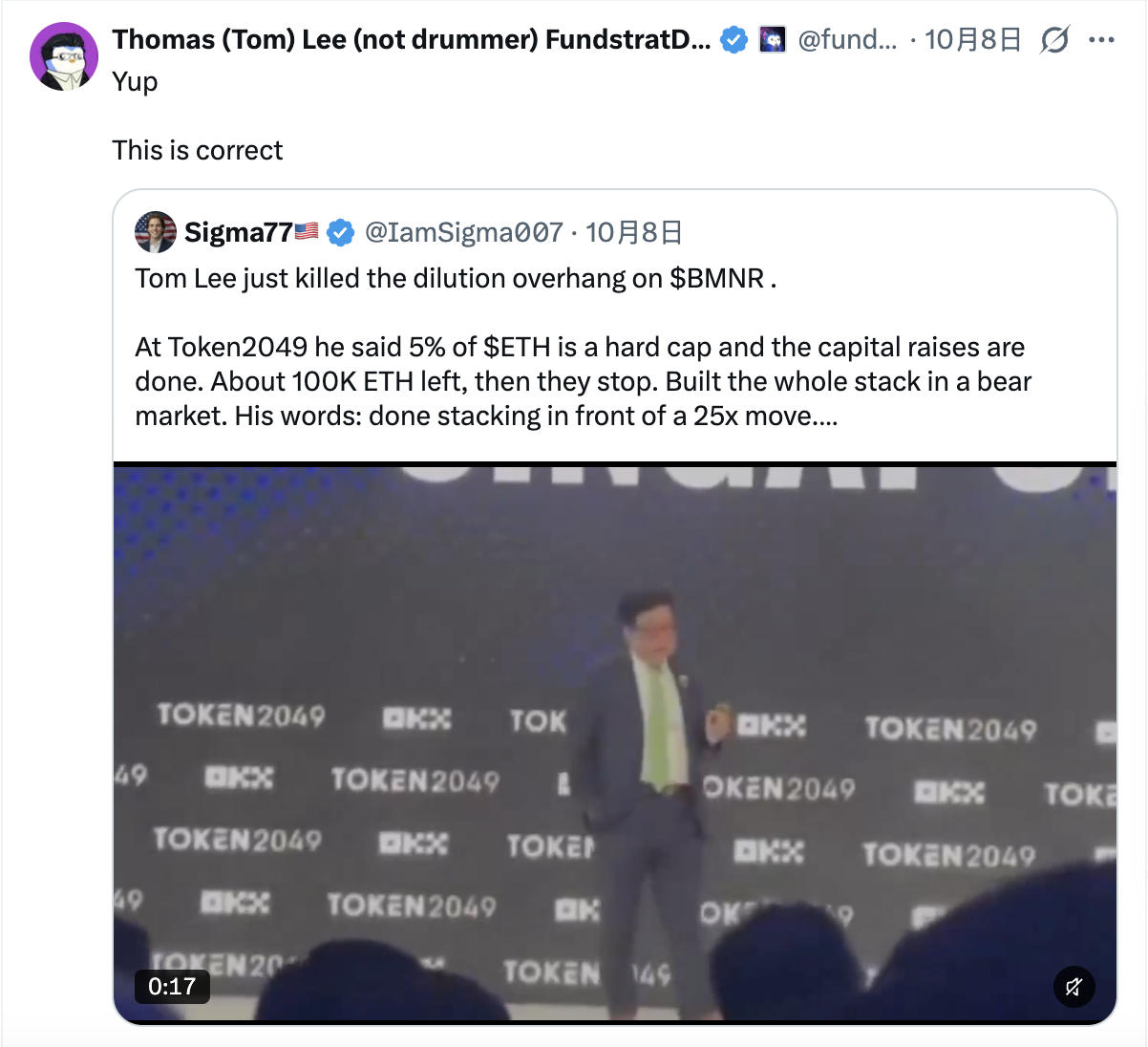
It's worth noting that several months ago, Tom Lee mentioned in an interview with Bankless that as more enterprises begin to view ETH as a long-term reserve asset similar to real estate, it might become reasonable for Bitmine to hold more than 5% of ETH's total supply. He also revealed that the company might reassess this holdings target in 2027, primarily based on Ethereum's adoption rate and ecosystem development.
Perhaps 5% is not the absolute upper limit for Bitmine's long-term holdings. Whether to continue accumulating in the future will still depend on the development of the Ethereum ecosystem and the company's own capital operation strategy.
Strategic Focus May Shift to Valuation Recovery, Covering Financial Expenses by Selling Staking Rewards
At present, Bitmine's choice to press pause upon nearing its holdings target likely considers both the healthy development of the Ethereum ecosystem and its own stock price performance.
From an ecosystem development perspective, Tom Lee has publicly explained multiple times that Bitmine set the ETH holdings target at 5% to hold a sufficiently large scale of ETH to exert positive influence while avoiding causing disturbances to the ecosystem. In his view, 5% is a holdings ratio that can generate substantial impact, also providing important long-term support for the Ethereum ecosystem, acting as a 'ballast stone' for network development.
On the other hand, Bitmine itself faces stock price pressure. Over the past year, BMNR's stock price has fallen over 55.6%. For Bitmine, continuous financing for buying coins is an important means to expand its ETH reserves, but the pressure from equity dilution brought by financing could also drag down the market's valuation of the company's stock.
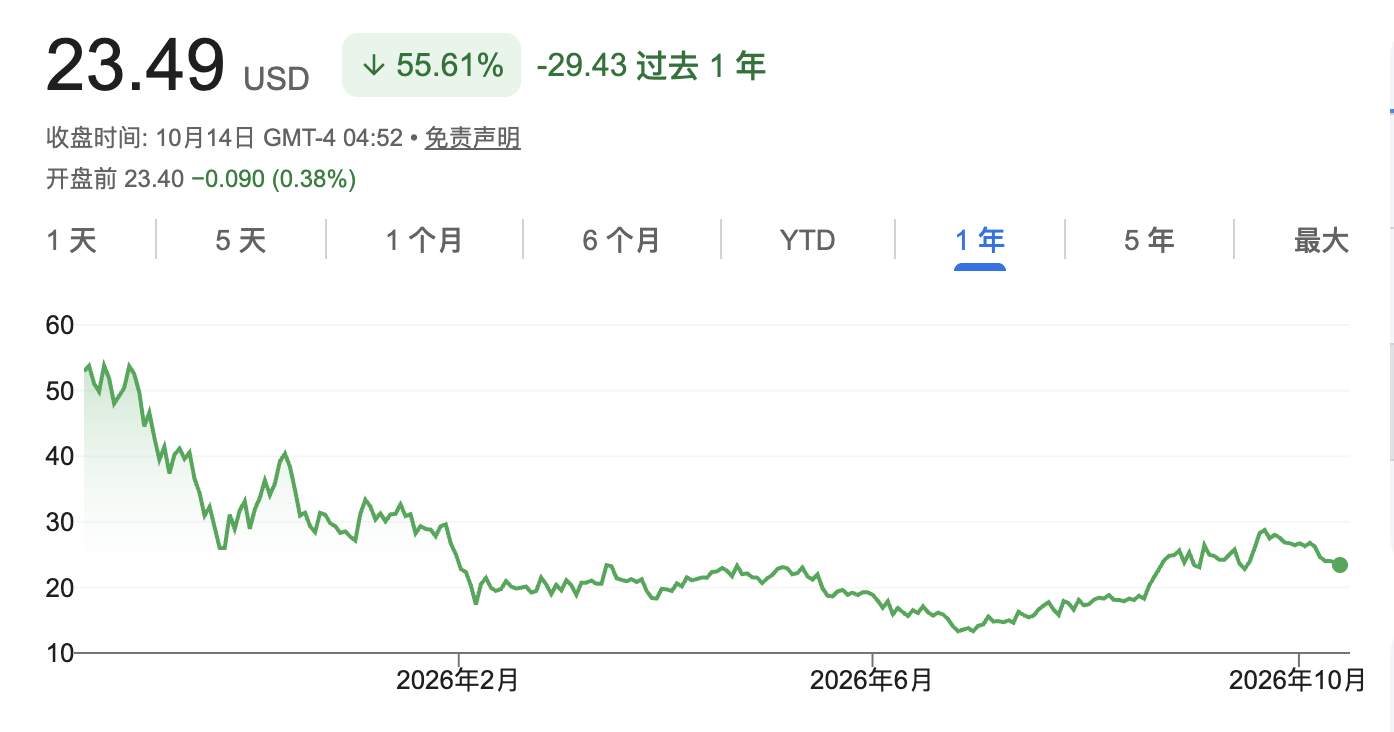
To boost the stock price, Bitmine has slowed its ETH buying pace while initiating a stock repurchase plan. According to official disclosures, between July 14th and August 17th, the company repurchased 21 million shares, costing $350 million. Tom Lee called this the largest stock repurchase in crypto industry history.
Now, as the accumulation scale approaches the set holdings target, Bitmine's strategic focus may shift towards shareholder returns and valuation recovery. Tom Lee pointed out during his recent Token2049 Singapore speech that after reaching the set holdings target, BMNR is expected to outperform ETH, because the company will no longer need continuous financing for buying coins, and market concerns about its equity dilution are also expected to ease.
However, completing the accumulation target does not mean Bitmine will sell its core ETH holdings for financial needs. Tom Lee recently stated that most DAT companies holding substantial assets may eventually need to sell part of their assets to cover operating expenses, repay debt, or distribute returns to shareholders. But Bitmine's situation is different; ETH can continuously generate income through staking, and the existing staking income is already sufficient to cover preferred stock dividend payments, thereby reducing the necessity for the company to sell core ETH holdings to meet financial obligations.
It is reported that Bitmine currently stakes 5,067,309 ETH, with annualized staking income of $336 million; if all holdings were staked, calculated at a 7-day staking yield of 2.61%, annualized income is estimated to reach $400 million.
Nevertheless, Tom Lee also clearly revealed that Bitmine will sell the staking rewards it receives. In his view, selling core ETH holdings might imply changing the existing strategy, whereas selling rewards generated from staking is a way to manage the holdings scale.
But even calculating based on the $400 million annualized income if all holdings were staked, the daily selling amount would only be about $1.1 million, having limited direct impact on ETH's price.
After the Biggest Buyer Stops Buying, Who Will Fill the Market Gap?
Undeniably, over the past year or more, Bitmine has not only been a significant buy-side force in the ETH market but also an important participant supporting market confidence.
According to SoSoValue data, as of October 13th, the total net asset value of U.S. spot Ethereum ETFs is approximately $15.83 billion, with a net asset ratio (ETF-held asset market value as a percentage of ETH's total market value) reaching 5.16%. In comparison, the ETH holdings scale of Bitmine, a single DAT company, is already on par with the overall holdings scale of U.S. spot Ethereum ETFs.

More importantly, Bitmine's buying scale can, to some extent, absorb ETH's new supply. Taking the past 30 days as an example, ultrasound.money data shows that ETH's new issuance is approximately 86,000 coins, while Bitmine bought about 72,000 ETH during the same period, equivalent to 75.2% of the new issuance.
However, if Bitmine no longer persistently sweeps up coins, who can take over as the new buy-side force for ETH has become a topic of market concern.
Currently, spot ETFs have not demonstrated sufficiently strong absorption capacity. Data shows that U.S. spot Ethereum ETFs have experienced net outflows for two consecutive weeks, with $542 million leaving just last week, marking the largest single-week net outflow since January this year. If the fund outflow trend continues, ETFs will not only struggle to fill the buy-side gap possibly left by Bitmine but may also further increase selling pressure in the market.
The buying capacity of other digital asset treasury companies is also limited. Currently, the second-largest ETH treasury company, SharpLink, holds ETH accounting for about 0.73% of the total supply, far from Bitmine's approximately 4.9% holdings ratio. Whether in terms of asset reserve scale or continuous accumulation capability, other DAT companies currently find it difficult to compare with Bitmine.
However, changes in buy-side forces do not necessarily mean ETH's price will continue to face downward pressure. Market demand still depends on ETF fund flows, other institutions' allocation intentions, and the overall risk appetite of the crypto market.
Regarding medium-to-long-term trends, Tom Lee remains optimistic. He believes the next crypto bull run could become the largest in history, driven by multiple factors including asset tokenization, generational wealth transfer, digital asset treasury companies continuously absorbing market supply, and the crypto industry benefiting from AI development as a downstream segment of the AI industry chain.
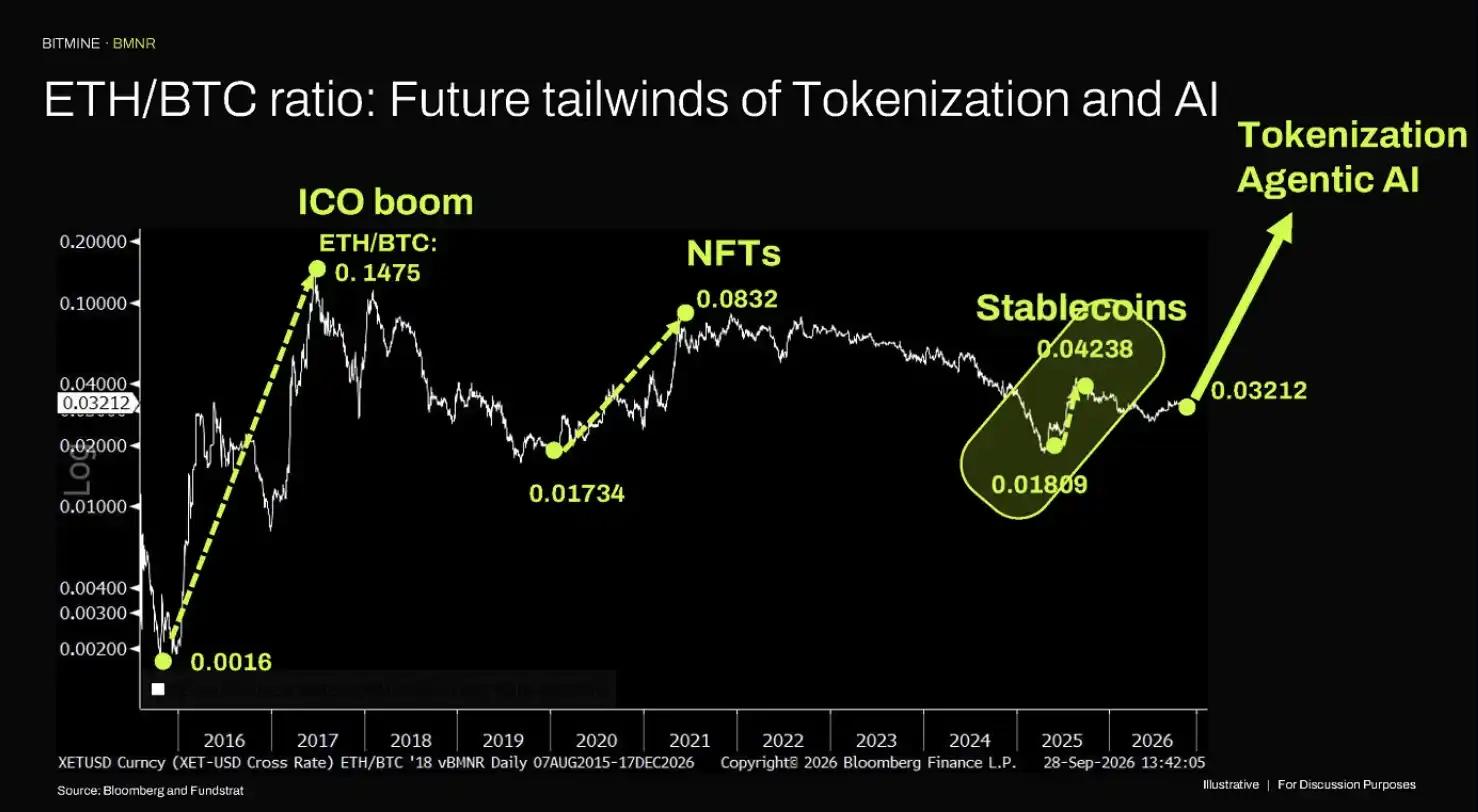
In Tom Lee's view, the ongoing wealth transfer could also bring new incremental funds to the crypto market. As the generation inheriting wealth is relatively younger and may have a higher risk appetite for crypto assets and stocks, this trend's impact in this cycle might surpass that of the 2019-2021 bull run.
Regarding ETH's price prospects, Tom Lee gives an even more aggressive forecast. He predicts ETH could break through $5,000 before the end of this year; if Bitcoin's price surpasses $100,000, ETH could further rise to about $7,500. His long-term bullish logic lies in Ethereum potentially experiencing a larger price breakout after years of consolidation.
In summary, after Ethereum's largest buyer stops accumulating, the absorption capacity of the ETH market may face a test. But the buying rhythm of a single treasury company cannot determine ETH's long-term trend. With the acceleration of asset tokenization, growing institutional allocation demand, and the continuous development of the Ethereum ecosystem, the market is still expected to welcome new incremental funds, providing new demand support for ETH.