Bitcoin Volatility Halved Yet Extreme Days Exceed 2018: VaR Models May Underestimate Tail Risk

marsbitPublished on 2026-10-10Last updated on 2026-10-10

Abstract

Bitcoin's volatility has significantly decreased in 2026, with annualized volatility dropping to approximately 46% from around 84% in 2018. However, it has already recorded 10 "3-sigma" trading days this year—days where price moves deviate by at least three standard deviations from recent norms—surpassing the 8 such days observed in the entirety of 2018. This indicates that while average daily price swings are calmer, extreme outlier movements remain frequent, even surpassing the frequency seen in a previous bear market. This paradox presents a challenge for standard risk models like Value-at-Risk (VaR), which often rely on recent volatility to gauge risk. Lower volatility can misleadingly signal reduced risk, potentially encouraging larger positions while failing to adequately capture persistent "tail risk"—the potential for rare but severe losses. Experts note the industry is shifting towards metrics like Expected Shortfall to better account for these extreme outcomes. Market participants attribute the continued occurrence of these sharp swings to unpredictable macroeconomic shocks and highly leveraged options positions, particularly strategies like shorting volatility or call overwriting. These strategies can amplify price moves when unexpected news triggers a market shift. Despite the persistent volatility spikes, the market demonstrates greater resilience in absorbing them, attributed to increased institutional participation, deeper liquidity from ETFs, and improved o...

Author: Omkar Godbole

Translated by: TechFlow

TechFlow Introduction: CoinDesk calculations show that Bitcoin has already recorded 10 '3-sigma' trading days in 2026, exceeding the 8 such days in the entire 2018 bear market, while its annualized volatility has dropped from about 84% to around 46%. For VaR position models reliant on volatility, the seemingly calmer surface may precisely encourage increasing positions, yet miss the recurring tail shocks that are still happening.
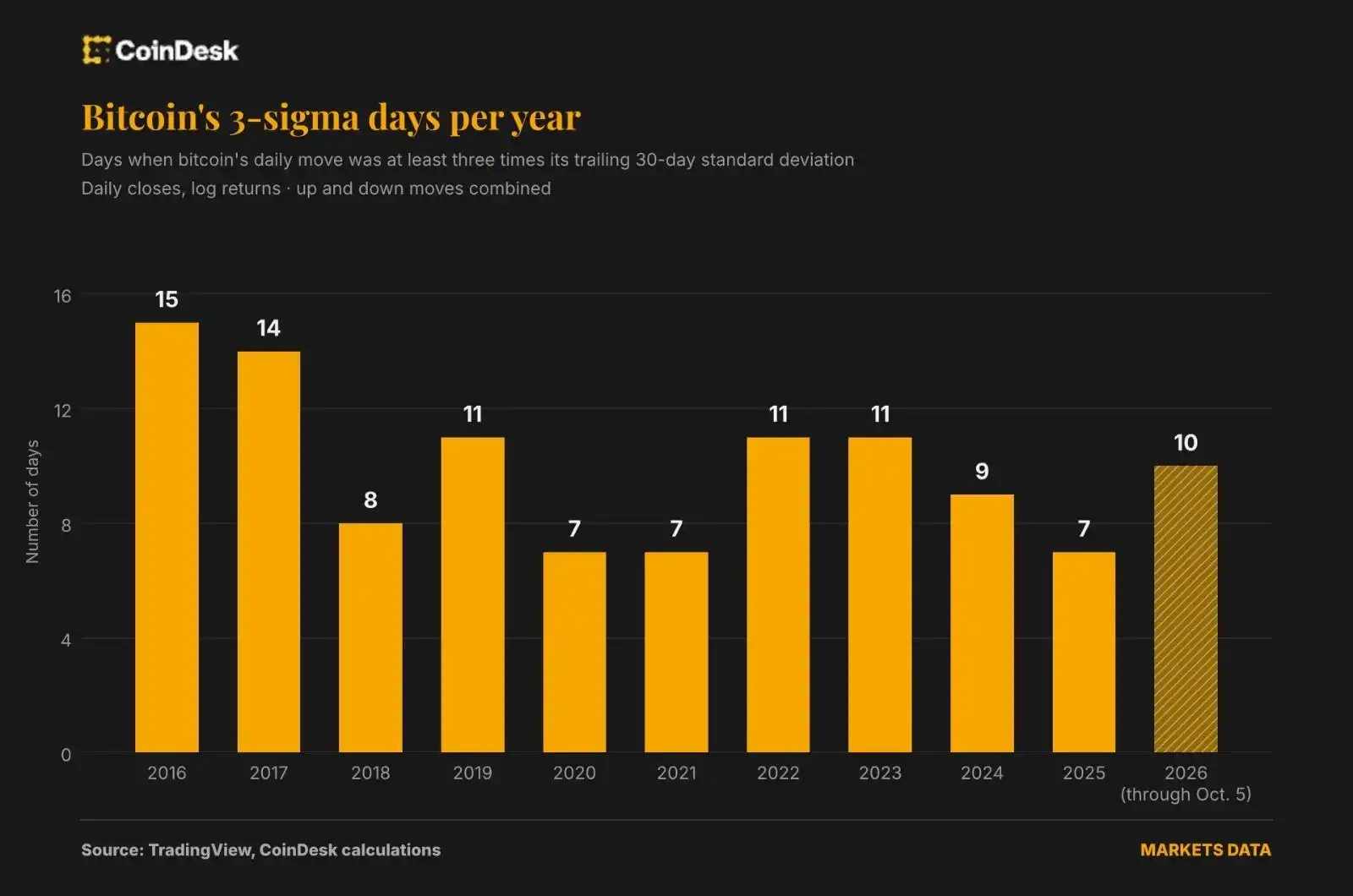
Bitcoin (BTC) has experienced more abnormally large price swings this year than during the 2018 bear market, even as its overall volatility has significantly declined — presenting a challenge for those relying on standard risk models.

According to CoinDesk's analysis, the largest cryptocurrency by market capitalization has recorded 10 trading days in 2026 where its price deviated from its recent trading pattern by at least three standard deviations. This surpasses the 8 such days recorded in all of 2018; a year in which Bitcoin's market value evaporated by 73%.

Traders use 'sigma' to measure these unusually large swings, signifying how far an asset's price has deviated from its normal behavior. To quantify these days, CoinDesk compared each trading day's price change with Bitcoin's 30-day realized volatility — a measure of how much the price typically moved daily over the past month. Any day where the move was at least three times that value (regardless of direction) was counted as a '3-sigma day'.

In a normal bell curve distribution, about 95% of moves fall within 2 sigma, and 99.7% within 3 sigma. Therefore, 3-sigma moves are inherently rare, and traders use them to mark exceptionally sharp swings. A high count suggests that even as overall volatility cools, the asset remains prone to sudden jolts.

These findings indicate that Bitcoin has indeed 'calmed down' over the years but still experiences extreme days, and this year they are occurring more frequently than in 2018. This implies: relative to its recent volatility, Bitcoin is undergoing more abnormally large swings, even though the absolute magnitude of these swings has become smaller. Bitcoin's annualized volatility this year is about 46%, compared to 84% in 2018; meanwhile, the average magnitude of its 3-sigma moves is about 7%, lower than the roughly 10% eight years ago.

"What hasn't changed is that Bitcoin still goes through long quiet periods followed by sudden repricing. The market has matured, with far more institutions, ETFs, and liquidity, so average days are calmer. But the shocks haven't disappeared: macro, leverage, positioning," said Nicolas Quatravaux, Head of Europe, Middle East, and Africa at Paradigm, a leading institutional liquidity network for crypto derivatives.

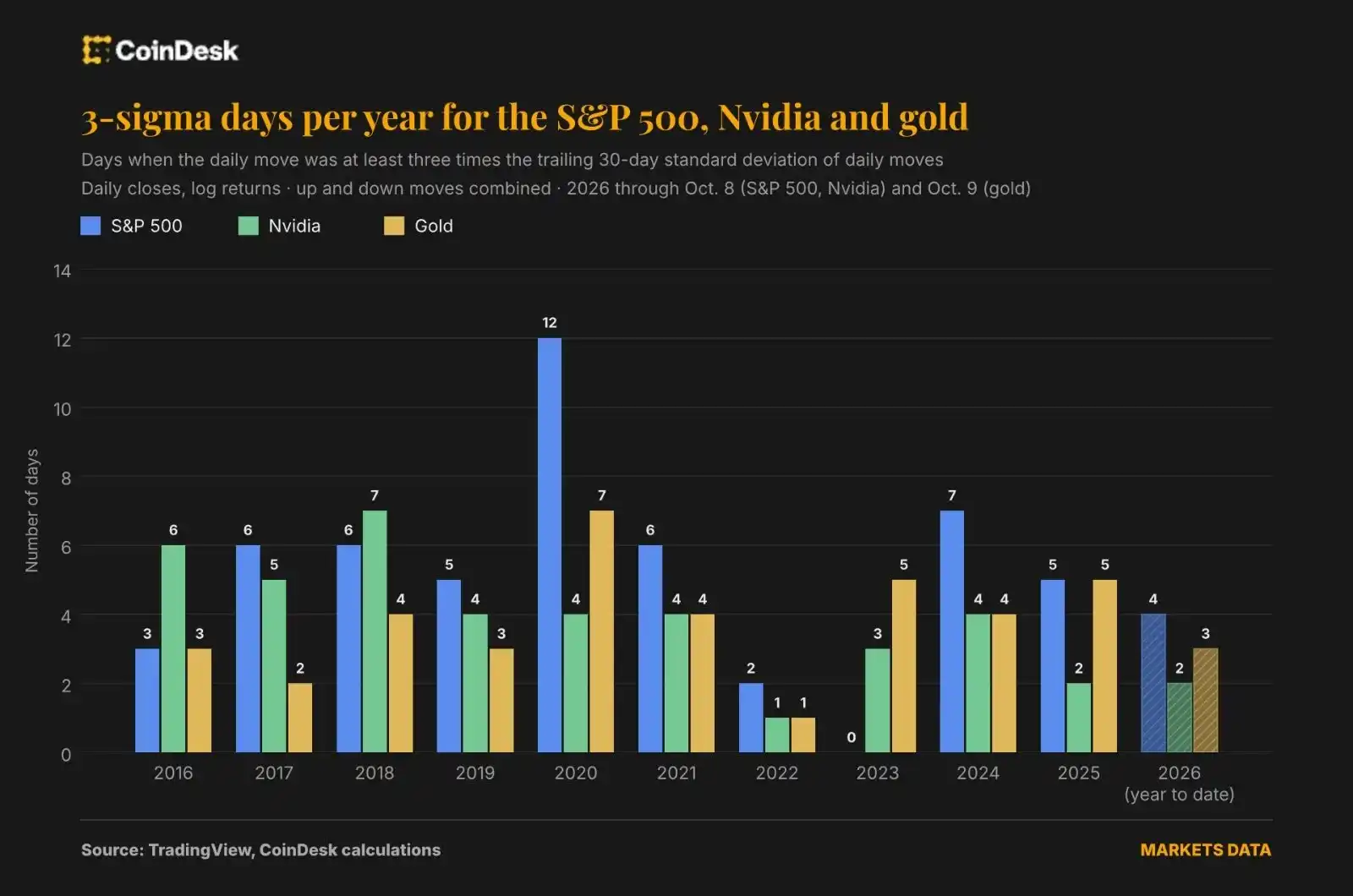
This contrast is evident even compared to other high-volatility assets. Since 2024, Bitcoin's volatility has been roughly comparable to Nvidia's, around 47%. But during the same period, it recorded 26 3-sigma days, while Nvidia had only 8; the S&P 500 had 16, and gold had 12.
How Declining Volatility Misleads Risk Models

The persistence of extreme volatility poses a challenge for investors who use volatility-based risk models to determine their Bitcoin positions.

A widely used metric is value-at-risk (VaR), which estimates how much a portfolio might lose on a bad trading day. Some VaR models heavily rely on recent price fluctuations, meaning an asset can appear less 'dangerous' if trading has been calm for an extended period.

Therefore, the decline in Bitcoin's 30-day, 90-day, and 180-day volatility metrics may encourage investors to increase their exposure. However, depending on how the model is constructed, this apparent decrease in risk may not adequately capture the potential for abnormally large losses.

It also estimates a loss threshold without telling investors how severe losses could be once that threshold is breached. This is known as tail risk — the potential for rare but exceptionally large losses that fall outside an asset's normal trading pattern. Bitcoin's recurring 3-sigma swings show that investors still need to factor in such extreme outcomes, even as day-to-day volatility decreases.

"Standard VaR metrics don't properly assess the full tail risk, which is one of the main reasons the industry is moving towards Expected Shortfall and similar metrics that do account for tail risk," said Luuk Strijers, CEO of crypto options exchange Deribit.

Expected Shortfall looks at how severe losses are on the worst trading days, not just how often such days occur. Unlike using VaR alone, this approach helps investors gauge the destructive power of those extreme losses.

"If the portfolio target doesn't account for tail risk, then a calmer Bitcoin would indeed encourage a larger allocation within the portfolio, making sudden price jumps more impactful for the portfolio," Strijers said.

He added that these 3-sigma risks can be hedged using Bitcoin options.

Why Sudden, Sharp Swings Still Recur

Market participants point to unpredictable macro shocks and highly leveraged options positioning as the dual drivers of these high-VaR trading days.

This year is a good example, said Paradigm's Quatravaux.

"Started slow, with rotation into tech stocks, and a string of DeFi hacks pushing people into selling volatility and structured products for yield. Then you hit Trump, Iran war, the Fed, and everyone is short volatility within a range. One headline is enough to give you an abnormal day," he said.

Essentially, risk builds when traders bet that prices will remain relatively stable. That positioning involves selling (shorting) options — essentially 'insurance' against large price moves — to collect premiums.

Such strategies work when markets are quiet. But when macro headlines hit and prices swing sharply, those sellers get caught on the wrong side, and their scramble to cover can amplify a move into a shock.

Alexander S. Blume, Co-founder and CEO of US SEC-registered investment adviser Two Prime, highlighted a particularly popular variation of this trade called call overwriting. Investors sell call options on Bitcoin they already own, giving up some upside potential in exchange for steady premium income from selling the calls.

"I believe the large increase in derivatives market positioning, despite the convergence in overall volatility, still enables outsized moves to occur relatively frequently. Currently, call overwriting is a highly crowded trade. When we see rallies like the past month, it creates a short squeeze and amplifies moves," Blume said.

A More Resilient Market?

The good news is the market is better equipped to absorb these jolts than before.

On September 21st — the day of Bitcoin's most recent 3-sigma jump — Paradigm facilitated a record $6.7 billion in options volume.

"This time we didn't see, nor hear of, any trading desks taking big losses," Quatravaux said.

"Participants are far more sophisticated than a few years ago, risk management has improved significantly, and there's more institutional money in the market. So a tough month is often just a tough month," he said.

Just don't expect these wild swings to stop.

"They're here to stay. Ten years of data show these days haven't disappeared as the market matured, because macro shocks aren't going anywhere," Quatravaux said.


Related Questions

QAccording to the article, how many '3-sigma' trading days has Bitcoin recorded in 2026 compared to the entire year of 2018?

ABitcoin has recorded 10 '3-sigma' trading days in 2026, exceeding the 8 recorded throughout the entire bear market year of 2018.

QWhat is a key limitation of standard Value-at-Risk (VaR) models highlighted in the article, and what alternative metric is suggested?

AA key limitation of standard VaR models is that they fail to adequately assess the full severity or 'tail risk' of extreme losses. The article suggests the alternative metric of Expected Shortfall, which considers how bad losses can be in the worst-case scenarios.

QWhat two main factors does the article cite as drivers for the continued occurrence of sudden, high-VaR price swings in Bitcoin?

AThe article cites unpredictable macro shocks and highly leveraged options positioning as the two main drivers for the continued occurrence of sudden, high-VaR price swings in Bitcoin.

QWhat specific, popular options trading strategy does Alexander S. Blume mention as contributing to amplified volatility during price rallies?

AAlexander S. Blume mentions the 'covered call' or 'call overwriting' strategy as a highly crowded trade that can create short squeezes and amplify volatility during price rallies like those seen in the past month.

QDespite the persistent extreme volatility, what positive development regarding market resilience does the article point out?

AThe article points out that the market's ability to absorb these shocks has improved. Participants are more mature, risk management has advanced significantly, and there is more institutional capital, meaning a difficult month is often just that, without causing major casualties like in the past.

Related Reads

Coinbase and PNC Bank Launch USDC Collection: Can Stablecoins Become the New Gateway for Enterprise Payments?

Coinbase and PNC Bank have expanded their partnership to launch a USDC collection service for enterprise and institutional clients. Eligible customers can receive USDC via the Ethereum network, which is then converted 1:1 into USD and deposited into their designated PNC bank account. The service uses Coinbase's Payment APIs integrated with PNC's existing treasury management systems, embedding the stablecoin collection process within the traditional banking framework. The collaboration highlights a complementary relationship between stablecoins and banks rather than pure competition. Banks provide client relationships, compliance, and deposit accounts, while blockchain offers round-the-clock value transfer. Coinbase supplies the stablecoin infrastructure and payment APIs, while PNC handles account and traditional financial services. For businesses, the appeal is gaining a new payment channel without overhauling their existing financial systems or managing wallets and private keys themselves. The partnership builds on earlier collaboration announced in July 2025, when the two firms began integrating crypto trading capabilities into PNC's services, followed by Bitcoin spot trading for eligible private banking clients in December. The USDC service extends the focus from wealth management into enterprise payments and treasury management. Coinbase has pursued similar integrations with Citigroup and payment technology firm Moov, signaling a strategic shift from a trading platform toward payment infrastructure. However, questions remain about fees, settlement times, compliance requirements, and actual adoption scale. The service is still in a pilot phase with limited eligibility, and full fee structures and processing times have not been disclosed. The key question is whether enterprises will adopt stablecoin collection in daily operations and whether the funds can be reliably converted, deposited, and used without adding excessive operational cost. The real competitive frontier may be integrating digital dollars into everyday corporate cash flows rather than simply accumulating on-chain assets.

marsbit13m ago

Coinbase and PNC Bank Launch USDC Collection: Can Stablecoins Become the New Gateway for Enterprise Payments?

marsbit13m ago

Crypto Stocks Weekly丨Strategy Adds 1,036 BTC but Holdings Fall Below Cost Basis; Bitmine Holds 4.97% of ETH Supply (November 10)

The article begins by noting that Democrats swept both chambers of Congress, ushering in a divided-government phase, after which markets shifted focus to AI regulation and capex payback cycles, with Anthropic's IPO seen as a bellwether for AI stocks. US equities fell sharply (Nasdaq -5.52% and Philadelphia Semiconductor Index -12.24% on Nov 5) before a Monday rebound driven by falling oil prices and oversold buying—characterized as a repair, not a new high. Macro data showed October nonfarm payrolls +165k and unemployment at 4.1%, keeping 10-year Treasury yields near 4.86% and rate-hike expectations alive. Citi cut US equities and global tech to neutral while upgrading Europe ex-UK, citing unstable AI sentiment; Goldman noted AI stocks are ~40% of the S&P 500 versus ~15% of STOXX 600. Crypto diverged from the equity rebound: US spot Bitcoin ETFs saw $1.282B in weekly net outflows (BlackRock's IBIT -$12.09B... actually $1.209B), Ethereum ETFs -$365M for a sixth straight weekly outflow, with continued outflows on Nov 9. NYSE-affiliated tokenized securities platform chose Avalanche for settlement infrastructure. Corporate treasury updates: Strategy bought 1,036 BTC at ~$79,012 (total 850,364 BTC, average cost ~$75,456, now above spot), funded partly by ATM share sales, with most proceeds used to repurchase STRC preferred shares. Strive added 29 BTC (total 43,153). Listed companies now hold over 6% of Bitcoin's supply (1.2664M BTC across 199 firms). Bitmine added 9,587 ETH, holding 6,070,092 ETH (~4.97% of supply, ~99% of its 5% goal). DeFi Development Corp's SOL rose to 2,609,829. Hyperliquid Strategies raised $911M in Q3, bought ~9.1M HYPE (holdings up to 38.5M, ~16% of circulating supply), and repurchased ~2.7M PURR shares.

marsbit34m ago

Crypto Stocks Weekly丨Strategy Adds 1,036 BTC but Holdings Fall Below Cost Basis; Bitmine Holds 4.97% of ETH Supply (November 10)

marsbit34m ago

Trading

Spot
活动图片