After Losing Tens of Millions of Dollars, Abstract Announced Shutdown. Is a Wave of L2 Exits Coming?

marsbitPublished on 2026-10-08Last updated on 2026-10-08

Abstract

Layer 2 blockchain project Abstract, backed by the Pudgy Penguins team (Igloo Inc.), has announced its shutdown scheduled for December 15th, after nearly two years of operation. The project, which positioned itself as a "consumer-grade blockchain network," reportedly incurred tens of millions of dollars in operational losses. The closure has sparked debate within the crypto community. Supporters commend the team for responsibly winding down without a token launch (TGE) to potentially "cash out." Critics, however, argue that users who invested significant time and money into the ecosystem—through activities like badge systems and network interactions—are left with nothing, feeling misled by earlier optimistic promises from leadership. Analysis points to several key reasons for Abstract's failure: 1) Underdeveloped DeFi ecosystem with low TVL and trading volume, limiting fee-based revenue; 2) Lack of institutional participation and liquidity, missing major trends like RWA; 3) High operational costs for infrastructure, partnerships, and marketing; 4) Unclear product-market fit, as the network failed to attract either a vibrant meme culture like Solana or significant institutional capital flows. The article suggests Abstract's shutdown, following similar moves by other L2s like Blast, may signal the beginning of a broader consolidation wave for unsustainable Layer 2 networks. This trend highlights the intense competition and challenges projects face in achieving viable economi...

Original|Odaily Planet Daily(@OdailyChina)

Author|Wenser(@wenser 2010)

On October 7th, Abstract, the L2 project under Igloo, the parent company of Pudgy Penguins, officially announced it will shut down on December 15th of this year. This "consumer-grade L2 public chain," once placed with high hopes by the Pudgy Penguins team and numerous NFT players, is concluding its nearly two-year operation, ending in a somewhat regrettable manner.

After the announcement, market opinions diverged sharply. One faction believes that the Pudgy Penguins team did not choose to "conduct a final round of token distribution (TGE) and cash out" as some other L2 teams have, showing integrity from start to finish. However, another faction strongly disagrees. They argue that the tens of millions of dollars in operational losses mentioned by Pudgy Penguins CEO Luca Netz in his lengthy announcement, as well as Abstract's previous operational activities like the badge system which were somewhat "PUA-style," were largely paid for by users. Many had pinned their hopes on Abstract's potential token launch to recoup losses, a hope now completely dashed.

Behind Abstract's shutdown, the hype surrounding Robinhood Chain's launch has cooled, and Blast has also announced its shutdown. Following the wave of some CEX closures, perhaps more unsustainable L2s will face a wave of shutdowns.

"Consumer-Grade Blockchain Network" Finds No Takers: DeFi, Meme, and Institutional Capital All Fail to Gain Traction

Looking back at Abstract's development, its positioning as a "consumer-grade encrypted blockchain network" might not have been a good business idea from the start.
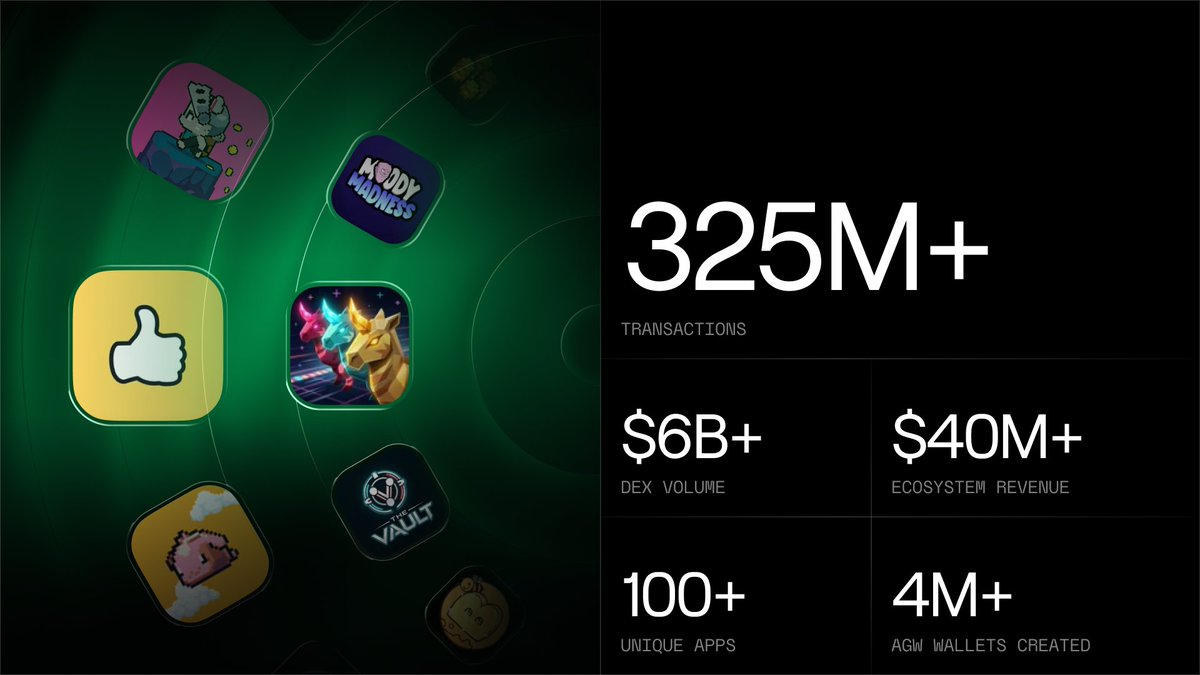
According to Abstract's official statements, the L2 network had attracted over 400,000 cumulative users and deployed more than 144 applications. Pudgy Penguins CEO Luca Netz also stated that Abstract had processed over 325 million on-chain transactions, launched Portal and AGW, and attracted global brands like Disney and Red Bull. On the surface, Abstract's performance seemed decent. However, what ultimately led it into an "operational dead end" might be similar to a strategic miscalculation made by Base in recent years regarding "crypto-social + on-chain consumption"—it neither followed the grassroots route like Solana and Robinhood Chain to develop its own Meme ecosystem, nor did it deeply cultivate DeFi around institutional and large investor needs to attract liquidity and complete its business self-sufficiency loop.

Main Reasons for Shutdown: Insufficient DeFi Ecosystem, Lack of Institutional Involvement, High Operational Costs, and Unclear PMF

Based on official announcements from Abstract and posts by Pudgy Penguins CEO Luca Netz, we can glimpse the "main causes of death" for this L2 network:

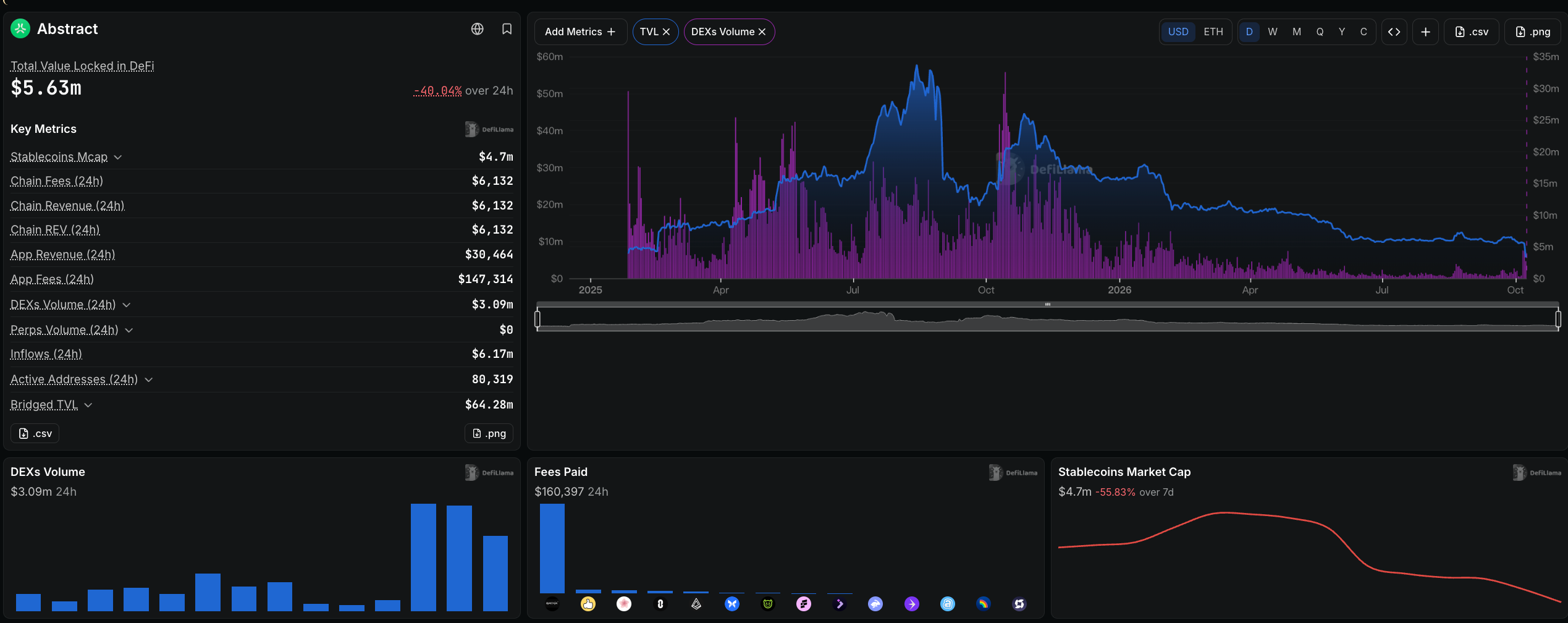
First, insufficient DeFi ecosystem; Although Abstract claimed its DEX trading volume reached $6 billion, considering its nearly two-year operational period, this is hardly an impressive figure. According to Defilama data, Abstract's DeFi TVL is currently around $5.6 million, ranking 90th among major L1 and L2 networks, with a 24-hour drop of about 40%. While heavily impacted by the shutdown news, its DEX trading volume had long fluctuated between $300k-$1 million; its stablecoin market cap saw a nearly 60% drop over 7 days, now standing at only $4.7 million.

For an L2 network, a failed DeFi ecosystem development almost inevitably means limited ecological activity, limited real user base, and difficulty in generating revenue and achieving self-sufficiency through fees.
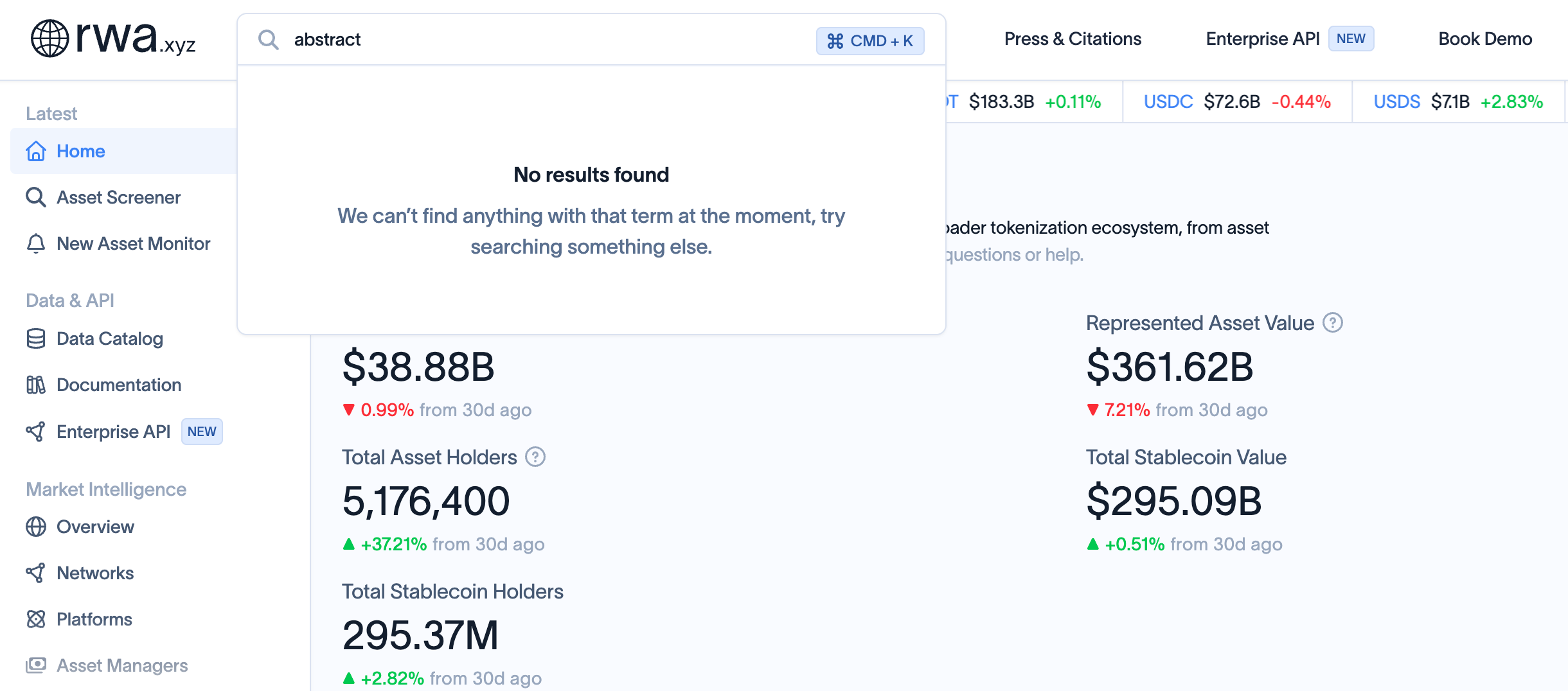
Second, low institutional participation and limited liquidity. This is one of the important reasons for Abstract's shutdown. Taking RWA asset data as an example, Abstract is essentially "absent" on RWA asset TVL network rankings. It also largely missed out on the major crypto and traditional finance trends of the past two years, such as institutional investment channels, the RWA asset wave, and stock tokenization trading. From this perspective, it represents an extremely serious strategic misjudgment.
Third, excessively high operational costs. Beyond the fixed operating expenses of an L2 (Odaily Planet Daily Note: including sequencer operations, ZK-related data availability and proof costs, bridging and front-end maintenance, infrastructure development, team operational costs, ecosystem incentives/developer support, etc.), Abstract's collaborations with traditional brands, partnerships, and offline events also required significant spending. The seemingly glamorous L2 path is not as low-cost as many imagine. Early technical development, mid-term growth operations, and long-term ecosystem building all require continuous capital investment. Abstract's shutdown also carries a sense of cutting losses in time.

Fourth, declining demand for related products and unclear PMF. Unlike the favorable situation Pudgy Penguins previously enjoyed due to its NFT community, physical toy IP, PENGU token launch, and a favorable crypto bull market, the current crypto market's demands on L2 networks, and even L1 public chains, are no longer limited to small-scale project prosperity. Instead, it requires "ecosystem-level hubs" like Hyperliquid and Robinhood Chain, which enable pre-pricing of traditional financial assets and introduce liquidity and institutional capital from traditional financial markets, thereby reaping the benefits of "fee harvesting." This is precisely the market that Abstract and numerous other L2 networks have been unable to tap into.

Beyond these reasons, homogeneous competition among L2 networks and the rapid alternation of crypto market bull and bear cycles are also contributing factors to Abstract's reluctant shutdown. And following Abstract's closure, heated debates have emerged in the market.

Praise vs. Criticism: No Intent to Cash Out or "PUA to the End"?

After Abstract's official shutdown announcement, the crypto community engaged in fierce debate. Here are some representative viewpoints:

Yuga Labs VP 0xQuit posted: "Abstract did a decent thing. They could have followed Blast's model and directly launched a token (TGE) to raise a massive amount of money. Instead, they admitted failure, choosing to wind down the project without a TGE. Sure, people still lost money, but it could have been much worse. Respect."

Community member Loki agreed: "Abstract could have done a TGE at any point before shutting down, like countless L2 projects with no users, but they didn't. Pudgy Penguins co-founder and CCO @chefgoyardi and CEO @LucaNetz bought the project with their own money and never cashed out from the community. Now, with Abstract, they've shown their integrity again. The best news: refocusing on the Pudgy Penguins project." His words express continued confidence in the Pudgy Penguins team.

However, others expressed extreme dissatisfaction, particularly users who invested real money, time, and effort into Abstract's ecosystem and network interactions.

Abstract power user Micka posted on X: "I participated in @AbstractChain during the testnet in July 2024. I built the French community, posted thousands of tweets about Abstract, and streamed over 1500 hours of Abstract mainnet content in 2025. I spent thousands of dollars over one year and ten months, accumulating 4 million Abstract interaction XP." Now, Abstract has fallen even before completing the first phase of its three-stage roadmap. He is "speechless" and "will no longer trust Luca."

Another community member, Chris, criticized sharply: "I sold all my PENGU tokens. That Space they used to announce the shutdown of Abstract services was awful, like they hadn't discussed it beforehand and hastily threw it together last minute. I somewhat understand their move because they didn't want to shut down after launching the ABS token via TGE. But what I really dislike is the overall narrative framework. Their response was a cold 'badges are useless anyway' and 'you supported our startup project.' The worst blow was when someone asked Luca if any Abstract users would receive any rewards from the Pudgy Penguins ecosystem, he immediately said no without hesitation, basically stating that what users can currently access in the ecosystem is it. This went on for far too long, completely unnecessarily. As a streamer, someone who diamond-handed tokens to zero for engagement, who invested massive time and effort weekly for six months, creating content series around this vision, I'm deeply disappointed in how this turned out."

Others even dug up an interview video of Luca from last year's Paris NFT conference, where he expressed full confidence in Abstract's future, claiming "Abstract will become the biggest L2 network in the future," and asked everyone to wait and see. Now, many received the official notice of Abstract's shutdown.

The brutal reality checks in the crypto market seem to keep happening. Often, you can't foresee that the project you invest heavily in will definitely be the winner at the table, just as you can't guarantee you'll reach the South Pole as long as you keep walking.

Conclusion: After the CEX Shutdown Wave, the L2 Shutdown Wave Has Arrived

After years in the space, I've seen too many failures—in sectors like NFT, GameFi, SocialFi, and the recent wave of CEX closures. Earlier, I even interviewed Luca Netz around January 2025. Back then, similar to his state at the NFT Paris conference, he was full of grand ambitions for the future of Abstract, Pudgy Penguins, and the Igloo group, placing high hopes on PENGU's prospects.

However, the development of things often doesn't follow individual will. The success or failure of a crypto project depends on numerous factors: beyond the usual track, strategy, and direction, there's also funding, business model, ecosystem building. It relies on the participation of institutions, market makers, and retail investors, and sometimes requires a bit of time and luck.

Just as I wrote numerous articles last year discussing "L2 is a detour for Ethereum," the shutdowns of Abstract and Blast are not the end of the exodus for these "ghost town" L2s. In the current climate where various models and projects are being proven unviable, projects unable to connect with traditional financial markets may need to reconsider their future direction and path forward.


Related Questions

QWhat is the main reason given for the shutdown of the Abstract L2 network?

AThe main reasons include insufficient DeFi ecosystem development, lack of institutional participation and liquidity, high operational costs, unclear product-market fit (PMF), intense homogenized competition among L2s, and the fast-paced shifts between crypto bull and bear markets.

QHow did some community members, like Yuga Labs VP 0xQuit, view Abstract's decision to shut down?

AYuga Labs VP 0xQuit viewed Abstract's shutdown as a decent move. He stated that the team could have chosen to conduct a TGE (Token Generation Event) to raise significant funds but instead admitted failure and chose to wind down the project without issuing a token, showing integrity.

QWhat was a major point of criticism from users like Micka regarding Abstract's shutdown?

AUsers like Micka criticized the shutdown because they had invested significant time, money, and effort into the Abstract ecosystem since the testnet phase, building communities and creating content. They felt betrayed that the project shut down before completing its roadmap, rendering their contributions and hopes for rewards meaningless.

QAccording to the article, what strategic misjudgment did Abstract make regarding institutional participation?

AThe article states that Abstract made a severe strategic misjudgment by largely missing out on major trends like institutional investment channels, the RWA (Real World Assets) wave, and stock tokenization trading over the past two years, failing to attract institutional liquidity.

QWhat broader trend does the article suggest might follow the shutdown of Abstract and Blast?

AThe article suggests that after the wave of CEX (Centralized Exchange) shutdowns, a wave of L2 (Layer 2) network shutdowns may have begun, indicating that projects unable to establish meaningful connections with traditional finance might struggle to survive.

Related Reads

From Harshly Criticizing Stablecoins to Building an L1: Airwallex's Jack Zhang Isn't "Converting" — the Battle for the Settlement Layer Has Begun

In June 2025, Airwallex CEO Jack Zhang publicly questioned stablecoins, arguing that fiat conversion costs outweighed their cross-border payment benefits and that crypto had failed to solve real-world problems for 15 years. Yet just 17 months later, in November 2026, Zhang emerged as co-founder of Alta, a blockchain project that raised $80 million (a $47.5 million Series A led by Index Ventures plus a $32.5 million seed round). Rather than a change of heart, the move reflects commercial necessity: a battle over the stablecoin settlement layer is underway, and payment giants that stay out risk becoming mere interfaces atop someone else's chain. Alta is not a general-purpose public chain but a compliant Layer 1 built for banks and licensed payment institutions. Co-founder Loong Wang, previously of Ren Protocol, says existing chains like Ethereum and Solana cannot simultaneously meet institutional demands for privacy, compliance, integration with local financial systems, and liquidity. Alta uses recursive zero-knowledge proofs to enable on-chain compliance checks without exposing identities or transaction amounts, and builds in programmable compliance modules, native identity authorization, and anti-airdrop protections. Co-founder Catherine Porter previously led Meta's Libra (Diem) partnerships. Airwallex itself is Alta's key advantage: with $287 billion in annualized volume, $1.3 billion in revenue, 200 countries, and 90 currencies, it will channel enterprise clients onto the new chain. Zhang's apparent reversal is consistent: he criticized stablecoins as cheap remittance tools, but now bets on tokenized fiat settlement infrastructure. Competitive pressure comes from Stripe, which acquired Bridge for $1.1 billion, bought Privy, and incubated the Tempo chain (raising $500 million at a $50 billion valuation, with OpenAI, Shopify, Deutsche Bank, and Visa as partners). Circle's Arc, Fireblocks, and Canton Network are also competing. With stablecoin market cap exceeding $320 billion and 2025 on-chain volume surpassing $33 trillion, the real contest is over who controls minting, clearing, and fiat redemption. Success will depend less on technology than on three factors: genuine adoption by traditional financial institutions, compliance adaptation across jurisdictions, and efficient on- and off-ramps to real banking systems. The paradigm has shifted: instead of disrupting banks, fintech giants now aim to build infrastructure that lets traditional finance voluntarily move on-chain. Pragmatism, not ideology, now dominates the race.

marsbit1h ago

From Harshly Criticizing Stablecoins to Building an L1: Airwallex's Jack Zhang Isn't "Converting" — the Battle for the Settlement Layer Has Begun

marsbit1h ago

"Everyone is too conservative with AI!" Head of Claude Code: My approach is more ambitious

Felix Rieseberg, who leads Claude Code's desktop app, argues that most people use AI too conservatively and should set more ambitious goals. His central trick: set unreasonably aggressive targets and insist they're achievable—for example, instead of cutting website load time from 10 seconds to 5, aim for 0.2 seconds, and when the model protests, keep telling it the problem is solvable and to try again. He organizes ambition into four categories: speed (doing the same work faster), height (raising the abstraction level to focus on desired outcomes rather than individual tasks), depth (working like top experts, using their real tools, data, and methods), and breadth (drawing on ideas from other fields). For height, he suggests asking what you ultimately want to happen and what the goal behind the goal is—e.g., instead of fixing single crashes, require the app to never crash. For a quarterly business review, move from filling in a template to understanding what changed and why, identifying the most urgent decisions, and redesigning the review process itself. For depth, he advises insisting on the tools top professionals actually use (databases and statistical models rather than Markdown tables), setting "unreasonable" targets, challenging your own assumptions against raw data, hunting for new knowledge, and using external validation rather than letting the model grade itself. A useful prompt asks the model what top experts would do that you haven't requested, what raw materials and tools they'd use, and what besides the model and you could prove the result correct. For breadth, he recommends replacing nouns with verbs (not "make a PPT" but "in 30 minutes, convince busy people of an explanation and drive a decision under uncertainty"), assembling cross-disciplinary teams, and using multi-agent setups—while avoiding mere role-play in favor of adopting other fields' actual methods. He closes with self-efficacy research: people given clear, challenging goals outperform those told to do their best, and believing difficult things are possible—as with the four-minute mile—unlocks achievement. In an era of rapid capability gains, updating our beliefs about what's possible matters more than ever.

marsbit1h ago

"Everyone is too conservative with AI!" Head of Claude Code: My approach is more ambitious

marsbit1h ago

The Traditional Santa Rally: Will It Happen in US Stocks This Year?

US stocks have suffered a sharp selloff, but technical and positioning conditions are repairing, with Goldman Sachs, Morgan Stanley and JPMorgan all signaling a potential year-end rally. Goldman strategist Cosimo Codacci-Pisanelli argues that aggressive deleveraging (the most intense in a decade), valuation multiples back near 35-year averages (MSCI world forward P/E at 15.6x), upward EPS revisions, and seasonal factors create conditions for a year-end short squeeze. Morgan Stanley data shows hedge funds are now underweight AI for the first time since 2023, with the longest deleveraging streak in over 15 years; JPMorgan calls poor sentiment a bullish signal. However, the report flags a paradox: when all three banks call the same trade, the contrarian "year-end squeeze" becomes a crowded consensus trade. Worse, inflation pressure is building faster than during the pandemic: global manufacturing import price inflation is running at about 24% annualized, and the share of import categories with annualized gains above 5% has jumped to 25-40% across major economies. Firms are absorbing costs via margin compression, but upstream pressures typically pass through to consumers in 6-12 months, meaning the bill arrives in Q1. January is historically the month with the most price resets, and Goldman has added a third Fed hike to its forecast. A reflexive loop means a rally that loosens financial conditions removes the rationale for central bank caution, effectively borrowing from future returns. Goldman recommends long front-end inflation as a portfolio hedge, and notes the best rule for 2026 is to short every consensus trade.

marsbit2h ago

The Traditional Santa Rally: Will It Happen in US Stocks This Year?

marsbit2h ago

Claude Deciphers Gödel's Cryptic Manuscripts: 80-Year-Old Notes Shake the Mathematics World

In 1978, logician Kurt Gödel left behind thousands of pages of unpublished notes written in Gabelsberger shorthand, a nearly extinct German stenography system understood by only a handful of people. In 2017, Finnish logician Jan von Plato, upon reaching mandatory retirement age, set out to decode 16 workbooks comprising 1,009 pages that Gödel wrote after settling in Princeton in 1940. After years of manually transcribing the shorthand into modern English, his team could barely digest one page per week—until computer scientists suggested using Claude. Fed the transcripts, von Plato's own books, and modern literature, Claude produced a 650-page interpretation within days, later expanding to 1,084 pages. The AI identified 663 theorem-like results, around 440 of which were confirmed as new theorems through formal verification—suggesting Gödel proved nearly one theorem every two days in the early 1940s. Claude also revealed that Gödel came within a hair of proving the independence of the Axiom of Choice two decades before Paul Cohen's 1963 forcing method earned him a Fields Medal; Gödel had constructed an equivalent framework but made an error in a key definition of "finite support," a result later verified in Coq and praised by Gödel expert Akihiro Kanamori. The notes also contain results rediscovered only in the 1970s–80s, 14 unexplored research topics, and physics work including early use of the Lüders rule (proposed in 1951) and serious study of time-travel via his rotating "Gödel universe." Gödel died in 1978 of starvation caused by paranoia.

marsbit2h ago

Claude Deciphers Gödel's Cryptic Manuscripts: 80-Year-Old Notes Shake the Mathematics World

marsbit2h ago

Trading

Spot
活动图片