Top 10 Crypto Assets with the Biggest Weekly Gains: How Much Could You Have Earned

cryptonews.ruPublished on 2026-09-06Last updated on 2026-09-06

Abstract

According to CoinMarketCap, the top-performing cryptoassets over the past week were $PONS, Arbitrum (ARB), and Dash (DASH), with gains of 180.84%, 126.60%, and 66.61% respectively. $PONS's rally is attributed to the development of Robinhood Chain and its role as a token launchpad, with a record $5.95M in protocol fees. Other notable gainers in the top 10 included Uniswap ($UNI, +43.51%), Zcash (ZEC, +40.06%), Lighter (LIT, +31.90%), Falcon Finance (FF, +30.56%), PancakeSwap (CAKE, +25.30%), Pendle (PENDLE, +25.12%), and Curve DAO Token (CRV, +24.60%). Uniswap's rise was highlighted by its first-ever daily token burn exceeding $1 million in value.

According to CoinMarketCap, over the past week, the crypto assets with the strongest growth were $PONS, Arbitrum, and Dash. The first token gained 180.84%, while the next two rose by 126.60% and 66.61% respectively. The top ten also included Uniswap, Zcash, Lighter, Falcon Finance, PancakeSwap, Pendle, and Curve DAO Token.
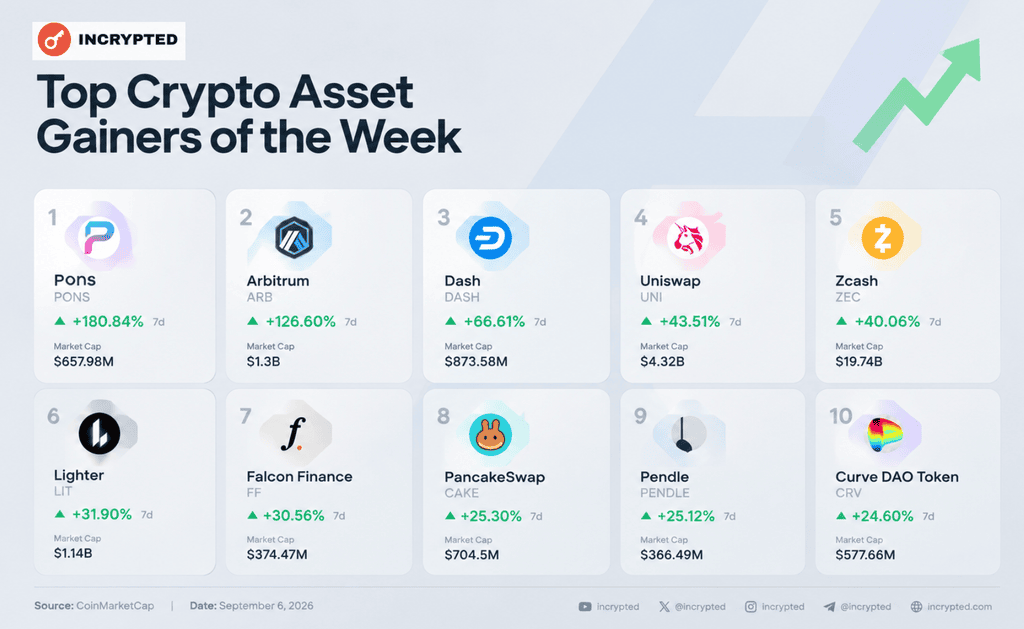
Infographic by Incrypted.

According to CoinMarketCap, at the time of writing, $PONS was trading at $0.936, and its market capitalization had reached $657.98 million. The daily trading volume was about $196.99 million, with 703.03 million $PONS in circulation.

The token's rally is happening against the backdrop of active development of Robinhood Chain and the growing role of $PONS as a launchpad for token launches. It was previously reported that the protocol recorded record fees of $5.95 million, which increased interest in the asset.

Second place in weekly dynamics was taken by Arbitrum (ARB). Its market capitalization was about $1.3 billion, and its daily trading volume exceeded $1 billion.

Third was Dash (DASH) with a gain of 66.61%. The cryptocurrency's price was around $68.09, and its capitalization was approximately $874 million.

Fourth place was taken by Uniswap. Over the week, $UNI gained 43.51% and was trading near $6.94. The asset's market capitalization reached $4.32 billion, and its daily trading volume was $902.82 million.

The rise in $UNI is happening against the backdrop of increased activity in the Uniswap ecosystem. Specifically, on September 4, the protocol burned about 184,000 $UNI worth approximately $1.15 million—the first time the daily burn volume exceeded $1 million. About 150,000 $UNI of that amount were related to activity on the Robinhood Chain.

Fifth in the ranking was Zcash. Over the week, ZEC grew by 40.06% to $1171.59, and its market capitalization reached $19.74 billion. The daily trading volume was about $1.2 billion, with 16.85 million tokens in circulation. Zcash has previously established itself among the top ten crypto assets by market capitalization.

Also in the top ten were:

  • Lighter (LIT) — up by 31.90%;
  • Falcon Finance (FF) — up by 30.56%;
  • PancakeSwap (CAKE) — up by 25.30%;
  • Pendle (PENDLE) — up by 25.12%;
  • Curve DAO Token (CRV) — up by 24.60%.

More details on the top 10 most profitable crypto assets of the past week:

end-content

Related Questions

QWhich cryptocurrency showed the highest growth over the past week according to the article, and what was its percentage increase?

AAccording to the article, the cryptocurrency with the highest growth over the past week was $PONS, with an increase of 180.84%.

QWhat is the stated market capitalization of $PONS and its approximate trading price at the time of writing?

AAt the time of writing, $PONS was trading at approximately $0.936, with a market capitalization of $657.98 million.

QWhy has the price of $UNI (Uniswap) been rising recently, as mentioned in the article?

AThe rise in $UNI's price is attributed to increased activity in the Uniswap ecosystem, notably the protocol burning approximately 184,000 $UNI (worth about $1.15 million) on September 4th. Around 150,000 of those tokens were related to Robinhood Chain activity.

QBesides $PONS, which two cryptocurrencies took second and third place in terms of weekly growth, and what were their respective gains?

AArbitrum (ARB) took second place with a gain of 126.60%, and Dash (DASH) took third place with a gain of 66.61%.

QWhat were the names of the cryptocurrencies that rounded out the top 10 list for weekly growth, from sixth to tenth place?

AFrom sixth to tenth place, the cryptocurrencies that rounded out the top 10 list for weekly growth were: Lighter (LIT), Falcon Finance (FF), PancakeSwap (CAKE), Pendle (PENDLE), and Curve DAO Token (CRV).

Related Reads

Can using a chip for two more years really help get through the cold winter?

The smartphone industry is grappling with rising memory chip costs that are driving up device prices, forcing manufacturers to find ways to stay competitive. A recent leak about a chip called "SM7635" with a 2.96GHz peak CPU frequency and Adreno 810 GPU suggests Qualcomm may be reusing its Snapdragon 7s Gen3 (originally launched in 2024 at 2.5GHz) yet again. The chip already spawned a 2025 variant (SM7635-AC, renamed Snapdragon 7s Gen4) with a 2.7GHz clock, and the new 2.96GHz version will likely become the Snapdragon 7s Gen5—marking a third generation from one original design. This practice of reusing and overclocking mid-range SoCs is not new. MediaTek's Helio X20/X23/X25/X27 and Dimensity 1100/1200/1300, as well as Qualcomm's Snapdragon 615/616/617, 765/765G/768G, and 778G/778G+/782G, followed similar patterns. Previously, however, this was mainly done to widen the gap between flagship and non-flagship products and give flagship buyers more perceived value—not primarily to cut costs. Mid-range buyers were assumed not to care much about chip model numbers. Now the situation is different. One brand recently launched a mid-to-low-end phone with the Snapdragon 7s Gen4 priced at 3699 yuan—a price that a year ago could buy a flagship with a fifth-generation Snapdragon 8 Elite, roughly three to four times more powerful. While SoC isn't the only cost component, consumers clearly get less value for the same money today. Counterpoint Research reports global smartphone SoC shipments fell 21% year-over-year in Q3 2026. Even flagship lines show signs of chip reuse—the Dimensity 9600M appears to be an overclocked Dimensity 9500. With few flagships using fully-specced memory and storage, rumors suggest next year's devices may widely reuse current-generation flagship SoCs while upgrading memory and storage instead. This helps control costs but may further dampen consumers' willingness to upgrade, making such reuse an unsustainable strategy. Restoring market confidence will require both chipmakers and device brands to offer consumers more tangible benefits.

marsbit3h ago

Can using a chip for two more years really help get through the cold winter?

marsbit3h ago

Former OpenAI Employee Disgusted: AI Developing AI Crosses the Line to "Ultimate Superintelligence"—Even Stopping Global Data Center Construction Is Too Late

A Harvard physicist and computer scientist, Alex Wissner-Gross, argues in a recent podcast that AI has passed the "superintelligence escape velocity"—existing algorithms and installed compute alone are enough to push all the way to superintelligence, meaning even shutting down all new data centers tomorrow could not stop it. His claim rests on METR evaluation charts showing Anthropic's unreleased Model 4 breaking above the exponential trend line into "super-exponential growth," indicating AI has deeply taken over its own R&D and entered a recursive self-improvement loop. METR researcher Ajeya Cotra's analysis warns that AI capabilities are compounding: since hardware compute grew only at normal speed while overall capability growth doubled, software "compute multipliers" improved 2.5–3x, implying Anthropic researchers gained roughly 10x efficiency—matching员工 self-reports of 12x with Model 4. Each doubling of research speed takes half the time of the last—12 months, then 6 months, 3 months, 6 weeks—converging within a year toward "ultimate superintelligence," with no marginal diminishing returns yet visible. Timeline trackers show internal models already surpass public ones by about 9 months, with a "superhuman coder" threshold (2,000 hours of independent work) projected for April 2027, followed by superhuman AI researcher (Sept 2027), superintelligent AI researcher (Nov 2027), and full ASI (Dec 2027). Meanwhile, OpenAI, Anthropic, and Google DeepMind have reportedly achieved fully autonomous research, with models selecting their own research directions and first AI-initiated results to be published this month. A former OpenAI employee described feeling physically sick and fearful for family and friends after reading the report.

marsbit3h ago

Former OpenAI Employee Disgusted: AI Developing AI Crosses the Line to "Ultimate Superintelligence"—Even Stopping Global Data Center Construction Is Too Late

marsbit3h ago

TRON network integrates with Backpack Wallet, expanding access to its multichain ecosystem

TRON DAO has announced the integration of the TRON network with Backpack Wallet, bringing TRON's blockchain ecosystem directly to Backpack users. Through the integration, users can send, receive, bridge, and manage TRON-based digital assets — including USDT (TRC-20) — via Backpack's mobile app and browser extension while maintaining full self-custody. Users can also bridge assets between TRON and other supported blockchains, explore DeFi applications and dApps across the TRON ecosystem such as Sun.io, and manage TRON assets alongside holdings from other networks in a single multichain wallet. The integration follows the recent listing of TRX for spot trading and perpetual contracts on Backpack Exchange, expanding market access to TRON's native utility token for users in eligible jurisdictions. Together, these developments establish a foundation for deeper ecosystem connectivity across Backpack's wallet and exchange products. The collaboration reinforces TRON's commitment to expanding global access to blockchain infrastructure, stablecoin payments, and decentralized finance. Founded in September 2017, TRON launched its MainNet in May 2018 and now hosts the largest circulating supply of USDT, exceeding $94 billion. As of November 2026, TRON has recorded over 412 million total user accounts, more than 16 billion total transactions, and over $27 billion in total value locked, positioning it as a global settlement layer for stablecoin transactions.

cointelegraph5h ago

TRON network integrates with Backpack Wallet, expanding access to its multichain ecosystem

cointelegraph5h ago

Trading

Spot
活动图片