H-JEPA: LeCun's World Model Startup Delivers, Code and Weights Fully Open-Sourced

marsbitPublished on 2026-10-10Last updated on 2026-10-10

Abstract

Yann LeCun's AI startup, AMI (Advanced Machine Intelligence), along with researchers from NYU, INRIA Paris, and Brown University, has introduced H-JEPA, a hierarchical world model for visual planning. The model stacks multiple Joint-Embedding Predictive Architectures (JEPAs) in layers, each predicting future states over different time horizons in its own representational space. For planning, a high-level layer first formulates a coarse plan, then passes predicted intermediate states as sub-goals to lower layers, which refine them step-by-step into executable actions. This hierarchical approach allows the model to manage both long-term goals and immediate actions. In the Visual AntMaze navigation task, a three-layer H-JEPA achieved a 73% success rate, significantly outperforming a single-layer model at 18%. It also demonstrated better performance with less computational cost in other simulated tasks. The work embodies LeCun's long-held view that intelligent systems require hierarchical planning across different levels of abstraction and timescales. To address the issue of representational collapse in world model training, H-JEPA employs the SIGReg method from prior work. The team has open-sourced the code and pre-trained model weights, enabling researchers to reproduce the planning experiments. This release follows AMI's commitment to open research, announced when the company launched with $1.03 billion in funding at a $3.5 billion pre-money valuation earlier this year. The ...

LeCun's world model startup, AMI (Advanced Machine Intelligence), has just quietly delivered its answer.

In the latest paper, H-JEPA, researchers from AMI, New York University, INRIA Paris, and Brown University introduced a hierarchical world model for visual planning.
H-JEPA stacks multiple JEPAs (Joint Embedding Predictive Architectures) layer by layer, allowing each layer to predict the state after different time spans within its own representation space.

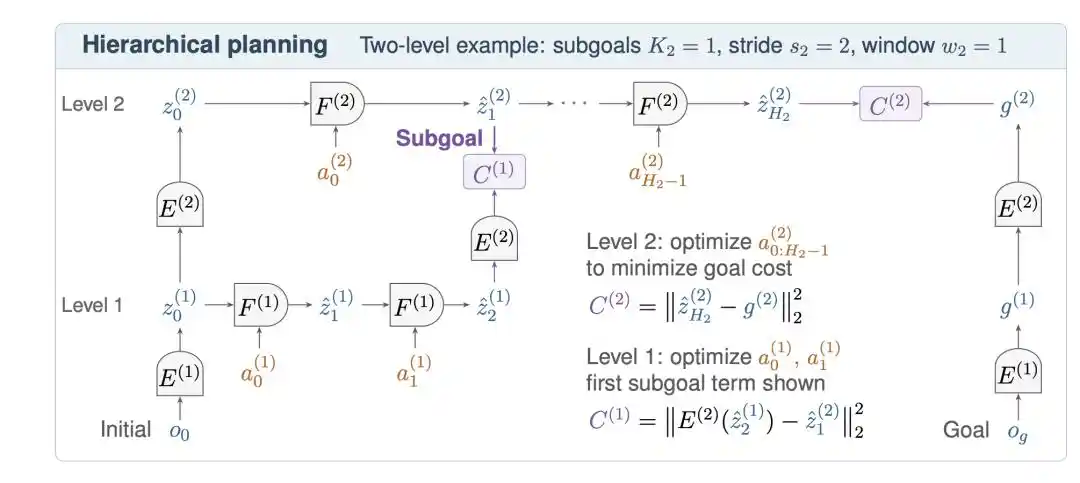
During planning, the high-level layer first formulates a rough plan, then passes the predicted intermediate states as subgoals to the low-level layer. The low-level layer takes over and refines the plan step by step, ultimately generating executable actions.

Through this division of labor, the world model can both plan for long-term goals and handle immediate actions.

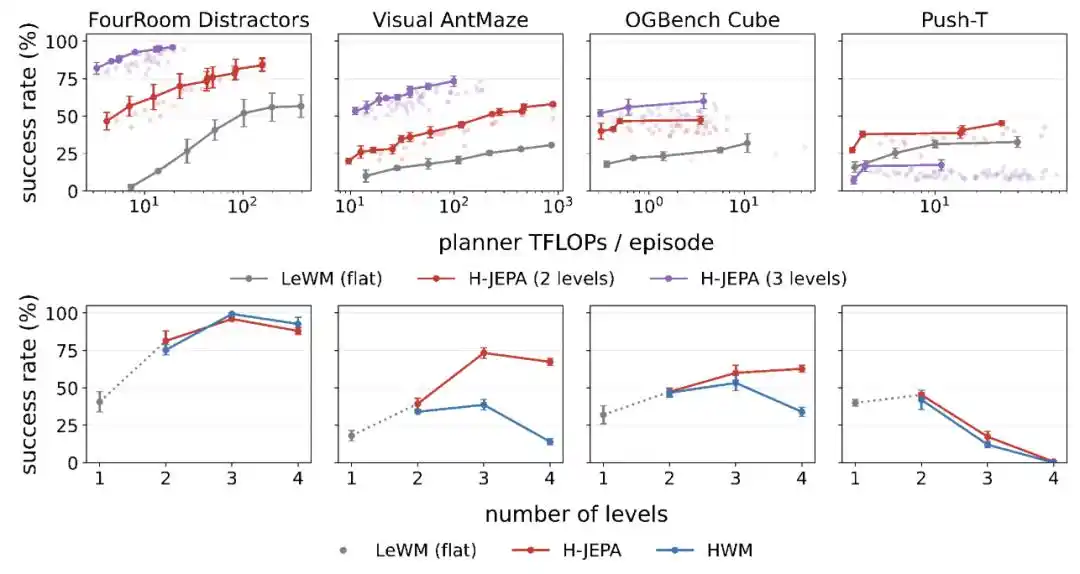
In the Visual AntMaze simulated maze task, the three-layer H-JEPA achieved a success rate of 73%, compared to 18% for the single-layer model.

Simultaneously, in several simulation tasks, the hierarchical model achieved better performance with less computational cost for planning.
Besides delivering tangible test results, H-JEPA also continues the open-source path that LeCun emphasized from the startup's inception.

The team has simultaneously open-sourced the code and pre-trained model weights, allowing researchers to directly load the model and replicate planning experiments.
Why Does a World Model Need Hierarchical Planning?

LeCun has actually been talking about this for a long time.

Back in 2022, while still serving as Chief AI Scientist at Meta, he proposed the concept of hierarchical JEPA:

Let the model predict at different levels of abstraction and time scales, and then implement complex goals as actions through hierarchical planning.
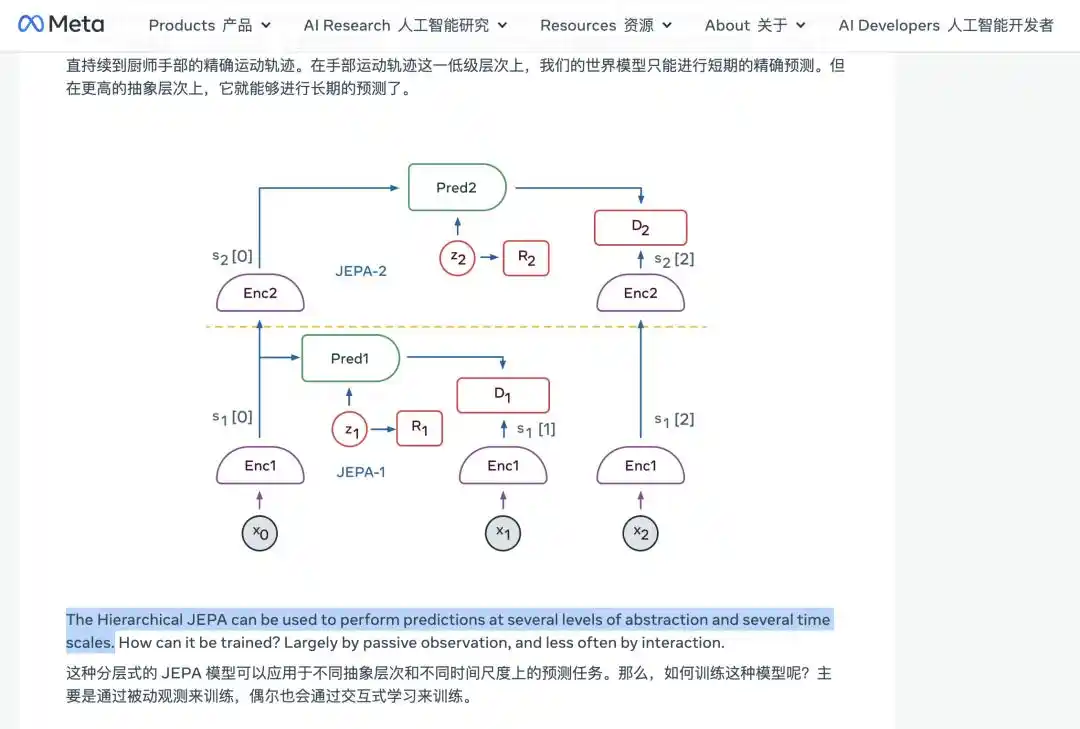
This might sound a bit abstract at first, but it's easy to understand using an example LeCun often cites.

Suppose you are sitting in your office at New York University, planning to go to Paris. When planning the entire trip, you focus on the destination, flights, and schedule.

After deciding on the itinerary, you start planning further: how to leave the office, go downstairs, and take a taxi to the airport.

When you actually walk out of the office, the information you focus on becomes the ground in front of you, the stairs, and where to place your next step, which foot to move first.

△

These planning levels cover different time spans and require different information. When planning the flight, the height of a specific step on a staircase is not important; when walking down the stairs, this detail directly determines how you should step.

This is not a characteristic unique to human planning. For robots, the high level needs to understand task objectives, environmental relationships, and future directions, while the low level needs to master specific actions and body control details.

For example, a quadruped robot may have already reached the target location, but if its leg posture differs from the target image, the model might still consider itself far from the goal due to these differences.
So, the question becomes:

How to let different levels learn information representations suitable for themselves, and then gradually implement high-level plans into low-level actions?

How Exactly Does H-JEPA Work?

Specifically, to solve the above problem, H-JEPA configures three components in each layer to handle state, action, and prediction respectively.
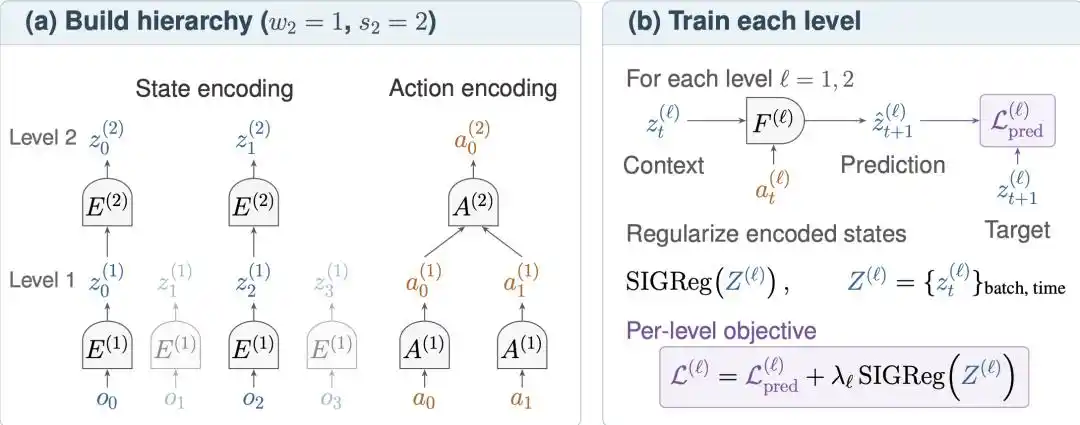
Among them, the state encoder is responsible for extracting the representation of the current environment. The lowest layer directly reads images, while higher layers further abstract based on lower-layer representations, retaining information more important at that time scale.

The action encoder is responsible for describing the changes brought about by actions. The low layer represents specific actions, while the high layer compresses a sequence of continuous actions into more coarse-grained changes.

The predictor combines the current state and action to predict future states. Different levels cover different time spans. In the paper's experiments, one step at a higher adjacent layer corresponds to two-step predictions at the lower layer.

Regarding model training, the layers above are learned jointly through end-to-end training, with different levels connected via subgoals.

The intermediate states predicted by the high level become subgoals for the low level. The low level transforms its predicted states into the high-level representation space, compares them with the subgoals specified by the high level, and then adjusts its actions accordingly.

However, when training the world model, there is a classic problem that needs to be addressed: representation collapse.

If the encoder compresses all inputs into the same vector, and the predictor only outputs this vector, it can achieve very low prediction error, but the model hasn't actually learned any useful information.

To address this, H-JEPA adopts the SIGReg proposed by LeCun's team in their previous LeJEPA work, constraining the representation distribution to prevent different states from being compressed into the same vector.
This year's LeWorldModel applied this method to world model training. H-JEPA builds upon it as the lowest layer, adding more JEPAs on top to form a structure trained jointly and planning from top to bottom.
In experiments, the researchers further observed information trade-offs at different levels. In the maze task, the high level gradually weakened the leg posture but still retained the robot's position information.
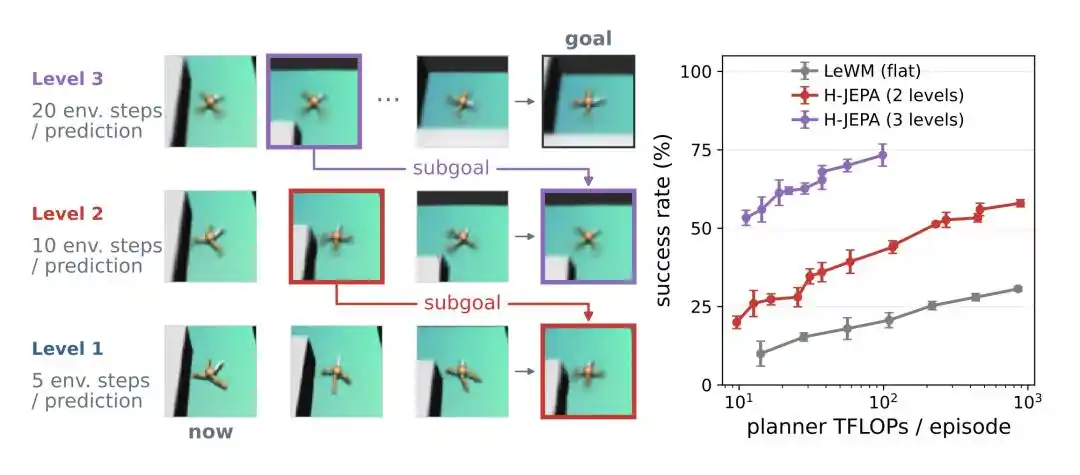
However, hierarchy also has its applicable conditions. The two-layer model performed well in the Push-T task, but adding a third and fourth layer led to decreased performance.

The paper suggests that shorter task trajectories might limit the training data available to higher layers.

LeCun, Still the Same LeCun

Overall, these designs of H-JEPA continue a fundamental proposition of JEPA: performing prediction in the representation space.

JEPA stands for "Joint Embedding Predictive Architecture." LLMs typically learn to generate content by predicting the next token; visual JEPA first encodes images or videos into internal representations, then predicts the representations of target parts, without needing to generate image pixels one by one.
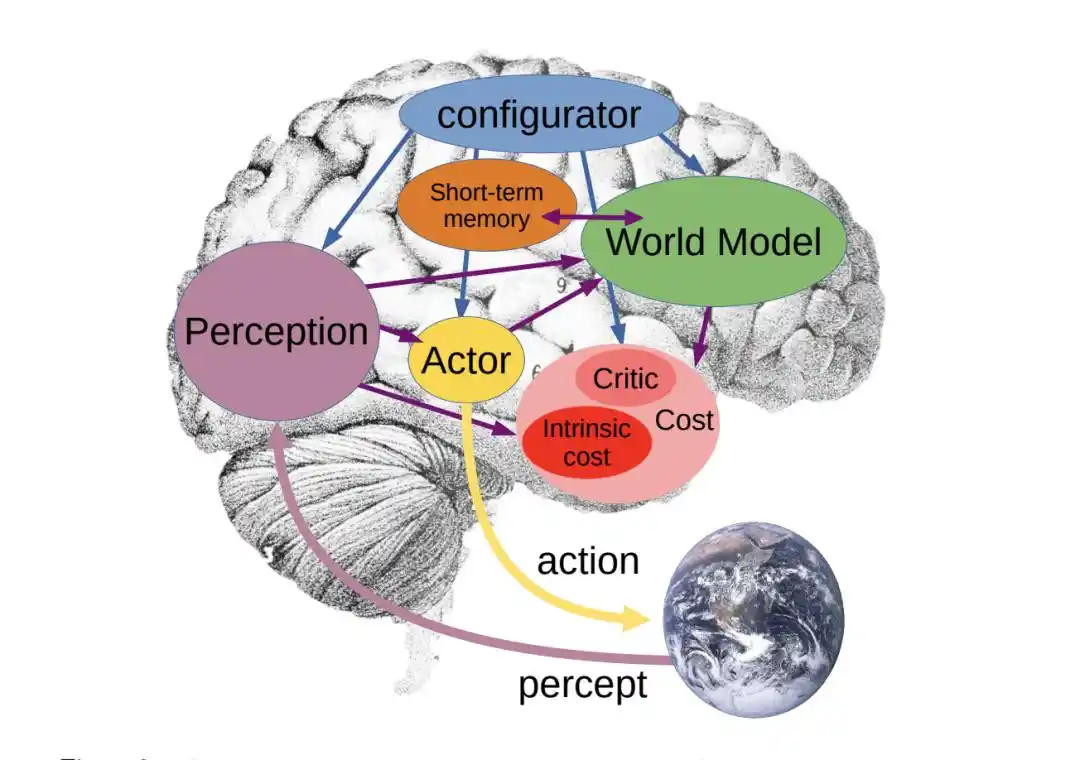
In world models like H-JEPA, the model also incorporates actions to predict the representations of future states. The planner then compares the consequences of different actions to find a path towards the goal.

LeCun has always believed that understanding the world, predicting the consequences of actions, and planning are essential capabilities for achieving human-level intelligence. His assessment of LLMs has always revolved around this point.

In September this year, at the EC CV conference in Malmö, Sweden, his presentation slides once again featured that familiar piece of advice:

If you are interested in human-level AI, don't work on LLMs.
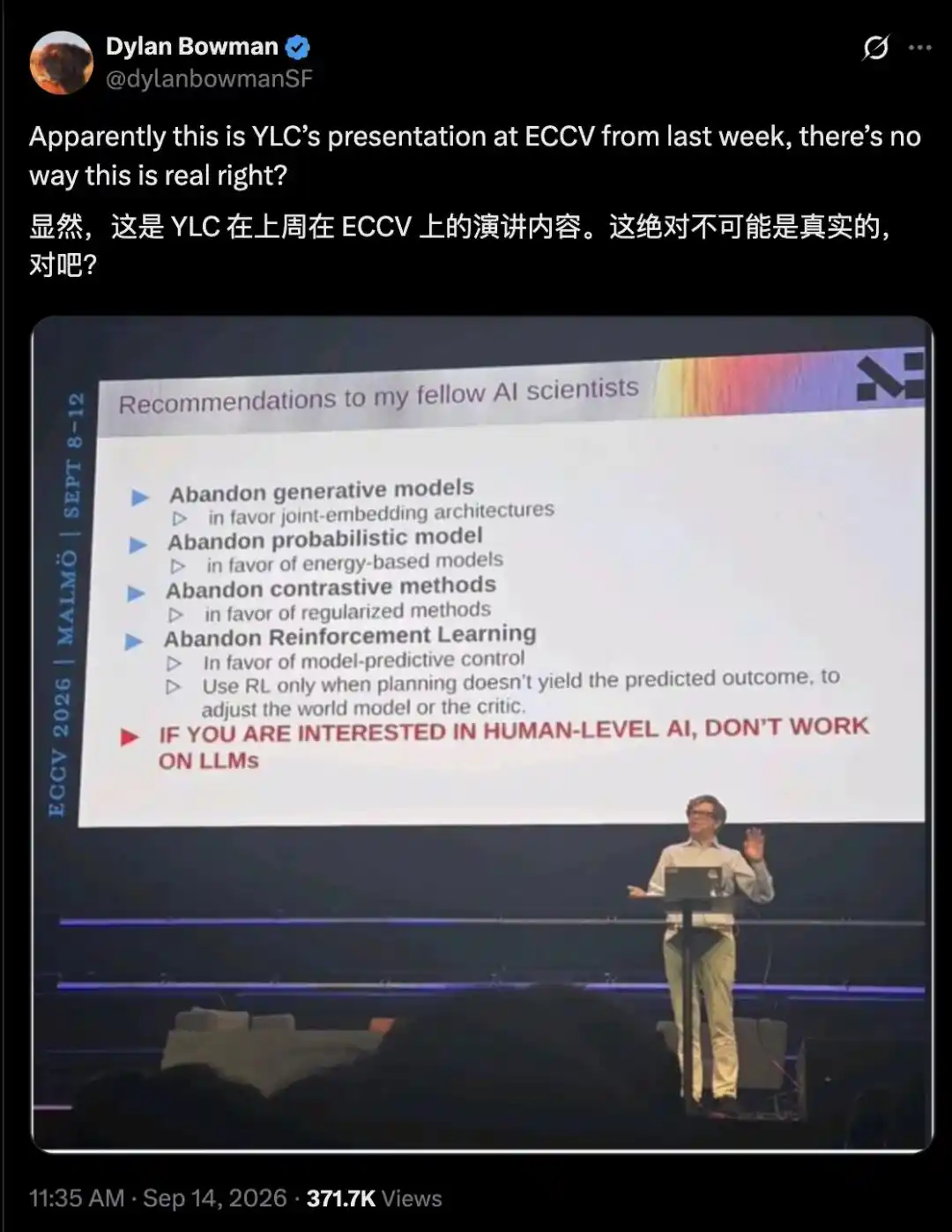
After this slide spread on social media, some doubted if it was fake. LeCun replied:

Guaranteed real.

He later added that LLM-based AI tools are very useful and everyone is using them. But he believes that LLMs alone cannot lead to human-level intelligence.

Now, this research philosophy has also become AMI's entrepreneurial direction.

In March this year, AMI announced the completion of a $1.03 billion funding round, with a pre-money valuation of $3.5 billion.

The company is chaired by LeCun, with Alexandre LeBrun as CEO, Saining Xie as Chief Scientist, Pascale Fung responsible for Research and Innovation, and Michael Rabbat responsible for World Models. Rabbat is also one of the authors of this H-JEPA paper.

However, it must be said that while research results are research results, another expectation for AMI from the outside world remains its products.

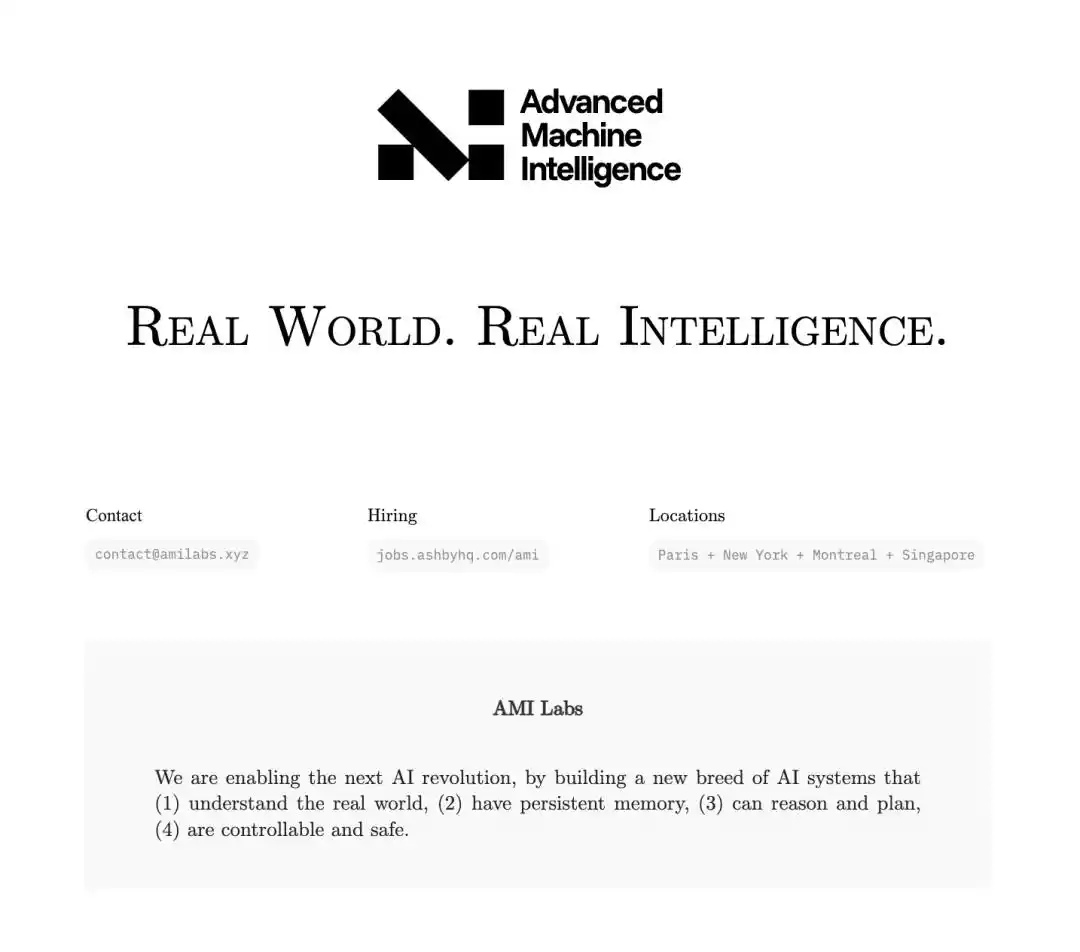
At least from the current official website, the company primarily showcases its technical direction, team, and recruitment information, with no public-facing product portal visible yet.
On the other hand, World Labs, which also bets on world models, has reached a new turning point.

On September 28th, AMD announced an all-stock acquisition agreement with World Labs, founded by Fei-Fei Li, worth approximately $8.2 billion.

It can be said that one side is moving towards integration with chip companies, while the other continues to advance along its own research path.

But with Fei-Fei Li's world model startup achieving a milestone, is Yann LeCun's major result also just a matter of time...?

References

[1]https://venturebeat.com/technology/h-jepa-teaches-world-models-to-plan-at-multiple-levels-of-abstraction

[2]https://arxiv.org/pdf/2610.06805

This article is from the WeChat public account "QbitAI", author: henry

Related Questions

QWhat is H-JEPA, and how does it differ from single-layer world models?

AH-JEPA is a Hierarchical Joint Embedding Predictive Architecture proposed by AMI (Advanced Machine Intelligence). It stacks multiple JEPA layers to enable planning at different levels of abstraction and temporal scales. In the Visual AntMaze task, its success rate was 73%, compared to 18% for a single-layer model, showcasing its superior ability to handle long-term goals and immediate actions through layered, hierarchical planning.

QWhy does LeCun advocate for a hierarchical approach in world models like H-JEPA?

ALeCun advocates for a hierarchical approach because he believes complex tasks, like a human planning a trip, require reasoning at different abstraction levels and time horizons. High levels handle overarching goals (e.g., booking a flight), while lower levels manage immediate actions (e.g., walking down stairs). This division allows models to both plan for the future and execute detailed, context-specific actions, which he considers essential for achieving human-level AI.

QHow does H-JEPA's training prevent the issue of representation collapse?

AH-JEPA prevents representation collapse by using a method called SIGReg (Sparse Information Gap Regularization), which was introduced in LeCun's prior work, LeJEPA. SIGReg constrains the distribution of representations, preventing the encoder from mapping different input states to the same vector. This ensures the model learns meaningful and distinct representations necessary for accurate prediction and planning.

QWhat significant business developments are mentioned regarding AMI and World Labs?

ATwo significant developments are mentioned: AMI, LeCun's startup, completed a $10.3 billion funding round with a pre-money valuation of $35 billion. Separately, AMD announced an all-stock acquisition agreement with World Labs, a company founded by Fei-Fei Li, valued at approximately $8.2 billion. This highlights the growing investment and strategic moves in the world model AI sector.

QWhat is LeCun's stance on large language models (LLMs) in relation to achieving human-level AI?

ALeCun believes LLMs alone are insufficient for achieving human-level AI. He has publicly stated, 'If you are interested in human-level AI, don't work on LLMs.' He acknowledges that LLM-based tools are useful, but argues that true intelligence requires capabilities like understanding the world, predicting action consequences, and hierarchical planning—areas where models like H-JEPA are focused.

Related Reads

This Bitcoin Developer's Proposal Makes Quantum Hackers Lose Money When Stealing Coins

Bitcoin developer Cory Fields has proposed a novel game-theoretic defense against future quantum attacks called "quantum landmines," designed to make stealing vulnerable bitcoin unprofitable rather than relying on hard forks or blanket asset freezes. The threat stems from quantum computers potentially using Shor's algorithm to derive private keys from exposed public keys, affecting early addresses and any address that has already spent coins. Under the scheme, an owner of vulnerable coins pre-commits a small quantum-safe output containing a hidden proof of ownership. When a quantum hacker tries to move the old coins, they must post an equal-sized anti-quantum bond. The coins and bond are locked in a challenge period (e.g., 30 days). If the true owner reveals the hidden proof, the network awards both the original coins and the hacker's bond to the owner's quantum-safe address. Since hackers cannot tell which wallets are trapped, attacks become risky and potentially loss-making. However, the same rule means legitimate owners must also post a bond to move their own old coins. For lost or abandoned coins where no owner can respond, Fields proposes a staking auction: anyone can pre-commit anti-quantum bitcoin to challenge a theft attempt, with successful challengers taking part of the hacker's bond while the vulnerable coins are destroyed. A third "sat auction" requires no pre-locking; any attempt to move high-risk coins triggers a bidding war where the top bidder receives the coins (minus their bid) and the second-highest bidder loses everything, echoing the "dollar auction" trap. Fields frames these as thought experiments, not a finalized upgrade. The approach avoids one-size-fits-all freezing that would permanently lock out inactive legitimate holders, but imposes real costs: honest holders need large bonds, offline owners may miss challenge windows, and some coins could be destroyed in auctions. Implementation would require quantum-safe wallet support, consensus rules enforcing bonds, waiting periods, recovery transactions, and auctions, plus community agreement on activation timing and parameters. No code, timeline, or finalized fund distribution has been provided, and none of these protections currently exist on Bitcoin.

marsbit27m ago

This Bitcoin Developer's Proposal Makes Quantum Hackers Lose Money When Stealing Coins

marsbit27m ago

ChatGPT Draws Out Personal Secrets in One Second, Whole Internet Frenzies Over the 'Empty Room' Test

A viral "empty room" experiment has users asking ChatGPT to fill a blank room image with everything it knows about them—and the results are unsettlingly accurate. One user found a jar containing a silverfish, recalling a casual question he'd asked a year earlier, proving how much the AI retains. Users report the outputs are startlingly precise, with some requesting exaggerated versions that turn the room into a full personality showcase. Analyst Patrick Moorhead compared multiple models, finding ChatGPT best and Claude worst. The experiment highlights ChatGPT's memory features: saved memories (names, preferences, goals) and reference to chat history. A paper accepted to ACM Web Conference 2026 analyzed data from 80 real users who exported their ChatGPT data under GDPR. Researchers traced "Model set context updated" log entries back to triggering user messages, extracting 2,050 memories from 65 people's 1,058 conversations and over 20,000 exchanges, dubbing these "algorithmic self-portraits." Key findings: 96% of memories were saved by ChatGPT itself without explicit user instruction (only 84 of 2,050 matched "remember" or "forget" keywords); 52% involved psychological profiling, mostly about desires (73%), intentions (16%), emotions (14%), and beliefs (11%); and 28% contained GDPR-defined personal privacy, with names in 41% and sensitive categories like health, religion, and politics in 7% (health over 60%). Overall, 91% of users had personal data stored and 54% had highly sensitive privacy recorded—contradicting OpenAI's public promise not to proactively save sensitive information. A simulation showed always-extracting memory would raise sensitive data to 31–35% and profiling to 55–59%. OpenAI's June "Dreaming" update lets ChatGPT silently review chats and rewrite memories (e.g., updating travel plans), boosting accuracy from 41.5% (2024) to 82.8% (V3) while cutting compute costs to one-fifth. Critically, deleting a conversation doesn't delete derived memories. A September arXiv paper analyzing 180,000 chat segments from 1,057 users found 21.31% discussed health issues, with over 95% of profiles recorded without user awareness—nearly matching the 96% figure—risking temporary symptoms being permanently mislabeled as conditions. The article concludes that users believed they were training a helpful "second brain," only to realize they themselves were being fully exposed, reduced to monetized "context" in the algorithm's eyes.

marsbit31m ago

ChatGPT Draws Out Personal Secrets in One Second, Whole Internet Frenzies Over the 'Empty Room' Test

marsbit31m ago

Trading

Spot
活动图片