Bitcoin fund flows show investors trading Fed rate path, not exiting market: CoinShares

cointelegraphPublished on 2026-09-08Last updated on 2026-09-08

Abstract

Bitcoin fund flows are increasingly tied to U.S. interest rate expectations, with CoinShares research head James Butterfill stating the Federal Reserve's policy is capping Bitcoin's price near $80,000 despite strong investor demand. Market reactions to Fed officials' speeches demonstrate this sensitivity, causing outflows and inflows as rate hike probabilities shift. Currently, markets price in a roughly 60% chance of a September rate hike. The analysis highlights Bitcoin's continued sensitivity to liquidity and monetary policy, similar to gold. Recent U.S. Treasury plans to increase bond buybacks have added liquidity, contributing to Bitcoin's rally from the low $60,000s to above $80,000 last month and leading to forecasts of a potential rise to $100,000 by year-end. Analysts suggest the rally may be driven more by a desire to de-risk exposure to the U.S. than by crypto-specific factors.

Crypto fund flows are becoming increasingly sensitive to changes in the US interest-rate outlook, with CoinShares arguing that Federal Reserve policy remains a key barrier to Bitcoin (BTC) breaking above $80,000 despite continued investor demand for crypto.

In his latest market update, CoinShares head of research James Butterfil argued that “Bitcoin is trading like gold again, but the Fed still sets the ceiling” at around $80,000.

That sensitivity was evident after Fed Chair Kevin Warsh’s speech at Jackson Hole. Warsh said progress on inflation had been modest and that price pressures were not easing quickly enough to give the central bank’s policy makers the confidence inflation was returning to its 2% target. Roughly $100 million exited digital asset investment products immediately after the speech, as markets sharply increased the probability of a September rate hike.

Flows reversed over the following week, reaching $1 billion by Sept. 4. The turnaround coincided with comments from Fed Governor Christopher Waller, who pointed to recent signs of “disinflation” and said he was inclined to keep rates steady in September if upcoming inflation data showed further progress.

“Investors are not exiting the asset class,” Butterfill wrote. “They are trading the rate path.”

As of Monday, Fed Funds futures prices implied a roughly 60% chance of a rate hike following next week’s Federal Open Market Committee (FOMC) meeting, according to CME Group.
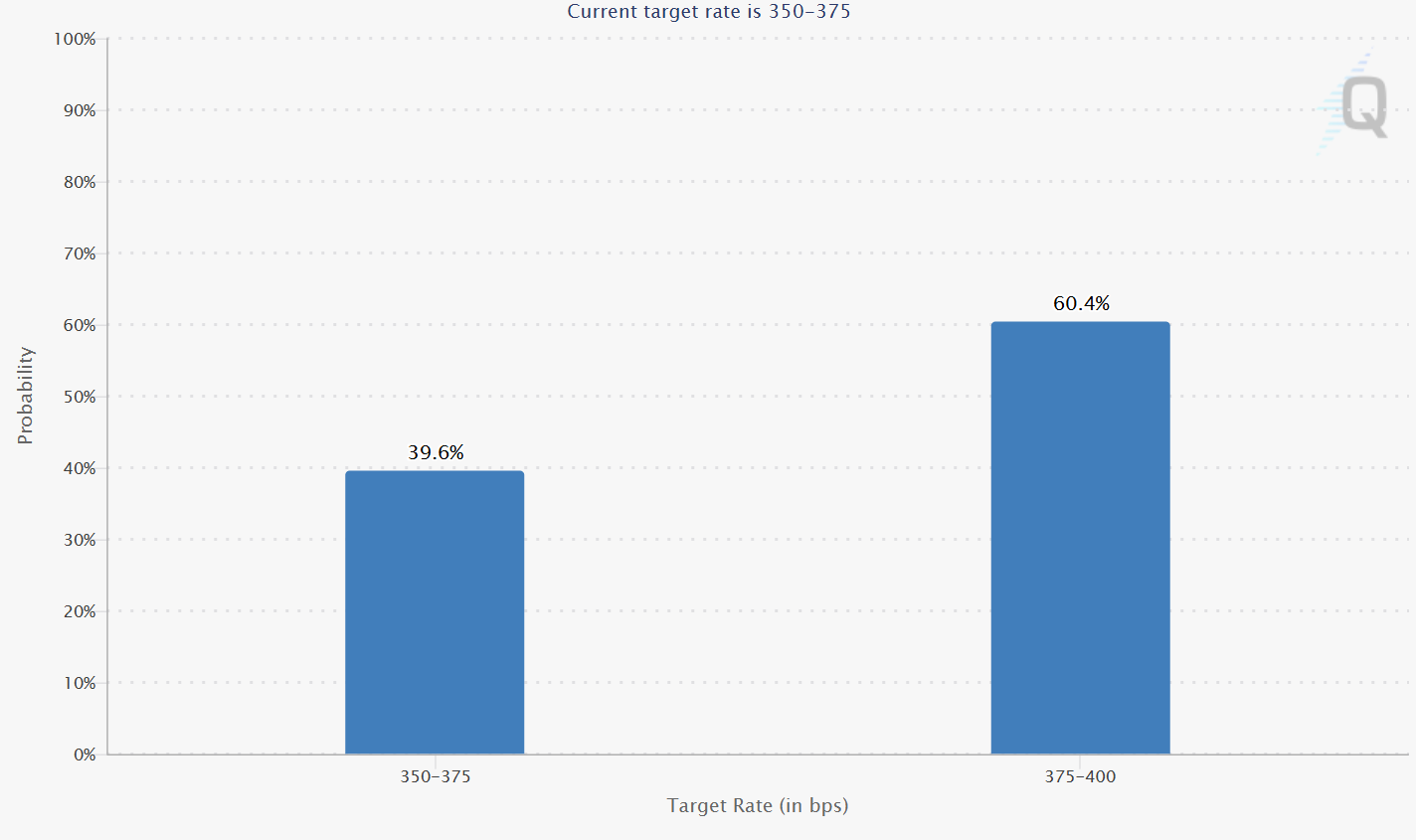
Markets are now pricing in a 25 basis-point rate hike on Sept. 16. Source: CME Group

The movements suggest that Bitcoin and broader digital asset markets remain highly sensitive to shifts in liquidity and monetary policy. Easier financial conditions have historically supported crypto and other risk assets.

Related: Crypto Biz: AI took a back seat when Bitcoin started climbing

Treasury buybacks add to liquidity backdrop

CoinShares’ assessment comes against the backdrop of a strong rebound in Bitcoin and the broader digital asset market last month, when the US Treasury announced plans to double certain long-dated bond buybacks from $2 billion to $4 billion per operation. Bitcoin climbed from the low $60,000s to above $80,000 during the month.

The expanded buyback program is expected to run from Sept. 9 through Nov. 4.

“Around the Treasury announcement we also saw equity sell-offs and shifts across the yield curve, layered on top of the ongoing noise from the Iran war — oil and equities swinging depending on whether or not people are feeling optimistic about diplomacy on any given day,” wrote 21shares co-founder Ophelia Snyder in her Substack newsletter last week.

“Taken together, these factors suggest to me that the current Bitcoin rally may have less to do with crypto-specific catalysts and more to do with growing interest in de-risking exposure to the US specifically,” she added.

The move reinforced the market’s focus on liquidity conditions and prompted Standard Chartered to forecast that Bitcoin could reach $100,000 before the end of the year.

Related: Strategy’s $66B Bitcoin machine hinges on capital markets, not BTC price: Report

Related Questions

QAccording to CoinShares, what is the main factor currently preventing Bitcoin from breaking above $80,000?

AAccording to CoinShares head of research James Butterfill, Federal Reserve policy remains a key barrier to Bitcoin breaking above $80,000.

QHow did crypto fund flows react immediately after Fed Chair Kevin Warsh's Jackson Hole speech, and why?

AImmediately after Fed Chair Kevin Warsh's Jackson Hole speech, roughly $100 million exited digital asset investment products. This occurred because markets sharply increased the probability of a September interest rate hike after Warsh stated that progress on inflation had been modest and was not easing quickly enough.

QWhat evidence does James Butterfill provide to support the claim that 'investors are not exiting the asset class' but are 'trading the rate path'?

AButterfill points to the reversal of fund flows the week after Warsh's speech. Outflows of $100 million were followed by inflows reaching $1 billion by September 4, coinciding with more dovish comments from Fed Governor Christopher Waller about potential disinflation and keeping rates steady.

QWhat US Treasury action is mentioned as contributing to Bitcoin's price rally last month, and what was its scale?

AThe US Treasury announced plans to double certain long-dated bond buybacks from $2 billion to $4 billion per operation. This expansion of liquidity is cited as a factor in Bitcoin's climb from the low $60,000s to above $80,000 during that period.

QWhat price target for Bitcoin did Standard Chartered forecast following the Treasury's buyback announcement, and by when?

AFollowing the US Treasury's buyback announcement, Standard Chartered forecast that Bitcoin could reach $100,000 before the end of the year.

Related Reads

Changing Gas Metering Could Break Smart Contracts? Ethereum Urgently Halts Hoodi Fork to Investigate Eight Major Security Risks

Ethereum core developers have paused the Hoodi testnet upgrade after security auditors found that two upcoming Gas improvement proposals could invalidate long-standing assumptions underpinning many deployed smart contracts. The proposals, EIP-8037 and EIP-8038, part of the Glamsterdam upgrade, aim to reprice state storage by decoupling state creation from state access and setting dynamic weights for certain opcodes, in order to curb unchecked growth of Ethereum's state data. However, this overhaul disrupts static Gas constants that developers have relied on as fixed system parameters. ChainSecurity identified eight invariant risks. Many contracts and off-chain infrastructure depend on hardcoded Gas limits, for example to prevent reentrancy or bound execution scope; higher costs could cause cross-contract calls to run out of Gas and revert. Other risks lie in error-handling logic that relies on precise prediction of inner execution costs, and in proxy contracts that forward Gas based on fixed ratios, potentially distorting execution paths or locking funds in incomplete state-machine branches. To avoid systemic compatibility failures and cascading disruptions across multisig wallets, bridges, and lending protocols, developers agreed at an ACD meeting not to hard-fork Hoodi until the affected contracts are fully mapped and compatibility guidance is issued. Because much logic lives off-chain in proprietary routing, settlement scripts, and liquidation bots, the Ethereum Foundation acknowledged it cannot audit the entire ecosystem alone. It has published a public repository detailing the eight affected invariants, sample problem code, and prompt templates for audit and scanning tools, so teams can check their own logic. Findings will be reviewed at next week's ACD meeting, when Hoodi activation conditions will be reassessed.

marsbit1h ago

Changing Gas Metering Could Break Smart Contracts? Ethereum Urgently Halts Hoodi Fork to Investigate Eight Major Security Risks

marsbit1h ago

What Exactly Drives the Value of Layer 1?

This analysis by Marc Arjoon, CFA, examines what actually drives Layer 1 valuation through time-series regression on major L1 assets. Short-term, all L1 price movements remain dominated by Bitcoin beta. Over longer horizons, Ethereum's market cap has fully decoupled from its own protocol revenue—a deliberate policy outcome of Dencun and higher gas limits rather than a demand collapse—with its 2025 rally driven instead by spot ETF and corporate treasury demand. Solana, by contrast, shows revenue and market cap moving in tandem, both rising ~15x since January 2023 and peaking the same week. Active addresses and DEX volumes show weak weekly correlations and large divergences despite long-cycle drift. Testing Metcalfe's Law, the fitted elasticity of market cap to active addresses is only 0.56 for Ethereum and 0.62 for Solana and BNB—closer to the square root of addresses than the square. None of six valuation multiples reliably mean-reverts; Mcap/REV is the only one that predicts positive 13-week returns from low valuation quantiles on Ethereum and TRON. No L1 has Bitcoin's deep holder base: only 4% of Solana and 10% of Ethereum supply has been dormant over three years versus 42% for Bitcoin. Ethereum's pricing anchors to peer capital share—59% of L1 market cap, 70% of DeFi TVL, 75% of tokenized RWA—rather than on-chain activity, where it holds just 5% of active addresses. Across chains, market cap rank correlates strongly with TVL (Spearman 0.87) and stablecoin supply (0.63) but weakly with transactions (0.17). The core conclusion: L1s are valued less as fee-generating businesses and more as monetary assets competing for capital settlement and liquidity share.

marsbit1h ago

What Exactly Drives the Value of Layer 1?

marsbit1h ago

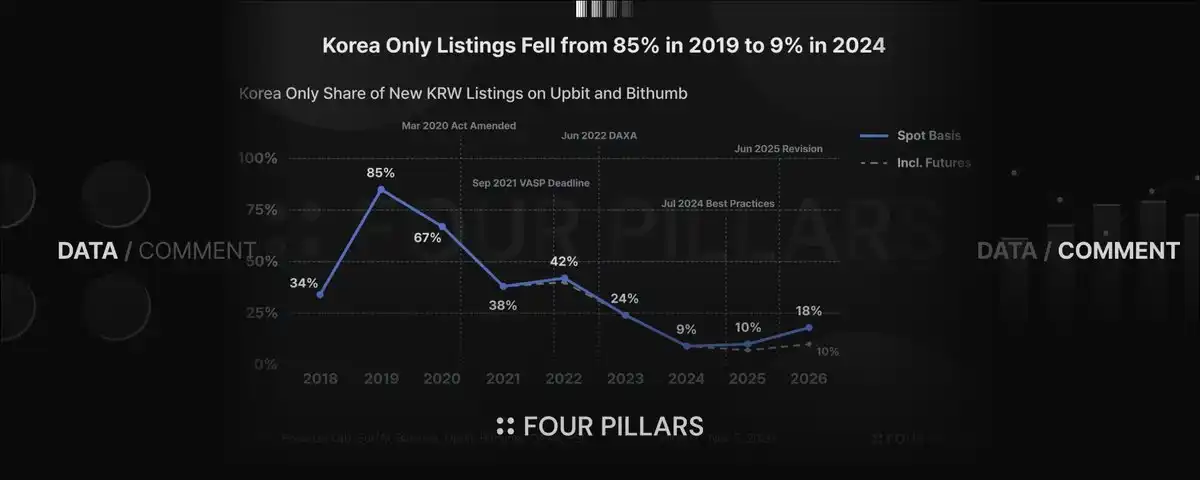
From 85% to 9%: The Dramatic Shift in Korean Exchange Listing Logic—Tokens Are Safer, but Is the Business Harder?

South Korea’s KRW crypto exchanges have fundamentally changed their listing logic. According to Bonanza Lab data across Upbit, Bithumb, Coinone, Korbit, and Gopax, the share of Korea-only token listings fell from 85% in 2019 to 9% in 2024, with a slight rebound to 18% in 2026 that drops back to about 10% when excluding assets first traded on overseas futures markets. The shift began with the 2021 Specific Financial Information Act, which required real-name bank accounts and traditional-finance-level AML compliance, and was reinforced by DAXA’s unified listing review guidelines effective July 2024, under which assets with two or more years of trading history on compliant overseas exchanges can automatically satisfy baseline disclosure and whitepaper requirements. Despite the collapse in local-first listings, total listings have grown: Upbit and Bithumb added 43 KRW-market tokens in 2022, 116 in 2023, 125 in 2024, and 238 in 2025. Listing timing remains cyclical—in the 2025 bitcoin high, 111 assets (47%) were brought to Korea within 30 days of overseas listing, while in 2026 mature assets with over a year of overseas trading became the mainstay (52 assets, 31%), including older tokens such as CRV and RSR. The consequences are clear. The share of assets hit by investment warnings or delisting within two years fell from 24% for the 2020 cohort to 10% for 2024. Among 2020–2024 listings, 44 of 148 Korea-only tokens (30%) faced warnings or delisting within two years, versus only 26 of 279 overseas-first tokens (9%). Overseas seasoning also reduces post-listing drawdowns: assets listed in Korea within 30 days of overseas launch saw a median 30-day price decline of 39%, compared with just 7% for assets with over a year of overseas trading history. The trade-off is revenue. Heavily traded overseas assets generate limited first-day speculative volume, and since Korean exchanges rely overwhelmingly on spot trading fees, weaker listing-day surges can hurt earnings. A renewed bull market could temporarily revive listings of newly launched overseas assets, but exchanges cannot build a durable, cycle-resistant business on listing structure alone. Their core challenge is to create new trading demand and diversify revenue beyond listing-driven fees.

marsbit1h ago

From 85% to 9%: The Dramatic Shift in Korean Exchange Listing Logic—Tokens Are Safer, but Is the Business Harder?

marsbit1h ago

Trading

Spot
活动图片