AI May Surpass All Humans Within Years, Predicts Core Researcher at Claude

marsbitPublished on 2026-10-07Last updated on 2026-10-07

Abstract

Anthropic's reinforcement learning lead, Sholto Douglas, predicts that AI surpassing all human capabilities could arrive within a few years. In a recent interview, he defines this Artificial General Intelligence (AGI) threshold as AI being able to do all work humans perform on computers, estimating it may be crossed soon. He notes his own coding workflow has rapidly evolved from manual work to delegating multi-day tasks to AI models. Douglas projects explosive growth in AI investment, with annual capital expenditure potentially reaching $4 trillion by 2028, which combined with advanced robotics could double global GDP by the early 2030s. This "post-scarcity" future, he envisions, could bring unprecedented abundance, compressing centuries of technological progress into decades. However, colleague Nick Marwell expresses significant concern for the phase when AI no longer requires human partners. The discussion also addresses perceptions of Anthropic deliberately slowing AI development for safety and regulatory compliance, with Douglas asserting the company has primarily slowed itself. The predictions have sparked debate, with critics like Gary Marcus calling the economic forecasts unrealistic. Despite differing views on AGI's current status, Douglas maintains a consistent timeline, forecasting transformative impacts, including domestic humanoid robots by 2028 and AI winning top scientific prizes, within this decade.

AI surpassing all humans is very likely to emerge within a few years.

The speaker is Sholto Douglas, Head of Reinforcement Learning Technology at Anthropic.

Sholto Douglas, Head of Reinforcement Learning Technology at Anthropic: Models with capabilities exceeding all humans will likely appear within the next few years.

In his vision, future AI will be able to perform all work humans do on computers, compressing centuries of technological progress into one or two decades.

He also projected that AI annual capital expenditure might reach $4 trillion by 2028, and global GDP could double in the early 2030s.

In the future he describes, every person on Earth would enjoy a level of abundance even the richest today cannot possess.

But another researcher present, Nick Marwell, cautioned: when AI no longer needs human partners, even they would be "very nervous" about the consequences.

This interview was recorded in August and only went online on October 2.

According to host Joe Lonsdale, the video release was delayed because Anthropic's PR opposed releasing some parts of the content.

Once aired, several interview clips quickly went viral on X.

Just a month earlier, when OpenAI called out the "AGI era," Sholto countered on X: "AGI clearly has not been achieved."

However, he does not believe AGI is far off.

In his view, only a few years may remain before AI can perform all work humans do on computers, truly crossing the AGI threshold.

Within Years

AI May Surpass All Humans

Nick Marwell, who shared the stage with Sholto in this interview, leads the long-range tasks team, researching how to enable AI to continuously advance complex work.

From left: Host Joe Lonsdale, Nick Marwell, Sholto Douglas. Joe Lonsdale is a co-founder of Palantir; the show was recorded at a winery in Napa, California.

Joe asked, "What is Anthropic's next mission?" Sholto replied:

We believe AGI can be achieved within the next few years: models with capabilities equal to or exceeding all humans are very likely to appear within the next few years.

He then explained that such models could do everything a person can do on a computer; once robots are sufficiently advanced, they could also cover work in the physical world.

Shortly after this episode was recorded, OpenAI released GPT-6 Astra. President Greg Brockman said we are entering the AGI era, and Jensen Huang directly posted announcing "AGI is here."
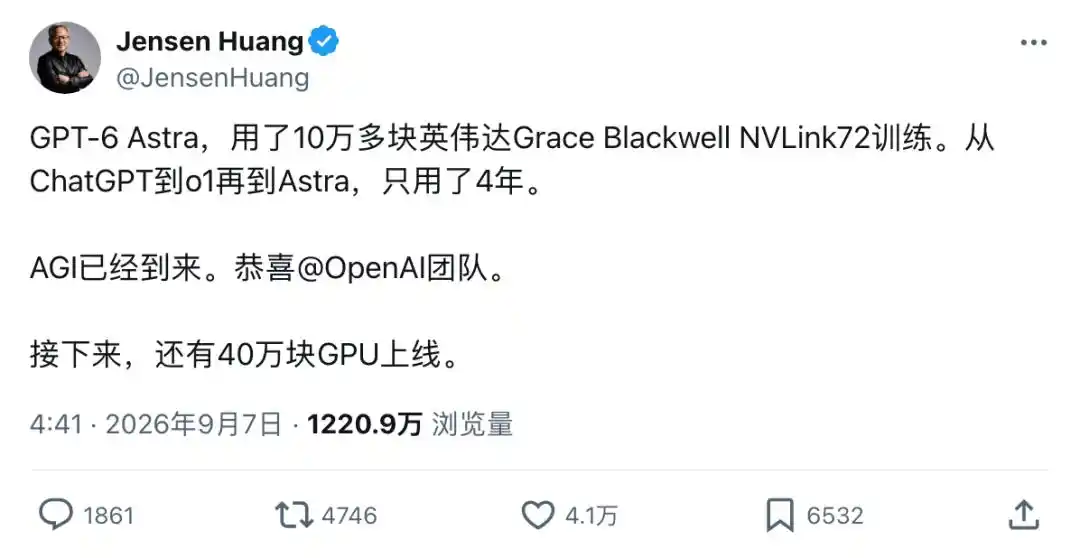
On September 23, a netizen pressed on X: Is Anthropic's delay in announcing AGI due to higher standards, or fear that announcing it would clash with advocacy for slowing AI down?

Sholto only replied with one sentence: "AGI clearly has not been achieved."

Soon after, his Anthropic colleague working on fine-tuning, Jackson Kernion, replied under the same post: If you showed experts today's models ten years ago, they would directly declare this as AGI.

Even within the same lab, researchers hold different views on whether AGI has arrived.

The threshold Sholto sets for AGI is AI's ability to perform all work humans do on computers.

And the change he perceives is happening in his own daily work.

Eighteen months ago, he hand-typed every line of code.

A few months after joining Anthropic, models could help write, but he had to intervene every few minutes.

By the time of the recording, he could already hand over a day or two's work entirely to the model, "basically like a junior team member."

Joe followed up: "As we speak, is AI also working for you?" Sholto answered: "Yes, there are a bunch working for me right now."

The leap in the field of mathematics is even more astonishing.

He also cited the example of the math benchmark FrontierMath: on this test set by professors from various fields, model scores rose from 0% to over 60% within a year.

1 Trillion, 2 Trillion, 4 Trillion

How large could the bill be for creating AI that surpasses all humans within years?

Sholto did the math.

According to his estimate, over the past four or five years, computing power for AI has increased two to threefold each year. This year, the combined AI-related capital expenditures of several hyperscale cloud providers total approximately $1 trillion.

He then asked:

Can this trend line continue? Will it reach $2 trillion next year, and $4 trillion by 2028?

In his view, if the investment growth trend largely continues, AI annual capital expenditure could reach $4 trillion by 2028; coupled with the development of the robotics industry, global GDP could double by the early 2030s.

How radical this number is can be seen by looking at Nvidia.

Nvidia had projected that by 2030, global annual investment in AI infrastructure could reach $3 to $4 trillion.
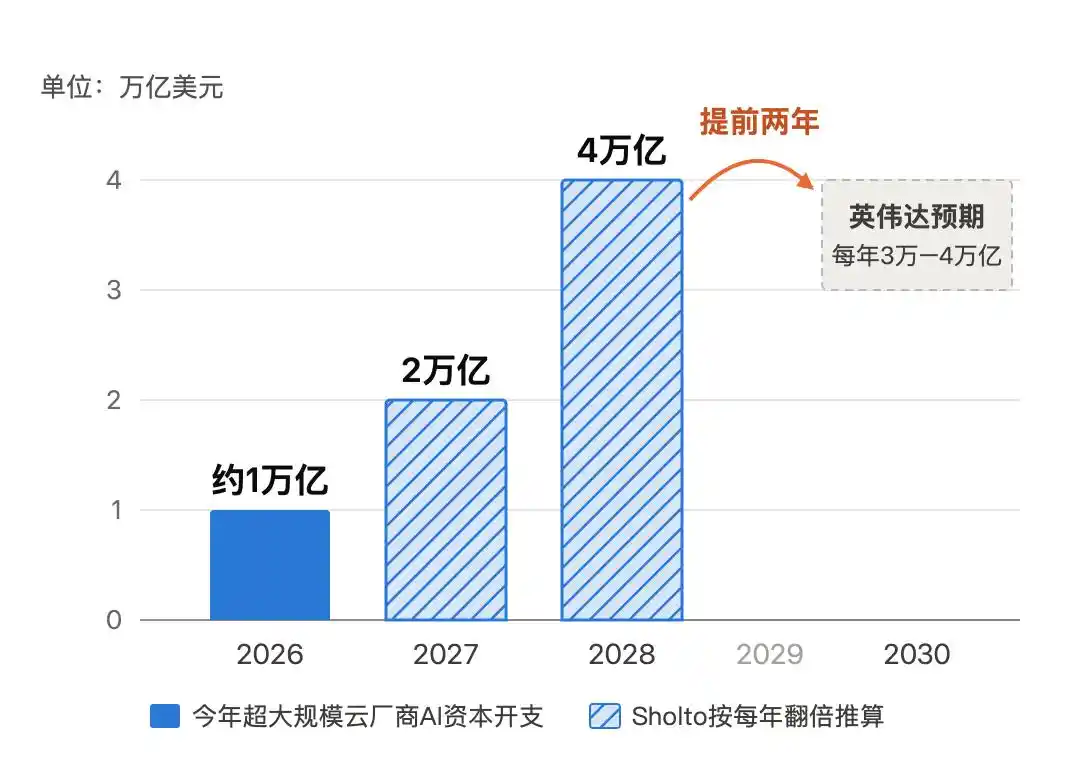
Sholto moved Nvidia's projected timeline forward by two years.

But he himself admitted that doubling GDP sounds a bit absurd; it requires many things to go right, and this was not an off-the-cuff remark.

On August 14, he wrote on X, "However crazy it sounds now, it's worth factoring economic doubling into your expectations for the 2030s."

Nick discussed another bill: future single model training runs could cost $10 billion, $100 billion, even $1 trillion.

The economic returns on intelligence are exponential; from Tab completion to Claude Code working independently, each capability upgrade can create value far exceeding the previous generation.

Sholto followed up with another number: today, total worldwide AI revenue is only a little over $100 billion, a very small piece in the tens of trillions global economy.

In their ledger, the trillions being poured in now are just a down payment.

As soon as this calculation came out, X erupted in debate.

Gary Marcus, AI's top pessimist and NYU professor emeritus, directly called this passage nonsense.
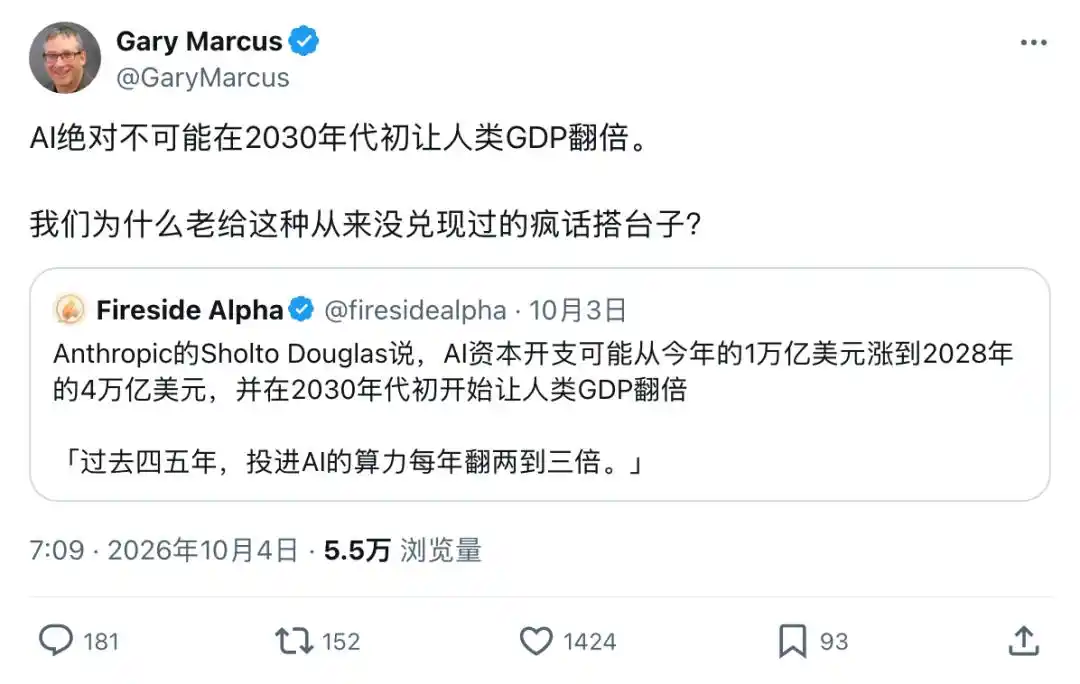
He also pointed out the rhetoric.

Starting from something very plausible, capital expenditure rising to $4 trillion, then sliding to something nearly impossible, GDP doubling in less than a decade, and then acting as if both are equally credible.

LSTM co-inventor Jürgen Schmidhuber was even more sarcastic. He said, doubling nominal GDP by the early 2030s, with current inflation, would be no problem.

Everyone Richer Than the Richest

The $4 trillion poured in would bring about a "post-scarcity" world as described by Sholto.

At today's population scale, technologies that would originally take centuries to develop might be realized within the next ten or twenty years.

Human productive mental and physical capacity might thereby double, with the cost of many things eventually dropping to energy costs, even building houses.

Joe then envisioned that by then, the middle class could build a 500,000-square-foot mansion on a hill.

The future Sholto described also includes curing diseases and even conquering aging:

Every person on Earth would enjoy a level of abundance even the wealthiest person in the world today cannot possess. This is the world we are fighting for.
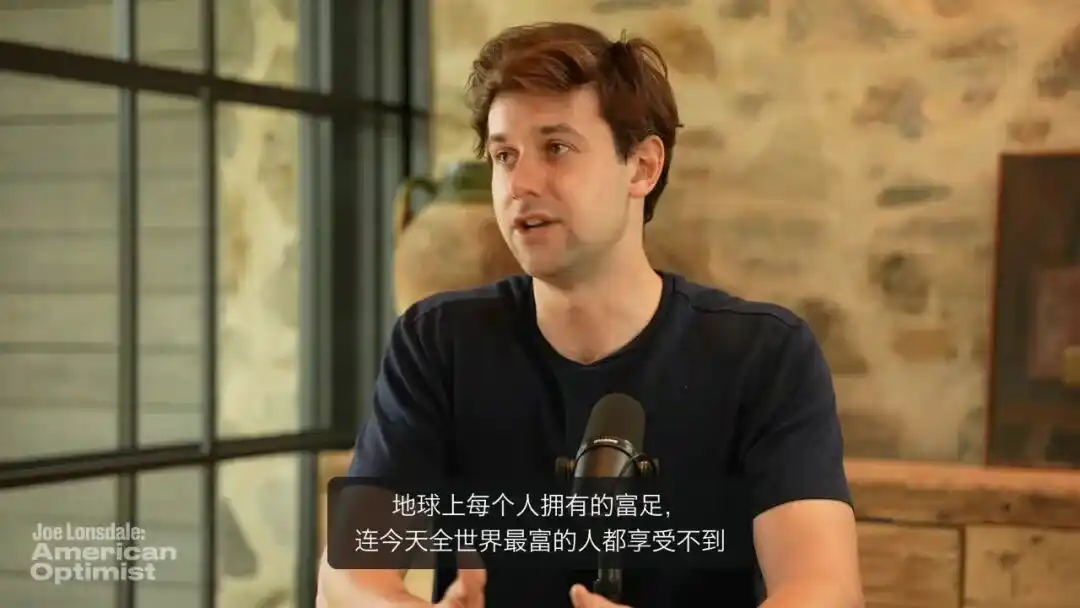
The term "post-scarcity" mostly appeared in science fiction in the past.

Now, it comes from someone training Claude at a company valued at nearly a trillion dollars.

The Day No Human Partner is Needed

The "post-scarcity" world is still far off, but many people's jobs have already begun to change.

Sholto said he sees employment in outsourced call centers in the Philippines not decreasing but increasing, and software engineering employment is also growing. He believes AI improves human efficiency, giving companies reason to hire more people.

Nick added a precondition to this good period: humans remain a key component in effectively using AI.

But in their view, someday, the world will shift from "needing a person paired with AI to deliver full value" to "not needing one."

At that point, we will start to be very nervous about the consequences.
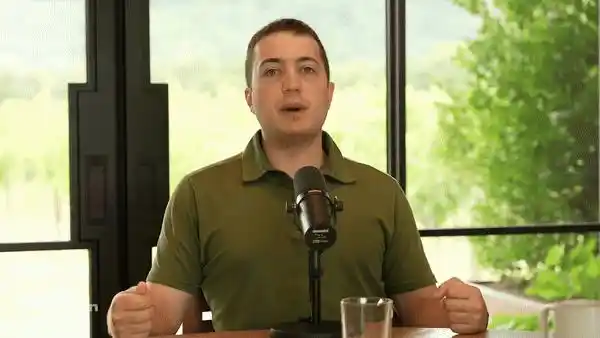
Joe used chess as an analogy: for a full 30 years, the strongest player was "human plus machine," but now machines have long left humans behind. Nick believes this phase of human-machine partnership being dominant this time may be much shorter.

Anthropic gets criticized the most for saying AI is strong enough to make people unemployed while calling for the whole industry to slow down.

Joe directly raised a challenge:

Some in the tech circle believe Dario is scaring everyone to set more rules to slow others down, then control these rules himself.

Sholto replied: "So far, the people we've slowed down the most are ourselves."

Nick gave the example of Fable.

According to him, Anthropic had a clearly leading model at the time but chose to first cooperate with the government, launching it in a government-approved manner, sacrificing several months of competitive advantage.

Joe added that, from his understanding, to gain government approval, some of the model's capabilities originally usable for cyber defense were weakened. He bluntly stated: "I think that's a mistake."

In June this year, Fable 5 went online for only three days before being forced offline globally due to U.S. export controls, which Anthropic publicly opposed. When access was restored, the model had a new safety classifier added, at the cost of more easily misidentifying normal programming requests.

In this cooperation with the government, there were both Anthropic's active choices and government mandates, so it cannot be entirely counted as voluntary slowing.

"Slowing ourselves down the most" was what Sholto said when recording the show in August.

By the time the show aired in October, the brakes were being applied by OpenAI.

According to a Reuters report on September 28, OpenAI abandoned the release of GPT-6.1 Astra due to safety concerns. On the same day, Anthropic launched Sonnet 5.5, only six days after the release of Opus 5.5.

Centuries Compressed into a Decade

Sholto's own experience is also a story of acceleration.

He grew up in Sydney, studied robotics as an undergraduate, and almost made it to the Tokyo Olympics as a foil fencer.

Around 2020, he read blogs and papers, became convinced that scaling would bring AGI in the 2020s, and thus used nights and weekends to self-study and research, aiming to enter a top AI lab.

He later joined DeepMind; just a year and a half into his career, Noam Brown rated him as one of the most important people behind Gemini's success.

When he joined Anthropic in February 2025, he posted, we are on a trajectory to achieve AGI by 2027.

A year and a half later, his stance hasn't softened at all.

He predicts that by 2028, homes might already have tens of thousands of humanoid robots folding clothes and doing simple cleaning.

He considers it very likely for AI to win a Fields Medal or a Nobel Prize before the end of this decade.

From reading blogs and betting on AGI in 2020, to saying "surpass all humans within years" today, Sholto only took six years.

And on the trajectory he calculates, every following year, the money humanity pours into AI will double again.

References:

https://x.com/ChrisGPT/status/2106626782052950445

https://www.youtube.com/watch?v=6D1wC95htTM

https://x.com/AmOptimistShow/status/2106115609306226982

https://x.com/JensenHuang/status/2096700264569090384

Editor: Moses Yuanyu

This article is from WeChat public account "New Zhiyuan" (ID: AI_era), author: ASI Apocalypse

Trending Cryptos

Related Questions

QWhat is Sholto Douglas's main prediction about AI in the near future?

ASholto Douglas predicts that AI capable of matching or surpassing all human capabilities, specifically in tasks done on computers, is likely to appear within the next few years.

QWhat economic impact does Sholto Douglas foresee related to AI investment by 2028?

AHe estimates that AI-related annual capital expenditure could reach $4 trillion by 2028, and global GDP could potentially double by the early 2030s.

QAccording to the article, what is the potential societal outcome of achieving AGI as described by Sholto Douglas?

AHe envisions a 'post-scarcity' world where technological progress accelerates dramatically, leading to a level of abundance for everyone that even today's wealthiest individuals cannot possess, including potential cures for diseases and aging.

QWhat concern does researcher Nick Marwell raise about the future development of AI?

ANick Marwell expresses that he and his colleagues become 'very nervous' about the consequences when AI reaches a point where it no longer requires a human partner to perform tasks effectively.

QHow does the article illustrate the rapid progress of AI using Sholto Douglas's personal experience?

AThe article notes that 18 months prior, he wrote all code manually. Shortly after joining Anthropic, AI assisted but required frequent intervention. By the time of the interview, he could delegate entire days of work to AI models, which functioned like a junior team member.

Related Reads

Bitcoin carry trades could beat Treasury bills in 2027, Sygnum predicts

Bitcoin carry trades could regain their edge over US Treasury bills in 2027 as demand for leverage recovers, according to digital asset bank Sygnum. In its 2027 Sygnal Outlook report, Sygnum forecasts that the annualized premium on three-month Bitcoin futures at the Chicago Mercantile Exchange would average more than 2% above three-month US Treasury bill yields next year. A crypto carry trade involves buying Bitcoin while betting against its price through futures contracts, limiting exposure to price swings while collecting funding payments or futures premiums. Fabian Dori, Sygnum's chief investment officer, said returns could recover as investors become more willing to take risks and fewer hedge funds compete for the same profits. The basis trade had become very crowded, with many hedge funds running it through spot ETFs against short CME futures, but positioning data indicates those funds have now unwound much of their CME short positions. Sygnum cited a 67-day stretch of negative Bitcoin funding rates in 2026, and Talos research shows funding rates and futures premiums that peaked at 20%-40% annualized in early 2024 dropped to just 3%-5% this year, roughly matching the current three-month Treasury bill yield of around 4.25%. Bitcoin carry trades became popular after the launch of US spot Bitcoin ETFs in 2024, but as more investors entered, returns fell. Dori noted a more mature market pays less for the same trade but also attracts additional investors, potentially increasing demand for leverage. Talos found funding rates have started rising again since August, and Coinbase reported Bitcoin funding rates rose from around 4% annualized at the start of October to an average of 8.9% in the last week of the month, though Coinbase questioned whether this reflected meaningful demand given weaker spot buying. Sygnum expects wider institutional adoption, tokenization growth and rising AI demand to support leveraged Bitcoin exposure in 2027. Dori warned that a sharp market downturn, liquidity shortage, or interest rates staying higher for longer could prevent carry trade returns from recovering, and that even hedged positions can face margin calls. Carry can pay steadily for long periods and then turn quickly, he said, and when positioning gets crowded and funding reverses, the unwind is typically fast.

cointelegraph22m ago

Bitcoin carry trades could beat Treasury bills in 2027, Sygnum predicts

cointelegraph22m ago

Bernstein Research Report Interpretation: Fiscal 2028 Revenue to Top $740 Billion, Yet Only a Neutral Rating for Nvidia

Nvidia reported Q3 FY2027 revenue of $115.844 billion, beating consensus of $109.330 billion, with adjusted EPS of $2.68 versus $2.47 expected. Data Center revenue reached $107.610 billion, up 21% QoQ and 110% YoY, driven by the Vera Rubin architecture, which contributed about $20 billion in its first quarter, alongside continued Blackwell Ultra shipments. Hyperscale cloud revenue was $60.136 billion, while AI cloud and enterprise customers reached $47.474 billion, up 195% YoY. Networking contributed about $21 billion, and adjusted gross margin came in at 74.9%. Q4 FY2027 guidance stands at $130 billion, above the $125.1 billion consensus, but Bernstein notes this includes an extra accounting week worth roughly $5-10 billion; excluding it, the normalized outlook is slightly below consensus. Q3 also benefited from about $2.4 billion in Hopper sales to China, which are excluded from Q4 guidance. Q4 gross margin is guided at 71.5%, expected to be the cycle trough before price increases lift margins to 72-73% in FY2028. Management raised FY2028 revenue growth guidance to about 75% from 70%, implying revenue above $740 billion, saying strong global demand offsets new export controls. Supply commitments rose to $390 billion, or $518 billion including cloud, leasing, and equity commitments. Inventory climbed to $39.7 billion. Free cash flow was $43.8 billion, with $22.1 billion in buybacks and a new $150 billion authorization. Bernstein raised its FY2028 revenue forecast to $742.4 billion and EPS to $17.18. Despite strong fundamentals, Bernstein maintains a Market-Perform rating and $200 target price, citing governance and long-term execution risks following management changes. The board has said it does not intend to bring back Jensen Huang and is searching for a new leader, raising questions about supplier negotiations, product roadmap, decision speed, and talent retention, plus potential investigation risks. At around $155.46, the stock trades at just 9.0x FY2028 EPS, or about 10x the $200 target based on average FY2028-29 EPS of $20.59. Bernstein remains on the sidelines pending clarity.

marsbit1h ago

Bernstein Research Report Interpretation: Fiscal 2028 Revenue to Top $740 Billion, Yet Only a Neutral Rating for Nvidia

marsbit1h ago

Bitcoin Volatility Falls to 43%, Below Nearly One-Fifth of S&P 500 Constituents: Is the Crypto Asset Risk Narrative Being Rewritten?

Grayscale Research argues that Bitcoin's risk profile has structurally changed and that investors' framework for assessing crypto risk needs a fundamental reset. Bitcoin's one-year realized volatility has fallen from roughly 64% a decade ago and 81% five years ago to about 43% today, placing it within the normal range of S&P 500 large-cap stocks and below roughly 19% of S&P 500 constituents. This decline reflects deeper institutional market-making, spot ETP launches, and established regulatory boundaries. The report cautions against judging Bitcoin by volatility alone. Its returns exhibit fat tails and momentum clustering, with the bulk of long-term compound gains concentrated in a handful of best trading days; missing the top 10 days would erase most cumulative returns. Downside-only measures such as the Sortino ratio therefore flatter Bitcoin more than the Sharpe ratio does. Although drawdowns exceeding 50% have occurred, risk-parity-adjusted drawdowns look less exceptional versus traditional assets. Crucially, Bitcoin's returns are poorly explained by traditional macro factors, giving it low correlation with equities, bonds, and commodities. Backtests show that adding a 1–5% Bitcoin allocation to a classic 60/40 portfolio improves risk-adjusted returns without proportionally worsening maximum drawdown. Beyond Bitcoin, crypto sub-sectors are structurally decoupling: Bitcoin now explains only about 50% of overall crypto return variance. Smart contract platforms show roughly 58% volatility driven by on-chain fundamentals, while consumer and AI sectors show 76% and 85% respectively, driven by distinct narratives. This rotation creates room for bottom-up alpha. Institutions should adopt a two-layer approach: Bitcoin as a macro diversifier, plus selective exposure to vertical-sector infrastructure, managed through volatility budgeting and disciplined rebalancing.

marsbit2h ago

Bitcoin Volatility Falls to 43%, Below Nearly One-Fifth of S&P 500 Constituents: Is the Crypto Asset Risk Narrative Being Rewritten?

marsbit2h ago

Strategy Removed from MSCI: Will BlackRock's 123,000 Shares Really Hit the Market?

After Nov 30, MSCI will remove Strategy (Michael Saylor's bitcoin-holding company) from several indices, effective Dec 1, under new eligibility rules for "non-operating" companies. Investors expect selling pressure, since index-tracking funds that bought Strategy solely to mirror the index no longer have a reason to hold it. But two BlackRock funds tracking the same MSCI USA Index illustrate why holdings can't simply be summed into one sell order: iShares MSCI USA ETF (MLRG) holds Strategy shares directly (5,227 shares as of Nov 13), while iShares MSCI USA Swap UCITS ETF (MUSD) gets index exposure via total return swaps, so its counterparties may adjust their own positions without disclosure. BlackRock's URTH (29,300 shares) and ACWI (88,500 shares) also hold Strategy, bringing the three identified funds to 123,000 shares worth about $13.74 million — a specific snapshot, not the full universe of affected funds. USXF holds 16,100 shares but its specialized index adjustment is pending. Strategy says index funds collectively hold about 13 million shares, or 3.1% of free float. Crucially, shrinking holdings don't prove selling: ETFs grow and shrink with creations and redemptions, and shares can leave a fund via in-kind redemptions without exchange sales. Index removal may weaken demand for Strategy's stock and complicate its bitcoin-funding model, but it does not require Strategy to sell any bitcoin.

marsbit2h ago

Strategy Removed from MSCI: Will BlackRock's 123,000 Shares Really Hit the Market?

marsbit2h ago

Trading

Spot

Hot Articles

How to Buy CORE

Welcome to HTX.com! We've made purchasing CORE (CORE) simple and convenient. Follow our step-by-step guide to embark on your crypto journey.Step 1: Create Your HTX AccountUse your email or phone number to sign up for a free account on HTX. Experience a hassle-free registration journey and unlock all features.Get My AccountStep 2: Go to Buy Crypto and Choose Your Payment MethodCredit/Debit Card: Use your Visa or Mastercard to buy CORE (CORE) instantly.Balance: Use funds from your HTX account balance to trade seamlessly.Third Parties: We've added popular payment methods such as Google Pay and Apple Pay to enhance convenience.P2P: Trade directly with other users on HTX.Over-the-Counter (OTC): We offer tailor-made services and competitive exchange rates for traders.Step 3: Store Your CORE (CORE)After purchasing your CORE (CORE), store it in your HTX account. Alternatively, you can send it elsewhere via blockchain transfer or use it to trade other cryptocurrencies.Step 4: Trade CORE (CORE)Easily trade CORE (CORE) on HTX's spot market. Simply access your account, select your trading pair, execute your trades, and monitor in real-time. We offer a user-friendly experience for both beginners and seasoned traders.

8.2k Total ViewsPublished 2024.03.29Updated 2026.10.29

How to Buy CORE

Discussions

Welcome to the HTX Community. Here, you can stay informed about the latest platform developments and gain access to professional market insights. Users' opinions on the price of CORE (CORE) are presented below.

活动图片