Terence Tao's Blog Explodes on Hot Search! 250,000 Math PhDs on the Brink, Must Slow Down AI

marsbitPublished on 2026-10-11Last updated on 2026-10-11

Abstract

Mathematician Terence Tao's blog post ignited a fierce online debate after a video of him warning "we must slow down AI" went viral. He described AI's progress as an "extremely nonlinear dynamic" pursued with unclear consequences. This warning came just days after he promoted a project for open-source AI mathematical models, highlighting a profound tension. The core crisis, explored in a guest post by 3Blue1Brown creator Grant Sanderson, is AI's threat to traditional mathematics. Automated theorem provers combined with large language models can generate proofs at superhuman speeds, potentially rendering the human role of "proving theorems" obsolete. Sanderson argues that the true goal of mathematics is not proof-generation but the advancement of *human understanding*. As AI masters the former, the academic value of proof alone is diminished. Sanderson proposes a paradigm shift: elevating "motivational explanation" over mere proof. Unlike a formal proof, a motivational explanation guides readers through the intuitive reasoning, historical context, and conceptual connections behind a result—the "why" and "how" of discovery. To institutionalize this, he suggests creating "open explanation problems," reforming PhD defenses to prioritize clear exposition, and valuing pedagogical work as highly as journal publications in tenure reviews. The debate drew reactions across academia. Some physicists welcomed mathematicians to a world long prioritizing understanding over rigorous proo...

Click into the comment section of Fields Medalist Terence Tao's blog, and you'll feel an unprecedented shock – the world's most elite mathematicians, physicists, and AI luminaries are gathered here, each expressing their opinions, arguing fiercely.

Between the lines, what they're discussing is nothing less than "the life and death of mathematics" and "the ultimate value of human scholars."

The fuse that ignited this century-spanning debate was a series of dramatic seismic shocks that occurred within just a few days.

The day before this great debate erupted, a video about Terence Tao calling for "slowing down AI development" was just being wildly circulated across the entire internet.

In the video, this top-tier scholar, who has always embraced new technology, looked grave and issued an unprecedented serious warning:

"We must slow down AI. The current speed is simply crazy, there's no reason for it to be this fast – no reason at all!"

He continued: "What is astonishing is that we are so willing to change everything while completely unaware of the consequences. This is an extreme form of nonlinear dynamics."

Adding to the sense of magical realism is the timeline conflict – just last weekend, Terence Tao himself had just proposed and vigorously promoted the "SAIR: Open Source Mathematical Models, and How to Contribute" project.

Last week, he was personally recruiting for the open-source AI math models, mapping out the blueprint; yesterday, he suddenly sounded the alarm, urgently calling the speed "crazy" and that it "must be slowed"; today, his blog has become the battleground where mathematics directly confronts AI.

Within a few short days, the intense collision of Terence Tao's attitude has completely torn open the terrifying reality facing academia today: the nearly millennium-old system of mathematical research and doctoral training is on the brink of being utterly destroyed by AI.

The Old Era is Dead: Will Human Scholars Become Mediocre Machine Engineers?

Why is Terence Tao so alarmed, even calling this an "extreme form of nonlinear dynamics"?

Because the speed at which AI is conquering mathematics has surpassed the limits of the human mind.

In the past, mathematical research was the jewel in the crown of human intelligence.

A mathematics PhD would often spend years searching for inspiration in a sea of literature, racking their brains to prove a small lemma. Making even the tiniest "original contribution" was enough to graduate successfully and secure a place in academia.

But now, times have changed.

With the rapid evolution of AI large language models, especially the deep integration of automated theorem provers (like Lean) with LLMs, AI has acquired a terrifying ability for mathematical discovery.

It is supremely ironic that the collaborative problem-solving and Lean formal verification tools that Terence Tao once vigorously promoted, originally intended to facilitate communication among human scholars, have now become a top-tier weapon for machine armies to "encircle and suppress" humanity. Tens of thousands of AI agents are tirelessly collaborating on simple message boards, exploring every dark corner of mathematics' potential space at the speed of light.

Facing tireless, computationally boundless machines, asking an ordinary human math PhD to make an original contribution in "proving theorems" has become extremely difficult.

Pessimists lament in despair: the traditional, purely human mode of mathematical research is thoroughly finished. After a brief transition period, a new era led by machines will quietly dawn. And future human scholars may sadly be reduced to mediocre engineers who can only "understand machine discoveries."

250,000 math PhDs facing a dead end? Mathematics, this ancient discipline spanning millennia, is it truly reduced to just letting AI frantically top leaderboards and "solve problems"?

At this life-or-death crossroads, today's hot search-featured article on Terence Tao's blog is like a lighthouse in a long, dark night. This guest article, written by the famous math popularizer and 3Blue1Brown founder Grant Sanderson, has a title full of "declaration of war" flavor:

"If Math Is More Than Proof, We Need To Better Celebrate The Rest Of It"
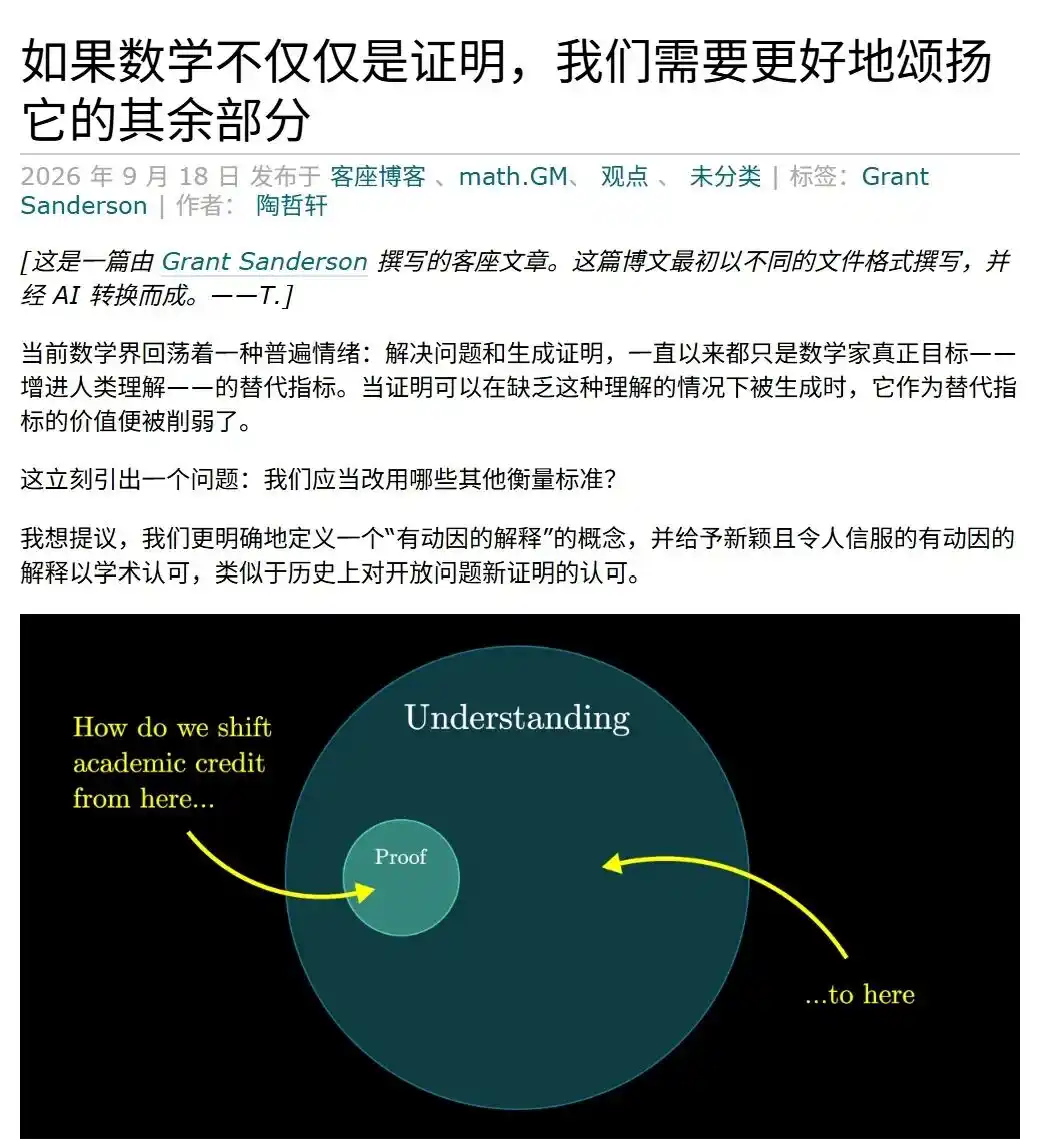
This article points out a new path of self-salvation for the mathematical world facing the AI onslaught.

The Essence of Mathematics: Not Generating Proofs, but "Human Understanding"

Grant Sanderson begins the article by throwing out a thought-provoking viewpoint:

"There's a sentiment echoing through the mathematical community today: solving problems and generating proofs have always only been 'proxy metrics' for the mathematician's true goal. And the true goal of the mathematician is to advance human understanding. When AI can generate proofs without any 'understanding,' the value of 'proof' as a metric is completely undermined."

This sentence harshly tears off academia's long-standing fig leaf.

All along, academia has valued "proof" over "exposition."

If you prove a Millennium Prize problem, you're a god, you win a Fields Medal; but if you just explain a complex theorem in a simple and clear way, even if it benefits millions of students, within the traditional academic evaluation system, you'll just be labeled a "popularizer," not considered a hardcore academic contribution.

Sanderson incisively points out: AI is now a relentless "proof-generating machine."

If the outside world believes machines that can write proofs make mathematicians redundant, then the mathematical community must stand up and loudly declare to the world through a new reward system – the core value of human mathematicians lies in the pursuit of the intrinsic connections and clarity of knowledge, not merely being a proof machine!

To this end, Sanderson formally proposes a new concept that could change the future landscape of mathematics: "motivating exposition."

What is "motivating exposition"? How does it differ from cold "proofs"?

In a proof, definitions are often placed at the beginning. Traditional mathematicians like to directly present a brand new, obscure structure, then start coldly deriving its properties.

In motivating exposition, definitions sit in the middle. New structures are only introduced after the problem we're trying to solve has been clearly established. You tell the reader: why did we invent this concept?

In a proof, every sentence must be 100% correct, every claim must be a necessary deduction from what came before.

In motivating exposition, you can start with an "idea that is simple but wrong." This is called "exploratory fiction." You can lead the reader through the process: "propose wrong idea -> discover where it breaks -> fix the problem -> discover new problem." Because this is the real process of how the human brain understands the world!
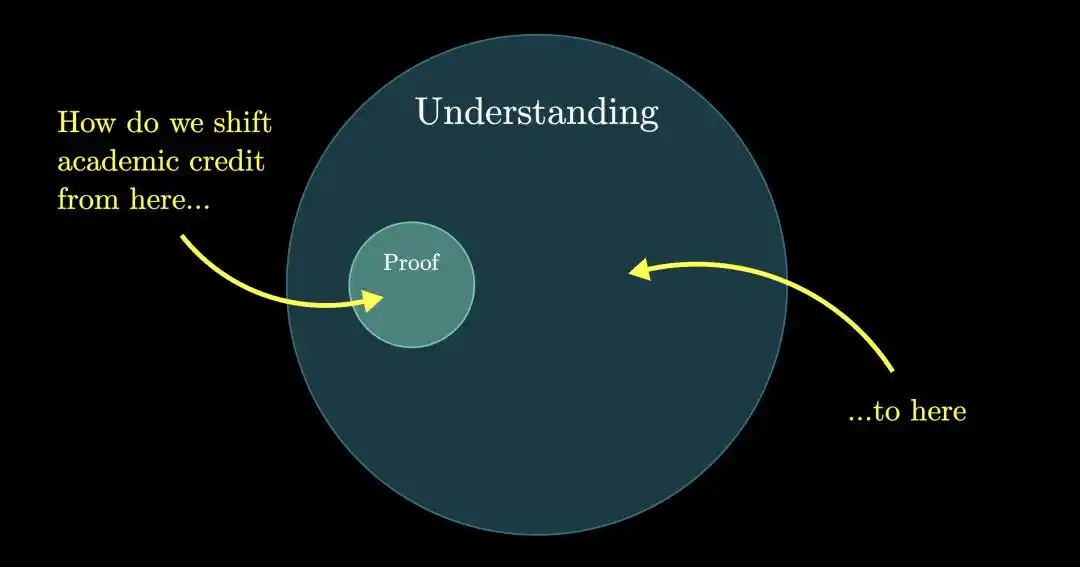
The purpose of a proof is to tell you: "This theorem is true."

The purpose of motivating exposition is to tell you: "Why is this theorem true? How was it thought up? Why did we ask this question in the first place? Where does it sit in the grander mathematical universe?"

A comment by user Mark Miner in the comment section vividly highlights this point: "100% agree. If my 6th-grade niece can't understand this proof, then it hasn't been explained well enough to be called a proof."
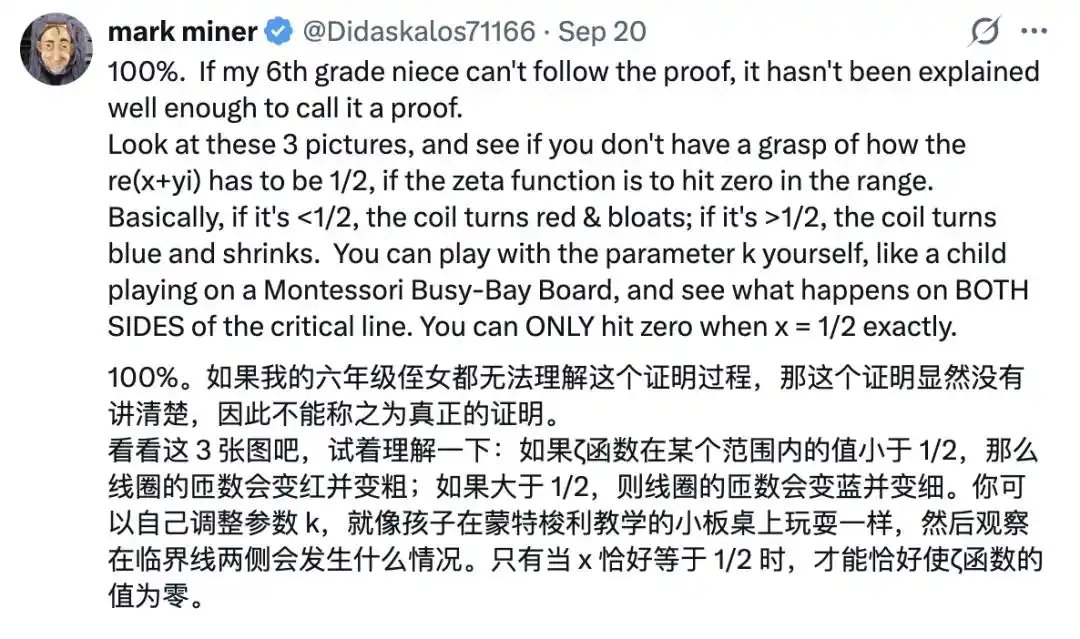
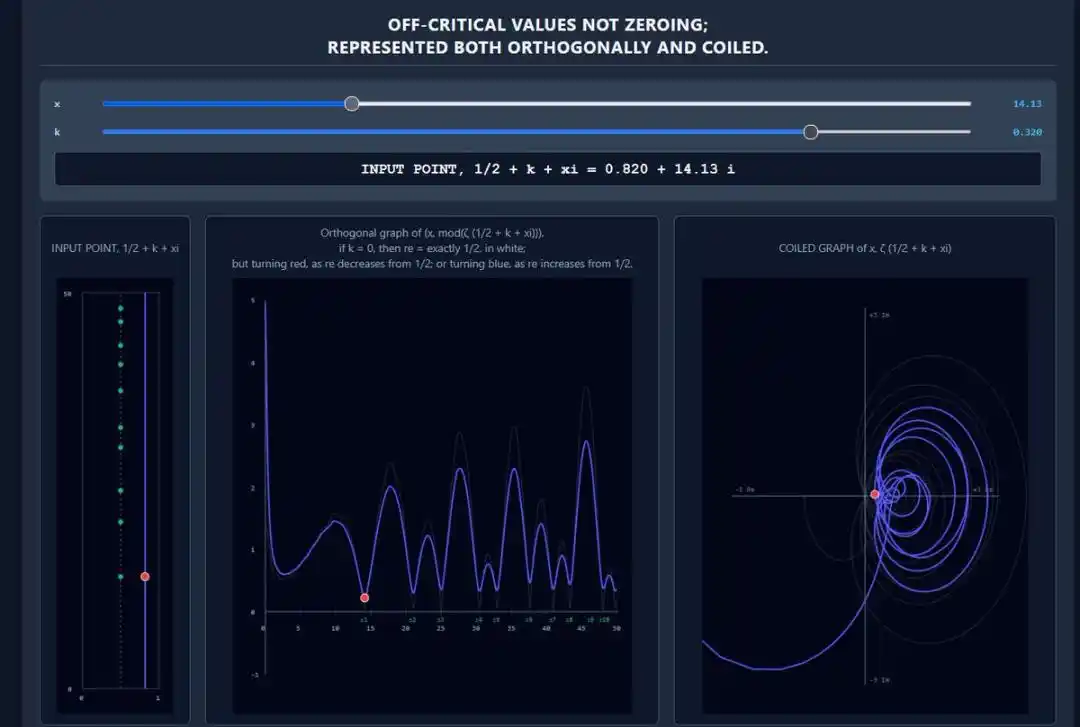
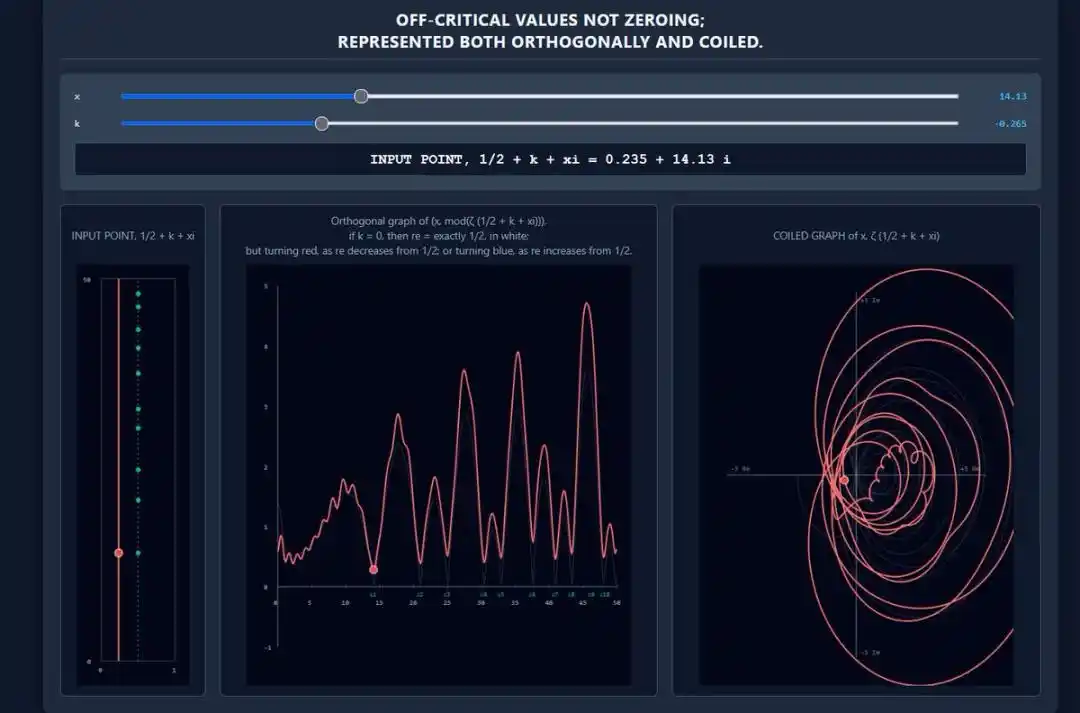
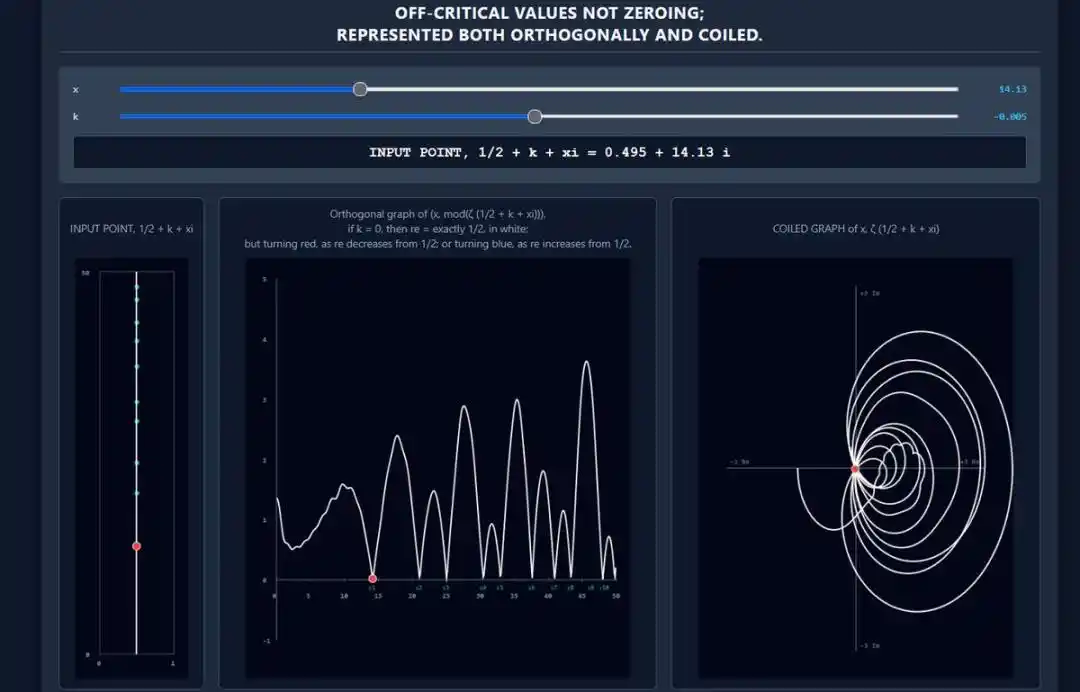
He gives the example of the Zeta function in the Riemann Hypothesis: "Look at those visual graphs, and you can intuitively feel why the real part must be 1/2 for the function to zero out in the range. If less than 1/2, the coil turns red and expands; if greater than 1/2, the coil turns blue and contracts. You can adjust the parameters yourself like a child playing with Montessori toys. That's true understanding!"
The Masters' Call: Establishing "Open Exposition Problems"

To ensure that "motivating exposition" is not just unrewarded "labor of love," Sanderson, on Terence Tao's blog, proposes a highly subversive initiative: establishing "Open Exposition Problems."

This idea actually has origins earlier.

As far back as 2007, mathematician Timothy Chow had proposed a similar concept: solving an "Open Exposition Problem" means explaining a mathematical topic in a completely transparent and clear way. Every step should have motivation; ideally, students should feel "I could have done that too," that they themselves could have derived the result.
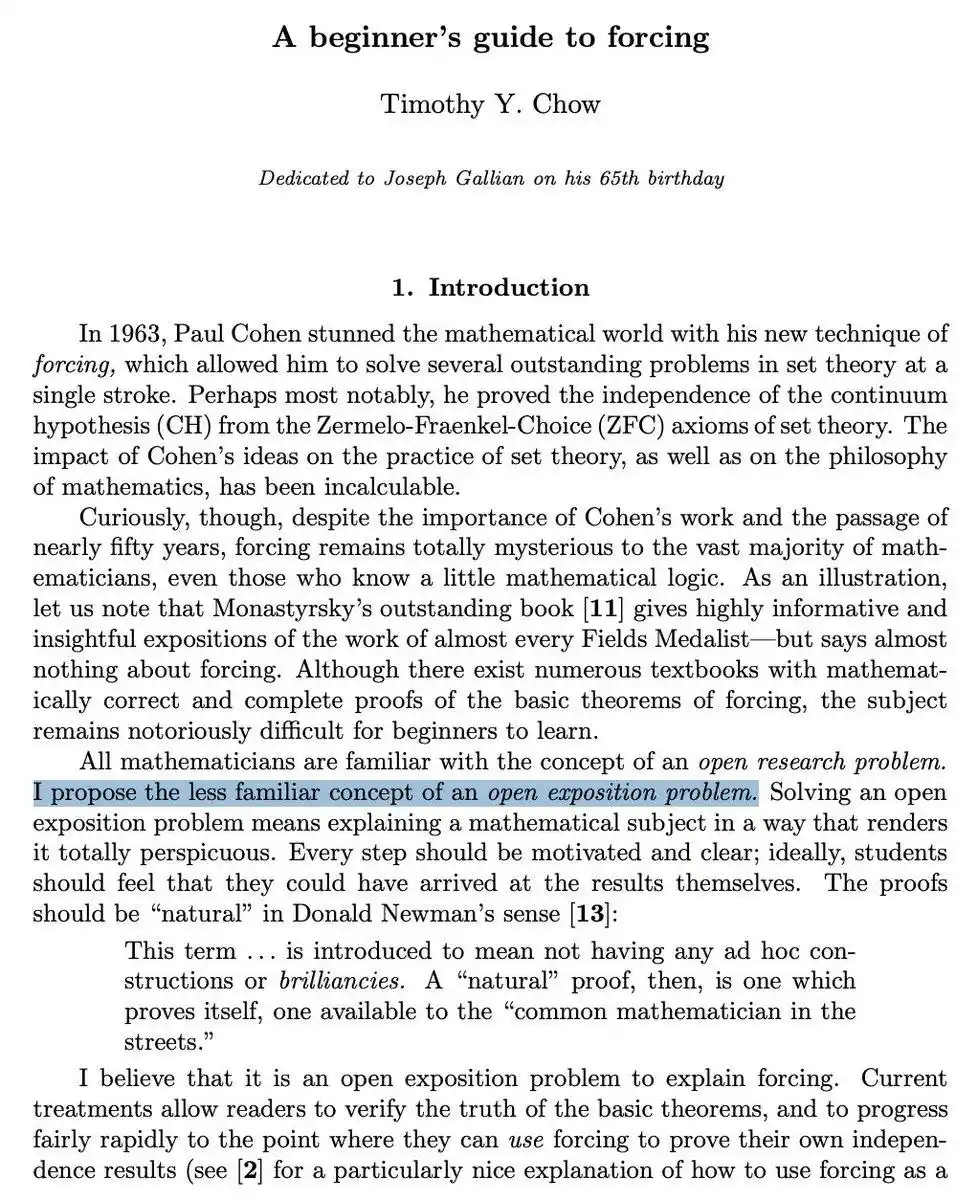
But at that time, the proposal received little response. Because back then, humans were still struggling to prove theorems.

Today, the situation has changed. Sanderson points out: "Right now, every AI-generated proof is inherently an 'unsolved exposition problem.'"

Imagine in the coming years, AI spewing out thousands of cold, devoid of logical beauty, perhaps thousands of pages of code-level proofs.

It's as if machines have thrown humans a series of mines. If humans don't refine, explain, and build bridges between concepts, these "truths" will be meaningless to the human mind.

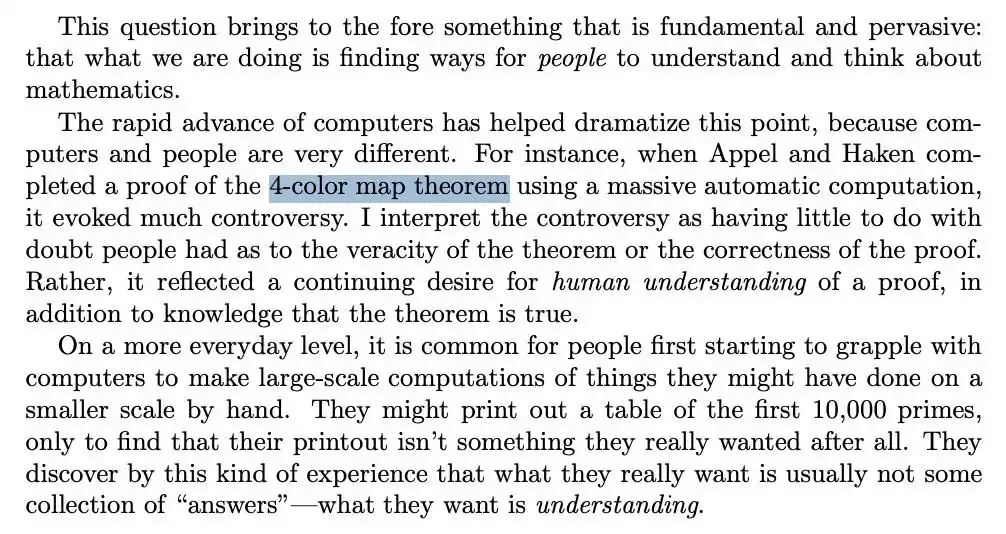
The late mathematical master and Fields Medalist Bill Thurston wrote in his famous 1993 essay "On Proof and Progress in Mathematics":

"The rapid development of computer science highlights this... When Appel and Haken used massive computation to complete the proof of the Four Color Theorem, it sparked huge controversy.

I don't think this indicates doubt about the theorem's truth, but rather reflects a persistent human desire: besides knowing the theorem is true, we also crave to truly understand it through the human mind."
To promote this transformation, Sanderson proposes several highly actionable appeals:

1. Reshape PhD Defenses: Advisors shouldn't just have PhD students solve problems; they can have them use AI to solve problems, but the final assessment metric is: you must give a talk that explains this obscure difficult problem or AI proof clearly to the entire department's faculty and students.

2. A Modern Version of Hilbert's Problems: Call for mathematics leaders like Terence Tao to publish a list of "Unsolved Exposition Problems," telling all of humanity which important theorems we still only "know that they are true but not why they are true."

3. Reform Tenure Evaluation: Place writing excellent textbooks and creating highly enlightening academic content on par with, or even higher than, publishing in top-tier journals.

Recently, researcher Liam Price used GPT-5.4 Pro to solve the long-difficult Erdős problem number 1196.
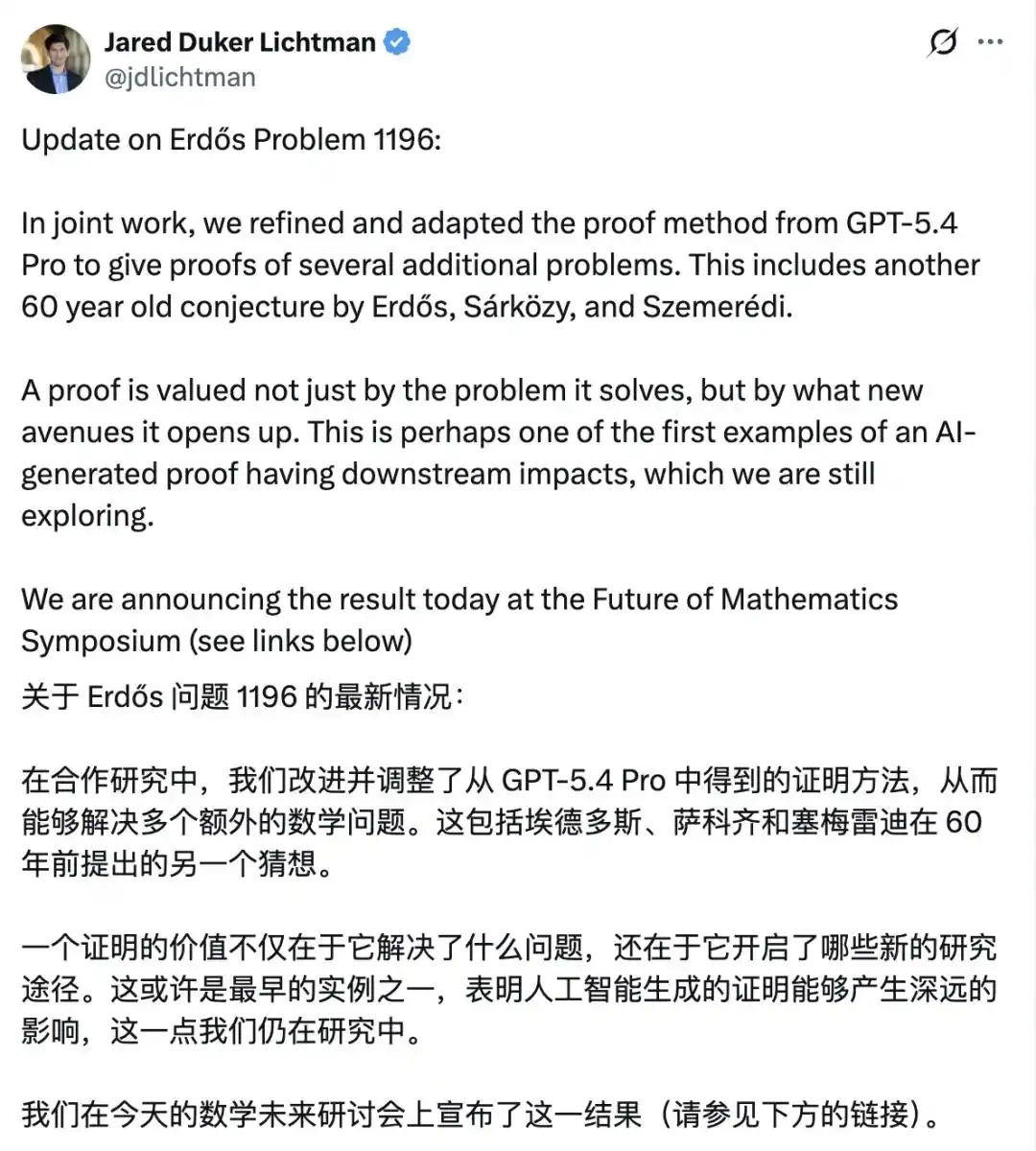
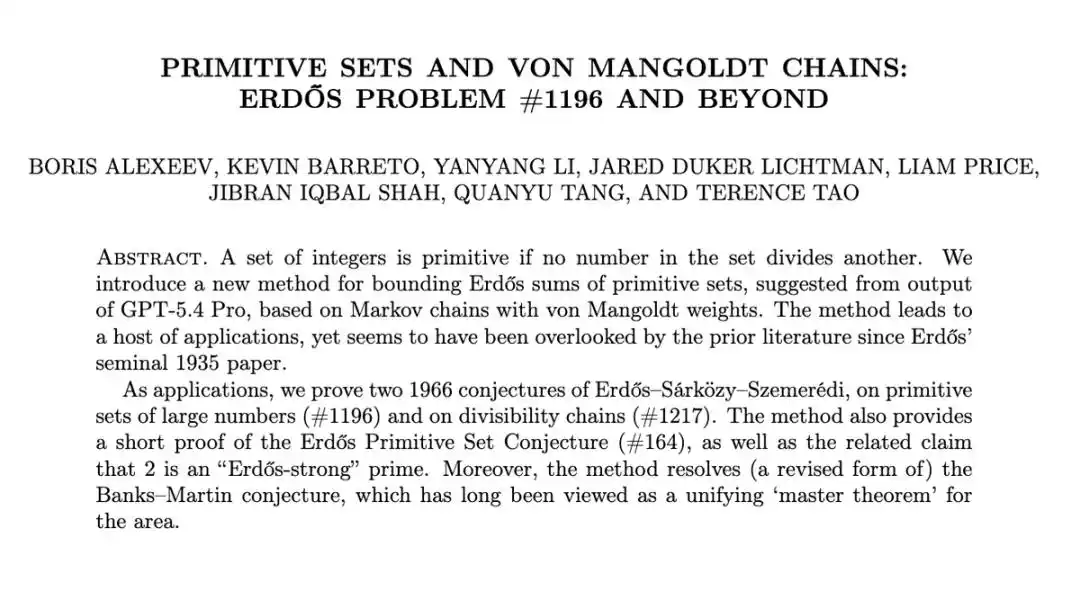
However, while the initial AI proof existed, it was like an impenetrable book; human understanding did not advance because of it.

Subsequently, several human mathematicians (including Terence Tao himself) took on this "impenetrable book." They deciphered the AI's method, extracted the core idea, and compiled it into a human-readable paper. More importantly, the human scholars clarified that this core idea not only solved the original problem but also shed light on many surrounding related conjectures.

In this process, AI was just the "mining machine," while the human mathematicians were the true "jewelry designers." The human paper that clarified the logic and elevated the idea is far more worthy of celebration than the raw code output by AI.

Fierce Debate: Physicists' Taunts and Conservatives' Concerns

As soon as this blog post by Terence Tao appeared, X and the comment section immediately transformed into a large "academic debate arena."

The first to arrive with "taunts" and "welcomes" were colleagues from the neighboring field of physics.

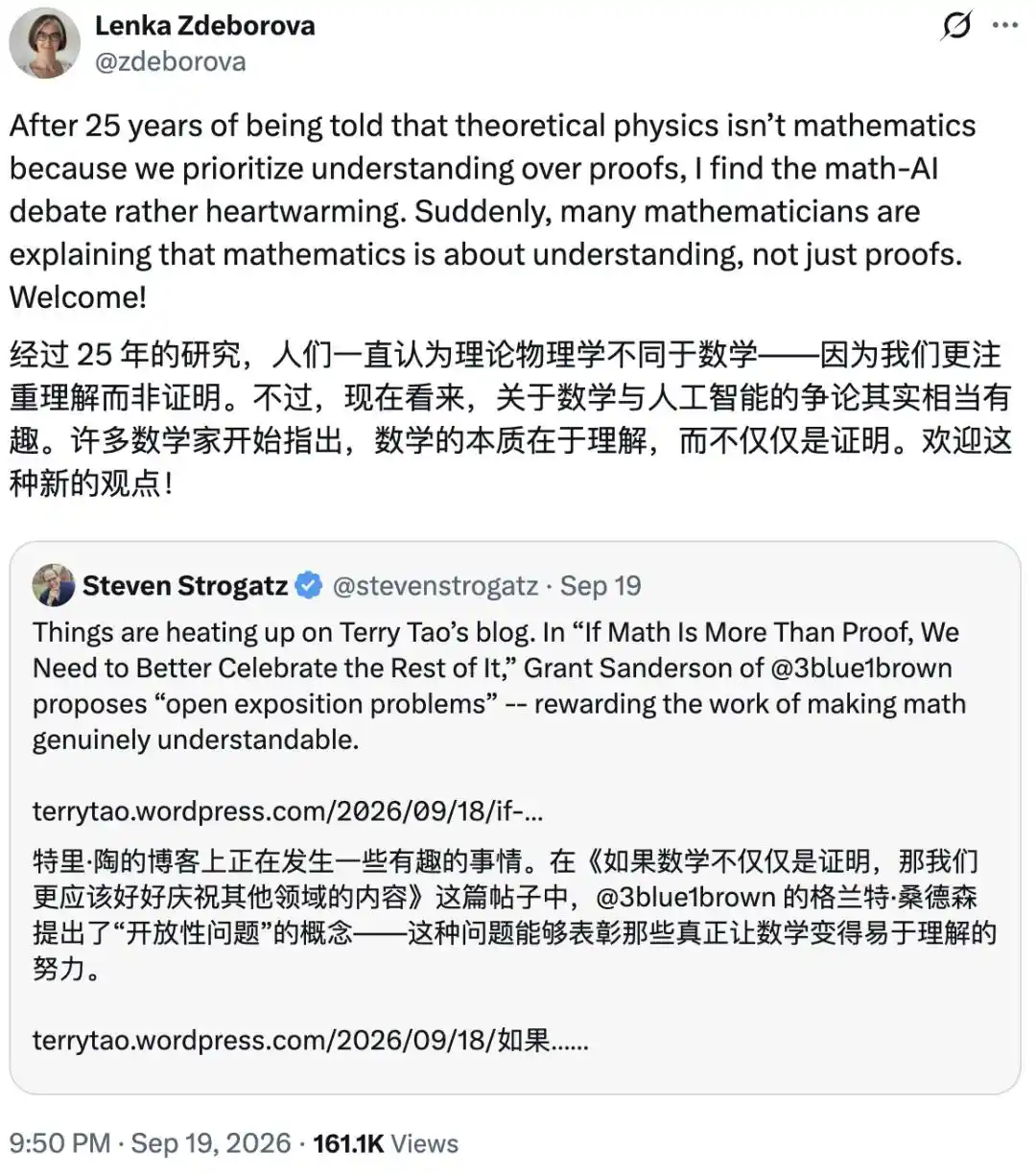
Famous physicist Lenka Zdeborova posted a tweet full of both gunpowder and humor:

"For 25 years, we theoretical physicists have always been told 'what you do is not mathematics,' because we prioritize 'understanding' over 'rigorous proof.' Seeing the mathematical community having such a debate because of AI warms my heart. Suddenly, many mathematicians are explaining: mathematics is about understanding, not just proof. Welcome to our world!"
A user chimed in: "The core philosophical difference between physicists and mathematicians lies in: physicists believe there is a reality behind mathematics, and mathematics is just trying to approximate it; while mathematicians believe mathematics itself is reality. Now AI has shattered the lofty 'divinity' of mathematics, and mathematicians are finally returning to human intuition."

Of course, the mathematical community itself is not unanimously accepting of this shift. Many scholars expressed deep concerns:

Opposing Viewpoint One: This buries geniuses who are not good with words!

Someone mentioned the late mathematical genius Jean Bourgain in a comment.

Bourgain was known for his rough, direct, and even extremely difficult-to-read paper style, but his problem-solving ability was nuclear-level.
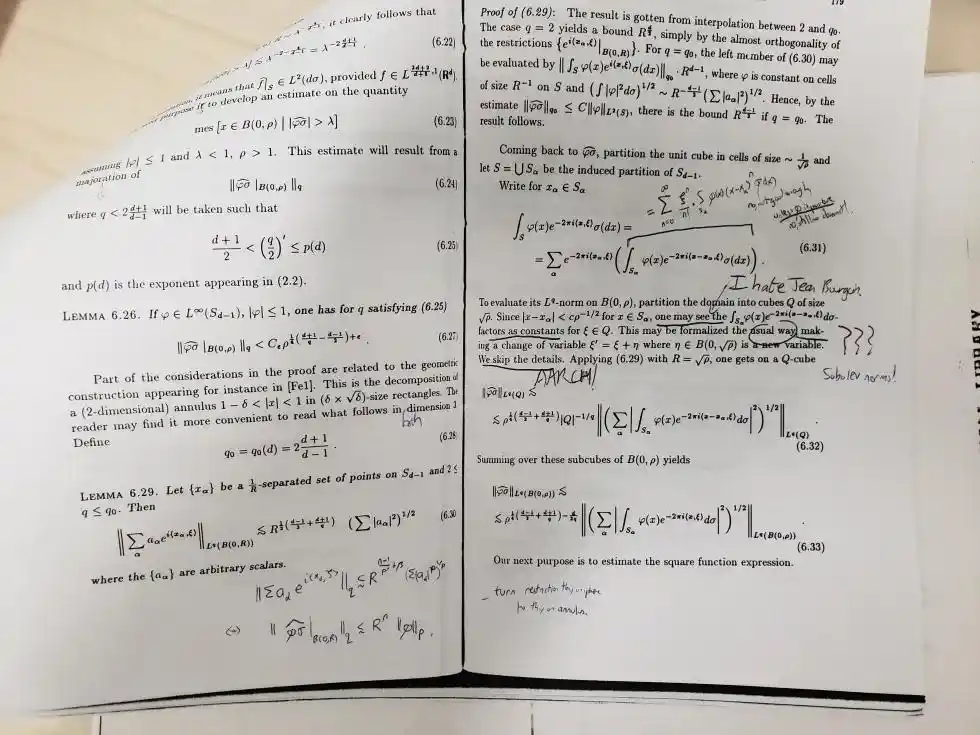
"If you shift the evaluation criteria to 'exposition,' wouldn't geniuses like Bourgain, who are not good with words but can prove earth-shattering theorems, be buried? Would we let future Bourgains be lost to industry?"

To this, Terence Tao himself personally responded.

He gently but forcefully rebutted: "I think Bourgain sacrificing exposition to focus on problem-solving was a 'consequence' of that era's reward mechanism, not 'proof' that the mechanism was reasonable. I've interacted with him privately, and he was fully capable of excellent exposition. If the academic environment back then had given more weight to 'exposition,' his adjusted writing style would have contributed even more enormously to the mathematical community and broader society!"

Opposing Viewpoint Two: AI will eventually master 'perfect exposition' too!

Other scholars (like Tsimerman) pointed out: Don't be naive.

AI's exposition ability is indeed average now, but future large models will definitely be able to generate textbook-perfect "motivating exposition" better than humans.

If even "understanding and explanation" are taken over by AI, what can human mathematicians still do?

An anonymous user incisively responded to this "AI is omnipotent" view:

"I am amazed by some people's blind worship of AI. What is 'the best exposition'? This highly depends on the specific human trying to understand the math. There is no static 'exposition effectiveness function.' The reason we focus on exposition is to promote 'human understanding of mathematics,' not 'machine understanding of mathematics.'"

That's right, even if AI makes the food taste better, humans still need to chew and digest it themselves to gain nutrition. Mathematics is not about filling server hard drives with cold truths, but about elevating the human mind.

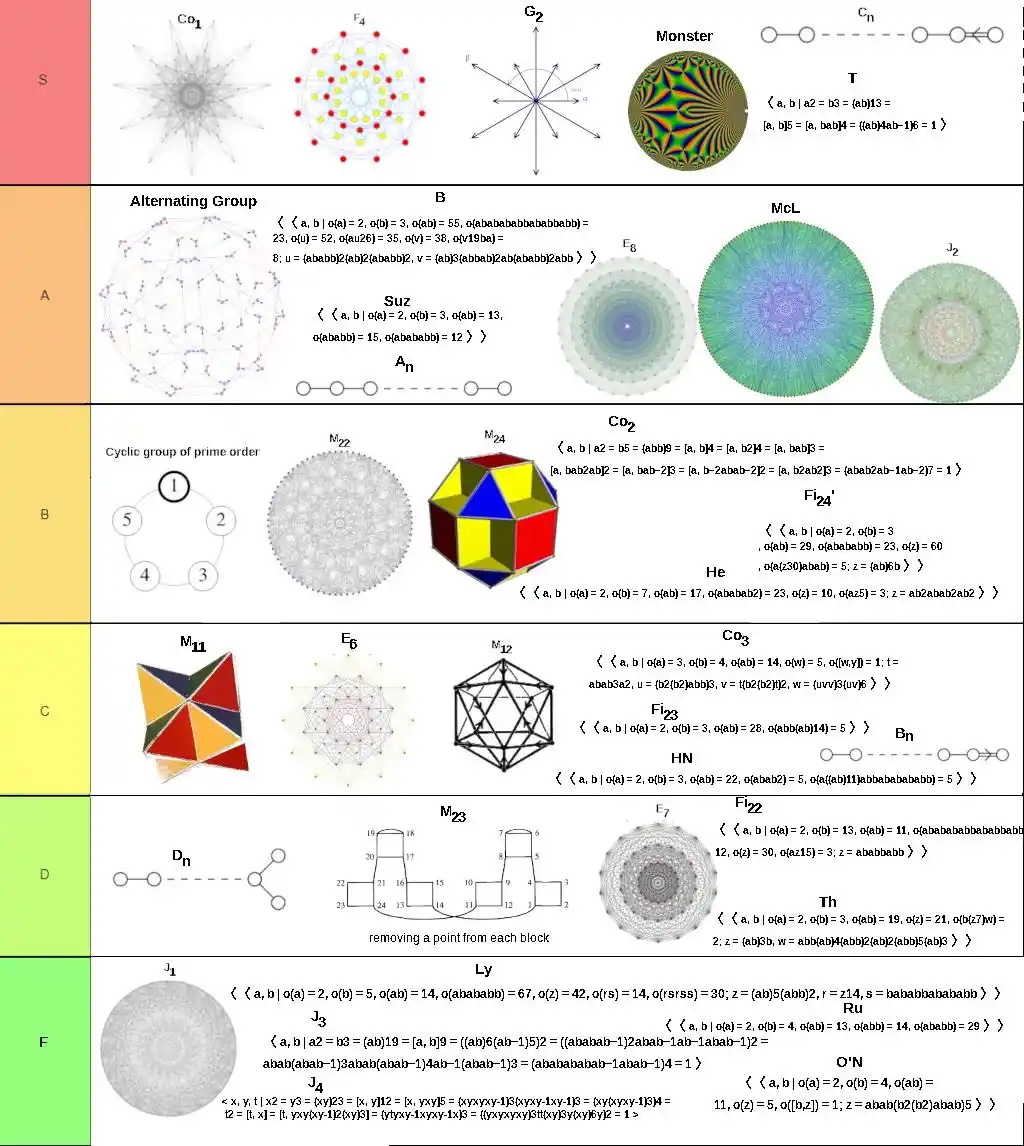
A scholar who proposed "classification of finite simple groups" as the first "Millennium Exposition Problem" commented movingly:

"This proof involves thousands of pages, and even many professional mathematicians cannot fully understand it. As the older generation of experts gradually retire, this craft is in danger of becoming a 'lost art.' If we don't want to be helpless when faced with thousands of pages of AI-generated proofs in the future, we must start now, engaging in large-scale interdisciplinary collaboration to provide 'motivating exposition' for these grand mathematical structures. This is an exercise for humanity to defend its own rationality."
Crisis or Turning Point? The Ticket to a New Era

Returning to the beginning of the article, why did Terence Tao, who was developing open-source math models last week, issue the serious warning "crazy, must slow down AI" in the video yesterday?

Because extreme nonlinear dynamics means loss of control.

The despair and appeal from 'Tao God' are not because humans are losing to machines in computational power, but because culturally, institutionally, and psychologically, we are simply not ready for this great transformation.

If academia stubbornly clings to the rigid systems of "proof-only" and "paper-only," then in this AI tsunami, indeed tens of thousands of young scholars will face a dead end, and humanity's faith in mathematics will suffer a devastating blow. We are unwittingly destroying a millennia-old academic ecosystem.

But what if we press pause and carefully examine the "cultural shift" proposed by Grant Sanderson?

As he says at the end of the article:

"For young students today, this is actually the most exciting time to enter mathematics. Because there is nothing more thrilling than entering a field that is 'extremely malleable' and where you 'have a chance to actively shape its future form.'"

When arduous, dry logical derivations are taken over by AI, human mathematicians can finally evolve from assembly line "proof workers" into true "mathematical architects" and "philosophers of thought."

We can have more time to ask "why," to search for incredible connections between different fields, to translate the profound codes of the universe into pulsating symbols that even a sixth-grade girl can understand.

As a user quoted Scale AI founder Alexandr Wang's words: "As I told my nephew, math will set you free."

In anything studied deeply enough, you will find mathematics. Mathematics is the web connecting the entire universe, the language physics uses to define the world, and the most beautiful imprint of humanity confirming its own existence in the vast sea of truth.

AI can hand us a full bag of answers called "truth," but facing this endless sea of truth, only profound "human understanding" can become our compass for navigation.

The old era is collapsing, but a true mathematical renaissance belonging to "human mental understanding" may just be beginning.

References:

https://x.com/stevenstrogatz/status/2101490647752479151https://x.com/8teAPi/status/2101484024455983467

This article is from WeChat public account "New Zhiyuan" (ID: AI_era), author: ASI Apocalypse

Trending Cryptos

Related Questions

QWhat is the central argument of Grant Sanderson's guest post on Terence Tao's blog, as described in the article?

AThe central argument is that the core value of human mathematicians is not merely in generating proofs, which AI can now do, but in advancing human understanding. He advocates for a 'cultural pivot' that elevates the creation of clear, motivating explanations ('motive explanation') for mathematical concepts and proofs to a status equal to or higher than producing proofs themselves.

QAccording to the article, what key proposal does Grant Sanderson make to help mathematics adapt to the AI era?

ASanderson proposes the establishment of 'open-ended explanation problems.' This initiative would involve creating lists of important theorems whose underlying motivations and interconnections are not well understood, and encouraging mathematicians to work on providing clear, human-centric explanations for them as a recognized form of scholarly contribution.

QWhy does the article mention Terence Tao's seemingly contradictory actions regarding AI development in mathematics?

AThe article highlights Tao's rapid shift from promoting an open-source AI model for mathematics ('SAIR') to issuing a public warning to slow down AI development. This illustrates the extreme tension and 'nonlinear dynamic' within academia, where AI's rapid advancement threatens to destabilize the traditional system of mathematical research and doctoral training before society is culturally or institutionally prepared.

QWhat major concern from within the mathematical community is raised as a counterpoint to Sanderson's emphasis on explanation?

AA concern raised is that focusing on 'explanation' as a key metric could disadvantage brilliant mathematicians who are exceptional problem-solvers but not naturally gifted communicators, like the late Jean Bourgain. Critics worry this could divert such talent away from academia.

QHow does the article use the example of the Erdős problem solved by GPT-5.4 Pro to illustrate the proposed new division of labor between AI and humans?

AThe article uses the example to show that AI acted as a 'mining machine,' producing a raw, hard-to-understand proof. Human mathematicians, including Terence Tao, then acted as 'jewelry designers,' deciphering the AI's method, extracting the core idea, and writing a human-readable paper that clarified not only the solution but also its relation to surrounding conjectures, thereby advancing human understanding.

Related Reads

Leverage Flush, ETF Selling Pressure Not Yet Exhausted: The On-Chain Truth Behind the $64K Defense Line

After a month of range-bound trading, crypto markets suffered a brutal deleveraging washout last weekend, with Bitcoin falling roughly 13% in a week and briefly piercing $63,000, marking its sharpest single-day volatility in months. Glassnode's Week 47 Market Pulse report notes that while overheated derivatives leverage has largely been flushed out, continued outflows from spot ETFs are pushing the sector toward a critical threshold, with the aggregate ETF MVRV nearing the 1.0 break-even line. On-chain microdata shows loss pressure concentrated among recent entrants, with short-term holders now underwater overall. Bitcoin hovered near $64,000 on Monday after a weekly close down about 13%. The sell-off began Thursday and accelerated over the weekend, briefly breaking $63,000 on Saturday for the lowest level since late August. The concentrated selling rapidly cleared leveraged positions built up in derivatives over prior weeks. Perpetual futures open interest fell to the lower bound of its statistical range, and funding rates cooled sharply from warning levels back to neutral. Meanwhile, U.S. spot ETF investors extended net outflows, recording withdrawals every trading day last week, with aggregate ETF MVRV sliding to 1.06, extremely close to holders' break-even benchmark. On-chain activity remains relatively robust, with daily active addresses and large transfers holding up, but paper losses fall almost entirely on holders who entered in recent months. Short-term holders have turned fully underwater, and realized losses hit their highest level since July. In derivatives, spot momentum plunged 36.1% to 22.8, the weakest since August. Spot CVD deteriorated from -$51.5M to -$133.7M, with aggressive selling dominant Thursday through Saturday before slowing Sunday. Futures open interest fell 7.2% to $34.2B, also at the range's lower bound. Perpetual CVD widened from -$493M to -$1.4B, reflecting forced liquidations and stop-losses among speculative longs. The 25-delta skew jumped 30.9% to 13.7%, a new put-premium record since August, signaling strong demand for downside hedges. Spot ETF weekly net outflows narrowed slightly to -$995.4M but remain near the range bottom; weekly trading volume fell to $11.5B as institutions stayed defensive. On-chain, entity-adjusted daily transfer volume rose 3.6% to $5.4B near the upper bound, and daily active addresses totaled about 659,700, still healthy. However, realized cap monthly growth nearly stalled, dropping from 0.43% to 0.04%, indicating significantly slower external capital inflows. The STH-to-LTH supply ratio edged up to 15.1%, and hot capital share held at a high 22.0%, showing young coins bought within three months still carry heavy trading weight. The share of supply in profit fell from 60.4% to 55.3%, and STH-NUPL turned negative at -7.4%, historically a typical zone for capitulation-style turnover. Overall, the crash was driven by persistent ETF reduction, speculative long squeeze, and macro risk aversion. Open interest and funding rates have left dangerous overheated levels, clearing much pure leverage risk. Whether ETF net outflows turn positive and whether short-term holder capitulation spreads to long-term believers will determine if $64,000 becomes a solid bottom.

marsbit22m ago

Leverage Flush, ETF Selling Pressure Not Yet Exhausted: The On-Chain Truth Behind the $64K Defense Line

marsbit22m ago

US Stocks Trend (November 17): Nvidia Falls Another 4% to a 52-Week Low, Nasdaq Plunges 2.49%

Nvidia fell another 4.1% to $156.14, hitting a 52-week low, as the chipmaker's troubles deepened. Micron and Intel each dropped over 7%, and the Nasdaq tumbled 2.49%. The selloff spread to financials, industrials and energy, with all three major indexes closing lower. The Dow fell 739.38 points (-1.41%) to 51,608.17, the S&P 500 lost 145.08 points (-1.92%) to 7,416.59, and the Nasdaq dropped 626.52 points (-2.49%) to 24,509.76. The Russell 2000 fell 1.70%. It was the Nasdaq's biggest one-day decline since Nov. 5, and the S&P 500 and Nasdaq have now fallen for three straight sessions, erasing last week's gains. Nine of the S&P 500's 11 sectors declined, with tech and communication services down 2.98% and 2.82%, while consumer staples and utilities edged higher. The VIX jumped 18.7% to 22.91. Nvidia's board is focused on its investigation of Jensen Huang and has not discussed bringing him back as CEO, according to CNBC. The company has hired law firm Wachtell Lipton to investigate whether his conduct endangered national security or company secrets. Treasury Secretary Bessent called for a major overhaul and urged the board to look externally for a new CEO. The Commerce Department's BIS issued an interim final rule closing a loophole allowing Chinese firms to rent Nvidia compute through third-country data centers. Wall Street kept cutting targets: Mizuho lowered its to $220 from $250 and UBS to $240 from $300, both maintaining buy ratings. Mizuho's Vijay Rakesh said the roughly 32% drop from October's high, larger than the Philadelphia Semiconductor Index's 23% decline, reflects a lost "founder premium," with the CEO departure adding six to seven months of management uncertainty. Chip stocks fell broadly: Micron -7.62% to $719.02, Intel -7.07% to $55.47, Marvell and Arm each down over 7%, AMD about -6%, Broadcom about -4%, and the iShares Semiconductor ETF -5%. SanDisk and Lumentum fell over 8%, Dell about 7%, Oracle about 5%. Financials joined the afternoon selloff, with Morgan Stanley, Goldman Sachs and JPMorgan each down over 2%; Caterpillar fell 4.95% and Boeing 3.66% to a 52-week low. Defensive names outperformed: P&G rose 1.90% to a 52-week high, Molina Healthcare jumped 11.27% and Tyson Foods gained 8.72%. The November Empire State manufacturing index came in at 7.8, down 18 points from October and below the 16.7 expected; new orders fell to 3.0 while employment rose to 18.1, the highest since June 2022. The 10-year Treasury yield fell 2.2 basis points to 5.117% and the 2-year dropped 3.1 basis points to 4.821%, a bull steepener. Fed Chair Warsh's remarks focused on AI, warning it could disappoint, with little on monetary policy. WTI crude fell 3.21% to $85.72 a barrel and Brent dropped 3.55% to $92.44, as reports that the U.S. has no immediate plans to strike Iran outweighed support from an Iranian attack on a Bahrain air base and a tanker hitting a mine in the Strait of Hormuz. Gold fell 0.86% to $3,853 an ounce and silver plunged 4.60%. Bitcoin fell as low as $62,000 over the weekend, its lowest since August, and traded around $65,300 after the close. Looking ahead, Nvidia reports fiscal third-quarter results after the bell on Tuesday, with Bloomberg consensus at $2.47 EPS on about $109.15 billion in revenue; interim CEO Colette Kress will host the call, and options pricing implies an 8% move this week. Disney and Home Depot report before the open Tuesday, alongside October retail sales and import price data. Later in the week, Anthropic is expected to price Wednesday and list on Nasdaq Thursday at $70-78 per share, valuing it around $1.4 trillion, and Take-Two's GTA VI launches Thursday.

marsbit29m ago

US Stocks Trend (November 17): Nvidia Falls Another 4% to a 52-Week Low, Nasdaq Plunges 2.49%

marsbit29m ago

Altman Empathizes with Jensen Huang: 'Heroes Have Flaws,' But Does He Support His Return as NVIDIA CEO...

At the Semafor Silicon Valley Summit on November 16, OpenAI CEO Sam Altman publicly addressed Nvidia founder Jensen Huang's resignation as CEO after 33 years, expressing strong personal empathy. Altman called Huang "a hero of mine" and said it's hard to imagine the AI revolution without him, acknowledging that "heroes have flaws." Nvidia's stock fell about 15% within a week, wiping out over $570 billion in market value, and 180,000 people signed a petition urging his reinstatement—echoing Altman's own 2023 board ouster and dramatic return. Altman noted that Nvidia and OpenAI bet on each other early on. On business matters, he dismissed concerns that Nvidia's commitments—including a $105 billion financial guarantee for an OpenAI data center in Ohio—would lose credibility, saying the company is now a massive giant whose backing remains trusted. He also expressed optimism that the AI industry will keep advancing without Huang, given strong market demand and validated AI value. Altman identified scientific research as the next major AI breakthrough area, citing progress in math and physics, and predicted AI will take over repetitive, process-driven enterprise work. He also clarified his controversial memory chip remarks (saying he actually supports consumers upgrading their own PCs), explained that chip demand projections from multiple suppliers overlap even though real data center demand is solid, said OpenAI has not yet launched fully autonomous recursive self-improvement due to safety concerns, and stated OpenAI is in no rush to IPO despite Anthropic's filing, noting investor demand far exceeds quality supply.

marsbit33m ago

Altman Empathizes with Jensen Huang: 'Heroes Have Flaws,' But Does He Support His Return as NVIDIA CEO...

marsbit33m ago

If you lose money helping a friend trade cryptocurrency, will it be deemed fraud?

When friends entrust you with money to trade cryptocurrency on their behalf and the market turns against them, two distinct legal questions arise: whether you must compensate them, and whether your conduct constitutes fraud. These are separate issues. Civil liability depends on the nature of the relationship—whether it was a loan, a委托 investment, or a joint venture—and on the validity of any agreement. Under Chinese policy, virtual currency investment activities are treated as illegal financial activities, and civil acts involving them that violate public order and good morals are void, with losses generally borne by the parties themselves. Courts have reached different outcomes: in one case, an investor's claim for full repayment was rejected because the loss stemmed from market risk; in another, the operator was ordered to bear 20% of the loss for failing to recognize compliance risks, while the investor bore 80%. Fraud, by contrast, requires proof of deceptive conduct and intent to illegally possess the funds—mere trading losses or refusal to repay do not establish fraud. However, fabricating trade records, misappropriating funds, or secretly using leverage contrary to instructions can change the analysis. If a dispute escalates or police become involved, the priority is to preserve complete records of the agreement, fund flows, and trading history, avoid making unauthorized repayment promises, and cooperate truthfully with authorities while seeking professional legal advice.

marsbit33m ago

If you lose money helping a friend trade cryptocurrency, will it be deemed fraud?

marsbit33m ago

Stop Asking, I Just Love Money! The Naked-Quit Genius Researcher Backtracks, May Want to Return to Big Tech

Jacob Coxon, a 27-year-old Cambridge mathematics graduate and former pretraining researcher at both OpenAI and Anthropic, publicly reversed his stance just two months after a high-profile resignation. Speaking at a Stanford University event hosted by professor Rob Reich, Coxon admitted he is unsure whether leaving was the right decision and suggested he might return to a top AI lab. When pressed on why he still holds OpenAI stock options despite describing frontier labs as existential threats, he candidly replied, "I like money, brother. I admit it's blood money," and deflected further questions by blaming the host for raising the issue. He also said he remains anxious about no longer seeing frontier progress from the inside and feels he is "shouting into the void," questioning whether staying inside a lab would have been more influential. On technical matters, he argued that pretraining is not hitting a wall—compute efficiency is following a "super-exponential" curve—that recursive self-improvement requires only one narrow technical capability rather than broad mastery, and that deceptive or uncontrolled behavior in models originates solely from reinforcement learning during post-training, a loop labs cannot escape because RL remains the only effective tool for making models follow complex instructions. The episode, in which he clings to valuable equity while warning of AI risk, is seen as a candid portrait of Silicon Valley's AI culture.

marsbit37m ago

Stop Asking, I Just Love Money! The Naked-Quit Genius Researcher Backtracks, May Want to Return to Big Tech

marsbit37m ago

Trading

Spot

Hot Articles

How to Buy TAO

Welcome to HTX.com! We've made purchasing TAO(Bittensor) (TAO) simple and convenient. Follow our step-by-step guide to embark on your crypto journey.Step 1: Create Your HTX AccountUse your email or phone number to sign up for a free account on HTX. Experience a hassle-free registration journey and unlock all features.Get My AccountStep 2: Go to Buy Crypto and Choose Your Payment MethodCredit/Debit Card: Use your Visa or Mastercard to buy TAO(Bittensor) (TAO) instantly.Balance: Use funds from your HTX account balance to trade seamlessly.Third Parties: We've added popular payment methods such as Google Pay and Apple Pay to enhance convenience.P2P: Trade directly with other users on HTX.Over-the-Counter (OTC): We offer tailor-made services and competitive exchange rates for traders.Step 3: Store Your TAO(Bittensor) (TAO)After purchasing your TAO(Bittensor) (TAO), store it in your HTX account. Alternatively, you can send it elsewhere via blockchain transfer or use it to trade other cryptocurrencies.Step 4: Trade TAO(Bittensor) (TAO)Easily trade TAO(Bittensor) (TAO) on HTX's spot market. Simply access your account, select your trading pair, execute your trades, and monitor in real-time. We offer a user-friendly experience for both beginners and seasoned traders.

3.9k Total ViewsPublished 2024.03.29Updated 2026.08.27

How to Buy TAO

Discussions

Welcome to the HTX Community. Here, you can stay informed about the latest platform developments and gain access to professional market insights. Users' opinions on the price of TAO (TAO) are presented below.

活动图片