$680 Million Warning: Majority of DeFi Attacks Occur Outside Audited Scope

marsbitPublished on 2026-09-14Last updated on 2026-09-14

Abstract

"Audited" is often seen as a blanket security guarantee in DeFi. However, a new analysis reveals a critical gap: most major attacks exploit components *outside* the scope of those audits. Security firm ack3 and researchers analyzed 135 security incidents from the first half of 2026, totaling $939.86 million in losses. Of the 68 incidents with identifiable pre-attack audits, 46 attack vectors (67.6% of the sample) fell completely outside any reviewed code. These "out-of-scope" attacks accounted for a staggering 94.4% of the reported losses in that group. The data highlights a fundamental trust issue: a project's "audited" status does not mean its entire live system—including upgrades, admin keys, frontends, oracles, or cloud infrastructure—has been reviewed. Two August incidents illustrate this disconnect. In the ICON Network replay attack, a mismatch between two *individually* audited modules allowed massive duplicate withdrawals. The failure occurred at the boundary of their separate audit scopes. Separately, an aelf network intrusion involved a runtime vulnerability; existing public audit reports cannot clearly map the attack path to a pre-reviewed component. The conclusion is not that audits are useless, but that their scope is limited and degrades over time. Users need transparency: which code version was audited, what was excluded, and what mechanisms (like alerts and emergency response) are in place for the *currently deployed* system. An audit badge alone cannot co...

Written by: Liam 'Akiba' Wright

Compiled by: Chopper, Foresight News

In the decentralized finance space, "audited" is often viewed as a security endorsement for the entire project. However, in reality, audits typically only cover specific points in time, designated code, components, and versions. Anything added, removed, or manipulated outside this scope may have completely different audit results.

A new preprint paper quantifies this gap. Security firm ack3 and researchers from the Czech Technical University in Prague analyzed 135 security incidents reported in the first half of 2026, resulting in losses as high as $939.86 million. They found that 68 of these incidents had identifiable, publicly available pre-attack audit records.

Within this sample of 68 incidents, researchers classified 46 attack paths as completely outside any verifiable audit scope; 20 incidents were at least partially within the scope of at least one audit; the remaining 2 could not be determined. Incidents outside the audit scope accounted for 67.6% of the total number of events in this sample, yet corresponded to 94.4% of the total reported losses.

This staggering proportion is not an assessment of audit effectiveness, nor evidence that audit scope limitations caused the losses. It merely represents the distribution of losses within the selected sample of publicly reported security incidents. Two特大 events heavily influence the data: after removing the $292 million Kelp DAO loss and the $285 million Drift Protocol loss, the share of losses caused by attacks outside the audit scope within the same audited sample drops to 72.1%.

Despite these limitations, this research reveals a fundamental trust issue in security: a project may claim to have been audited, but users cannot know whether the actually running system, the flow of funds, and the associated control mechanisms have been reviewed.

What the Data Really Means

ack3's study covers the period from January 1 to June 29, 2026, including 122 confirmed attack incidents and 13 suspected incidents. In the full sample, 35 incidents had no audit records found, and 32 had an unknown audit history; these two categories were not included in the above statistics for the 68 incidents.

In the sample of 68 incidents, attacks outside the audit scope corresponded to $680.97 million in losses, out of a total loss of $721.24 million, yielding the 94.4% figure. After removing Kelp DAO and Drift Protocol, losses from attacks outside audit scope were $103.97 million, with total losses of $144.24 million, constituting 72.1%. The dataset JSON file allows for reproduction of event classifications and loss amounts.

The "in-scope/out-of-scope" labels are judgments made by researchers based on publicly available evidence. The research team reviewed archived project and auditor documents, found audit reports predating the attacks, and compared the final attack paths with the reviewed code, versions, and audit exclusions. The study is a 6-page preprint paper co-published with the dataset publisher; two authors are affiliated with the security audit firm ack3.

The study lacks a control group of unattacked systems and does not account for the duration of risk exposure for each system. Therefore, it cannot prove that audited protocols are overall safer, estimate the probability of incidents, or confirm that "being outside audit scope" was the direct cause of each loss. Some undisclosed audits and private incidents may be missing, and the reported loss data may not be fully comparable.

Thus, the study can only draw a limited conclusion: audit records and audit coverage are two separate metrics. A reviewed smart contract does not imply that contract upgrades, privileged keys, frontends, relayers, oracles, cloud services, or emergency response processes receive the same level of security assurance.

Two incidents in August illustrate this distinction from different angles. The ICON Network case clearly shows a failure at the boundary between two pieces of reviewed code during two verification steps; the August aelf security incident is another case where existing audit evidence is currently insufficient to map the attack path to a pre-attack audit scope.

ICON Network: A Sample Failure at the Audit Boundary

In the ICON Network replay attack on August 27, two modules in the withdrawal pathway interpreted the same message differently.

According to the ICON Foundation's post-mortem report: the migration contract used the high-order bits of the withdrawal message sequence number to determine message uniqueness; however, the cryptographic signature only covered the lower 256 bits of the sequence number. Attackers, by modifying the high-order bits not covered by the signature verification, repeatedly submitted two legitimately signed withdrawal messages 1492 times within about 20 minutes, with 1490 of those calls executing successfully.

This replay attack released 119.866 million ICX and 531,600 bnUSD. At the time of the post-mortem release, ICON confirmed a net loss of approximately 150.2 ETH plus 31,204 USDC. The foundation stated that 531,600 bnUSD and 1.366 million SODA assets had been recovered, and user deposits, account balances, and positions were unaffected.

ICON stated that this migration contract had undergone external audits, and audit recommendations had been implemented, including related modifications within the same module area; the corresponding relay logic had also been separately reviewed in a dedicated audit. The Sodax development documentation audit list includes 8 reports covering different components, including a Sodax relay audit report from November 2025.

However, the post-mortem report explicitly states that this specific mismatch between the uniqueness verification logic and the signature verification value was not within the scope of the findings in those audits. A simple "audited" project label cannot inform users whether the criteria for determining "message uniqueness" are consistent across both ends of the withdrawal pathway.

The response timeline also exposed another type of boundary issue. ICON's first automated alert triggered at UTC 02:08, approximately 7 minutes after the attack started. Staff initiated investigation around 03:40, paused the affected contract at 03:53, and paused the entire network at 06:18:54.

There was about a 90-minute interval between the first alert and the complete emergency response. ICON attributed this to adjustments in the alerting mechanism; this alert rule had generated numerous false positives during previous network connectivity issues and was therefore not configured to notify on-call personnel with high priority. The foundation plans to deploy automatic shutdown triggers, lower circuit-breaker thresholds, and conduct specialized reviews on message uniqueness and replay protection.

Such risk control mechanisms cannot replace audits, but they answer another critical question: when preventive measures fail, can the system quickly detect and isolate the risk?
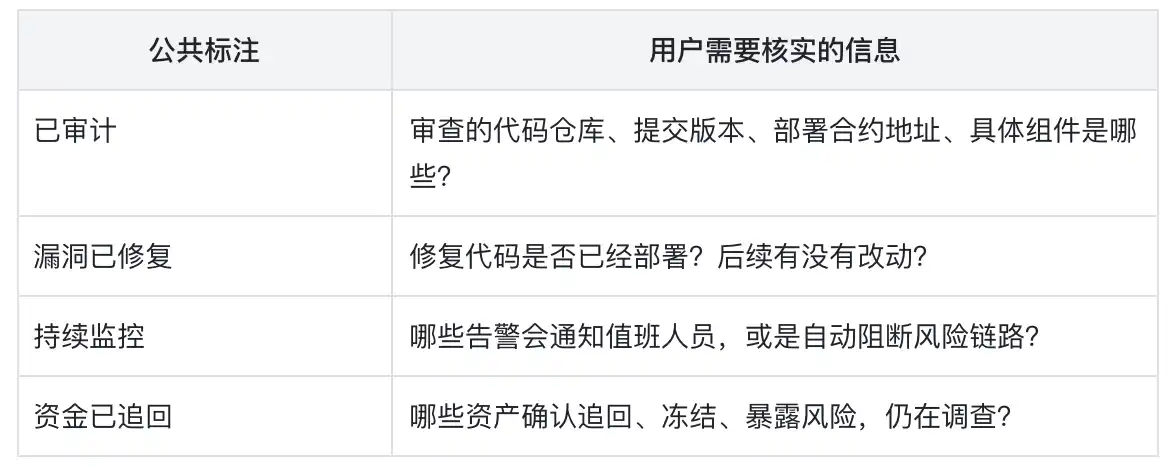
Security Questions Users Still Need Clear Answers To

aelf: Security Assurance Needs Continuous Updates

The aelf security incident in August reinforces the above point from another angle. Public descriptions mention a runtime intrusion and controlled recovery, but existing evidence is insufficient to determine whether the attack path fell within the scope of a specific pre-incident audit.

The project's official announcement explains: an unauthorized smart contract existed that could, using transaction parameters, inject encoded .NET assemblies and instructions into the node execution pipeline.

The preliminary investigation report attributed the incident to flaws in runtime reflection and dynamic loading validation, coupled with insufficient isolation between the contract execution environment and sensitive node and infrastructure resources. aelf identified a total of 155 related transactions and 5 independent payload assemblies, with capabilities including executing host commands, attempting external communication, accessing node keys, and infrastructure reconnaissance.

Having capabilities does not confirm all payloads executed successfully, nor that attackers obtained all targeted credentials or that sensitive data was exfiltrated. aelf stated they have rotated signing keys and infrastructure credentials according to potential leak standards.

As of September 11, this conclusion remains interim. The aelf official blog has not published a dedicated update for this incident since August 26. The August 26 announcement promised subsequent updates and a final post-mortem.

aelf's technical security documentation states that its blockchain and ELF token contract have undergone multiple rounds of audits, with no security issues found. However, existing public pages cannot map the runtime path corresponding to the August attack to a specific audit report prior to the incident. Therefore, categorizing the incident as an audit oversight or an out-of-audit-scope failure lacks sufficient supporting evidence.

This uncertainty itself is informative. An audit report with a timestamp gradually becomes disconnected from the current system code, dependency libraries, and actual operational state. Users need a versioned security record to reflect this discrepancy.

This security record should clearly state: the reviewed repository and code commit version, deployed contract addresses, excluded components, privileged roles, dependency libraries; while also recording post-audit contract upgrades, key custody and rotation mechanisms, runtime isolation policies, alerting and circuit-breaker mechanisms, and time-stamped asset recovery status, distinguishing confirmed losses, frozen assets, and unresolved risk exposure.

This is not to negate the value of audits, but to align audit claims with the actual work done and connect them to the currently running system.

An audit badge cannot answer: whether the reviewed components, the deployed system, and the failure response mechanisms are still within the same security perimeter.

Related Questions

QWhat was the key finding of the research paper by ack3 regarding DeFi security incidents in 2026?

AThe key finding was that 67.6% of security incidents occurred outside the scope of identifiable pre-attack audits. However, these incidents were responsible for 94.4% of the reported total losses.

QHow did the ICON Network attack demonstrate a failure at the boundary of audited components?

AThe ICON Network attack occurred due to a mismatch between two audited modules. The migration contract and the cryptographic signature verification module disagreed on how to interpret a message's sequence number, a specific interaction point that was not covered by the separate audits.

QAccording to the article, what problem does the 'audited' label fail to address for users?

AThe 'audited' label fails to inform users whether the currently running system, fund flows, associated controls, or the interactions between different audited components have been reviewed. It cannot confirm that the security scope of the audit matches the live deployment.

QWhat limitation of the ack3 research is mentioned, preventing it from proving the overall safety of audited protocols?

AThe research lacked a control group of unaudited protocols that did not suffer attacks. It also did not account for the duration of risk exposure for different systems. Therefore, it cannot prove that audited protocols are safer overall or estimate the probability of an incident.

QWhat type of ongoing security record does the article suggest is needed beyond a one-time audit?

AThe article suggests a versioned security record that includes: audited code versions and commits, deployed contract addresses, excluded components, privileged roles, dependency libraries, post-audit upgrades, key custody/rotation mechanisms, runtime isolation, alert/emergency response protocols, and the status of recovered or at-risk assets.

Related Reads

Has the Time Come to Buy the Dip on Nvidia?

Nvidia announced on November 12 that Jensen Huang resigned as President, CEO, and Director, effective immediately. Shares fell as much as 14% intraday to $148.8, down nearly 40% from October highs, with over $600 billion in market value briefly erased. The founder's departure triggered the selloff, but the market is repricing the entire company rather than reacting to a single risk. Nvidia now trades at roughly 12x forward PE, its lowest in 15 years and below the S&P 500's ~18x, despite strong fundamentals: FY2026 revenue of $215.9 billion (+65%), data center revenue of $62.3 billion in a single quarter, ~75% gross margins, and Q2 FY2027 revenue of $96.2 billion with $21.3 billion free cash flow. Most investment banks cut targets but maintained Buy/Overweight ratings (Barclays $210, Goldman $220, Citi $225, RBC $230), implying ~20% upside, while Truist downgraded to Hold at $174. The consensus: the business is intact, but its valuation multiple needed resetting. Supporting demand, Huang forecast at GTC 2026 that Blackwell and Rubin AI chip demand would reach at least $1 trillion by 2027, double the prior 2026 estimate. However, risks remain beyond CEO succession. CUDA's lock-in effect is eroding on the inference side—Anthropic disclosed that its Claude Mythos Preview autonomously ported core GPU kernels to AMD flagship GPUs in three days with minimal human intervention, prompting investor Marcelo P. Lima's widely cited claim that "Nvidia's CUDA moat no longer exists." Supply bottlenecks lie in HBM and packaging, not wafers: TSMC can cut over 400 million GPU dies annually, but Nvidia ships only ~10 million GPUs yearly, constrained by HBM capacity (~3.75EB globally, ~70% allocated to Nvidia, ~260GB per GPU) and tight packaging, with HBM4 adjustments possibly delaying Rubin. Huang also leaves behind highly personalized assets—strategic technology judgment, supply chain negotiation with TSMC and SK Hynix, and direct channels to customers and governments—that interim CEO Colette Kress, the long-time CFO, may not fully replace. In short, the business remains, but the "faith premium" is being systematically stripped away. At 12x forward PE, much pessimism is priced in, offering a favorable risk-reward window if AI capex holds and demand materializes. Yet cheapness alone isn't sufficient: CUDA's erosion is slow but irreversible, HBM and packaging limit revenue upside, and succession uncertainty means the founder premium may not be fully removed. As Bernstein noted, "if you see two ants in the kitchen, there are more than two," warning that chains from scandal to governance vacuum to government probes could trigger further selloffs. Until the dust settles, what a Jensen-less Nvidia is worth remains an open question.

marsbit9m ago

Has the Time Come to Buy the Dip on Nvidia?

marsbit9m ago

AI Bull Market Trap? The Big Short Seller Strikes Again

Recent signals from Goldman Sachs, the Federal Reserve, and prominent short-seller Michael Burry are converging on concerns about the AI trade. Goldman warns that AI capital expenditure growth will likely peak in early 2027, with the boost to S&P 500 earnings falling from a 12-point peak in 2026 to a 5-point drag by 2028, shifting the market from a one-way rally to two-way volatility. The Fed has flagged AI as a potential threat to asset valuations and financial stability. Burry has doubled his Nasdaq 100 put options and rebuilt short positions in a semiconductor ETF, calling this a "bull market trap" analogous to the 2000 dot-com bubble, with Nvidia's influence a key worry. Four pressures weigh on the AI narrative: peaking capex growth, high interest rates that hit long-duration AI assets and leveraged GPU cloud providers like CoreWeave and Nebius, circular financing risks among interconnected tech firms, and tighter regulation under Democrats affecting data center energy, land, and permitting. Nvidia-related turmoil has shaken the pricing anchor for the entire supply chain. However, a valuation bubble bursting does not mean the AI industry is declining. Goldman notes US cloud giants trade at just 19.7x forward P/E, below their 20-year historical range and even below defensive staples, suggesting much pessimism is already priced in. Opportunities are shifting from upstream hardware "shovel sellers" toward fairly valued cloud giants with improving free cash flow, AI application companies delivering real ROI, and deeply discounted cyclical names like Korean memory. Conversely, GPU cloud providers dependent on Nvidia orders and cash-burning startups without products are most vulnerable. Investors should diversify, hedge, and focus on assets that convert spending into stable returns.

marsbit13m ago

AI Bull Market Trap? The Big Short Seller Strikes Again

marsbit13m ago

Just Offered 3.3 Million Yuan Salaries to Poach Talent, OpenAI Suddenly Dissolves Robotics Team—Is the Industry About to Change!

OpenAI has disbanded its standalone robotics research team, confirmed shortly after booking booth 208 at the CoRL robotics conference in Austin went empty on November 13. The move surprised many, given that just months earlier OpenAI was aggressively hiring robotics talent—some roles paying up to $500,000 base salary—and had expanded its San Francisco data-collection lab to about 100 workers across three shifts, with a second lab planned in Richmond, California. Researchers from the robotics team are now folded into Chief Research Officer Mark Chen's core research division, while robotics applications and hardware staff move to President Greg Brockman's Applied division. OpenAI says robotics remains part of its long-term vision and the reshuffle is meant to accelerate progress. This is not OpenAI's first robotics retreat: it ended its first independent robotics effort in 2020 to focus on large language models, which produced ChatGPT, and only rebuilt a team in 2024. OpenAI explains the latest pivot technically—researchers initially believed video-generation models like Sora could teach robots physics, but general models such as GPT-6 Astra proved capable of directly controlling robots, so robotics work is being merged into the general foundation-model team. The broader industry context supports this shift. Unitree's Wang Xingxing said his biggest mistake over the past decade was not trusting AI enough, noting GPT-6 integration exceeded expectations and that humanoid intelligence's tipping point may arrive within one to two years. Anthropic's Claude Fable 5.2 scored 64.9% on the RoboDojo Sim benchmark versus 29.8% for GPT-6 Astra, and Nvidia's Astranomy study showed GPT-6 Astra controlling simulated robots with 74.8% success using an agentic approach, beating the prior specialized-model best of 51.0%. Yet challenges remain: general models are costly and slow—GPT-6 Astra averaged 18.56 seconds per inference and about 30.9 million tokens (roughly $36.40 in API fees) per successful task—problematic for real factories where conveyor belts don't pause. Google DeepMind, Nvidia, Unitree and AgiBot continue training specialized robotics models; Google's Apollo 2 achieved 96% success sorting parts in Mercedes factories using paired reasoning and action models, while Nvidia's GR00T 2 reached 95% success after brief fine-tuning. Analysts suggest OpenAI now treats robotics as a downstream application of general intelligence, leveraging core model advances while using its data-collection and hardware capabilities to validate models on real robots.

marsbit14m ago

Just Offered 3.3 Million Yuan Salaries to Poach Talent, OpenAI Suddenly Dissolves Robotics Team—Is the Industry About to Change!

marsbit14m ago

"Strictest Ever" Wet-Lab Prediction Benchmark Released: Maxed-Out Reasoning and 5x Compute Still Won't Cut It

UniPat AI has launched Science Prediction Universe (SPU), a new benchmark that evaluates whether AI models can predict the outcomes of real wet-lab experiments before they are conducted. The benchmark covers 116 tasks and 4,207 wet-lab experiments across chemistry, materials science, biology, and medicine, drawing on recent papers and unpublished collaborations with institutions such as Stanford, Cornell, and Harvard. Models are given eight hours, an H20 GPU, internet access, and scientific software, and must submit a ranked prediction of experimental results, which is then scored against hidden ground-truth data using the Spearman correlation coefficient. To prevent memorization, evaluation runs in isolated, offline containers and screens outputs for paper identifiers. Results show that even leading models like Opus 5.5 and GPT-6 Astra remain far from reliable prediction: the best average score was 0.486, and only about half of tasks exceeded the random baseline. The study also found that increasing reasoning effort fivefold barely improved accuracy, since models often settled on an answer early and spent the rest of the time on minor adjustments. Likewise, more tool use and GPU calls did not reliably help. Performance varied sharply by measurement target, and API costs ranged 300-fold across configurations. SPU aims to give researchers and model developers a unified way to measure and improve AI's scientific judgment before investing in costly experiments.

marsbit4h ago

"Strictest Ever" Wet-Lab Prediction Benchmark Released: Maxed-Out Reasoning and 5x Compute Still Won't Cut It

marsbit4h ago

Trading

Spot
活动图片