Author: insights4vc
Compiled by: Deep Tide TechFlow
Deep Tide Intro: Rain has secured a $1.95 billion valuation. Both Western Union and MoneyGram use its infrastructure. Yet, public information is far from sufficient to explain how much profit it can actually retain. This article dissects the legal structures, settlement processes, and revenue-sharing arrangements behind Rain's card business, helping you see which parts of the stablecoin payment company's valuation logic are solid gold and which are just a story.
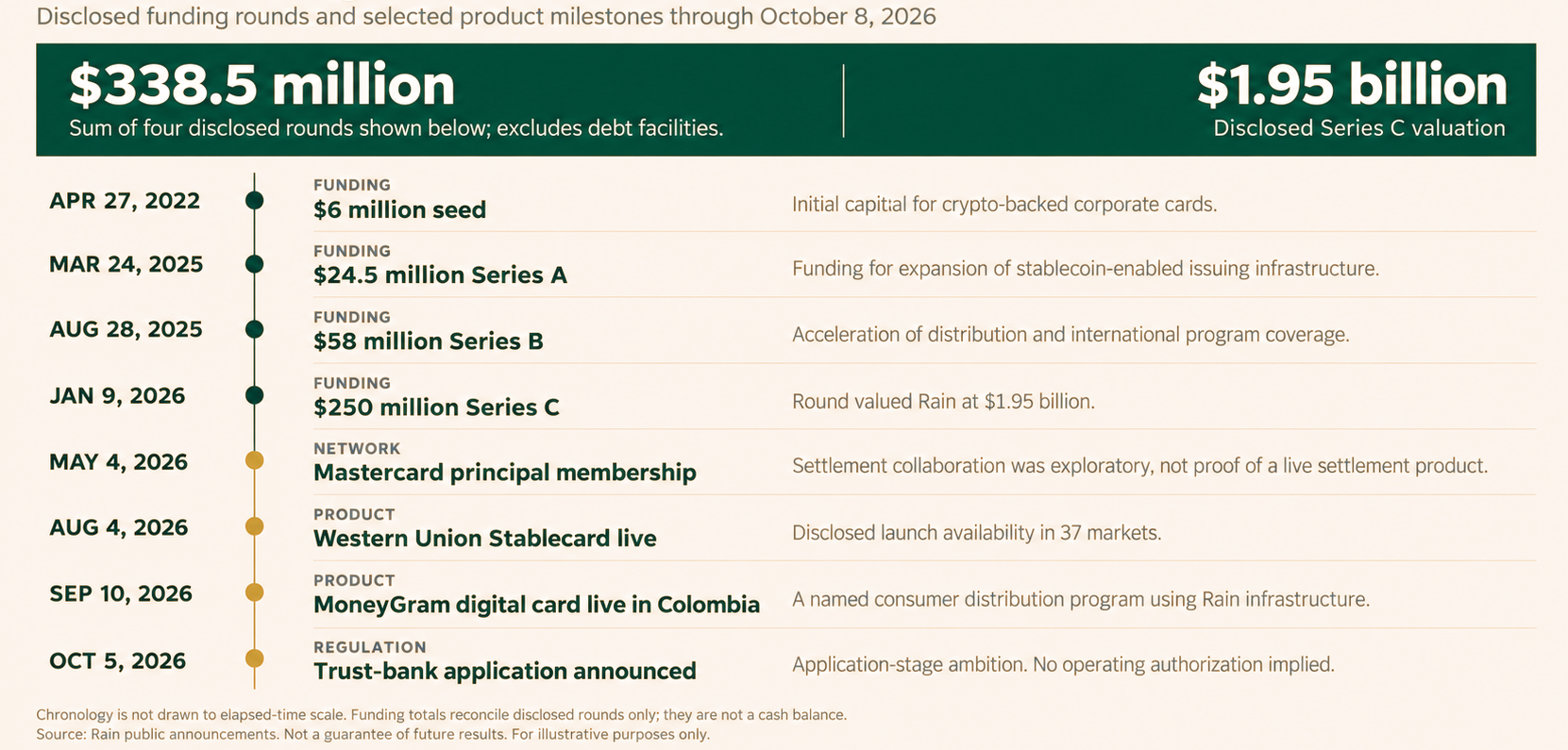
Rain's proposed national trust bank would bring more assets underlying its payment programs under its own regulated umbrella. On October 5, the company announced it had applied to establish Rain National Trust Bank in New York, with business covering institutional custody, reserve management, and stablecoin issuance and redemption. As of October 8, this remains only a company-announced application and has not yet received any operational authorization. [1]
This application sharpens the questions already present in Rain's card business. Owning more infrastructure can improve control and create additional fee income. But it also brings capital commitments, operational responsibilities, and costs, all of which must ultimately be recouped from customers. Growth in payment volume can occur simultaneously with a shrinking economic benefit from payments.
Rain has proven its infrastructure solves a real problem. Western Union and MoneyGram have both launched products based on it; crypto businesses use it to enable everyday spending from on-chain balances. A January funding round set its valuation at $1.95 billion. Yet public disclosures remain insufficient to connect payment growth to retained revenue, customer profitability, and durable pricing power. [2, 3, 4]
The most compelling evidence is more specific than those brand logos. Customer agreements reveal the division of revenue distribution, funding obligations, and control between Rain's issuing entity and the companies distributing its products. These arrangements suggest a defensible operating business is possible. They also illustrate why stablecoin settlement alone does not guarantee attractive infrastructure margins.
Partner Highlights

Umia is building an operational system for token-native projects, integrating funding, legal entity formation, treasury management, and market-based governance.
A Corporate Spending Problem, Turned into an Infrastructure Business
Farooq Malik and Charles Naut founded Rain in 2021. Previously, they worked on SignandWire, connecting signatures with investment payments. The demand to accept USDC exposed a related issue: organizations could hold significant digital assets but struggled to pay routine expenses. Rain's first product combined corporate cards with spend controls. [5]
Their backgrounds help explain their execution. Malik previously served as Treasurer and Investment Officer at the Development Bank of North America. Naut worked at Microsoft, founded PlaybookHR (sold to Intuit), and later worked on QuickBooks-related projects. This pairing combined treasury management experience with financial operations software. [6]
Serving other companies' card programs changed the business model. Rain only needs to secure one enterprise client relationship to reach that company's customer base, but must support integrations, compliance, dispute handling, and service continuity across multiple brands. Its current media kit marks the timeline for the API card issuance platform and Visa principal membership as 2024; the March 2025 funding announcement made this membership public, so it should not automatically be assumed as the start date. [7, 8]
Rain has also acquired capabilities around the payment flow. In November 2025, it acquired Uptop for loyalty; in December 2025, it acquired Fern for payment orchestration and conversion routing; in August 2026, it acquired merchant wallet company Ansa. Fern's relationship with Rain began with adding Rain cards to its tech stack. Ansa's acquired wallets hold prefunded fiat balances, indicating Rain's expansion is not limited to replacing all fund flows with blockchain transactions. [9, 10, 11]
These acquisitions can add services sold to existing accounts. But they also require integration and complicate comparisons of organic growth. Their strategic value will depend on whether customers buy more high-margin services, not just receive a larger product catalog.
Legal responsibility resides under the Rain brand. Group disclosures confirm related entities such as Signify Holdings, Rain Liquidity, Rain Payments Services, Rain Products, and Nimbus, which operate under the name Third National. Their roles vary in lending, payment processing, and card issuance. The group lists SSB as the banking services provider and states that Rain itself is not a bank. Therefore, customers must confirm the applicable issuer and contract, and cannot assume every Rain product uses the same legal structure or enjoys bank deposit protection. [12, 7]
A Single Card Transaction Creates Multiple Independent Obligations
Take a card program collateralized by stablecoins. The cardholder places eligible assets into a designated collateral arrangement, and the program establishes a spending limit based on it. The merchant's acquirer routes the authorization request through the network; Rain's system checks the balance and program control rules. Approval means locking spending capacity. It does not mean the merchant has received tokens, nor that the issuer's settlement obligation has vanished. [13, 14]
Settlement determines the amounts each party owes the others. In direct stablecoin settlement, the issuer pays its network obligation using the accepted stablecoin. The acquirer pays the merchant through conventional payment infrastructure. Other stablecoin-linked cards convert funds to fiat before network settlement. Thus, the cardholder's funding source, the issuer's settlement asset, and the merchant's receipts may all differ. [15]
Collateralized credit programs create a receivable from the cardholder, with collateral protecting repayment. Prepaid arrangements spend funds deposited in advance; debit arrangements deduct from a linked account. These labels cannot be interchanged simply because an app shows a dollar balance. Rain's own corporate card agreement describes credit, designates Third National as issuer, and establishes collateral and repayment rights. In contrast, Takenos describes its TakeCard as a prepaid card in its client terms. [16, 17]
Repayment extinguishes the cardholder's obligation; remaining collateral and program limits determine subsequent spending capacity. Unencumbered collateral can be released per the rules. Rain's corporate terms require advance notice for collateral withdrawals and allow liquidation if obligations are overdue or collateral is insufficient. Thus, holding a wallet private key does not mean unrestricted control over assets already committed for card spending. [16]
Collateral also does not guarantee the right liquidity is automatically available at the right time. In a September 8 case study, Visa described Rain using Credit Coop's revolving credit line since August 2023 to fund network settlement. Repayment flows through a smart contract that repays the financing obligation. Visa reported Rain had cumulatively settled ~$2 billion in financing, with interest of at least $1.58 million, attributing these numbers to Credit Coop. Another figure over $2.5 billion covered Credit Coop's broader financing activity. [18]
These disclosures show the repeated use of working capital, not a $2 billion credit line or equity investment. Cumulative financing, current outstanding principal, and line capacity are three different metrics. Dividing cumulative interest by cumulative financing payments does not yield an annualized borrowing rate, as neither average outstanding debt nor tenure is given. Published pages retain editorial caveats beside the statistics; these numbers should be cited, not treated as audited financial results. [18]
Faster settlement can reduce some idle balances and currency mismatches but cannot eliminate all reserves. Third National's platform terms, updated May 9, 2025, require prefunding or next-business-day funding, and maintaining a non-interest-bearing reserve not less than three times the maximum single-day settlement amount over the prior 30 days, unless a private agreement specifies otherwise. This is program funding in addition to cardholder collateral. It establishes a contractual baseline, not a balance requirement for every Rain customer. [19]
Rain's current card issuance page instead advertises one-day reserves. This discrepancy precisely illustrates why marketing comparisons cannot substitute for applicable business agreements. [20]
Rain's broader product proposition requires the same precision. Rain obtained a Mastercard principal membership in 2026, establishing another network relationship; a press release described on-chain settlement for some scenarios as exploratory. September's payment extensions covering 80+ countries and 50 currencies were for select beta partners. Issuing eligibility, merchant acceptance, and payment availability remain different operational coverages. [21, 22]
Retained Revenue Matters More Than Payment Volume
The clearest public monetization evidence starts with Rain's founders describing interchange and subscription revenue in a May 2024 interview. Separate historical bill payment terms stipulated a percentage payment fee and a service fee. This suggests more than one charging method exists, but neither source provides current enterprise price lists or comprehensive revenue composition. [23, 24]
Third National's platform agreement explicitly outlines a sharing mechanism. Customer revenue is tied to interchange-eligible transaction volume, net of processing and network fees, and adjusted for refunds, disputes, and chargebacks. Commercial share ratios are in private agreements and may adjust with network economics. Service fees, bank and network fees, and physical card pricing may also apply. Terms allocate a substantial share of program losses to the client. These terms explain potential value capture and risk transfer but do not reveal the share Rain actually retains. [19]
Merchants' total acceptance fees cannot all be attributed to Rain. Acquirers and networks have their own economics; issuer interchange supports program operation, with the issuer, infrastructure provider, and distribution client dividing the remainder via contract. Rewards are another use of the fee pool, possibly supplemented by subscription fees or promotional funds. Thus, a cashback offer reveals neither Rain's take rate nor the client's sustainable margin. [13, 25]
Six metrics must be viewed separately. Payment volume measures spend amount. Total program fees describe charges generated around that spend. Rain's recognized revenue depends on its contractual role and accounting policy, while economic retained revenue describes the amount remaining after commercial shareouts—this is an analytical metric for this article, not a reported Rain figure. Gross profit and contribution profit then require corresponding service and operational costs. Without audited revenue policies, treating every pass-through as revenue, or automatically deducting every share as a revenue reduction, imposes an unwarranted accounting conclusion.
Sensitivity is significant even at fixed transaction volume. Take a purely illustrative program: $100 million annual processing, assuming the infrastructure provider retains 40 basis points after contractual shareouts and network or partner fees, equaling $400,000. If variable funding, service, and expected losses consume 15 bps, contribution before fixed costs is $250,000. If the retention ratio is renegotiated to 25 bps, only $100,000 remains at the same volume and cost. These assumptions are not estimates of Rain's pricing or margins; they illustrate that transaction growth alone cannot demonstrate operating leverage.
Larger clients can lower acquisition and integration cost per dollar spent, but simultaneously demand lower pricing, customized risk controls, and stronger service commitments. Contractual indemnification clauses can transfer losses on paper, but actual collection depends on the client's solvency and enforceability. Security incidents, even if contractually assigned to another party, can incur remediation and retention costs. Therefore, contribution after funding, fraud, and support costs is more telling than an attractive headline infrastructure rate.
More accounts, wallets, exchange, and payout features can increase revenue per client. But the availability of these features does not prove independent monetization, positive margins, or client adoption. Implementation fees may merely recoup onboarding costs, not create recurring revenue. Rewards may boost activity while consuming subsidies. The proposed custody and issuance businesses introduce new potential fees, but processing USDC today does not equate to owning an equity stake in its issuer's reserve income.
Rain's most attractive economic path combines recurring spend, profitable service expansion, and declining per-program support costs. A weaker outcome bundles more features into a competitive rate while adding compliance, liquidity, and integration obligations. Public product roadmaps allow both; differentiating them requires client-level economic data.
Capital Buys Time to Validate the Model
Rain announced a $6 million seed round in April 2022, led by Lightspeed with participation from Coinbase Ventures, Uniswap Labs, and others. On March 24, 2025, a $24.5 million Series A closed, led by Norwest with Galaxy Ventures and existing investors participating. The pivot to enterprise-grade card issuance made distribution and compliance execution more central to the funding narrative. [26, 8]
Sapphire Ventures led the $58 million Series B announced August 28, 2025, with participation from Dragonfly, Galaxy, Endeavor Catalyst, Samsung Next, Lightspeed, and Norwest. On January 9, 2026, ICONIQ led a $250 million Series C, disclosing a $1.95 billion valuation, with participation from Sapphire, Dragonfly, Bessemer, Galaxy, FirstMark, and others. Four announced rounds total $338.5 million, consistent with Rain's description of raising over $338 million. [27, 4]
This timeline separates equity financing from revolving settlement financing and acquisitions. Proceeds are not current cash balances, and announcements do not disclose full cap tables, ownership changes, or acquisition consideration. Understanding the expected step-up does not require back-calculating early round valuations from promotional growth multiples.
ICONIQ's investment memo indicates clients value speed to market, regulatory credibility, and direct Visa relationships. This is useful evidence from investor due diligence, but investor-published theses are not independent validation of retention or profitability. The capital base can support enterprise integrations, geographic expansion, and building regulated subsidiaries, providing runway before these investments generate cash. [28]
Nonetheless, this valuation requires far more than transaction throughput. A $1.95 billion enterprise must ultimately support significant sustainable earnings, or a credible path thereto. Payment run-rate is an unsuitable denominator for a revenue multiple. Assuming a take rate and applying a software multiple hides two assumptions within a seemingly precise valuation.
The appropriate tests are: whether recurring retained revenue grows with manageable customer acquisition and service costs; whether profitable customers are retained; and whether added products increase return on invested capital. Funding merely extends the validation period. It does not prove that expansion yields returns exceeding the capital and operational expenditure required to achieve it.
Growth Disclosures Speak More to Activity Than Durability
Rain's January 9 data cited over $3 billion annualized transaction volume, over 200 partners, a 30x year-over-year growth in active cards, and 38x YoY growth in annualized payment volume. But the company did not provide an absolute base for active cards. Its simultaneously cited figure of 2.5 billion refers to reachable populations through various programs, not acquired users. [4]
In reviewed materials, no subsequent figures verify full-platform payment run-rate on the same basis. The 10x transaction growth cited for August 2025 "since January" lacks clarity on the period for comparison. Endeavor's July 2026 report cited 20x growth in revenue and transaction volume for full-year 2025 but provided no absolute revenue or reconciliation with Rain's 38x annualized figure. This may describe different metrics; existing sources offer no explanation. [27, 29]
Other metrics measure different levels. Rain's June rewards launch cited over 100 live programs. January cited over 200 partners, while an October announcement cited over 100 organizations. These floor numbers cannot prove churn. The CEO's August statement that payments reach over 100,000 merchants measures payees, not Rain's paying enterprise clients. [30, 1, 31]
Beyond company-wide percentages, some evidence exists. Rain stated Avalanche Card rewards test participants spent 25% more than non-participants. This contrast indicates an opportunity to boost engagement but does not provide randomized design, post-incentive adjusted profit, or post-rewards retention. Selection bias matters: already-active consumers are more likely to join a rewards test. [30]
Rain also stated the Exa card processed over $1 million in transactions within its first three months. The exact publish date of this public post could not be independently confirmed, so this is historical cohort data, not October 2026 run-rate. However, it remains a more informative operational cardholder metric relative to Exa's prior migration announcement or pre-migration beta user counts. [32, 33]
The unresolved key question is the quality of subsequent growth. Without recurring cohort spend, concentration, and revenue retention data, investors cannot tell if new volume comes from enduring existing clients, new program launches, or incentives. Judging whether these payments improve the business requires absolute retained revenue and contribution profit. A larger active card base is commendable; increased profitable spend per retained account would be more convincing.
Customer Distribution Does Not Equal Owning the Full Tech Stack
Western Union provides a test case of a mature distribution channel. Its Stablecard launched August 4 covers 37 markets, targeting over 60 by year-end. Rain provides wallet and collateralized card infrastructure; Anchorage issues Western Union's USDPT on Solana. Western Union's customer FAQ lists Nimbus (operating as Third National) as issuer and program manager, explicitly differentiating the card from prepaid cards or bank accounts. [2, 34]
Rain can make remittance balances spendable upon receipt without owning the remittance business franchise or token issuance economics. The commercial question is whether recipients retain and repeatedly spend balances rather than immediately cash out. Western Union's global distribution and launch announcement cannot provide Stablecard active user or spend data.
MoneyGram's September 10 launch is another combination: Rain's card infrastructure, Crossmint wallet, and Stellar rails, with digital cards live in Colombia and physical cards planned for late 2026. This is a live deployment but with confirmed narrow geographic coverage. It also illustrates that choosing Rain for card services does not require purchasing all of Rain's adjacent services. MoneyGram's overall customer scale cannot be attributed to this new card. [3]
Ether.fi shows how a client retains alternatives. In an April 2025 interview, CEO Mike Silagadze noted Rain and Reap served different card arrangements and stated ecosystem subsidies were part of the cashback funding source. A current Cash help page confirms the product is operational but does not specify the current spend allocation between the two vendors. A historical dual-vendor setup only indicates exclusivity should not be assumed, not that Rain subsequently lost share. [25, 35]
In these programs, the distributing brand attracts users and designs the product offering. The issuer controls regulated card access; other vendors may control custody, tokens, funding, or wallet services. Rain's privacy policy also distinguishes between processing data on behalf of partners and its own compliance and anti-fraud duties. Thus, customer ownership comprises multiple dimensions: brand loyalty, data rights, permission to authorize spends, and the right to recourse for repayment—not necessarily belonging to the same company. [12]
Third National's platform terms also require program interfaces and marketing to be approved by the issuer. Owning a distribution channel does not mean owning unfettered product control. [19]
The following table distinguishes documented partnerships from what they actually prove regarding adoption. Metrics correspond to the card program itself where possible; total company users, remittance flow, and merchant network coverage are excluded.
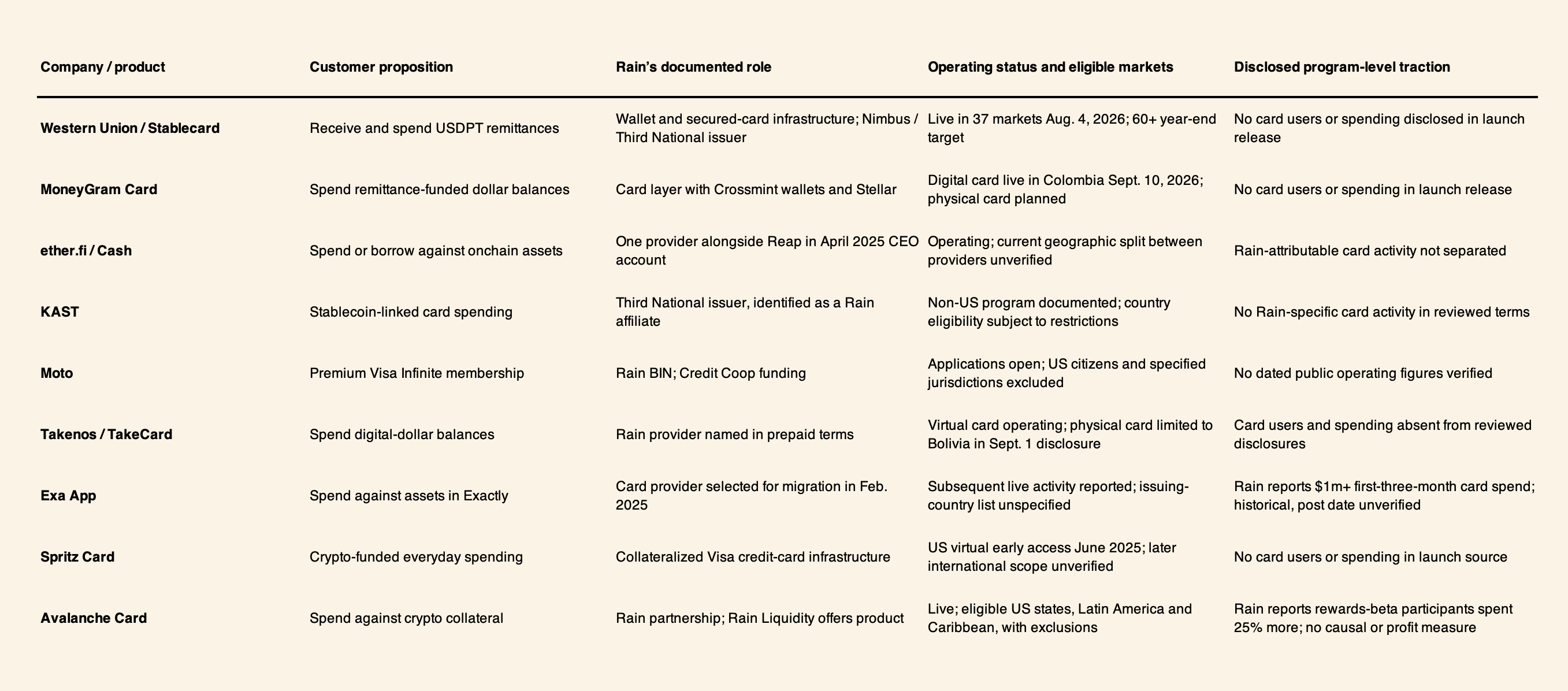
Status reflects dated announcements or accessible live documentation as of October 8, 2026. Absence of program data does not equal zero activity. Avalanche Card is provided by an affiliate of Rain; this differs from an enterprise client relationship. Exa's historical disclosure does not represent current run-rate.
Moto Separates Premium Experience from Payment Infrastructure
Moto presents as a Visa Infinite membership product combining travel benefits and concierge services with self-custody wallets. Its advertised Full membership costs $250/month or $2,500/year. The website accepts applications subject to approval. This is a consumer-facing wrapper around an infrastructure relationship and cannot prove Moto operates every service itself. [37]
International card terms dated September 29 name Rain and define Third National as the issuer. Terms describe collateralized credit, USDC collateral on Solana supporting spend 1:1, and automatic month-end repayment. The issuer funds merchant spend; another clause attributes platform credit decisions to Moto. These are distinct responsibilities, insufficient to prove either party funds every aspect. Visa independently identifies Moto as a program under a Rain BIN, with Credit Coop funding the monthly credit cycle. [39, 38]
Membership fees add another economic layer. Terms offer a Lite membership at $50/month or $500/year. Full members receive FX subsidies borne by Moto; Lite members may incur up to 2.2% FX fees. Registration excludes U.S. citizens and certain jurisdictions, though the card is usable internationally. Public subscription prices establish Moto's ask but disclose no Rain revenue share. [39]
This distinction matters for both businesses. Moto must convince users the benefits and service are worth the fee, then use that revenue to fund benefits and support. Rain needs stable, recurring spend generating sufficient retained fees to cover its obligations. A higher retail price may support infrastructure investment but may equally be consumed by rewards, travel benefits, and acquisition costs. Price alone cannot infer either outcome.
Official terms pages differ regarding trial periods, rewards, and yield statements; this report uses the newer dated version as the current pricing basis. Staked assets remain subject to withdrawal and liquidation conditions. No dated public operational or funding data for Moto was verified. This case establishes a division of functions, but scale and profitability remain unmeasurable. [44, 39]
Competitors Can Contest Both Card Business and Broader Accounts
Rain's realistic market consists of eligible clients who want to support spend or fund flows using stablecoin balances. Card issuance, cross-border top-ups, and wallet settlement may be sequential stages of the same payment. Adding their market sizes double-counts activity; embedded finance describes distribution, not an independent pool of funds.
Based on December 2025 data, McKinsey and Artemis, via transaction identification and modeling assumptions, estimate stablecoin payment activity at ~$390 billion annualized. Visa reported completing ~$5.2 billion in stablecoin-linked card volume in 2025. The latter also exceeds a $4.5 billion card transaction estimate from a prior report, with no reconciliation of coverage. Neither denominator yields Rain's market share from January's annualized run-rate figures. [45, 15]
Stripe's Bridge constitutes direct economic competition. Its current card product page advertises clients keeping 100% of interchange, alongside custom transaction fees and other monetization opportunities. Full infrastructure rate cards are not public, so this does not prove the overall product is cheaper. But it does force buyers to compare retained economics, not just card issuance features. Visa's March announcement stated Bridge cards were live in 18 countries, targeting over 100, and described Lead Bank's role in stablecoin settlement. [46, 47]
Reap's operational model overlaps more directly with Rain's. Payward completed its acquisition of Reap on July 1. Reap holds Visa principal memberships in Hong Kong and Mexico; its September expansion announcement described existing stablecoin settlement capabilities in APAC alongside a target of over 100 markets. Direct issuing and stablecoin settlement are thus meaningful capabilities but no longer unique ones. Announcement coverage must still be distinguished from programs operating live. [48, 49, 50]
Marqeta announced a partnership with zerohash on July 22 to bring stablecoin custody, compliance, and liquidity into its existing card infrastructure. The announcement describes planned integration, not proven joint adoption. The strategic threat is client convenience: existing issuing relationships may be extended, not replaced. Circle's April launch of CPN Managed Payments competes in adjacent orchestration and payouts, allowing clients to interact in fiat while Circle manages USDC operations in the background. Based on available evidence, it is not a full replacement for Rain's card functions. [51, 52]
These competitors can contest broader accounts and price individual services accordingly. This is a strategic possibility, not evidence of current loss-leading customer contracts. Rain's appeal as a specialist coordinating multiple assets, markets, and vendors may persist, provided that coordination yields measurable improvements in reliability, time-to-market, and cost.
Switching costs are plausible: changing issuers may require new agreements, cards, authorization logic, collateral arrangements, and dispute processes. Exa's announced migration to Rain still shows vendors are replaceable. Visa's acceptance network belongs to Visa; more Rain clients do not automatically create Rain-specific network effects. Its defensiveness must come from accumulated operational knowledge and integration depth that customers are willing to pay for continuously. [33]
Shared Infrastructure Exposes Brands to Common Failures
An attack on August 28 stressed this operational thesis. Blockaid's September 2 analysis traced ~$1.1 million stolen from outdated Rain Solana collateral contracts. Its technical reconstruction found a signature verification vulnerability allowing the attacker to grant themselves withdrawal rights. The affected assets were committed card balances, not private keys stolen from users' personal wallets. Analysts identified identical vulnerable code across multiple deployments, with at least two already drained. [53]
Contemporaneous CoinDesk coverage described affected Avici and Tria clients and refund promises. Rain stated vulnerable deployments were upgraded. Blockaid later reported Avici had completed refunds, including additional cashback. This establishes compensation for that program beyond a general refund promise but does not establish ecosystem-wide indemnification or Rain's ultimate outlay. Insurance payouts and final loss allocation were not verified. Rain's direct social statements are not retrievable; its response is paraphrased through available reporting. [54, 53]
This loss cannot serve as a defensible annual fraud rate: relevant exposed balances, observation period, and recovery amounts were not disclosed together. Its broader significance lies in common dependency. One infrastructure flaw can damage multiple client brands, making contract deployment, upgrades, and monitoring a core business cost. Stablecoin depegs, redemption halts, and network or local restrictions constitute additional channels where cheap token transfers can still lead to expensive operational failure.
The Proposed Bank Must Justify Its Additional Costs
Rain's announced trust bank would be independently capitalized, not covered by deposit insurance, and have restricted activities. The company stated the bank will not take deposits, offer consumer accounts, or make commercial loans; client assets will be segregated, and reserves for issued stablecoins will not be lent, staked, or rehypothecated. Existing card and payments businesses will continue through other subsidiaries. [1]
On the OCC's digital asset applications list reviewed October 8, no Rain-related application appeared. The agency's search tool notes a five-business-day posting delay, so absence shortly after announcement neither negates filing nor proves approval. Receipt date and control number were not independently verified. The OCC's licensing manual distinguishes preliminary approval from final authorization and allows for additional capital, liquidity, and operational conditions. Rain's specific requirements remain unknown. [55, 56, 57]
The legal environment is contested. ICBA's October 2 complaint challenges the OCC's trust chartering approach and alleges exceeding statutory authority. These are claims in litigation, not a ruling against Rain. The OCC described its February rule as clarifying existing authority. This dispute adds uncertainty to the path but does not determine this application's outcome. [58, 59]
Custody, reserve management, and issuance can reduce vendor reliance and expand institutional fee income. But they also introduce governance, reconciliation, compliance, and capital costs before sufficient assets or clients arrive. A U.S. trust charter does not confer global licensing or replace merchant acquiring and card networks. The economic test is incremental risk-adjusted returns relative to capital and operational burdens, not the halo of a bank name.
The Next 2-3 Years Should Be Judged on Retained Earnings Ability
A 24-36 month bull case: remittance integrations produce recurring spend, existing programs expand without disproportionate incentives, and Rain sells profitable add-on services within these relationships. Reliable operations and integrated workflows subsequently support client retention and lower unit costs. A trust bank, if approved, becomes an additional source for institutional business, not a prerequisite for the card business thesis.
A base case: activity continues growing, but strong clients negotiate away part of the economics. Compliance, integration, and acquired products consume most operating leverage. Rain remains useful and grows revenue, but its financial quality depends on whether service expansion outpaces the costs of serving larger, more demanding clients.
A bear case: bundled competitors depress pricing, clients spread programs across multiple vendors, another incident or restriction raises costs. Transaction volume may keep rising while retained fees and contribution per dollar deteriorate. Regulatory delays extend spending without adding proposed bank revenue. These are analytical scenarios, not profit forecasts; public evidence is insufficient for a numerical exit valuation.
Five measurable developments would change the judgment. First, quarterly actual payment volume, active cards, and cohort spend would reveal recurring usage. Second, bridging from total fees to retained revenue and contribution profit would expose growth costs. Third, revenue retention rates and top-five client concentration would show bargaining power and concentration. Fourth, launch spend for major programs, measured alongside incentives and completed incident remediation, would connect distribution to economically sustainable activity. Fifth, OCC milestones, committed capital, and subsequent trust business fees would allow capital-return assessment of regulatory expansion.
Rain has demonstrated a commercially relevant product and the ability to integrate it into established distribution channels. Its strongest potential advantage is the operational knowledge required to keep complex programs running across multiple institutions. Public contracts show ways to retain fees and transfer some risk, but clients and competitors can contest these economics. The bar to becoming a high-quality infrastructure business is retained, growing client contributions after funding, service, and losses. Until then, the $1.95 billion valuation remains a bet on execution, not a conclusion supported by disclosed profitability.
Sources (1-10)
Report cutoff and source access date: October 8, 2026. Undated documents treated as current observations, not historical proof. Company disclosures, investor narratives, and third-party estimates are sourced. Commercial interpretation and scenarios are insights4vc analysis. Jointly issued press releases count as one source.
[1] Rain files application with OCC to establish Rain National Trust Bank. Rain via PR Newswire, October 5, 2026.
[2] Western Union partners with Rain to launch Stablecard. Western Union, August 4, 2026.
[3] Introducing MoneyGram Card: Empowering Customers to Use Their Money More Freely, Anytime, Anywhere. MoneyGram via PR Newswire, September 10, 2026.
[4] Rain Raises $250 Million Series C to Expand Stablecoin Payments Infrastructure for Global Businesses. Rain via PR Newswire, January 9, 2026.
[5] Founder Story: Farooq Malik & Charles Naut of Rain. Circle Ventures, September 22, 2022.
[6] Rain: A Global Platform Bringing Stablecoins into Everyday Commerce. Norwest, March 24, 2025.
[7] Media Kit | Rain Company Information, Headshots, and Logos. Rain, undated; accessed October 8, 2026.
[8] Rain Announces $24.5 Million Funding Round Led by Norwest to Expand Stablecoin-Powered Card Issuance Globally. Rain via Venture Capital Access Online, March 24, 2025.
[9] Rain Acquires Uptop, Adding Rewards Features to Its Full-Stack Platform for Enterprise Card & Wallet Programs. Rain via PR Newswire, November 12, 2025.
[10] Fern has been acquired by Rain. Fern, December 2, 2025.
Risk Disclaimer
insights4vc provides independent research primarily based on public information deemed reliable at the time of publication. Data may change due to market prices, token supply, reclassifications, and methodology updates. Legal structures, investor rights, and regulatory treatment vary by product and jurisdiction.
This article does not constitute investment, legal, tax, accounting, or financial advice, nor an offer, solicitation, or recommendation of any security, token, fund interest, or other asset. insights4vc makes no representation regarding the completeness or accuracy of third-party data. Readers should conduct independent due diligence and consult appropriately qualified advisors before making any investment or business decision.