70% of U.S. Offshore Production Shut Down, Yet Oil Prices See Only Minor Gains: Will Iran Talks or the Hurricane Rewrite the Market First?

Published on 2026-10-12Last updated on 2026-10-12

Abstract

As Hurricane Isaias approaches the northern Gulf of Mexico, over 70% of U.S. offshore crude production has been shut in, with WTI settling at $91.85 on October 9. Statements describing Iran talks as 'productive' and China's resumption of refined fuel exports have tempered supply risk premiums, leaving the oil market caught between actual supply cuts and potential relief.

Trading Snapshot

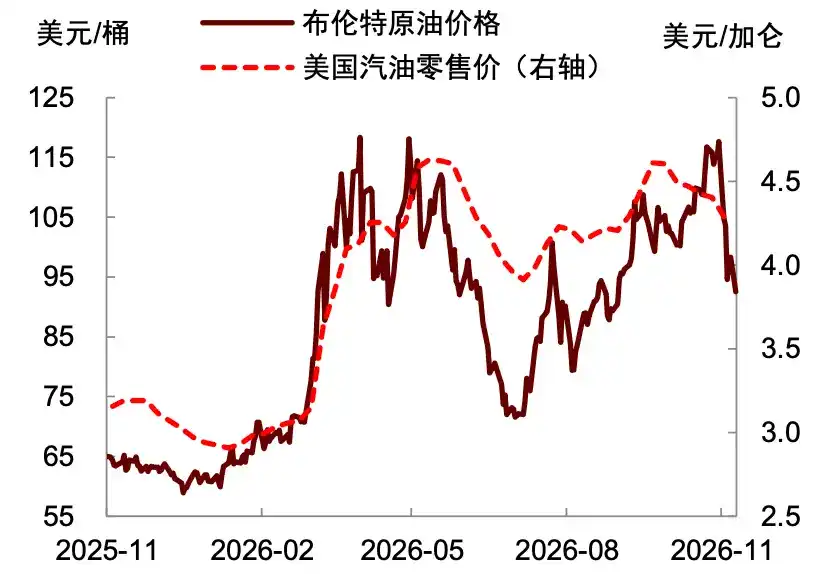
Price: WTI settled at $91.85, up $0.36 or 0.39%; Brent settled at $104.72, up 0.42%.

Supply: Approximately 1.3 million barrels per day, or 62.9%, of U.S. Gulf of Mexico offshore crude production was shut in on Thursday; the shutdown rate increased to over 70% on Friday.

Catalyst: Hurricane Isaias approaching the northern Gulf of Mexico.

Risks: Progress in U.S.-Iran negotiations, China's resumption of refined product exports, and changes in shipping traffic through the Strait of Hormuz.

Hurricane Drives Massive Offshore Field Shutdowns

October 9 — Oil prices closed higher. As Hurricane Isaias moved toward the northern Gulf of Mexico, oil companies shut down over 70% of U.S. offshore crude production. Brent crude futures settled at $104.72 per barrel, up 44 cents, or 0.42%; U.S. West Texas Intermediate (WTI) crude futures settled at $91.85 per barrel, up 36 cents, or 0.39%.

The U.S. Bureau of Ocean Energy Management stated that as of Thursday, producers in the Gulf of Mexico had shut in approximately 1.3 million barrels per day of crude oil output, equivalent to 62.9% of current offshore production. As the hurricane continued to approach, the market worried that the shutdowns would expand and affect refining facilities.

Iran Talks News Weighed on Early Session Prices

Earlier in the day, U.S. President Trump stated that talks with Iran to end the Middle East war were "productive," causing oil prices to dip temporarily. He also previewed an undisclosed decision related to diesel and said he was considering a pause on the federal gasoline tax.

Trump said on Thursday that Washington is engaged in "productive discussions" with Iran and has no plans to launch attacks before the U.S. midterm elections on November 3. Iran's Tasnim news agency later reported that Iranian Foreign Minister Araghchi stated Tehran is assessing the U.S. response to its proposal, which involves reopening the Strait of Hormuz within seven days.

Sanctions, Exports, and Shipping Risks Simultaneously at Play

The U.S. continues to exert economic pressure on Iran, imposing sanctions on individuals, networks, and 17 vessels involved in transporting Iranian crude oil, petroleum products, and petrochemicals. The Iran war and the Russia-Ukraine conflict have already disrupted the supply of refined products, especially gasoline, jet fuel, and diesel.

China's plan to resume refined product exports after a brief halt during the Golden Week holiday also pressured the market. Tamas Varga, an analyst at PVM Oil Associates, said Trump's remarks on Iran and China's resumption of product exports were factors pushing oil prices lower.

Strait of Hormuz Keeps Volatility from Fading

Oil prices were volatile this week. Increased shipping threats in the Gulf region and the Strait of Hormuz — through which about 20% of the world's oil and fuel passed before the war — contributed to the swings. Actual production cuts caused by the hurricane supported prices, but progress in talks and the resumption of exports limited gains. Both Brent and WTI were still on track to record weekly gains.
Related Reads

The Crypto World Doesn't Lack Tokens, It Lacks Trust: A New Vision for Ethereum's 'Human Commitment Markets'

The crypto world doesn't lack tokens—it lacks trust. Independent researcher hitesh.eth argues that if open finance keeps leaving ordinary people feeling unsafe, they will trade freedom for predictability, accepting surveillance, gatekeeping, and custodial control—hollowing out the movement's original ideals even as the technology survives and gets absorbed by institutions. Drawing on Timothy C. May's crypto-anarchist vision (where reputation is central), Eric Hughes on privacy as selective self-disclosure, David Chaum's blind credentials, Wei Dai's b-money, and Elinor Ostrom's polycentric governance, the article proposes "Human Commitment Markets" on Ethereum. Instead of starting with tokens, these communities start with real services: escrowed payment, staked collateral, predefined evidence of completion, and agreed dispute-resolution paths. Three pillars—commitment, collaboration, and reputation—must be threaded with privacy throughout. Reputation should be domain-specific and non-transferable (using standards like ERC-5484 and ERC-1155/6909 for service credits), with zero-knowledge proofs verifying claims without exposing personal data, and scoped nullifiers preventing reuse. Stealth addresses (ERC-5564) reduce linkage but don't hide amounts, so full privacy needs extra infrastructure—echoing Vitalik's "Three Transitions." Disputes go to independent evaluators who verify real-world evidence, while contracts enforce escrow payouts. Systems need fallback paths, caps on early exposure, gradual trust-building for newcomers, and immutable, forward-only rule changes with exit rights. Pilots should be small: one community, one settlement asset, no speculative governance token, tested on Sepolia, audited, measured by real outcomes—completed jobs, repeat customers, dispute times, losses—not token prices. AI agents (per draft ERC-8004) could participate with capped accounts and staked collateral. Crypto can't solve coercion or physical-world fraud, but it can reduce reliance on blind trust and build economies worth staying in, not just tokens worth flipping.

marsbit43m ago

The Crypto World Doesn't Lack Tokens, It Lacks Trust: A New Vision for Ethereum's 'Human Commitment Markets'

marsbit43m ago

21 Banks Pledge $270 Million to Build New Stablecoin Faro: What to Watch

Goldman Sachs, Citi, Santander, and Deutsche Bank are among institutions that have reportedly committed a combined $270 million to cover five years of operating expenses for a joint-venture stablecoin company, internally codenamed Project Faro. The US-registered venture was announced in September 2026 by 21 institutions, with plans to establish the company in H2 2026 and issue a dollar stablecoin in H1 2027, followed by a euro stablecoin. However, the company's name and CEO remain undisclosed, and none of the four prerequisites—entity registration, licensing path, reserve custody, and blockchain design—have been completed ahead of the GENIUS Act's January 18, 2027 effective date. The budget is modest relative to incumbents: Circle's quarterly revenue is about 16 times Faro's annual budget, and the $270 million represents less than 1.1% of the roughly $290 billion stablecoin market, where USDT and USDC together hold over 80% share. Faro also trails competitors—Open Standard's Open USD, issued by Stripe's Bridge, is already live with over 140 participants, while Europe's Qivalis has obtained a Dutch e-money license. Banks are hedging across multiple tracks, with BBVA in both Faro and Qivalis. Key open questions include whether banks will mandate distribution of their stablecoin and how reserve yields—currently around 3.5% for Circle—will be split among issuers, distributors, and banks. Before January 2027, the company name, leadership, licensing path, and first chain will determine whether Faro becomes an operating issuer or remains an expensive letter of intent.

marsbit43m ago

21 Banks Pledge $270 Million to Build New Stablecoin Faro: What to Watch

marsbit43m ago

Inflation Stickiness Has Not Yet Subsided: CICC Maintains Its Call for a 25 Basis Point Rate Hike in December

US October CPI rose 0.4% m/m (vs 0.6% prior) and core CPI rose 0.3% m/m, both above expectations; no y/y data due to last October's government shutdown. Inflation remains sticky, with core CPI up 0.3% for a third straight month, supporting further Fed tightening. Fed Governor Waller floated a possible 50bp December hike, but CICC argues policy is not clearly "behind the curve" and financial conditions have tightened modestly, so accelerated tightening is unnecessary. CICC maintains its baseline call of a 25bp hike in December, keeping this cycle gradual and mild. Energy inflation eased (0.7% m/m vs 5.2% prior), though electricity rose 0.9% amid数据中心 power demand. Food CPI rose 0.5%, a five-month high, with broad-based gains across fruits/vegetables, dairy and meat, partly reflecting pass-through from earlier energy costs. Core goods rose 0.2%, with used cars down 1.2% and AI-related hardware inflation easing slightly. Housing CPI rose 0.3%, with OER and rent both up 0.3% and 0.2% respectively, showing no acceleration. Supercore services remained sticky at about 0.4%, with transport services up 0.8%; service inflation sources remain broad. CICC notes the 0.3% core reading meets Waller's condition for considering a 50bp hike, but argues larger hikes are meant to catch up on insufficient tightening, whereas recent tightening is already taking effect and inflation shows stickiness rather than acceleration. Waller himself supported a pause in October. Even hawk Dallas Fed's Logan favors two more 25bp hikes. CICC's baseline remains a 25bp December hike within a gradual, moderate tightening cycle.

marsbit1h ago

Inflation Stickiness Has Not Yet Subsided: CICC Maintains Its Call for a 25 Basis Point Rate Hike in December

marsbit1h ago

When AI Fills the Gaps in the Crypto Industry, These Fifteen Startup Opportunities Are Worth Watching

Most crypto projects failed not from bad ideas but from three missing infrastructure pieces: costly judgment, no stable unit of account, and slow settlement. After 2023, all three changed. LLMs can now adjudicate contracts and evidence in seconds for cents, and multi-model juries are harder to bribe than human panels. AI agents have become users, generating millions of tiny transactions humans cannot arbitrate. Stablecoins (about $310B by mid-2026) let contracts pay in dollars, and fast cheap chains like Solana make per-call settlement and on-chain rulings viable. The pattern: find old ideas whose bottleneck was "needs a trusted human judge"—exactly what AI removes. Fifteen opportunities ranked by revenue potential and readiness: 1. Online commercial courts (Kleros-style arbitration): AI juries settle $4 disputes; chargeback losses hit $33.8B in 2025. 2. Oracles for questions without APIs (Augur, futarchy): model juries rule on subjective outcomes with reasoning for appeals; prediction markets traded $120.7B in Oct 2026. 3. Insurance without adjusters (Etherisc, Nexus Mutual): neutral juries rule on claims from policy wording and evidence; parametric insurance is a ~$19.4B market. 4. Escrowed job markets (Colony, Gitcoin): juries verify deliverables; Upwork did $788M revenue in 2025. 5. Data and media licensing (Ocean, Ujo): AI labs are buyers; juries check license compliance. Opportunity lies in the long tail of small creators. 6. Machine payments (Lightning, x402): agents don't mind paying 26 cents a hundred times; x402 settled ~199M transactions worth ~$52.7M by Sept 2026. 7. Reputation and agent bonds replacing collateral (Bloom): AI agents' ruling history plus slashable bonds make commitments enforceable. 8. Proof of personhood (World, BrightID): demand changed—agents everywhere make "a real human behind this" valuable; World reported 18M verified humans. 9. Organizations with enforceable rules (DAO constitutions): juries check proposals against written charters before treasury signs. 10. Curated lists: written listing criteria audited by juries with published reasons. 11. Content provenance (Po.et): juries weigh evidence chains, not just hashes; urgent with generative media. 12. Supply chain tracking: modest AI gains—check documents at scale, not inside boxes. 13. Tokenized assets with legally binding terms (Polymath, tZERO): legal agreements become jury-adjudicated contracts; arbitration awards enforceable under the New York Convention. Only ~$23.6B tokenized so far, mostly treasuries. 14. Shared infrastructure and compute markets (Golem, Akash, Helium): AI agents as buyers plus jury-adjudicated service claims with slashed bonds solve the trust problem; sector earned only ~$72M on-chain in 2025. 15. IP backed by real contracts (Story Protocol): agents draft licenses, file registrations, and juries rule on compliance; licensed merchandise retail hit $389.8B in 2025. Selection test: someone already pays for the slow human version; the question can be answered from evidence a jury can see; it works without a token. Risks: model juries sharing blind spots, forged evidence, regulation (licenses remain), and thin proven demand—measure before scaling.

marsbit1h ago

When AI Fills the Gaps in the Crypto Industry, These Fifteen Startup Opportunities Are Worth Watching

marsbit1h ago

When Crypto Privacy Moves to the Network Layer, How Does Zodl Use OHTTP to Hide "Who You Are" Behind Transactions?

Privacy-focused Zcash wallet Zodl (formerly Zashi) has made network-layer privacy protection the default in version 3.20.0 by integrating Oblivious HTTP (OHTTP). While zero-knowledge proofs hide what happens on-chain, lightweight mobile wallets still leak IP addresses, request contents, and timing to the servers they query—metadata that can be used to deanonymize users. OHTTP splits each request into two segments handled by separate parties: the wallet encrypts requests with a key only the ZODL gateway can decrypt, a relay operated by Cloudflare or Fastly strips identifying headers before forwarding, and the ZODL gateway decrypts the request and passes it to lightwalletd. Thus the relay knows who is asking but not what, while ZODL knows what is asked but only sees the relay's address. The open-source implementation also pads traffic to fixed size buckets and uses HMAC-based, non-linkable logging with ephemeral in-memory keys. The main caveat is trust: OHTTP assumes relay and gateway do not collude, and US-based relays can be subpoenaed, so it complements rather than replaces Tor or Nym. The broader industry is also addressing metadata leaks—Nym's mixnet integration in Zcash wallets, the Ethereum Foundation's Kohaku wallet and anon-rpc standard, Flashbots' Flashnet, and Bitcoin Core's private broadcast via Tor/I2P with per-transaction connections. The key takeaway is that privacy is becoming a built-in default rather than an opt-in setting, though dependence on a few cloud providers remains a concentration risk worth watching.

marsbit1h ago

When Crypto Privacy Moves to the Network Layer, How Does Zodl Use OHTTP to Hide "Who You Are" Behind Transactions?

marsbit1h ago

Trading

Spot
活动图片