USDD金库看板和JST回购销毁机制正式上线 打造DeFi透明最高标准

marsbitPublished on 2025-10-22Last updated on 2025-10-22

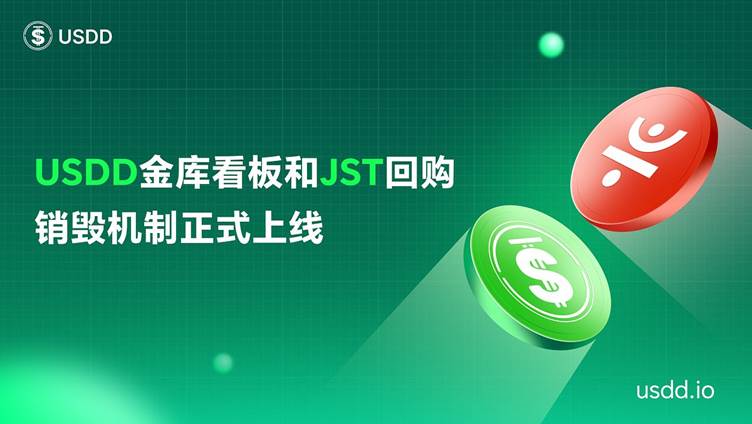
10月22日,去中心化稳定币USDD官方宣布正式推出USDD金库看板,作为一个全新的透明度公示工具,该功能将为USDD生态系统的财务表现和进展提供全面公开展示。同时,JST回购与销毁机制也正式启动。这是波场TRON生态中的DeFi应用JustLend DAO和USDD长期赋能JST和持续提升DeFi可用性、透明性采取的战略举措组合。

官方公告表示,USDD金库看板( https://usdd.io/treasury)旨在为社区提供一个清晰、数据驱动的视角,以了解其金库运营情况。该看板将每季度更新,跟踪USDD的关键财务指标,包括收入、支出、净成果和金库余额。用户可以定期监控协议的增长和财务健康状况。

USDD

官方强调,透明度和问责制是USDD使命的核心,金库看板的正式推出,标志着USDD在DeFi领域迈向更高开放和信任标准的又一重要步骤。

另外,随着JustLend DAO生态系统的持续发展,其治理代币JST在JustLend DAO和USDD中扮演着越来越重要的角色。为充分发挥其在治理和生态系统稳定性中的核心作用,社区引入了JST回购与销毁机制。这一战略举措旨在优化代币经济模型,增强长期价值,并提升整个JST生态系统的治理效率。

据悉,回购计划的资金主要来源于JustLend DAO的净收入,和USDD生态系统超过1000万美元阈值的收入。值得关注的是,所有回购操作都将在链上透明执行,用户可在USDD金库看板上查看JST回购与销毁计划的关键指标。

通过战略性地利用JustLend DAO和USDD的收入,回购销毁计划为JST建立了可持续的通缩模型,为整个生态系统的更健康、更稳健的增长奠定了基础。该机制也通过优化JST的代币供应结构,不断增强社区信心并创造长期价值。

自推出以来,USDD已经成为了加密行业DeFi领域一支重要的创新力量,通过PSM(价格稳定模块)和Smart Allocator(智能分配器)的机制设计,确保透明性、安全性和稳定性,同时提升用户可用性和流动性。目前,USDD的流通量近5亿美元,并已部署至波场TRON、以太坊、BNB Chain等主流公链。近期上线的sUSDD还为用户提供了12%的自动储蓄收益。

USDD金库看板与JST回购与销毁机制的正式上线,共同体现了两大DeFi项目对透明度、可持续性和去中心化治理的持续承诺。这些举措旨在为社区提供必要的信息公开机制,以透明、安全和协作的方式为波场TRON生态塑造了一个DeFi透明、安全的未来。

Trending Cryptos

Related Reads

WasabiCard Launches "Global Card Issuance Solution" to Help Businesses Launch Local Card Programs in 100+ Markets

WasabiCard has launched its "WasabiCard Local Issuing Solution," enabling businesses to quickly establish and manage local card issuing programs in over 100 markets through a single API, while meeting regulatory compliance requirements, offering competitive rates, and supporting stablecoin settlement in USDT, USDC, and Open USD (OUSD). CEO Ray Yang noted that companies expanding globally previously had to issue cards from one market and hope the model worked elsewhere, which increased friction around compliance, payment acceptance, and fees. The new solution lets businesses use one API to build local card programs across 100+ markets while flexibly choosing stablecoin settlement, branded experiences, and familiar payment methods. Built on WasabiCard's underlying infrastructure and partnerships with local financial institutions, the solution lets businesses use regional BINs and build card programs around local issuing systems. Local issuing helps reduce cross-border and FX costs and improves the payment experience. After a single API integration, businesses can issue and manage cards across markets, control card lifecycles, and set program rules. Following KYB, compliance, and partner review, accounts can be opened in as little as 24 hours. Businesses can choose corporate or individual BINs, support virtual and physical cards via Apple Pay and Google Pay, and opt for white-label services. The solution combines stablecoin settlement with familiar card payment experiences, offering Visa and Mastercard commercial and individual card options. Compliance checks begin before deposited funds can be spent: on-chain data is cross-verified to understand funding sources and identify links to fraud or stolen assets. Directly high-risk funds are rejected, while indirect links trigger further review. Use cases span global payroll and payouts to Web3 teams, contractors, and partners; creator and commission payouts for content and livestream platforms; digital advertising and AI service subscriptions; and corporate procurement and employee expense management. WasabiCard serves over 700 enterprise clients, with more than 700,000 cards issued and over $1 billion in transaction volume, covering 200+ countries and regions and supporting 70+ card BINs. WasabiCard is a global payment infrastructure platform providing card issuing, global payouts, and cross-border payment capabilities through stablecoin-driven financial infrastructure, serving advertising, AI and SaaS subscriptions, global payroll, treasury management, and digital finance use cases.

marsbit31m ago
WasabiCard Launches "Global Card Issuance Solution" to Help Businesses Launch Local Card Programs in 100+ Markets

marsbit31m ago

Jensen Huang Caught in Another Affair with Subordinate, Probability of Departing NVIDIA by Month's End Nears 90%

NVIDIA CEO Jensen Huang is facing escalating scandal after reports of a second extramarital affair. Following earlier allegations involving Alice Huang, an executive at Singapore data center company Megaspeed, The New York Times reported that Huang also had an affair with Kimberly Powell, a married NVIDIA vice president of healthcare and one of roughly 60 executives reporting directly to him. Powell, 48, joined NVIDIA in 2008 and has led its healthcare business since 2017. NVIDIA's code of conduct prohibits private relationships that could create conflicts of interest. NVIDIA's earlier statement that the matter would not affect Huang's role as CEO has reportedly been withdrawn. The Wall Street Journal reported that the board is considering meeting to discuss Huang's future, potentially appointing an interim leader while searching for a new CEO with outside firms. Polymarket odds of Huang leaving before November 30, 2026 have risen to 88%, and to 93% before March 31, 2027. Elon Musk, responding to a suggestion that he hire Huang, said it "would be an honor." The news triggered sharp stock moves: NVIDIA closed up 2.87% but fell as much as 10% after hours, shedding over $300 billion in market value and dragging down other AI stocks including Intel and Dell. A key concern is succession: NVIDIA has no clear plan, and Huang's unusual management structure—with dozens of direct reports and few layers—makes him the central node of the company. While executives like CFO Colette Kress could handle operations, none can quickly replace Huang's industry influence and role as NVIDIA's public face. Neither Huang nor NVIDIA has confirmed or denied the second affair.

Odaily星球日报56m ago

Jensen Huang Caught in Another Affair with Subordinate, Probability of Departing NVIDIA by Month's End Nears 90%

Odaily星球日报56m ago

Ethereum Plans to Move Post-Quantum and Anti-AI Upgrades Forward to 2027: Ethlabs Proposes Restructuring the Hegotá Hard Fork Plan

Ethlabs, a non-profit Ethereum R&D lab, has submitted the pqai27 community proposal to the Ethereum community forum, calling for 2027 to be the target year for achieving quantum resistance and AI resistance on Ethereum. With Ethereum's on-chain TVL exceeding $41.16 billion as of November 12, the proposal argues that Ethereum should leverage its existing hash-based cryptography and formal verification foundations to reinforce its position as the global value settlement layer as AI evolves rapidly and quantum timelines accelerate. The direct motivation is the compression of external timelines: the U.S. government has moved its quantum-resistance target from 2035 to 2030, and Google plans to complete its full cryptographic migration by 2029. AI attack capabilities are also advancing—OpenAI has used frontier models to find and patch roughly 1,000 Linux vulnerabilities and solve hundreds of math problems. "AI resistance" means relying on minimal hash primitives, formal verification, and client diversity to harden the base layer. The roadmap splits 2027 into two stages. The baseline "pqai-ready" stage requires quantum resistance at the consensus layer and ensures users can migrate to quantum-resistant accounts via the Frames account abstraction proposal EIP-8141; if existing cryptography fails early, the network can degrade to calldata to keep running. The advanced "pqai-scaled" stage targets full-capacity operation, introducing EIP-8288 for quantum-resistant signature aggregation and EIP-8479 for quantum-resistant data availability, so quantum-resistant transactions and blobs can regain normal throughput after scaling. To this end, Ethlabs recommends restructuring the scope of the Hegotá hard fork, stripping out non-critical upgrades and reassessing the impact of the FOCIL anti-censorship proposal (EIP-7805) on progress and compatibility; if the execution layer is decoupled from the consensus layer, Frames could ship independently first. The consensus layer must choose between retrofitting the existing Gasper implementation for quantum resistance and moving to decoupled consensus. Ethlabs announced it is withdrawing its push for Quick Slots (EIP-8198) in Hegotá, deferring it to 2028, while Glamsterdam and its scaling plans proceed as normal. The roadmap remains an Ethlabs community initiative; any Hegotá fork restructuring or consensus-layer switch requires further discussion and agreement among Ethereum's All Core Devs. Ethlabs notes that AI is also accelerating formal verification and zero-knowledge proof benchmark optimization, and that advancing pqai27 aims to consolidate Ethereum and ETH's role as the trust root for global value settlement during extreme security cycles.

marsbit1h ago

Ethereum Plans to Move Post-Quantum and Anti-AI Upgrades Forward to 2027: Ethlabs Proposes Restructuring the Hegotá Hard Fork Plan

marsbit1h ago

Former OpenAI Researcher Changes His Tune: Super AI Researcher Could Arrive as Early as Next Year

Former OpenAI researcher Daniel Kokotajlo and the AI Futures Project have revised their timelines, now predicting superhuman AI researchers (SARs) could arrive as early as 2027 rather than 2029. The key driver is a METR assessment of Anthropic, which found that since October 2025, the benchmark score growth rate of Anthropic's internal models reached about 1.9x the previous pace (95% CI: 1.5–2.8x) — roughly two years' worth of progress in one year. METR estimates that by October 2026, about 80% of the extra acceleration may come from AI itself, though this is a subjective guess with high uncertainty. AI is already helping researchers write experiment code, run tests, and try out more ideas. Using METR's estimates, the team calculated that by early November 2026, AI-driven acceleration alone could push overall model progress to 1.7x the historical rate — a speed that, in the original AI 2027 scenario, wouldn't be reached until around April 2027, about five months later. Notably, METR says most of the evidence underpinning its core conclusions was redacted from the public report at Anthropic's request, to avoid helping competitors; only the benchmark curves are publicly verifiable. Depending on the method used, SAR arrival estimates range from February 2027 to mid-2028. If acceleration compounds across model generations, superintelligence could arrive sooner than expected.

marsbit1h ago

Former OpenAI Researcher Changes His Tune: Super AI Researcher Could Arrive as Early as Next Year

marsbit1h ago

Aave V3.8 Officially Launches: Covering 15 Public Chains, $15.2 Billion Liquidity Pool, Introducing Low-Gas-Cost Reentrancy Protection

Aave has launched V3.8 across 15 active V3 markets, following approval by the Aave DAO and development by Aave Labs. According to DeFiLlama, Aave's total value locked exceeds $16.4 billion, with active V3 markets holding over $15.23 billion. The upgrade was deployed via AIP #541, completing a 22-day governance process that began with a forum proposal on October 21 and a Snapshot vote on October 27. V3.8 covers active instances on Ethereum (Core and Lido), Plasma, Avalanche, BNB Chain, Monad, Base, and Arbitrum, along with Mantle, X Layer, Polygon, Linea, Optimism, Gnosis, MegaETH, and Celo. Legacy markets that were frozen with zero caps were deliberately skipped. The release introduces kernel-level reentrancy protection for external callback operations on liquidity pools. Traditionally, preventing cross-function reentrancy requires writing a lock flag before state changes, but after EIP-3529 capped SSTORE refunds at 20%, maintaining persistent locks in high-frequency lending pools became gas-intensive. V3.8 instead uses EIP-1153 transient storage, where TSTORE and TLOAD cost only 100 gas per read or write and automatically clear at transaction end, providing reentrancy hardening at minimal cost. Aave Labs addressed developer concerns that the lock might block liquidation composability within flash loan callbacks. The flashLoan and flashLoanSimple entry points only check the lock status without setting it, creating asymmetric isolation: users can still compose liquidations, deposits, or repayments inside a flash loan callback, but attempts to initiate a flash loan from within a regular pool operation callback are rejected and reverted. Security verification included Certora formal verification and independent external audits before the AIP vote. The new contract code is published in the official Aave V3 repository under the Business Source License. Developers also noted that downstream integrators reading view functions such as account health factors or reserve data during callbacks should account for intermediate ledger states and ensure peripheral risk controls remain compatible.

marsbit1h ago

Aave V3.8 Officially Launches: Covering 15 Public Chains, $15.2 Billion Liquidity Pool, Introducing Low-Gas-Cost Reentrancy Protection

marsbit1h ago

Trading

Spot

Hot Articles

HTX Learn: Learn USDD to Share 1000 USDT​

To enhance your understanding of USDD, we are rolling out various rewarding events. Join them now and bring home generous rewards through learning and trading.

30.5k Total ViewsPublished 2026.05.25Updated 2026.05.25

HTX Learn: Learn USDD to Share 1000 USDT​

Discussions

Welcome to the HTX Community. Here, you can stay informed about the latest platform developments and gain access to professional market insights. Users' opinions on the price of USDD (USDD) are presented below.

活动图片