An online confrontation broke out between the Bitcoin and XRP communities over the weekend, fueled by former President Donald Trump’s last weeks’ announcement of a “Digital Asset Stockpile” under his administration’s newly unveiled crypto executive order. Although many observers expected a declaration of a “Bitcoin Strategic Reserve,” the broader term set off debates about whether assets beyond Bitcoin—particularly XRP—would be included in the United States’ national digital asset holdings.
Jason P. Lowery, a US Space Force officer and astronautical engineer known for his well-regarded MIT thesis linking Bitcoin’s Proof-of-Work consensus mechanism to a form of national security infrastructure, has positioned himself to the question if it is likely the the Trump administration will add other crypto assets to its “digital asset stockpile” besides Bitcoin.
Why Bitcoin And Not XRP
In a post on X on Sunday, Lowery expressed skepticism about whether governments like those in the BRICS bloc (Brazil, Russia, India, China, and South Africa) would ever adopt a cryptocurrency that is perceived to be under US jurisdiction. While he did not specifically name XRP, Lowery’s references to “meme coin” or “one controlled by an American CEO” can be interpreted as a veiled nod to XRP or any cryptocurrency managed by a US-based entity.
In his own words: “Do you really think BRICS is interested in adding a meme coin to their reserves, or one controlled by an American CEO? Do you believe they’d choose a USD stablecoin issued by an American company trying to position itself as a neo-Federal Reserve Bank?”
He added, “Or are they far more likely to adopt the coin that has been relentlessly vilified and condemned by the US for over 15 years precisely because it operates beyond US control? The coin that guarantees sovereign access to block space, ensuring transactions cannot be censored or denied, provided they continue to possess the physical power and infrastructure they’ve already invested in.”
Lowery’s remarks underscore his overarching thesis that Bitcoin has strategic properties appealing to nations outside the US sphere of influence, particularly because of its decentralized, censorship-resistant architecture. In his view, this places Bitcoin in a unique position on the global geopolitical chessboard.
Lowery’s critical question revolves less around technological merit and more around geopolitical choice. He contends that, when it comes to forming the next “global reserve asset,” the ultimate deciding factor will be what other nations want to hold—particularly potential competitors and adversaries such as China or Russia. He explained:
“The next global reserve asset, by definition, will be the one chosen by other nations—particularly our global competitors. And BRICS will almost certainly favor the asset that offers the greatest independence from US influence—the one that is demonstrably censorship-resistant, provably decentralized, and sovereign. The one that wasn’t premined. The one that isn’t being shilled by cringey, wannabe American influencers.”
His caution to the US crypto community is explicit: favoring an asset domestically is not enough if adversaries find no strategic reason to adopt it. Lowery emphasized the importance of assessing whether foreign governments would realistically add significant amounts of a given digital asset to their state reserves. Otherwise, he suggests, advocating for any other coin—especially one tied closely to US authorities or corporate entities—may be a futile exercise that could inadvertently “undermine the future security and prosperity of this nation.”
While the Trump administration has yet to clarify whether any crypto beyond Bitcoin will be included in the US “Digital Asset Stockpile,” Ripple advocates remain hopeful. They contend that regulatory clarity around XRP and ongoing partnerships with financial institutions may eventually secure it a position as a recognized strategic asset.
Still, according to Lowery, global trends—and notably BRICS’ actions—might override any domestic optimism. If countries in the BRICS bloc and beyond decide that Bitcoin’s decentralization and resistance to censorship confer a distinct geostrategic advantage, they could choose to adopt it en masse. From Lowery’s perspective, this potential international preference for Bitcoin would force the US to bolster its own holdings or risk strategic disadvantage:
“If you cannot confidently say that nations like China or Russia will add massive amounts of your favored crypto asset to their strategic reserves, then you are being insincere—and you’re undermining the future security and prosperity of this nation.”
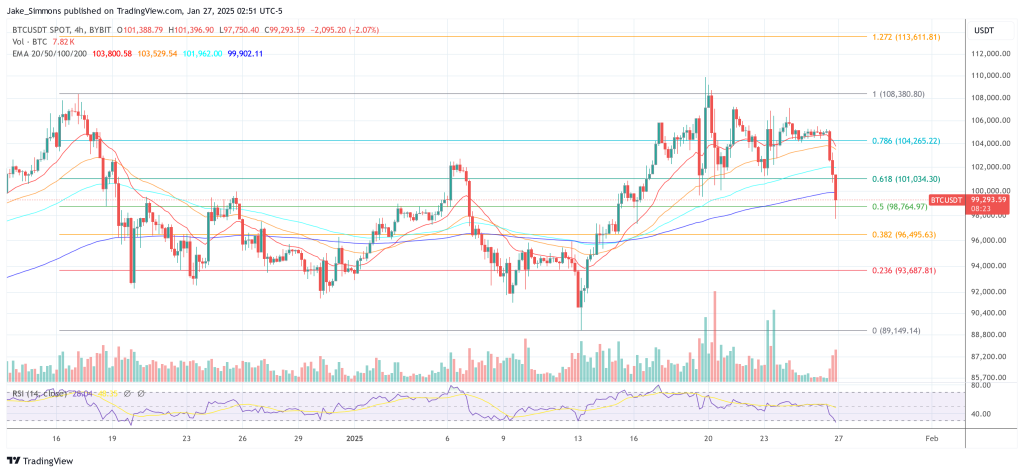
At press time, BTC traded at $99,293.

Related Posts