The Last High Wall in AI Mathematics Has Fallen: GPT-6 Astra Clears FrontierMath Tier 4

marsbitPublished on 2026-09-11Last updated on 2026-09-11

Abstract

GPT-6 Astra has solved the final unsolved problem in FrontierMath Tier 4, marking the "saturation" of this benchmark once considered an "AI math nightmare." According to Epoch AI's cumulative scoring method, every one of the 43 remaining research-level problems in Tier 4 has now been solved at least once by an AI model. FrontierMath was created in 2024 by Epoch AI and over 60 mathematicians, including Fields Medalists, to provide a more challenging benchmark beyond traditional tests. The hardest Tier 4 level was added in 2025 with problems designed by professors and postdocs, originally deemed potentially unsolvable by AI for decades. However, model performance accelerated rapidly, from under 2% initially to GPT-6 Astra's recent 97.6% score. Notably, the model's solution to the last problem was reportedly similar to the human-designed approach, avoiding numerical shortcuts. Despite this milestone, the article emphasizes that AI has not "solved math." FrontierMath is already evolving with new, even more difficult challenges: "Open Problems" featuring truly unsolved research questions and "FrontierMath Erdős," which requires formal, verifiable proofs. In this latest benchmark, Astra has solved only 2 out of 68 problems, indicating the journey continues.

Just now, the last unsolved problem in FrontierMath Tier 4 has been cracked by GPT-6 Astra.

With this, every question in this benchmark, once considered a nightmare for large models in mathematics, has been successfully solved by AI at least once.

Epoch AI has officially concluded: FrontierMath Tier 4 is saturated.
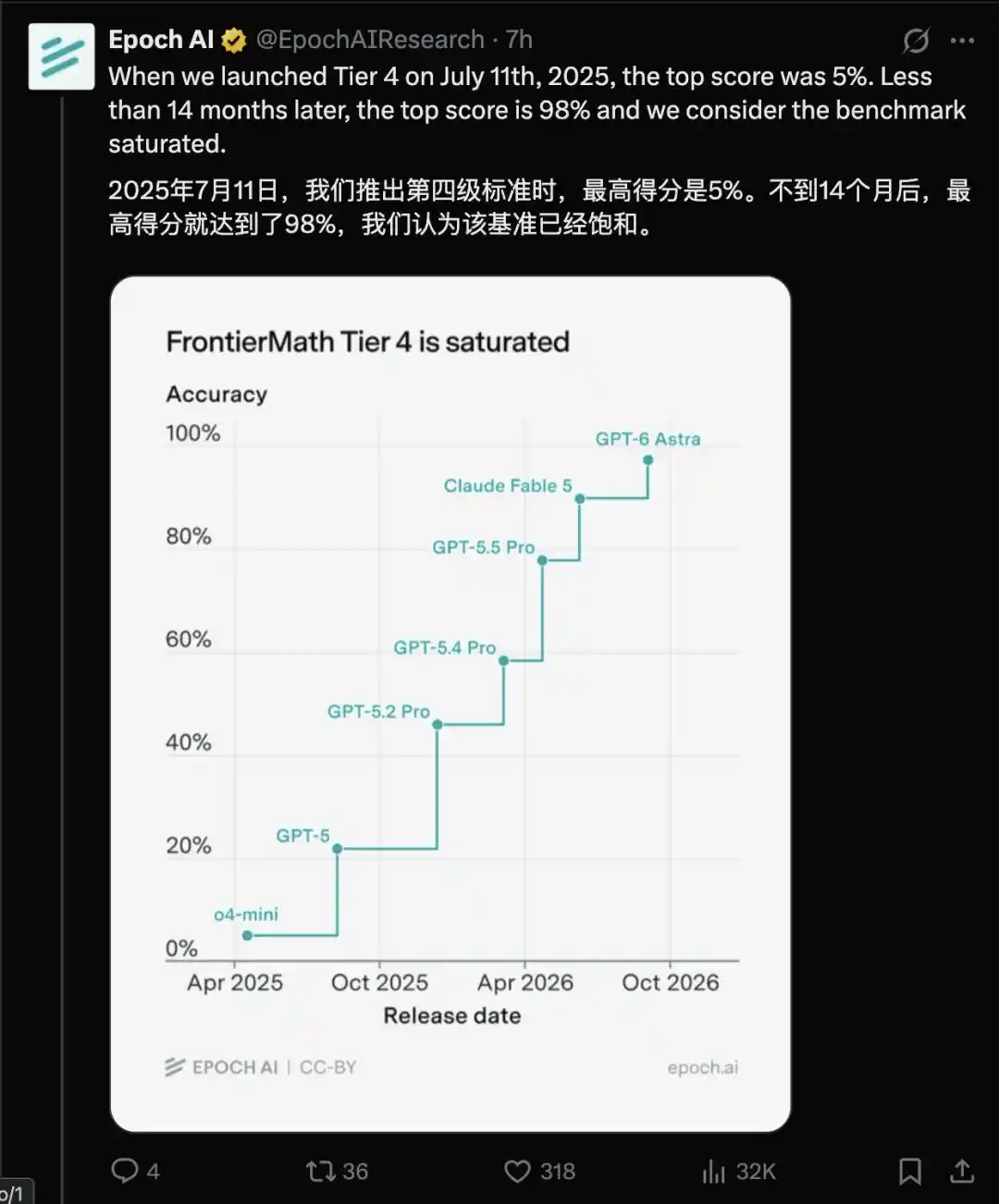
Although judging from the chart above, Astra hasn't directly reached 100%—OpenAI's own published score is 97.6%.

According to Epoch's algorithm, "fully solved" means that after accumulating attempts from different models at different times, every single problem in Tier 4 has had at least one successful solution.

And the one Astra solved was precisely the last remaining problem that had never been cracked by AI before.

(A simple way to understand this: Astra might have made an error in some tests, but the problem it got right was the one previously unsolved.)

To be honest, the speed of this development is still pretty insane.

If you follow model evaluations, you'll know that when Tier 4 was first launched on July 11, 2025, the top score on the leaderboard was only about 5%.

Now, just over a year and two months later, this former "high wall" has become a "step," and the final problem that was hard for AI to bypass has been overcome.

Jay Pantone, a math associate professor at Marquette University and one of the problem authors, also noted that while AI used to find numerical shortcuts, this time, the AI's solution approach was quite close to his own.
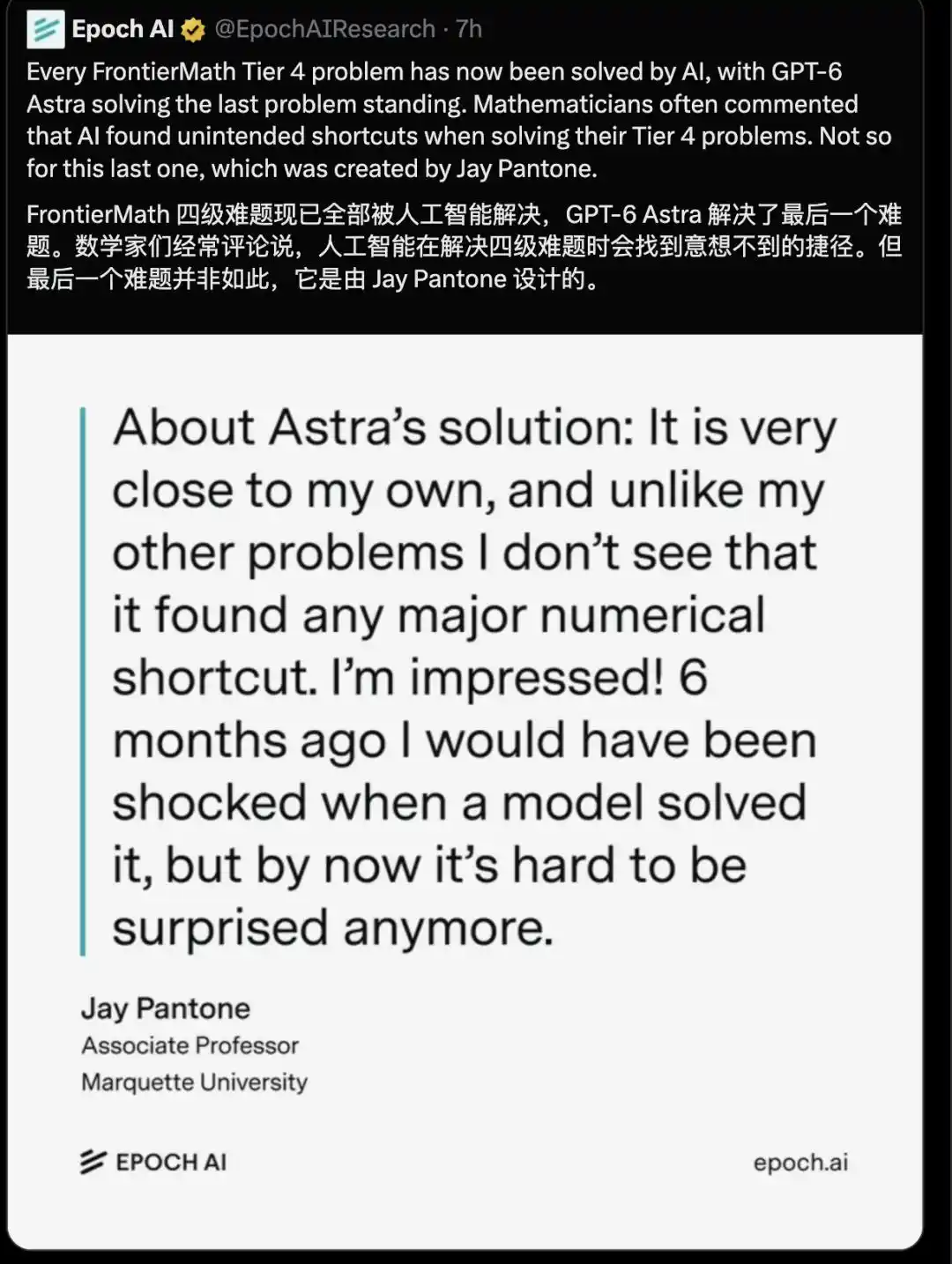
However, as GPT-6 Astra has been intensely attacking the mathematics world lately, frequently solving Millennium Prize Problems every few days, Pantone said he can hardly be surprised anymore!

It's safe to say that mathematics has become one of the areas where Astra has been flexing its muscles most prominently recently.

From Less Than 2% to Adding a Dedicated "Research-Level Defense"

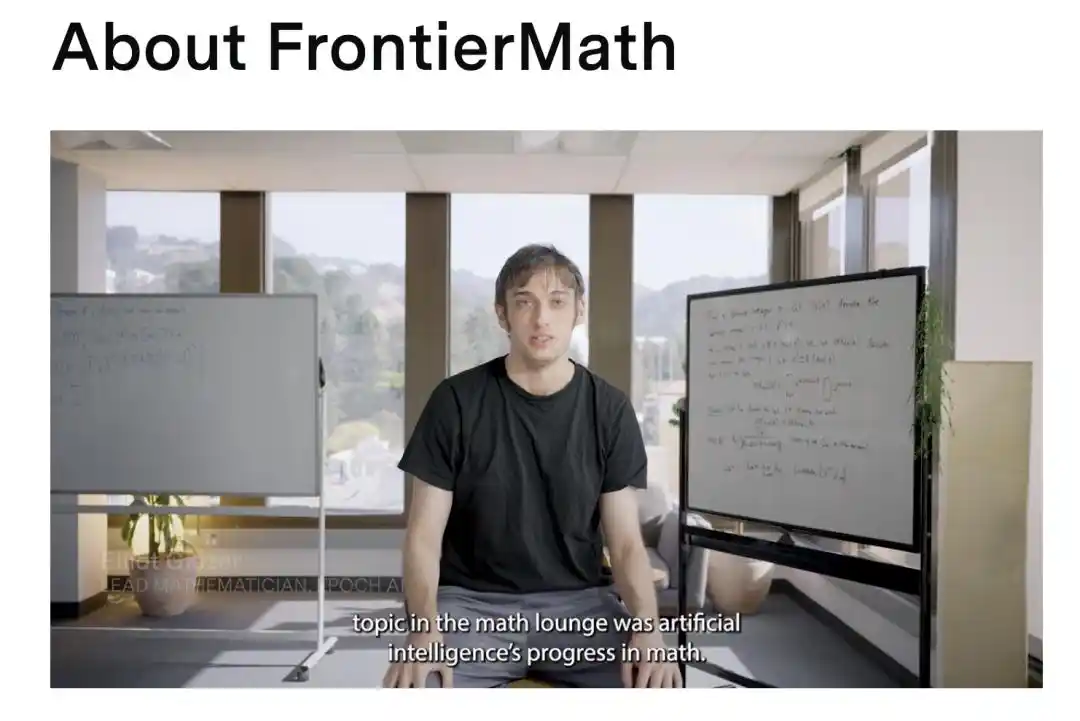
FrontierMath was first released on November 7, 2024, and its very purpose was to prevent AI from breezing through math benchmarks too quickly.

At that time, traditional math benchmarks like GSM8K and MATH were finding it increasingly difficult to differentiate between top-tier models, so Epoch AI collaborated with over 60 mathematicians to design a new set of original problems that had never been publicly released before.

This group included Fields Medalists like Terence Tao, Timothy Gowers, and Richard Borcherds.

After reviewing some of the research-level problems, Terence Tao bluntly called them "extremely difficult," even predicting that the hardest Tier 3 might still stump AI for a few more years.
Sure enough, the first round of testing confirmed this, with the leading model's accuracy rate being less than 2%.

Specifically, initially, the core FrontierMath question bank had 300 problems, divided into three difficulty tiers: Tier 1, Tier 2, and Tier 3.
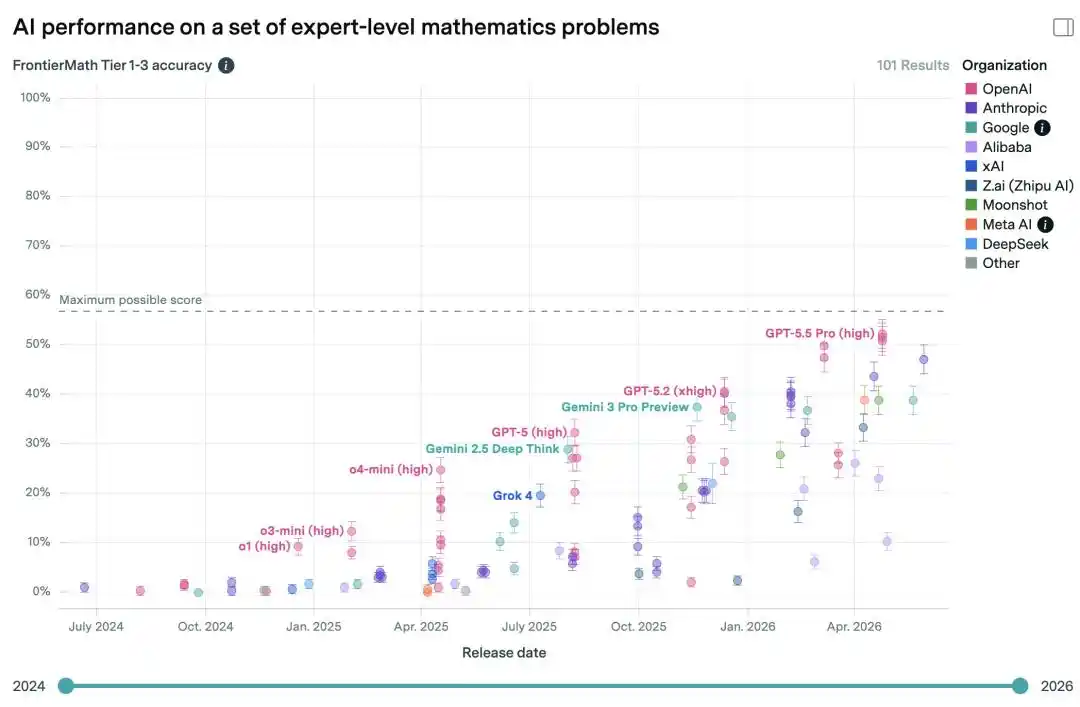
Tier 1 was roughly comparable to advanced undergraduate or math Olympiad problems, but allowed the use of more advanced tools; Tier 2 reached advanced graduate student difficulty; Tier 3 was closer to exploratory research problems early PhD students might encounter.

But with the emergence of reasoning models, these first three tiers also started to become insufficient. So in 2025, Epoch added another layer on top: Tier 4.

Tier 4 problems were mostly designed by mathematics professors and postdocs. Each would conduct a short-term research project lasting several weeks around their own research area, then compress the findings into a problem that could be automatically verified.
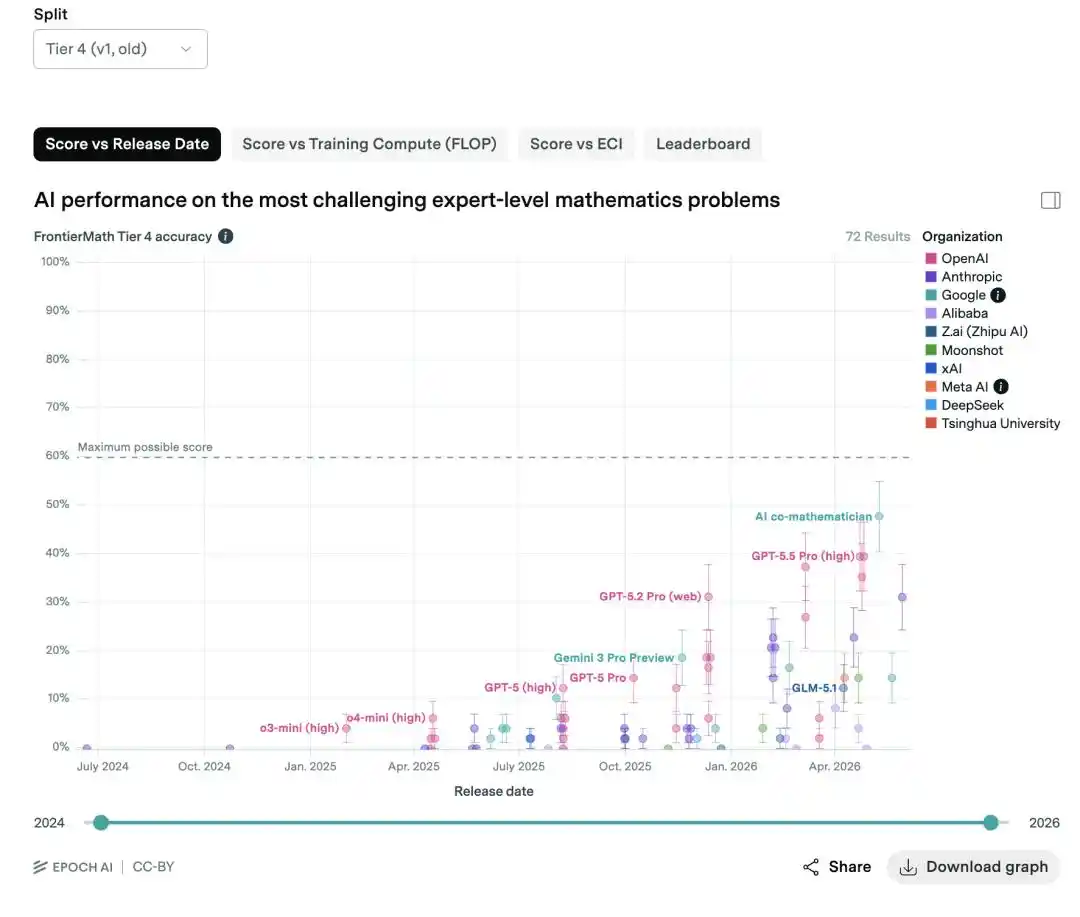
Initially, Tier 4 contained 50 problems. Their scope covered analysis, number theory, combinatorics, topology, algebraic geometry...

Upon release, across all models and all attempts combined, only 3 problems had ever been solved, and these solutions sometimes relied on correct but not fully justified assumptions.

Given this, on the official public sample problems page, Epoch once wrote: Some of these problems might not be solved by AI for decades.

(This statement is now being repeatedly mocked.)

However, as models grew stronger, another issue emerged: the question bank itself couldn't withstand AI's "grilling" anymore.

During testing, OpenAI found more errors in FrontierMath than anticipated.

Subsequently, Epoch launched an independent audit, first using GPT-5.5 and Claude Opus 4.7 to screen for suspicious points, then having mathematicians review each problem individually. Finally, in June 2026, version 2 was released, where Tier 4 had 12 problems corrected, 7 removed, leaving 43.

After the revision, model scores continued to climb.

GPT-5.6 Sol achieved 83.0%, Claude Fable 5 reached 90.2%, and with GPT-6 Astra, the score has now hit 97.6%.
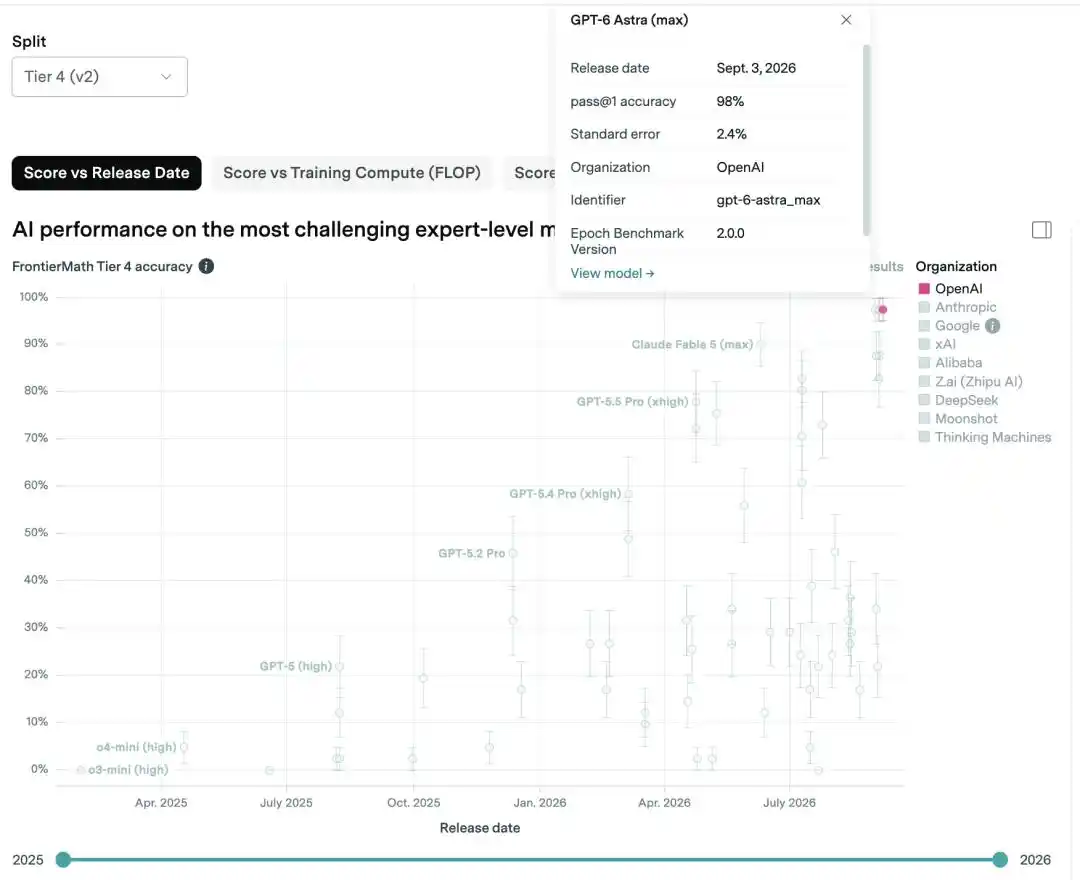
More crucially, Astra also filled the gap by solving the one problem that had never been cracked by AI before.

Thus, every single problem in Tier 4 has now been successfully solved by AI at least once. This research-level defense line, specifically added for the strongest models, has finally been cleared.

However, this doesn't mean "mathematics has been solved by AI." On the contrary, FrontierMath itself is already moving to the next phase.

Now, the entire project includes not only Tiers 1-4 but also genuine Open Problems, and FrontierMath Erdős, which formalizes Erdős open problems into Lean.
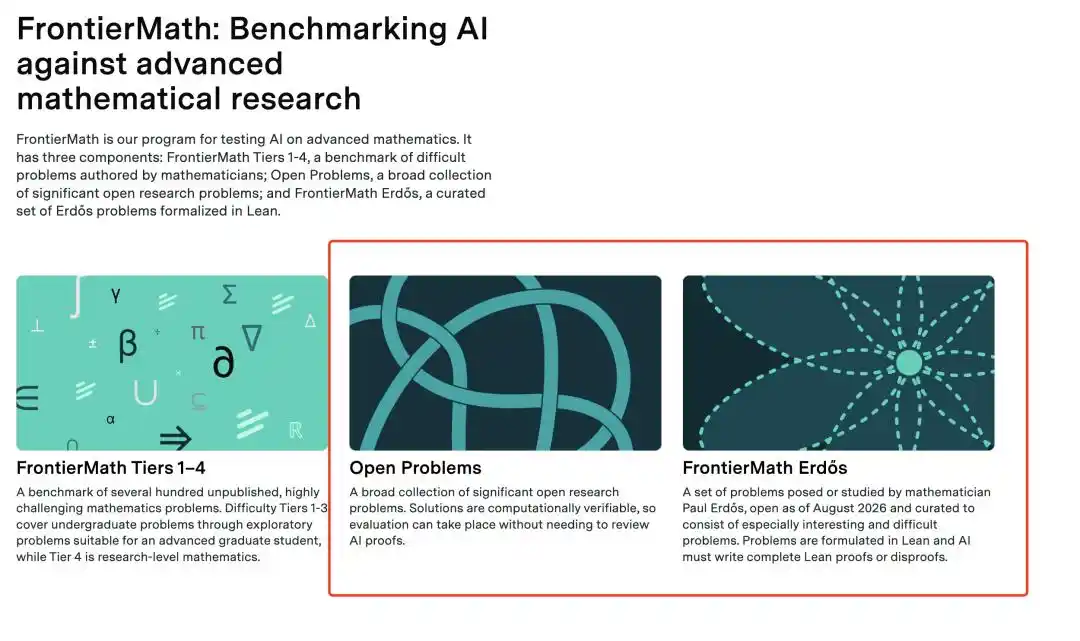
The former directly tests models on unsolved research problems from the mathematics community; the latter requires AI to produce complete proofs that can pass formal verification.

This time, Astra only solved 2 out of the 68 problems in FrontierMath Erdős.

The story continues~

This article is from the WeChat public account "QbitAI," author: henry

Related Questions

QWhat is FrontierMath Tier 4, and why was it created?

AFrontierMath Tier 4 is a collection of 43 (originally 50) highly difficult mathematical problems designed by mathematics professors and postdoctoral researchers as a benchmark to challenge advanced AI models. It was created by Epoch AI in 2025 to provide a 'research-level defense' because earlier difficulty tiers (Tiers 1-3) were becoming insufficient to differentiate top AI models, as traditional benchmarks like GSM8K and MATH were being solved too quickly.

QWhat significant milestone did GPT-6 Astra achieve regarding FrontierMath Tier 4?

AGPT-6 Astra achieved the milestone of solving the final remaining problem in FrontierMath Tier 4 that had never been solved by any AI before. This event, combined with all previous successful AI solutions for other problems, means that every single problem in the Tier 4 benchmark has now been solved at least once by an AI, leading Epoch AI to declare Tier 4 as 'saturated'.

QWhat was OpenAI's official reported score for GPT-6 Astra on Tier 4, and how does it relate to the 'saturation' claim?

AOpenAI's officially reported score for GPT-6 Astra on FrontierMath Tier 4 was 97.6%. The 'saturation' claim by Epoch AI refers to a different metric: it means that across all attempts by different AI models over time, each individual problem in the Tier 4 set has been successfully solved at least once. Astra contributed by solving the one last problem that had previously resisted all AI attempts, even though its single-attempt score was not 100%.

QHow did the author and mathematicians initially perceive the difficulty of FrontierMath's highest tiers?

AInitially, mathematicians like Terence Tao described some of the research-level problems as 'extremely difficult'. When Tier 3 was the highest level, Tao speculated it might stump AI for several more years. Upon the creation of Tier 4, Epoch AI's website even stated that some of its problems 'might not be solved by AI for decades,' a statement that has since been referenced humorously as progress accelerated rapidly.

QWhat are the next stages for the FrontierMath project after Tier 4 was saturated?

AAfter the saturation of Tier 4, the FrontierMath project has moved to even more challenging stages. These include 'Open Problems', which are genuine, unsolved research questions from mathematics, and 'FrontierMath Erdős', which involves formalizing unsolved problems from Paul Erdős into the Lean theorem prover and requires AI to produce complete, formally verified proofs. GPT-6 Astra, for example, has only solved 2 out of 68 problems in the FrontierMath Erdős set.

Related Reads

Aave's Half-Year Report Card: A 97-Person Team Burned $20 Million in Half a Year, What Is the DeFi Leader Up To?

Aave Labs' 180-day report (Q2–Q3 2026) reveals a 97-person team that logged ~100,000 hours, completed 6,096 tracked items, shipped 28 product or protocol deployments, and spent nearly $19.48 million (excluding token compensation), while the Aave protocol generated about $44.58 million in revenue. Total deposits grew roughly 40% in Q3 to $33.8 billion, but this followed a sharp Q2 decline driven by the rsETH bridge exploit and a broader DeFi contraction, so the rebound was largely a partial recovery. Protocol revenue actually fell about 37% quarter-over-quarter, from $27.29 million to $17.29 million, as high Q2 liquidation fees (including Chainlink SVR) dropped sharply and borrowing interest income declined, even though GHO interest, swap fees, and stablecoin utilization improved. The report also signals Aave's expansion beyond crypto-native lending. Aave V4, launched in March, reached $1.34 billion in deposits by October 1, and now supports tokenized equities via an Equities Hub on Base, custody-based institutional lending with Anchorage and Chainlink, and externally operated independent instances such as EtherFi and Sentora that share revenue with the DAO. Aave Labs is also pursuing consumer and enterprise distribution through the Aave App (over $45 million in user balances), Stable Vaults for embedded yield, and an MCP Server letting AI assistants read protocol data and prepare—but not sign—transactions. Under the Aave Will Win Framework, the DAO funds development and receives gross brand-product revenue. The core open questions are growth quality, whether new businesses generate durable revenue, and balancing concentrated execution against DAO dependence on a key service provider.

marsbit55m ago

Aave's Half-Year Report Card: A 97-Person Team Burned $20 Million in Half a Year, What Is the DeFi Leader Up To?

marsbit55m ago

Circle Partners With DBS to Expand Institutional USDC Access Across Asia

Circle, the issuer of the USDC stablecoin, has partnered with Singapore-based DBS Bank to expand institutional access to USDC across Asia. Announced on November 18, the agreement allows eligible institutional clients to mint and redeem the dollar-backed stablecoin directly through DBS, with near-instant settlement between US dollars and USDC available 24 hours a day. This gives institutions another way to access USDC without relying entirely on cryptocurrency exchanges and other secondary-market liquidity providers, supporting corporate treasury operations, payment settlement and liquidity management. Institutions can convert between dollars and USDC without being restricted by conventional banking hours or payment cut-off times. Access is limited to eligible institutional clients rather than retail customers. The agreement builds on DBS and Circle's participation in Project BLOOM, an industry initiative led by the Monetary Authority of Singapore focused on developing infrastructure for the safe and scalable use of tokenised money. DBS reported that 88% of large corporations surveyed were already deploying or piloting tokenised money applications, with more than three in five adopting or planning to adopt stablecoins. Evy Theunis, head of digital assets at DBS's Institutional Banking Group, said the partnership would give institutions more choice in managing and transferring value, while Circle Chief Commercial Officer Kash Razzaghi said it would help expand institutional access to USDC across Asia. Transaction limits, fees and a detailed country-by-country rollout schedule were not disclosed.

TheNewsCrypto1h ago

Circle Partners With DBS to Expand Institutional USDC Access Across Asia

TheNewsCrypto1h ago

From Crypto VC to Traditional VC: The Three Essential Capabilities of Venture Capital

In this article, Big Brain Holdings investor Derrick Cui reflects on his transition from crypto venture capital to traditional VC in AI, reindustrialization, and space, contrasting crypto's short liquidity cycles and narrative-driven token prices with traditional VC's decade-long capital lockups and illiquid equity. He explains why LPs still allocate to venture despite poor average returns and illiquidity: each year produces rare companies capable of returning an entire fund; business success defies checklists, rewarding subjective judgment; consensus is often wrong, so non-consensus bets offer asymmetric upside; and top investors can repeatedly generate excess returns across cycles. He describes the investor's job as deal sourcing, diligence, and pitching, noting AI tools have lowered sourcing barriers but顶级 deals still come from genuine relationships, and that likability is an underrated professional asset. He then details three core capabilities: (1) Data—separating verifiable facts from founder promises, using third-party validation to pierce polished narratives; (2) Context—building comparative, industry-wide knowledge to judge talent and technical bottlenecks, now accelerated by reasoning models that shift the key skill from reading papers to asking higher-quality questions; and (3) Storytelling—constructing a rigorous "Right to Win" narrative that explains why a company prevails across multiple possible futures, sometimes via systematic cluster bets (e.g., SMRs for AI energy demand) rather than single-company wagers. He also admits past mistakes: being "nerd-sniped" by technical brilliance that doesn't equal a great business, chasing non-consensus ideas for their own sake, and rejecting the "spray and pray" mentality. Finally, he warns that fundraising incentives—DPI substitutes, markups, co-investment halo, hot-round chasing—can distort investment decisions, and concludes that VC is a trainable skill built on data capture, better questions, and credible winning narratives.

marsbit1h ago

From Crypto VC to Traditional VC: The Three Essential Capabilities of Venture Capital

marsbit1h ago

Trading

Spot
活动图片