Author: Nancy, PANews
With the security alarm still not lifted, veteran hardware wallet manufacturer Ledger has chosen to high-profile launch its new product, Atom, at this time.
This smartphone-like hardware wallet promotes product design features such as a dual operating system, privacy protection, tamper-proof and anti-disassembly design, and an AI Agent as selling points, attempting to regain market trust and attract more attention. However, the market does not seem to be buying it.
Before its official launch, Atom has already sparked community controversy and even attracted considerable ridicule due to its launch timing and product design.
Launch of the Phone-Style Hardware Wallet Atom, with Tamper-Proof Design and AI Agent as Highlights
On October 16, Ledger announced the launch of the phone-style hardware wallet Ledger Atom. This product resembles a smartphone in appearance and user experience but is not a traditional mobile phone. It is a device that integrates daily applications, cryptocurrency asset management, and hardware security functions.
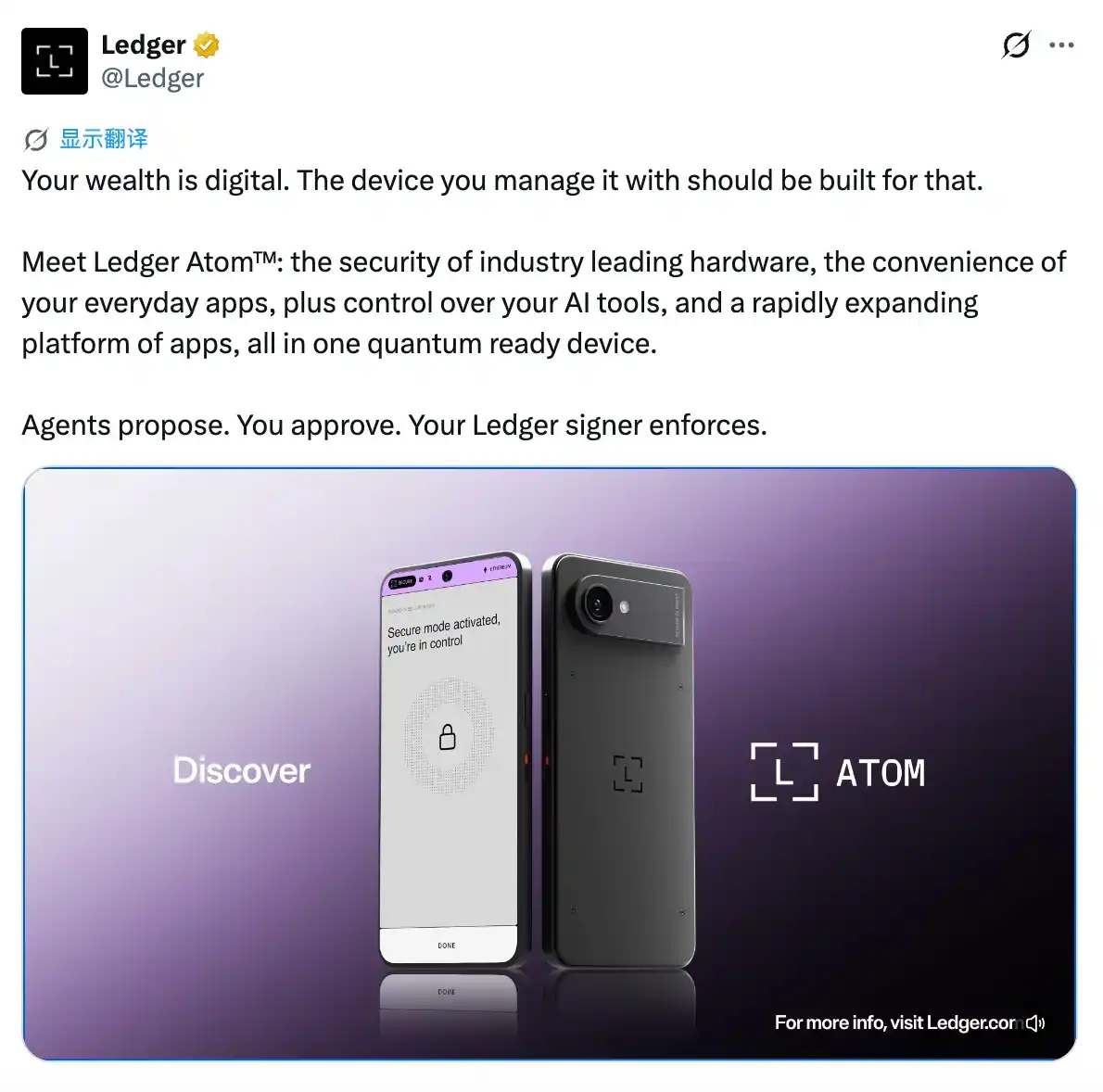
The Founder's Edition pre-order price is $849, and users can reserve it with a refundable $100 deposit; the regular version is expected to be priced at $899 and is planned for official release around mid-2027.
Ledger Atom does not support full mobile communication functions. According to official disclosure, the device only supports mobile data services and can connect to the internet via 4G/5G networks, but it does not support cellular voice calls, including VoLTE, VoNR, and VoWiFi, nor does it support SMS. Even with a SIM or eSIM card installed and within network coverage, users cannot make emergency service calls, such as 112 or 911, through this device.
In terms of security architecture, Ledger Atom adopts a dual operating system design, separating daily applications from sensitive operations involving asset security to reduce the risk of malicious software tampering with transaction information or inducing users to sign malicious transactions. Among them, the standard mode, based on the Android Open Source Project (AOSP), is responsible for running daily applications and networking services such as WhatsApp, Instagram, and TikTok; Ledger OS runs in an independent secure chip environment, specifically handling sensitive operations like private key storage, transaction signing, AI Agent authorization, and identity verification. When initiating a transaction, users can verify the transaction details through the secure screen and complete the signature after confirmation.
It is worth noting that, although the two operating systems share the same screen, Ledger still attempts to achieve isolation at the hardware level. Officially, the device controls access to the screen and touchscreen through an FPGA hardware multiplexer. When the device enters secure mode, the FPGA cuts off standard mode's access to the screen and touchscreen. Theoretically, even if the standard mode is completely controlled by malware, attackers cannot forge or tamper with the transaction approval interface seen by the user through this mode, nor can they use it to steal private keys or inject click operations.
Privacy protection is also a key design focus for Ledger Atom. The device is equipped with a physical privacy switch that can cut off power to the camera and microphone at the circuit level; when entering secure mode, these sensors are automatically turned off. The device also supports NIST-compliant post-quantum cryptography schemes, attempting to prepare in advance for potential future quantum computing threats.
In response to the recently exposed risks of hardware wallet devices being tampered with, Ledger has added multiple protective mechanisms to Atom, claiming it to be their most advanced anti-tampering and anti-disassembly solution to date. The device is equipped with protective shields around key sensitive components and features sensors to detect if the screen or back cover has been removed; the product packaging is also specially designed to identify if it has been opened. Meanwhile, the anti-tampering detection system is equipped with an independent battery, allowing it to operate continuously even when the device is powered off.
Beyond hardware security, Ledger has also introduced an AI Agent into the asset management process. Their Ledger Agent Intent allows AI Agents, including OpenClaw, to monitor the market, prepare transactions, and provide operational suggestions but does not grant them access to private keys. All requests involving fund transfers or other sensitive operations must ultimately be physically confirmed by the user through Ledger Atom's secure screen to be executed. In other words, users can use AI to assist in analysis and prepare operations, but the ultimate control over assets remains in the user's hands.
In terms of the application ecosystem, Ledger Atom will come pre-installed with Ledger Wallet, supporting cryptocurrency asset management and transaction signing. Additionally, Ledger announced a collaboration with Solana Mobile to introduce the Seeker app into the device; it is also collaborating with Cyber50 to explore using Ledger Atom and its hardware-level security technology to further enhance communication security and privacy protection.
Regarding sales channels, to reduce the risk of supply chain attacks exposed in recent incidents like the CryptoBilis event, Ledger plans to initially sell Atom only through its official website, bypassing third-party seller channels. As for the device upgrade issue for existing users, Ledger stated that there are currently no plans to offer a trade-in program for customers affected by this incident but did not rule out the possibility of future upgrade promotions.
Security Trust Not Yet Restored, Ledger's Hasty New Product Launch Raises Questions
However, even before its official market launch, Ledger Atom has already stirred community dissatisfaction.
On one hand, the trust crisis Ledger faces has not subsided. Previously, Ledger's authorized distributor in Southeast Asia, CryptoBilis, was exposed in a hardware wallet supply chain attack incident, where devices were implanted with malicious hardware, causing nearly a hundred million dollars in user losses.
In response, Ledger has suspended product sales through related authorized channels in Southeast Asia and Hong Kong, stating that the attack originated from a localized distribution channel rather than vulnerabilities in the company's chips, operating system, or servers. According to Ledger's disclosure, a highly organized criminal group spent months purchasing genuine devices, disassembling them to add custom hidden components in an attempt to steal the recovery seed phrases generated by users during the initialization process, and then reintroduced the tampered devices into the market through Southeast Asian distributors. The attackers were also said to have invested millions of dollars to build a logistics network, seed phrase collection servers, and infrastructure for stealing funds and money laundering, ultimately stealing user assets through coordinated actions.
Although Ledger has responded to the incident, the users' most pressing concern—how to address supply chain attacks—has not been clearly resolved. Meanwhile, regarding how to handle the asset losses of affected users, and whether clear compensation or replacement plans will be provided, the official has yet to give clear answers. At this point in time, instead of prioritizing responses to users' most urgent demands, Ledger is attempting to reshape the product's security image by launching Atom with hardware isolation and anti-tampering mechanisms, which naturally makes it difficult to dispel external doubts. For current users, properly handling the existing security incident and responding to victims' demands might be the key to restoring trust, rather than launching a new product.
On the other hand, while Ledger Atom offers stronger software isolation and protection against remote attacks, it still faces security risks from the physical world. Compared to traditional hardware wallets, Atom has an appearance and user experience close to that of a smartphone, but its prominent Ledger branding could also make it a target for potential criminals, with the community even joking it's a "walking ATM."
Such concerns are not unfounded. In recent years, wrench attacks targeting cryptocurrency holders have become increasingly frequent. Unlike remote hacking, this type of crime directly targets the victims themselves, using violent assault, kidnapping, torture, or threats to life to force them to hand over private keys or transfer assets on the spot. According to a previous disclosure by security agency CertiK, there were 52 verified wrench attack incidents in the first half of 2026, with recorded losses reaching $124.1 million; the number of incidents increased by 33.3% year-over-year, while the loss amount grew to 11.8 times that of the same period the previous year.
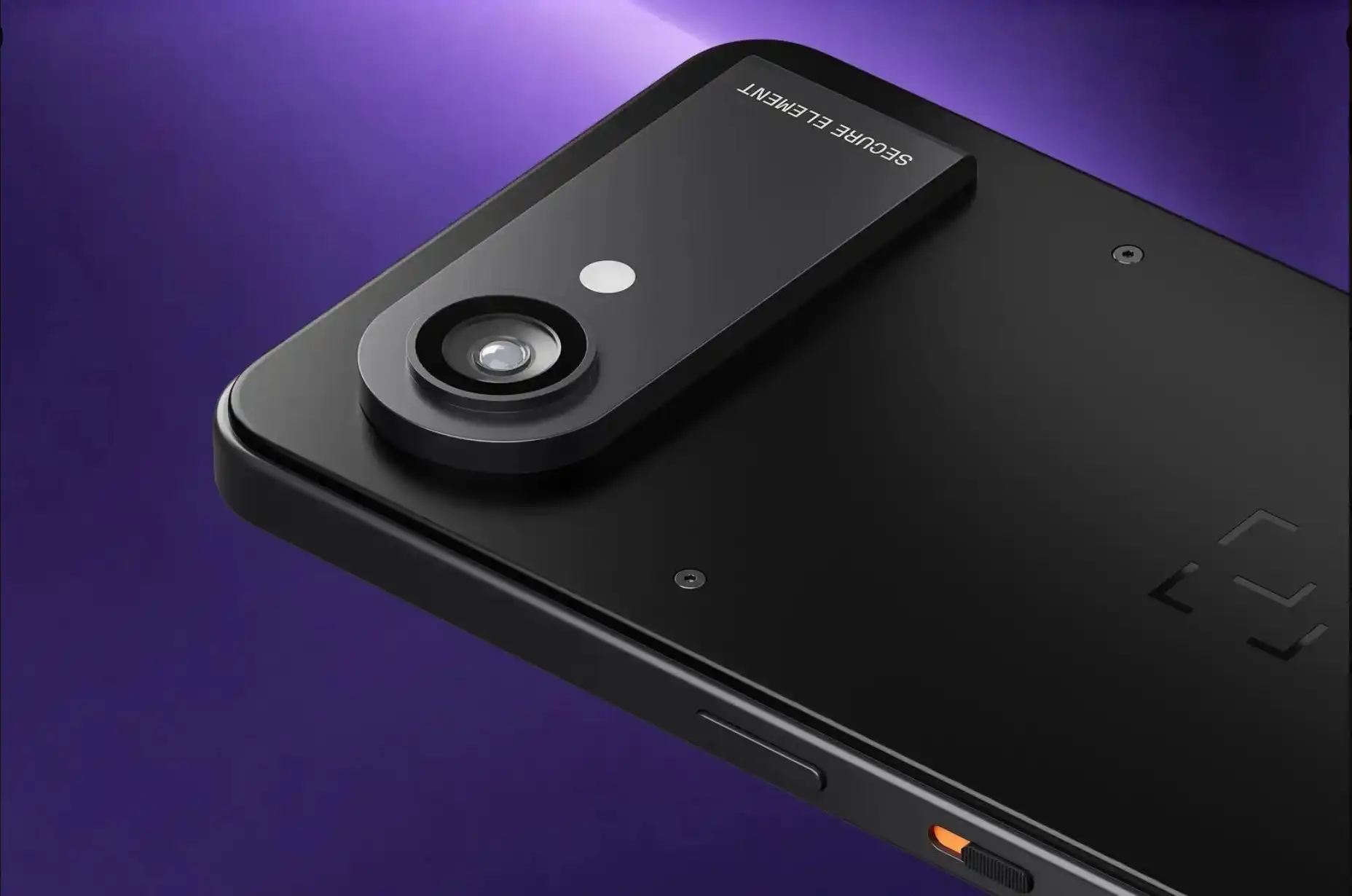
Additionally, the pricing of Ledger Atom has sparked controversy. Its price is considered significantly higher than most of Ledger's existing hardware wallet products, even approaching that of many mid-to-high-end smartphones. Given that the official explicitly states Atom is not a traditional smartphone, with its functional positioning clearly different from regular phones, many users have expressed unwillingness to pay this security premium.
Ultimately, in the cryptocurrency market, security is always the core value of hardware wallets. Relying solely on technological upgrades and product form innovation is not enough to win user trust. Especially at a time when Ledger's security incident remains controversial and user trust still needs repair, only by directly responding to user demands and effectively resolving security risks can market confidence be re-established.