Pineapple Financial Places $1 Billion Worth of Mortgage Records on Injective

cryptonews.ruPublished on 2026-09-05Last updated on 2026-09-05

Abstract

Pineapple Financial has migrated over $1 billion worth of residential mortgage records onto the Injective blockchain as part of a larger initiative to transfer its historical loan portfolio on-chain. The company ultimately plans to transfer more than 29,000 mortgages, valued at over $10 billion. Each on-chain record contains detailed loan-level data for verification, auditing, and risk analysis, but represents the mortgage data itself, not ownership of the underlying loans. The market capitalization of the token (PAPL0) tracking these records on Injective has grown significantly. This migration is one component of Pineapple's broader partnership with Injective, which also includes a $100 million digital asset treasury. The news highlights the growing trend of tokenizing real-world assets (RWA), with real estate being a primary focus. Tokenization can simplify fractional ownership and transfer of property assets. Recent examples include a Goldman Sachs-led tokenized real estate fund and a pilot project in Dubai. However, the total value of tokenized real estate remains a small fraction of the broader tokenized RWA market, which is currently valued in the tens of billions.

Pineapple Financial has migrated over $1 billion worth of residential mortgage records onto Injective. Injective is a first-layer blockchain focused on financial applications. This is part of a larger effort to transfer the company's historical loan portfolio on-chain.

As Injective announced on Friday, Pineapple plans to ultimately migrate more than 29,000 originated mortgages, with a total value exceeding $10 billion, onto the network. Each mortgage is represented by an on-chain record linked to the corresponding loan file, rather than being repackaged into a new mortgage-backed security.

The records contain over 500 parameters, including loan-level information intended for verification, audit trail creation, and risk analysis. Pineapple's dashboard indicates the migration now covers 2,079 mortgage records, compared to 1,259 at the initiative's launch in December 2025.

According to Token Terminal, the market capitalization of PAPL0, which tracks the on-chain mortgage records, is approximately $1.1 billion, having increased by 48.2% over the past nine months. The tokens represent the mortgage records, not ownership rights to the underlying loans.
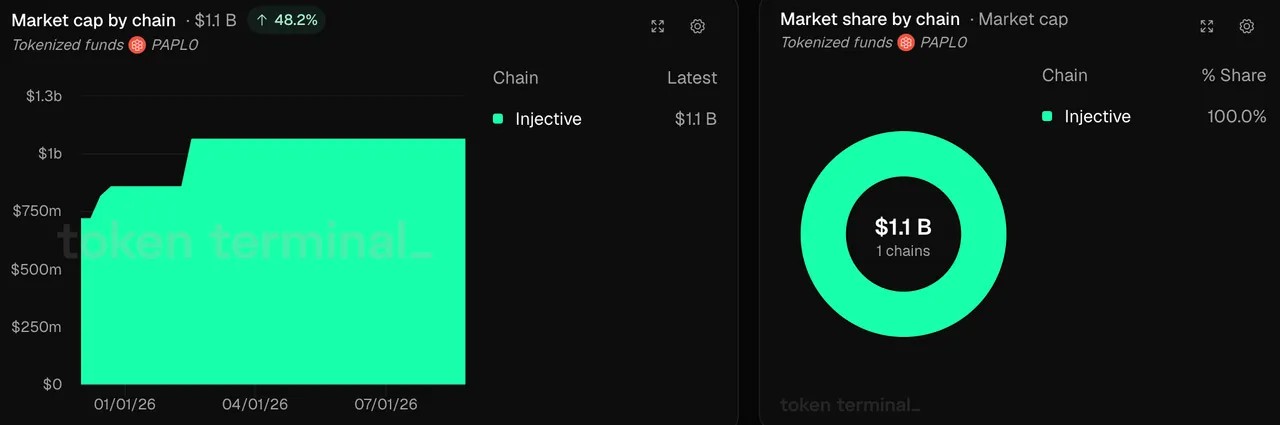
Market capitalization of PAPL0 on Injective. Source: Token Terminal

The migration of mortgage data is part of a broader collaboration between Pineapple and Injective, which includes a separate $100 million Injective Digital Asset Treasury ($INJ). Pineapple is staking $INJ from this treasury, with Kraken acting as the primary validator for the assets.

Related: Five Types of Real-World Assets Tokenizing Fastest On-Chain

Real Estate Tokenization Gains Momentum

Real estate has become a primary focus for bringing traditionally illiquid assets on-chain: tokenization can simplify the fractionalization, transfer, and access to real estate properties or investment shares.

In June, Apex Group joined Goldman Sachs, Archax, and LRC Group in a tokenized real estate fund, whose shares are issued as digital tokens via the Goldman Sachs Digital Asset Platform. This structure provides investors with blockchain-based ownership rights to fund shares, rather than merely recording property data on-chain.

Dubai has also expanded its real estate tokenization efforts. In February, the Dubai Land Department launched the second phase of a pilot project after tokenizing approximately $5 million worth of real estate, with transactions recorded on the XRP Ledger.

However, tokenized real estate still represents only a small fraction of the broader real-world asset (RWA) market. The total value locked (TVL) for this segment is around $226.5 million, up 11.7% over the last 30 days, compared to $38.8 billion for tokenized RWAs tracked by RWA.xyz.
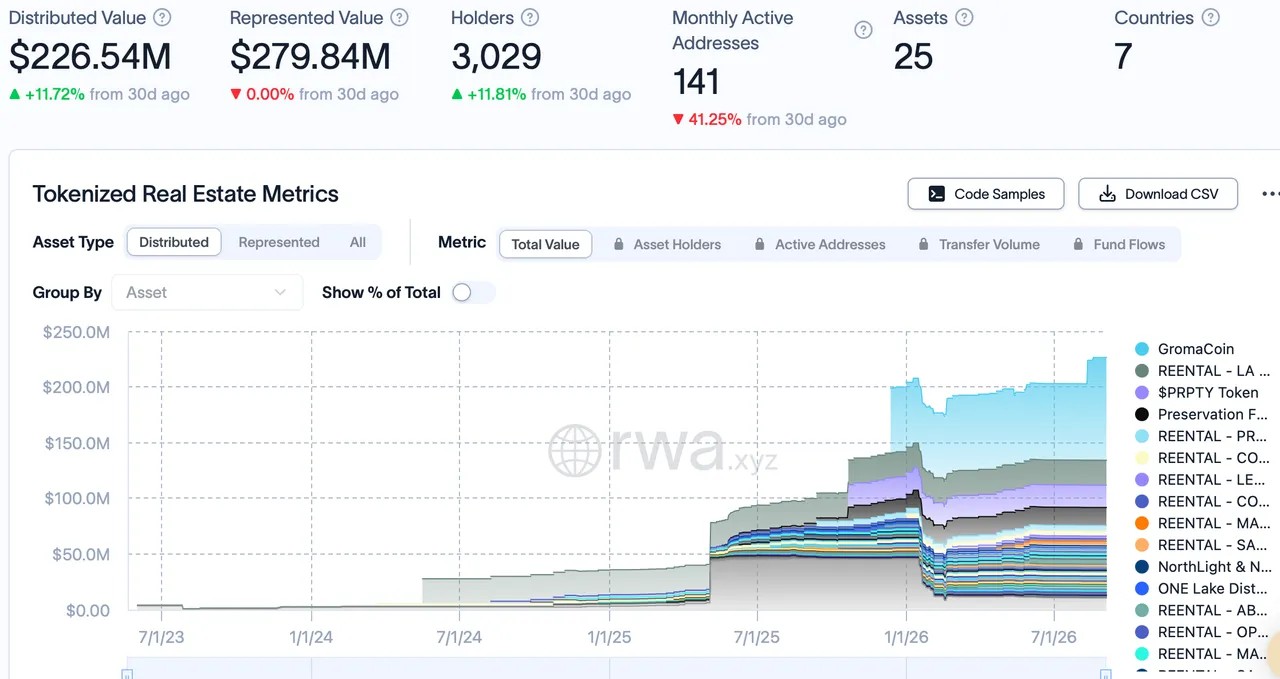
Tokenized Real Estate. Source: RWA.xyz

Magazine: Token buybacks are trending. But are they good for crypto projects?

end-content
Related Questions

QWhat is the value of the mortgage records that Pineapple Financial has migrated onto Injective?

APineapple Financial has migrated over $1 billion worth of residential mortgage records onto the Injective blockchain.

QWhat does the PAPL0 token represent in the context of Pineapple's mortgage records on Injective?

AThe PAPL0 token represents the on-chain mortgage records, not ownership of the underlying loans.

QWhat is the total value of mortgages Pineapple Financial ultimately plans to bring on-chain, and how many loans does this involve?

APineapple Financial ultimately plans to migrate over 29,000 issued mortgages with a total value exceeding $10 billion onto the Injective network.

QWhat is one key difference between how Pineapple is recording mortgages on-chain versus a typical tokenized real estate fund structure?

APineapple's approach creates on-chain records linked to individual loan files, whereas a typical tokenized fund structure issues digital tokens representing fractional ownership shares of the underlying assets.

QBeyond mortgage record migration, what other element of collaboration exists between Pineapple Financial and Injective?

AThe collaboration includes a separate $100 million Injective digital asset treasury ($INJ), from which Pineapple stakes $INJ, with Kraken serving as the primary validator.

Related Reads

4.8 Billion Dollars: Tether's Hand Has Reached Into 13 U.S. Public Companies

Tether, the world's largest stablecoin issuer, holds roughly $4.8 billion in public-market exposure across 13 U.S.-listed companies, according to a Protos review of regulatory filings. Its holdings span a controversial video platform, gold royalty companies, a satellite firm, bitcoin miners, and a bitcoin treasury project. Key positions include a 50.3% stake (including warrants) in Rumble (RUM), though voting power is capped below 9.9%; Rumble has also acquired Tether's Northern Data and counts Tether as its most important advertising client, committed to $50 million annually for two years. Tether and Bitfinex are controlling shareholders of Twenty One Capital (XXI), with rights to nominate four of seven directors, including Tether CEO Paolo Ardoino; the company trades at about 60% of its bitcoin value. In gold, Tether holds about 27% of Elemental Royalty (ELE), 12.6% of Gold.com (GOLD), 12.6% of Versamet Royalties (VMET), 14.6% of Metalla (MTA), 14.4% of Gold Royalty (GROY), 12% of Aurelion (AURE), and about 8% of Antalpha (ANTA). It also holds 19.7% of Bitdeer (BTDR) and a stake in Adecoagro (AGRO), plus shares in Satellogic (SATL), 9.9% of SDEV (down about 99%), and a stake in VCI Global (VCIG) via Oobit. Powerlaw Corp (PWRL) claims roughly $20 million in Tether equity. The exposure is concentrated in a few large holdings—Twenty One, Rumble, and Adecoagro—showing Tether's growing role as a multi-sector financial institution that also places executives in key positions.

marsbit21m ago

4.8 Billion Dollars: Tether's Hand Has Reached Into 13 U.S. Public Companies

marsbit21m ago

Tesla and SpaceX Merger Accelerates: A $3.47 Trillion Giant, Deal Could Be Announced as Early as December

Tesla and SpaceX are reportedly advancing merger talks, with a deal potentially announced as early as December, though complex corporate structure and regulatory issues could delay it to early 2027. Based on recent market values—SpaceX at about $1.90 trillion and Tesla at about $1.57 trillion—the combined entity would be worth roughly $3.47 trillion, making it one of the largest corporate integrations in history and bringing rocket launch, satellite internet, EVs, energy storage, AI, and robotics under one roof. In October, Musk called a merger "a good idea" and confirmed both companies had formed independent director special committees. The strategic logic centers on AI infrastructure—chips, compute, and energy—with the Terafab chip manufacturing joint venture as a concrete example, expected to produce first test chips in mid-2027 and reach mass production in Q3 2028. Shareholder impact is significant: Musk holds about 40-45% economic interest in SpaceX with over 80% voting power via dual-class shares, versus nearly 20% of Tesla with equal voting rights, raising questions about control and whether Tesla shareholders would accept a new structure. Regulatory hurdles may be the hardest obstacle, given SpaceX's sensitive U.S. defense contracts and Tesla's major China operations, implicating CFIUS and Chinese regulators. The merger reflects Musk's ambition to unify his business empire around a shared technology base spanning Earth and space.

marsbit56m ago

Tesla and SpaceX Merger Accelerates: A $3.47 Trillion Giant, Deal Could Be Announced as Early as December

marsbit56m ago

10-Second 4K Image Generation: MiniMax Once Again Delivers Open-Source SOTA

MiniMax has released MiniMax H3 Image, an open-source image generation model that has quickly claimed state-of-the-art status among open-weight models. It natively outputs 4K images (around 16 million pixels) in roughly 10 seconds with the fast version, supports up to 16 reference images, and ranks first among open-weight models on Artificial Analysis for both text-to-image and image editing. The model is available via web, API, and local deployment on GitHub and HuggingFace. In hands-on tests, H3 Image produced highly realistic WeChat chat screenshots with accurate iPhone status bar details, rendered complex graffiti-style text ("MiniMax H3 Image") with 3D lettering and spray-paint effects, and generated convincing Victoria's Secret backstage photos, cinematic street portraits, and Y2K-style retro portraits. It also handled image-to-image tasks well: turning a photo into a hand-drawn sticker, adding CCTV-style face bounding boxes and zoom-ins, and converting realistic images into anime collage styles. The model further demonstrated understanding of physical structure by generating a labeled exploded-view diagram of a 35mm camera, producing accurate outfit try-on images, e-commerce product posters, and typography-heavy Eastern botanical posters, and following complex multi-reference editing instructions. Architecturally, H3 Image derives from MiniMax's full-modal video model H3, retaining its backbone and text encoder (a 32-billion-parameter multimodal language model) while dropping the audio branch. Its core is a 33.1-billion-parameter diffusion Transformer using 3D multimodal rotary position encoding, with text and reference-image tokens processed in a single stream and decoded by a VAE. Native generation avoids external super-resolution. The video-first lineage is credited with giving the model strong visual world knowledge, including viewpoint, material, lighting, and motion understanding. The release has energized the global AI community: derivatives such as Pruna's P-H3-Image, Nvidia's Sol-H3, and Pika H3 Flex have appeared, with roughly 220 H3-based entries on Hugging Face. Chinese open-source technology is increasingly the foundation for overseas teams, and MiniMax is building a commercial loop around free weights plus paid hosted APIs and subscriptions. The article argues competition is shifting from raw model capability to ecosystem strength.

marsbit1h ago

10-Second 4K Image Generation: MiniMax Once Again Delivers Open-Source SOTA

marsbit1h ago

Jensen Huang Resigns, CFO Becomes NVIDIA Interim CEO, Who Is Kress?

NVIDIA announced on November 12 that co-founder Jensen Huang has resigned as president, CEO, and board member, effective immediately, after scandals involving extramarital affairs. The board accepted his resignation on November 11, and Huang, who led the company for 33 years and holds about 3.6% of shares, also left the board entirely. CFO Colette Kress has been appointed interim CEO while continuing as EVP and CFO; she becomes the first female leader in NVIDIA's history. Former Synopsys CEO Harvey C. Jones, a director since 1993, becomes the company's first independent board chair. The board will search for a permanent CEO internally and externally. Kress, 59, holds a finance degree from the University of Arizona and an MBA from SMU Cox, and previously worked at Texas Instruments, Microsoft, and Cisco before joining NVIDIA in 2013 at Huang's invitation. During her 13 years as CFO, NVIDIA's revenue grew from $4.13 billion in FY2014 to $215.9 billion in FY2026, roughly 52-fold, and she became a billionaire in July 2025 with a net worth of about $1–1.2 billion. The resignation followed reports of Huang's infidelity, including a New York Times report of a romantic relationship with NVIDIA healthcare VP Kimberly Powell. NVIDIA shares fell sharply, hitting a five-month low below $150 before recovering to about $160. The board expressed confidence that operations, customer commitments, and product roadmaps will not be disrupted.

marsbit1h ago

Jensen Huang Resigns, CFO Becomes NVIDIA Interim CEO, Who Is Kress?

marsbit1h ago

Trading

Spot
活动图片