Interviewing Peter Thiel has never been a comfortable experience.
He never conforms to the interviewer's assumptions and is stingy in offering any cheap consolation. While the whole of Silicon Valley rushes to take sides in the binary opposition between "accelerationism" and "doomsdayism," Peter Thiel sat across from Axel Springer CEO Mathias Döpfner, fitting the stagnation of the physical world, Goethe's Faustian bargain, the nascent global authoritarianism, and that almost offensive statement "99% of leaders are utterly incompetent" seamlessly into the same cognitive framework.
This conversation took place in Döpfner's high-end interview program "MDMeets." Döpfner helms Europe's most powerful media group, holding Bild, Welt, Politico, and Business Insider. But in front of Thiel, this dialogue was more like a dissection of the internal pathology of Western civilization.
In the mainstream narrative of today, civilization is being swept forward by the roar of superintelligence. But in Thiel's coordinate system, the West has essentially been treading water for the past fifty years. Bits race ahead in virtual space, while atoms stagnate in the physical world. AI is not a miraculous technical marvel that adds icing on the cake; it is civilization's final attempt at self-rescue to break free from the zero-sum quagmire and prevent the collapse of the intergenerational contract.
Following this main thread, he launched a full-scale intellectual blitz.
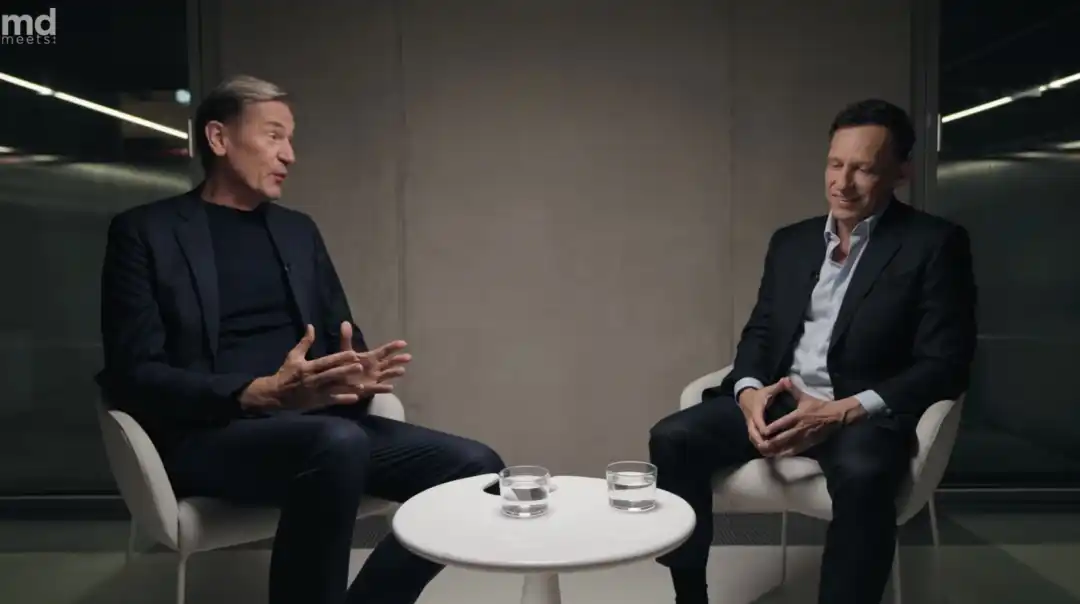
The following is the interview content
The Stagnation Thesis
Q: You have consistently emphasized over the past few years that the West lacks sufficient technological breakthroughs, even directly using the word "stagnation." But today, public discussion is focused on the exact opposite; people feel AI might be accelerating too fast. Have you changed your mind, or do you still believe current technological progress is far from enough?
Peter Thiel: In some sense, I have changed my mind. But first, let's step back to the "stagnation thesis" I proposed twenty years ago.
Measuring technological development comprehensively is extremely difficult; the dimensions of science and technology are too vast and complex. But the core logic is quite clear. Since the 1970s, the overall pace of technological development has slowed down.
Computers, the internet, mobile internet, software—these represent our frenetic progress in the world of "bits." But in the world of "atoms," physical breakthroughs have been minimal.
Most engineering disciplines dealing with atoms are no longer even career tracks young people pursue for success. Mechanical engineering, chemical engineering, aerospace—all are receding. As for nuclear engineering, it has been widely seen as a poor career choice since the 1980s.
For various reasons, this slowdown has genuinely happened. In my view, it is precisely this comprehensive technological stagnation that lies at the root of many systemic crises in modern society.
For example, why is politics becoming increasingly polarized? Because when the economy loses positive growth, every winner's gain implies a loser's loss. Society degenerates into a pure zero-sum game, and the overall ecosystem rapidly deteriorates.
Looking at a longer historical cycle, we have been stuck in this stagnant quagmire for decades. The late 1990s internet was a massive growth engine, surpassing anything before in scale, but it still failed to propel the entire civilization into the next stage of qualitative change.
Perhaps today, the scale of AI is even larger than the internet's. At the very least, it has the potential to reignite positive growth—whether that brings honey or poison.
But the reason I still defend the "stagnation thesis" is that, precisely because of AI's emergence, today, no one comes to refute my statement anymore: "For the decades before this, we were essentially treading water."
Extinction Probability
Q: In recent weeks, Dario Amodei, Sam Altman, and Elon Musk jointly issued warnings, saying "this monster could spiral completely out of control." How do you view this high-profile warning wave? Is it a PR tactic, expectation management ahead of a trillion-dollar IPO, or do they genuinely fear AI surpassing human civilization?
Peter Thiel: The disputes surrounding AI span incredibly complex dimensions.
There certainly exist scenarios that lean towards science fiction yet carry a touch of reality. If you create something vastly more intelligent than the human mind in all aspects, is it possible it could completely derail and slip free from human control?
We've all seen dystopian sci-fi like *The Matrix* or *The Terminator*. Personally, I don't think the probability of such extreme disasters is very high. But from another perspective, even a 5% or 10% probability of annihilation is chilling enough.
The most dangerous consequence of this public discussion is that it directly pushes societal sentiment towards an extremely defensive, even utterly conservative "precautionary" dead end.
Q: If we really calculate by probability, a recent experiment asked the same question to six leading large language models: "Does AI pose a risk of causing human extinction?" The probabilities given by the models ranged between 1% and 10%. Is this merely the models absorbing human-projected pessimism, or is it a genuine existential crisis?
Peter Thiel: Let's assume for argument's sake it's a real existential crisis. No one can guarantee the probability is absolutely 0%.
But this absolutely does not mean we must permanently slam on the brakes and retreat into precautionary bunkers. Because if you do nothing for absolute safety, letting civilization stall in all dimensions, this society will instantly disintegrate.
The only psychological pillar allowing the Western middle class to endure the present is the belief that the next generation will live better than themselves. Our society's core intergenerational contract lies in incremental breakthroughs from one generation to the next—say, growth in material wealth, breakthroughs in healthcare, and upward social mobility.
Once this contract is torn up, the whole society will descend into chaos in a profoundly twisted way.
Zero growth is not neutral. And time cannot flow backward.
Q: But if this danger is real, is hitting the brakes on AI feasible in reality? If the U.S. slows down while the other side of the ocean races ahead, aren't we unilaterally ceding advantage while solving nothing?
Peter Thiel: Theoretically, you can only truly apply the brakes to technology if you achieve genuinely deep, seamless global coordination. But the terrifying premise behind this is that you need a single world government with absolute authority and coercive enforcement power.
My inner classical liberal reminds me that this is jumping from the frying pan into the fire—an even more dangerous cure than the disease itself. A more likely outcome is that we produce a pseudo-global governance system filled with endless transnational meetings and empty declarations.
Another risk is that the West slows down unilaterally while the other side of the ocean races ahead.
The Pope recently issued an encyclical on AI—accurately speaking, an "anti-AI encyclical." Leaders on the other side of the ocean will certainly not listen to the Pope, but millions in the West will take it seriously. The ultimate objective effect is simply to make the Pope a "useful idiot" for the opposing camp.
Q: I've spoken with founders of two leading AI platforms. They insist they have evidence showing the opponent is spreading anti-AI panic through U.S. social platforms to guide public sentiment and expand their own advantage. Have you observed similar signs?
Peter Thiel: I haven't delved deeply into specific chains of evidence, but I'm inclined to believe it's true. However, in my view, this is not the core driver of the situation. What truly drags us into this predicament is precisely what we ourselves are doing within the West.
I'd also like to simply label Greta Thunberg as an agent sent by the opposing camp, but she is entirely a product that grew from within our own Western society.
Q: But is Greta Thunberg's actual impact on U.S. societal sentiment really that powerful?
Peter Thiel: Her own peak influence may have passed, but Western society has inflicted this kind of self-inflicted attrition on itself far too many times.
I have always been a severe critic of China. We must face this great power competition with the utmost seriousness. But often, blaming China for the West's own weakness and failure is too cheap and convenient.
Q: Then why is there such a strong anti-AI wave in the U.S. right now? In Europe, public attitude is quite mild, even positive, as long as they feel they can participate. But in the U.S., generally seen as embracing technology, people protest with placards. Where does this contrast come from?
Peter Thiel: Because the real qualitative technological change is happening in the U.S., and Europe was left behind long ago.
In my coordinate system, Europe lags so far behind it has even lost the possibility of catching up. In the U.S., domestic companies are under immense pressure to completely restructure their businesses with AI. In our business at Palantir, sales growth from U.S. enterprise customers is exploding rapidly. Every company is chased by the urgency of "accelerate or be left behind."
In contrast, a profound inertia still shrouds everything in Europe. They think, "We can wait. What can be pushed to the day after tomorrow, don't do tomorrow."
Bad, Not Evil
Peter Thiel: The public no longer believes tomorrow will be better. All interest conflicts degenerate into brutal zero-sum struggles.
AI is by no means a panacea. But if positive growth cannot be reignited, the base of those parties entrenched at the far left and far right of the political spectrum will only expand further.
Q: Should we stop the moral evaluation of new technologies? Technology is like a knife; it can both chop vegetables and kill. Why do the public and elites habitually subject new technologies to moral judgment?
Peter Thiel: Our moral judgment of technology is far too pervasive.
On the moral scale, the opposite of "Good" is "Evil." But on the functional scale, the opposite of "good" is merely "Bad and Incompetent."
A Ferrari is an "evil" car because its fuel consumption per gallon is shockingly high. But a Trabant (the dilapidated East German car) is a "bad" car because it can barely move on the road.
An evil person, at the very least, possesses the ability to implement their will and achieve their goals.
In Marlowe's *Doctor Faustus*, the protagonist is a charlatan peddling shoddy pseudoscience and ultimately falls into hell. But in Goethe's version, Faust, though he makes a pact with the devil, his actions ultimately lead to genuine creation, and he is ultimately redeemed.
The true failure of society today is filled with badness and incompetence. 99% of political politicians, business titans, and corporate executives are hardly evil; they are merely utterly incompetent. This is the real elephant in the room we should confront.
Incompatible Freedom
Peter Thiel: That was a casual essay I hastily wrote one late night for the Cato Institute's libertarian online publication. Two weeks after publishing it, I wrote a formal clarification.
What I was truly calling for then was a kind of "depoliticization" and "de-intensification" of public life. My criticism was aimed at those libertarian colleagues who put all their chips on "transforming the world by winning elections."
Q: Are you worried about the continued polarization of global society and the systemic collapse of moderate leadership?
The moderate political elites of today underestimate the structural crises triggered by technological stagnation and the rupture of the intergenerational contract. Look at the UK—seven prime ministers in just over a decade, yet not a single one has produced a real plan to reverse social decline.
Q: In the Berlin election, the far-left party (Die Linke) got 25% overall, but among voters aged 16-24, support was as high as 47%. What's your take on this radicalization of the younger generation?
Peter Thiel: You must take seriously the visceral survival plight of the younger generation. In Berlin, rents are exorbitant, new residential construction is blocked everywhere, and young people find they have almost no hope for upward mobility.
Germany and much of Europe have long degenerated into a gerontocracy—a system dominated by and entirely serving the elderly. Extreme parties can gain ground in elections simply because they at least openly discuss the pain points that moderates pretend don't exist, even if the extreme parties' prescriptions are useless.
Q: What about the other end of the spectrum, Germany's AfD (Alternative for Germany)? Do you see it as an alternative form of conservatism, or is it equally concerning?
Peter Thiel: The rise of the AfD essentially reflects the incompetence of the establishment parties—their failure to develop an inclusive economic blueprint for Germany, even lacking the basic ability to balance the budget.
As for foreign policy, there should be full public debate around Ukraine, China, and Israel. But I believe the AfD's answers on all three of these core battlefields are wrong.
Q: In 2016, you were one of the few in Silicon Valley to publicly endorse Trump. Looking back today, how do you analyze the gains and losses of his two terms?
Peter Thiel: Trump's emergence was essentially an inevitable product of the abysmal report card handed in by traditional establishment elites regarding long-term growth stagnation, the aftermath of globalization, and the Middle East geopolitical quagmire.
His first administration was filled with endless bureaucratic factional infighting. By his second administration, he overcorrected, placing loyalty tests above all else, resulting in the selection of executives with severely inadequate professional competence.
Q: You were an early supporter and mentor to J.D. Vance. What irreplaceable qualities did you initially see in him?
Peter Thiel: I have always held a special fondness for truly brilliant minds. Vance is a deeply thoughtful, intellectually open, and highly charismatic individual. He worked at my Mithril fund, wrote *Hillbilly Elegy*, and I supported him when he ran for the Ohio Senate seat in 2022.
Q: Looking ahead to 2028, who do you think will be the core contenders for the two major parties?
Rich as an Argentine
Q: What lessons can Argentina's Javier Milei offer to the struggling Western world?
Peter Thiel: Argentina is a mirror, fully demonstrating where a society goes after experiencing "below-average mediocre growth" for a century. In 1900, "as rich as an Argentine" was a popular phrase.
Milei faces an existential-level problem today. At the macro level, the debt-ridden Western world deep in deficit has only three options: slash spending like Milei, endure socialist-style tax hikes, or kick the debt can down the road with borrowing.
Typical moderate politicians like Germany's Friedrich Merz blindly choose the third path.
Q: Since you repeatedly emphasize you are an "unelectable politician," why do you invest so much thought and energy in politics?
Peter Thiel: I have sufficient self-awareness to know I am absolutely not someone who could run for public office. But the reality is that politics has permeated every pore of society. It's toxic, yet it's the air we have to breathe.
I invest many dimensions of thought in politics because I've always been trying to isolate myself from that toxic air.
Q: In the geopolitical landscape of U.S.-China competition, where should Europe position itself?
Peter Thiel: Europe should be a reliable ally of the United States. It is completely in America's strategic interest for Europe's economic engine to restart and maintain a healthy business cycle.
Looking back to the late 1960s, Europe, by wholeheartedly building the Concorde supersonic airliner, overtook the U.S. in high-end aviation. But in today's AI battle, Europe's lag is even more catastrophic than France's embarrassing attachment to the Minitel network in the 1990s.
Q: Why has Germany, renowned for engineering and manufacturing, not produced a single technology giant with a global foothold for decades?
Peter Thiel: Beyond a conservative culture fearful of failure, the more deep-seated illness here is a "fear of success."
Europe's entrepreneurs and capital never dare to push a company's boundaries to the extreme, never dare to build disruptive mega-machines like Musk or Zuckerberg.
The data is more brutal. Among the 50 richest Americans, 12 belong to Generation X or younger, and 9 of those 12 are purely self-made entrepreneurs.
Among Germany's 50 richest, 20 are from Generation X or younger, but all 20 of those are inheritors of family wealth.
For decades, this soil has not produced a single new, scaled, trillion-euro tech giant.
Outsiders, the Physical Body, and the Antichrist
Q: You once said you try to banish Germany from your mind intellectually, but emotionally you cannot completely erase it. Where does this sense of撕裂 (conflict) come from?
Peter Thiel: I grew up speaking German at home with my parents and grandparents. Germany has always been at the core hub of the European continent and Western civilization. To save the entire West, Germany is crucial.
Q: Talk about your two co-founders, Alex Karp and Max Levchin. What founder qualities do they possess?
Peter Thiel: Top founders often possess an extremely rare dynamic tension of being "Insider/Outsider." They have both the institutional resource channels to enter the heart of power and retain the raw, disruptive drive of an outsider.
Alex Karp and I graduated together from Stanford Law School, belonging to the standard elite insider circle, but his blood always flowed with that of a marginal rebel. Max Levchin arrived in Chicago alone from Ukraine at 16, carrying that nearly ferocious desire to break through.
Q: Why are you so persistently dedicated to contrarian thinking?
Peter Thiel: Contrarian thinking is never about being contrarian for its own sake. Its core lies in defending the ability for independent thought.
In a technological society filled with the narrow specialization of Adam Smith's "pin factory," we must preserve space for generalists who can horizontally connect history, science, economics, and human psychology.
Q: In your personal life, what hobbies do you pursue purely out of passion, with absolutely no commercial justification?
Peter Thiel: Chess. It's a game combining ultimate intellectual beauty with dangerous addiction.
Q: How have four young children reshaped your perception of the world and your temporal horizons?
Peter Thiel: It completely shatters your original time scale. By 2100, my eldest daughter will be 81. When you realize that, your brain is forced to think about what civilization will look like in the 22nd century.
Q: Why do you invest significant resources and attention in the field of health and longevity?
Peter Thiel: Tracing back to the early modern optimism pioneered by Bacon, Franklin, and Condorcet, the most fundamental mission of science was always to completely resolve the human condition, ultimately conquering terminal illness and death itself.
Our collective abandonment of this lofty pursuit today is a shocking civilizational regression. If we reinterpret biology as a foundational information science, then the entire aging process is essentially computable—and reversible.
My current primary investment focus is to completely conquer brain atrophy, dementia, and Alzheimer's disease.
I hold an identity deeply rooted in the physical body, heavily influenced by the Christian tradition. I seek the real extension of bodily life, not slicing and uploading my brain consciousness into some cloud program. Cold code does not constitute the real me.
Q: The final question remains your most famous one. What truth do you believe deeply that almost everyone disagrees with?
Peter Thiel: Three years ago, I began giving a series of public lectures on the "Antichrist." At the time, I thought it must be an extremely unorthodox, provocative, contrarian heresy.
But now I'm gradually realizing its contrarian nature is far less than I imagined. Many people, in private, actually tacitly acknowledge we are entering a nascent global authoritarian system.
At the meta-cognitive level, the true absurdity is that, in public, everyone says the "Antichrist" is the talk of a madman. But when the spotlight is off, they all quietly agree with my assessment in the shadows.
Epilogue
In Silicon Valley, selling the future has always been the most lucrative orthodoxy.
Some sell superintelligence leading to divinity; others sell doomsday indulgences for salvation from destruction.
Peter Thiel wants to buy neither.
Throughout the conversation, his coldest deconstruction was uprooting the reality everyone takes for granted.
The clamor of fifty years of digital prosperity was merely a collective hallucination where bits obscured atoms. The public's moral judgment of new technology is essentially a fig leaf for their own mediocrity and incompetence. And those calls for global governance under the banner of "safety" are without exception hypocritical pathways to a single authoritarian system.
Yet the most striking aspect of this conversation, filled with Faustian bargains, imperial decline, and geopolitical confrontation, was not those grand inferences, but several pauses in Thiel's life.
A venture capitalist who has staked his life's chips on the technological singularity refuses to upload his consciousness to the cloud. A doer who believes in capital and power is addicted late at night only to online chess with zero commercial ROI. And a prophet who has deduced countless zero-sum dead ends recalibrates his temporal coordinates merely because he calculated his eldest daughter will be 81 in the year 2100.
He spent twenty whole years swimming against the tide of his era, finally waiting for AI to confirm the stagnation thesis. But he clearly has no interest in stopping to enjoy this belated vindication.
Sitting in that chair across from Döpfner, Thiel left behind a huge, cool-toned question mark. If technology's frenetic charge is destined to be unstoppable, and human society is inevitably governed by 99% mediocrity, then at the narrow gate leading to the 22nd century, are we rushing toward redemption or toward that endgame everyone secretly acknowledges but dares not speak?
He offered no answer. He didn't even leave a single word of well-wishing.
Just as in the thousands of chess endgames he's played, the clock is still ticking, the pieces have crossed the river, and the true player never leaves the board early.
End of the full text.