The U.S. jobs report fell short of expectations, yet U.S. stocks rose; Treasury yields fell first then rose, with the Nasdaq Composite still closing up 1.2%. If one only explains this day with 'weak data, so rates will fall,' they would miss the most important contradiction in the market movement.
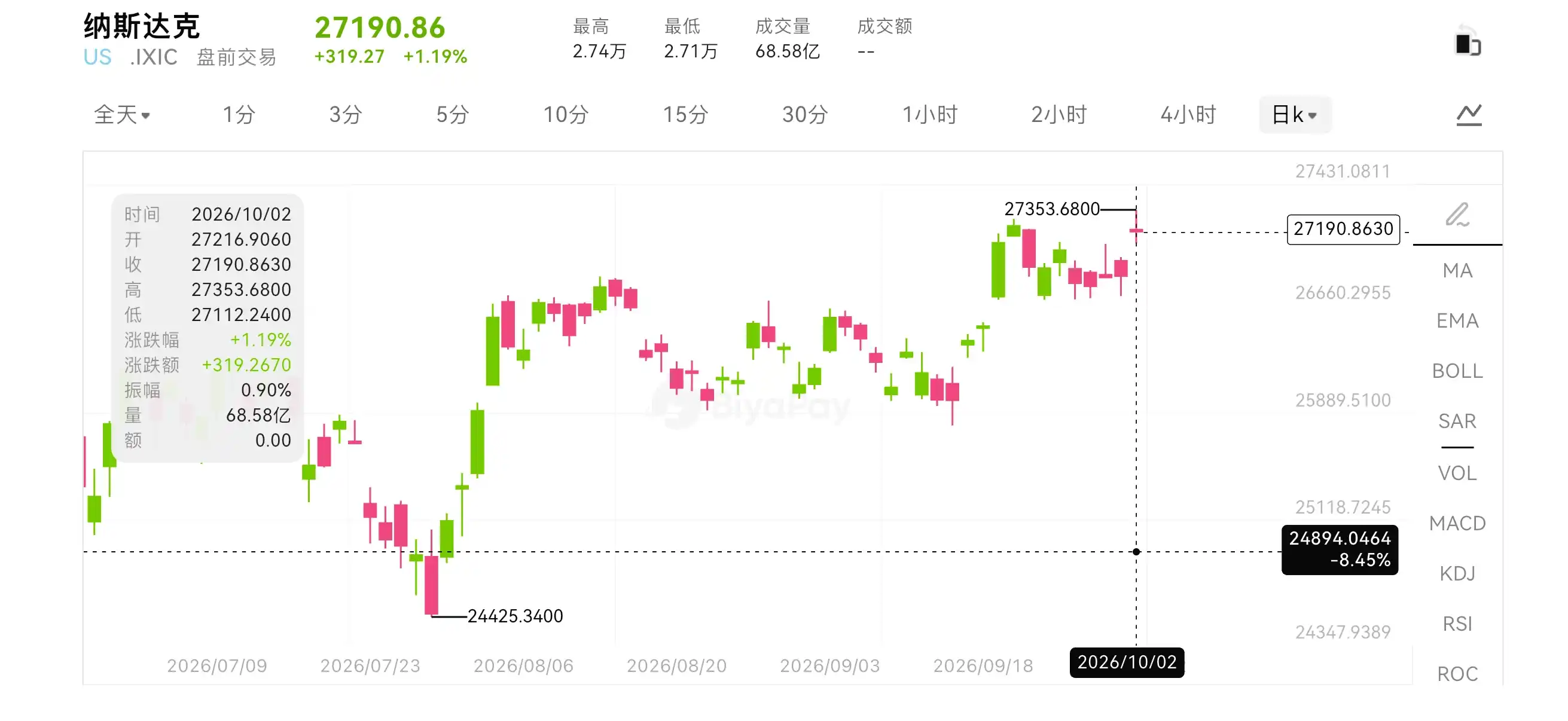
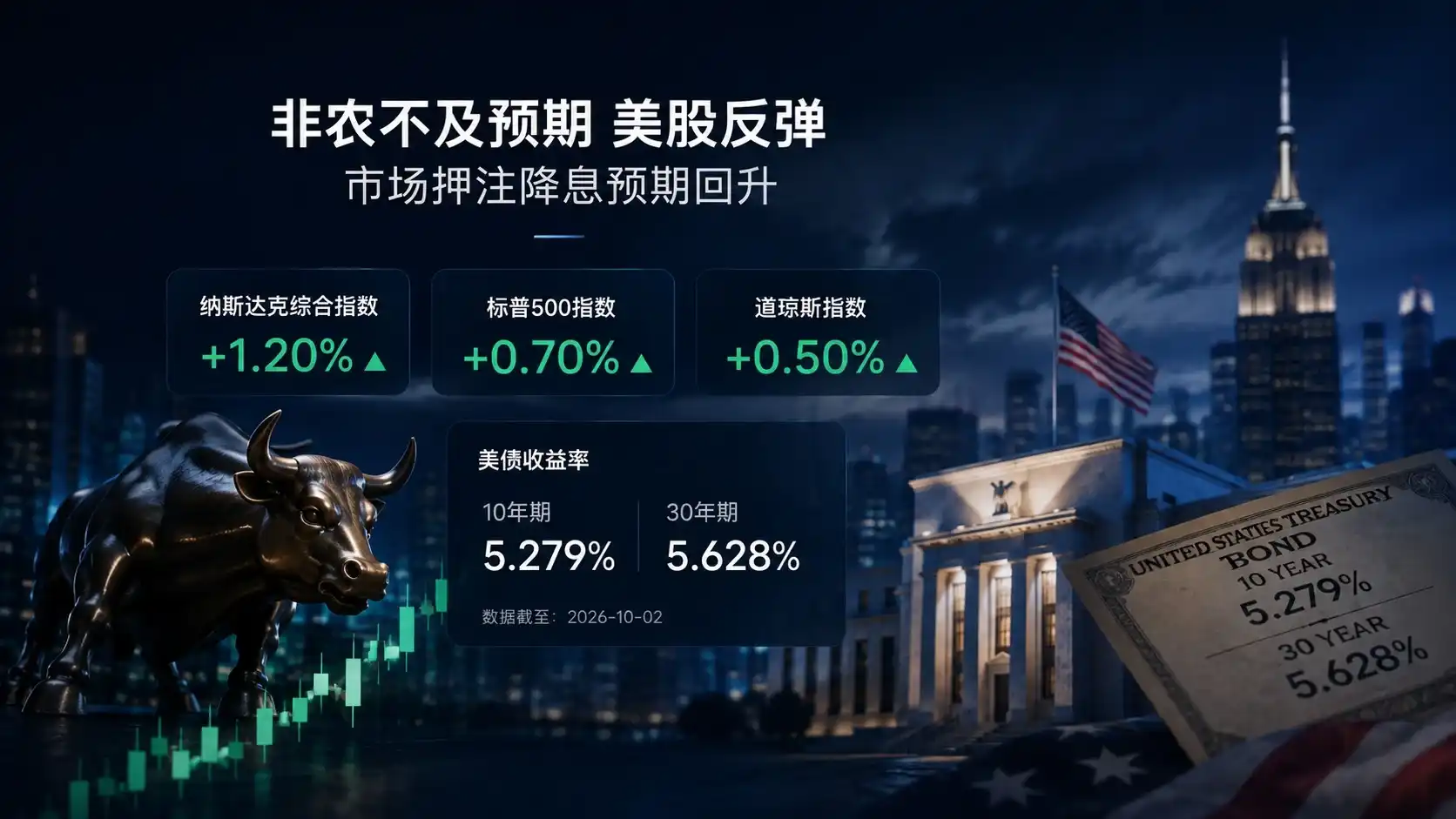
On October 2, BiyaPay market data showed the Nasdaq Composite Index rose 1.2%, the S&P 500 rose 0.7%, and the Dow rose 0.5%. On the same day, the 10-year Treasury yield closed at 5.279%, and the 30-year at 5.628%. The simultaneous rise of stocks and long-end yields indicates that the market has not given a unanimous answer regarding growth, inflation, and funding costs.
It's important to see clearly where the jobs report was weak
Nonfarm payrolls increased by 29,000 in September, lower than the revised 133,000 in August; July was revised down to a loss of 10,000 jobs. The unemployment rate rose to 4.2%, but has remained in the 4.1% to 4.3% range since March. The average monthly job gain over the past three months is about 51,000, slightly higher than the 45,000 monthly average over the past 12 months.
Therefore, the more accurate meaning of this report is that signs of accelerated job growth previously seen by the market were impacted by revisions, and hiring continues at a slow pace. It does not provide sufficient evidence that the economy is rapidly decelerating, nor does it support the judgment of robust growth. This in-between state happens to give the market space to readjust interest rate expectations.
Wages and work hours are also worth examining together. Average hourly earnings rose 0.1% month-over-month and 3% year-over-year in September, with the average workweek at 34.4 hours. These metrics do not show significant wage reacceleration, but they also cannot directly substitute for consumption or inflation data. The jobs report answers questions about the labor market; the Federal Reserve and corporate earnings still face broader information.
When observing such linkages, BiyaPay, as a global one-stop asset allocation platform, allows centralized viewing of market data for U.S. stocks, Hong Kong stocks, BTC, ETH, etc. It supports converting digital currency to USD/HKD, enabling real-time participation in stock trading without applying for an offshore account. Combined with public Treasury and macroeconomic data, it becomes easier to compare how different markets react to the same piece of news.
Bad news can boost the stock market, but there's a prerequisite
Following the weak employment data, the market reduced bets on further Fed rate hikes. Reports on October 2 showed the implied probability of a 25-basis-point hike at the October meeting was 22.7%, down from 64.2% a week earlier. This number is the futures market's pricing for the future; it constantly changes and should not be interpreted as a predetermined meeting outcome.
Stock prices depend on both future cash flows and the market's required rate of return. If weaker data only reduces the pressure for further tightening without significantly harming corporate revenues, then valuation improvements may take precedence. This is why certain economic data falling short of expectations can sometimes drive stock prices higher.
But this logic has its limits. If employment continues to weaken and transmits to household income, consumption, and corporate orders, earnings expectations will be revised downward. Then, even if the market anticipates lower future interest rates, reduced cash flows and increased risk premiums could offset the valuation benefits. Whether 'bad news is good news for stocks' holds true depends on the degree of the economic slowdown, not a fixed rule.
The rebound in long-term bond yields limits optimistic imagination
The most noteworthy aspect of the bond market that day was that the yield decline after the jobs report did not last. The short end more directly reflects the next few Fed meetings, while the long end also incorporates long-term inflation expectations, term premium, and the market's overall judgment on Treasury supply and economic prospects. Reducing bets on one more hike is not enough to resolve all long-end pressures.
This is also why the federal funds rate cannot be directly substituted for the discount rate in stock valuation. Corporate funding costs also involve credit spreads, and the return required by shareholders includes risk premiums. A more dovish Fed outlook may help valuations; but if long-term bond yields and market risk compensation remain high, companies may not immediately obtain cheaper financing.
It's also necessary to distinguish between nominal and real interest rates. Simply seeing the 10-year yield rise does not directly mean real rates rose by the same amount; inflation expectations are also changing. For U.S. stocks, what truly affects valuation is the funding cost resulting from the combined action of these factors, not just a single yield number.
AI trades still have support, but companies are diverging
Nvidia hit a new high that day, and HPE was boosted by data center network demand expectations, indicating capital remains focused on AI infrastructure. But in a high-interest-rate environment, growth expectations must withstand stricter financial scrutiny. The gap between orders, profit margins, and cash flow will become a source of divergence in individual stock performance.
Chipmakers need to convert orders into shipments and profits, cloud service providers need to prove that added computing power can generate revenue, and software companies must demonstrate paid demand for AI features. Two companies with similar revenue growth may receive different valuations from the market if one requires continuous heavy capital investment while the other already generates relatively stable cash flow.
Large technology companies also have advantages in cash reserves and financing capabilities; the impact of interest rate changes on them may not be the same as on growth companies with faster cash burn. Grouping all tech stocks under 'rise when rates fall' overlooks business structure, balance sheets, and competitive positioning. A rise in the Nasdaq may include the strength of a few heavyweight companies and does not automatically represent synchronized improvement across the entire growth sector.
After the index rebound, watch if earnings can meet expectations
To judge the sustainability of this rebound, besides index gains, one must see if the rally has broadened to more sectors, whether earnings expectations have improved, and if earnings guidance supports current prices. If the index is mainly driven by a few heavyweight stocks while revenue and profit expectations for more companies are still being revised down, the foundation of the rally will be relatively concentrated.
Different paths lie ahead. If employment cools moderately alongside inflation easing, and corporate profits hold up, valuations may gain more room; if growth weakens noticeably, the market will worry about earnings; if inflation rebounds or long-term rates remain high, valuation pressure could reemerge. These paths require verification by subsequent data; it's impossible to choose one based solely on one nonfarm payroll report.
The October 2nd rise shows the market is willing to reprice for reduced rate hike pressure. But the closing performance of Treasuries also reminds the market that funding costs have not disappeared. Whether the U.S. stock rebound can continue ultimately depends on whether companies can deliver the growth already priced in, and whether the interest rate environment leaves enough valuation space for that growth.