Moore Threads Plunges 20% to Limit Down in Early Trading, Company Responds

marsbitPublished on 2026-09-07Last updated on 2026-09-07

Abstract

On September 7th, China's domestic GPU maker Moore Threads' stock price hit the 20% daily limit-down during morning trading on the Sci-Tech Innovation Board (STAR Market). This marked the first such steep decline since its listing in December 2025. The immediate trigger was a large-scale unlocking of restricted shares. A total of 25.77 million IPO-related shares became tradable, representing 5.48% of the total shares and an estimated market value of approximately 13.39 billion yuan. This nearly doubled the company's tradable share count, placing significant short-term selling pressure on the market. In response, the company's securities affairs representative stated that the unlocking was a normal post-IPO event, with the shares primarily held by institutional investors from the initial offering. The company emphasized its operations remain normal with no major changes to its fundamentals, urging investors to view the price volatility rationally. Financially, Moore Threads' latest half-year report showed strong growth. Revenue for the first half of 2026 reached 1.74 billion yuan, a 147.42% year-on-year increase, surpassing its full-year 2025 revenue. While still reporting a net loss, the loss narrowed significantly compared to the same period last year. As a key player in China's domestic GPU sector, the company continues to advance its product lines for desktops and data centers. Market analysts note that while share unlockings cause short-term volatility, long-term stoc...

On September 7th, domestic GPU company Moore Threads hit the 20% limit down in early trading on the STAR Market. This marks the first time the company has experienced a 20% limit down since its listing on the STAR Market in December 2025.

As of the midday close, the company's stock price stood at 415.48 yuan, down 103.87 yuan or 20.00% from the previous trading day. Its total market capitalization fell below the 200 billion yuan mark, settling at approximately 195.3 billion yuan.
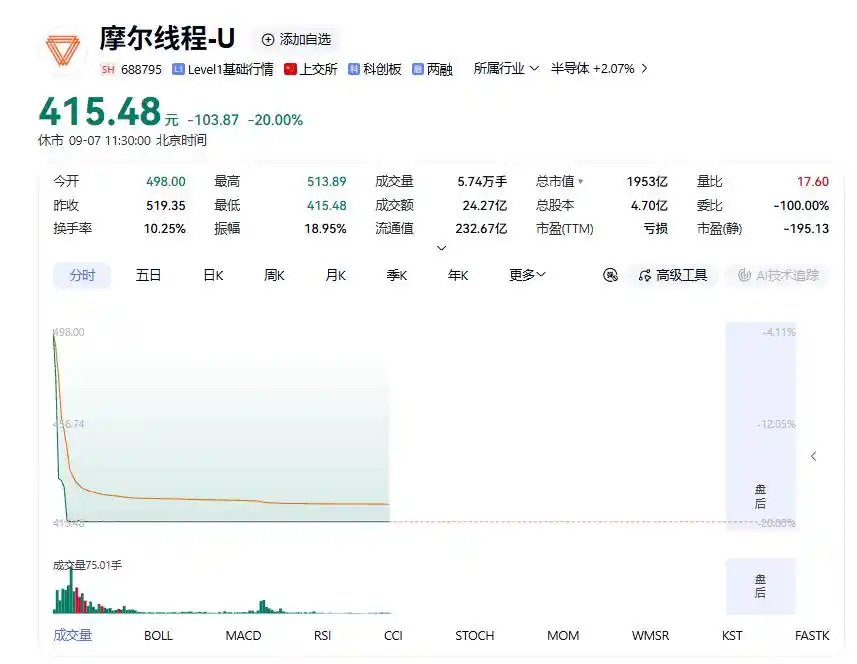
The direct trigger for this sharp stock price movement was the large-scale lifting of sales restrictions on shares. According to the company's previous announcement, on September 7th, a total of 25.7745 million shares of IPO offline placement shares became tradable upon the lifting of their sales restrictions. These shares account for 5.48% of the company's total share capital and were subject to a lock-up period of 9 months from the listing date. Based on the closing price of 519.35 yuan per share on September 4th, the market value corresponding to this batch of shares is approximately 13.386 billion yuan.

Prior to this lifting, Moore Threads had only 30.2255 million shares in public circulation. After the restriction lift, the number of publicly traded shares will increase to 56 million, nearly doubling the public float. For STAR Market stocks, which are often newly listed and have a relatively small public float, such a concentrated release of a large volume of tradable shares created significant selling pressure in the secondary market in the short term, serving as the core driver behind the stock price hitting the limit down.

From a broader market perspective, according to Wind data, a total of 16 listed companies had restricted shares becoming tradable on September 7th, with a combined volume of 521 million shares and a corresponding market value of approximately 27.785 billion yuan. Moore Threads' lifted shares were among the largest in terms of value on that day.

In response to the limit-down incident, Moore Threads quickly issued an official statement.

The company's securities affairs representative stated in an interview with the media that the day marked the lifting of restrictions on a large volume of shares from the offline placement during the IPO, which is a normal post-listing capital market event. The shares becoming tradable mainly belong to mutual fund institutions and offline investors who participated in the IPO subscription. The representative also emphasized that the company's current production and operations are normal, with no significant changes in its fundamentals. The company called on investors to rationally view the stock price fluctuations caused by the lifting and make rational investment decisions.

Other company personnel also told the media that this lifting of restrictions represents the normal expiration of the lock-up period for IPO shares, and the market does not need to overinterpret it.

From an operational perspective, the company's latest interim report data supports the assessment of stable fundamentals.

In the first half of 2026, Moore Threads achieved operating revenue of 1.736 billion yuan, a significant year-on-year increase of 147.42%, with revenue scale already surpassing the full-year 2025 level. Gross profit reached 989 million yuan, up 103.78% year-on-year, indicating synchronized improvement in profitability. On the profit front, the company's net profit attributable to shareholders and net profit attributable to shareholders after deducting non-recurring items narrowed by 95.73% and 52.37% year-on-year, respectively, showing significant reduction in losses and continuous improvement in profitability.

As a core player in the domestic GPU sector, Moore Threads continues to advance its product line layout in areas such as desktop graphics cards and data center GPUs. The industry logic of import substitution remains a long-term focus for the market.

It is worth noting that this lifting of restrictions is not the largest one for Moore Threads post-listing.

According to the IPO prospectus schedule, on December 7th, 2026, the company will face an even larger wave of lifted restrictions, with 185.9064 million restricted shares becoming tradable, accounting for 39.55% of the total share capital, leading to a more substantial expansion of the public float.

Some market analysts point out that short-term stock price volatility caused by the lifting of share restrictions is a normal market phenomenon. The medium- to long-term trend of a stock ultimately depends on the company's fundamentals and industry growth logic. Future developments in domestic GPU technology iteration and commercialization progress will be the core variables affecting the company's valuation.

Source: Galaxy Business Observation

This article is from "ZAKER Finance"

Related Questions

QWhat directly triggered the 20% drop in MTT's stock price?

AThe direct trigger was the large-scale lifting of trading restrictions (解禁) on locked-up shares from the initial public offering's offline placement. Approximately 25.7745 million shares, accounting for 5.48% of the total shares, became tradable.

QAccording to the company, what is the current status of its fundamental operations?

AAccording to the company's official response, its production and operations are normal, and there have been no significant changes to its fundamentals. Its latest semi-annual report also shows a significant year-on-year increase in revenue and a notable narrowing of losses.

QWhat major shareholder event is expected for Moore Threads in December 2026?

AAccording to the company's prospectus, a much larger-scale lifting of trading restrictions on locked-up shares is expected on December 7, 2026. Approximately 185.9064 million shares, representing 39.55% of the total shares, will become tradable, significantly increasing the free float.

QHow did the lifting of trading restrictions on September 7th affect Moore Threads' free float of shares?

APrior to the lifting, Moore Threads' free float was 30.2255 million shares. After the 25.7745 million shares were added, the free float increased to approximately 56 million shares, nearly doubling in size.

QWhat are the key factors mentioned in the article that will influence Moore Threads' valuation in the long run?

AThe article states that the company's long-term valuation will ultimately depend on its fundamental performance and industry growth logic. Specifically, the progress in technological iteration and the commercial adoption of its domestic (Chinese) GPU products are highlighted as the core variables.

Related Reads

Mercado Bitcoin begins post-hack reopening without a timeline for withdrawals

Mercado Bitcoin, one of Brazil's largest crypto exchanges, began restoring read-only access to customer accounts in phases on Monday, a week after attackers drained an estimated $49 million from the platform. Access started at 19:00 UTC, with all accounts expected to be viewable by 21:00 UTC, showing holdings as they stood on Nov. 2, the day of the hack. The exchange has yet to say when customers will be able to withdraw funds. Fabricio Tota, vice president of new business, said the exchange hoped read-only access would reassure customers that their assets were still recorded on the platform. He explained that the company opted for "a more conservative approach" to reactivating accounts "to ensure our return happens with the utmost security." The caution follows concerns from blockchain security analysts that attackers were able to access addresses, draining funds through standard transfers rather than a smart contract exploit. Blockchain analysts traced some of the stolen funds to customer deposit addresses, but Mercado Bitcoin says customers won't bear the losses. Tota said the vast majority of assets were never even touched by anyone and were not involved in the incident. On Nov. 4, Mercado Bitcoin pledged to cover all losses with company funds, bolstered by a $20 million investment from stablecoin issuer Tether in July. Tota highlighted that a portion of the stolen funds were also frozen in the hours after the company announced the attack. The next phase of recovery will require users to confirm their registration details before they can move funds. The exchange plans to restore withdrawals via Pix, Brazil's instant payment system, initially allowing customers to withdraw only to accounts in their own name. Tota gave no date for either step. Mercado Bitcoin has yet to explain how the attackers gained access to its wallets. Blockchain data company Bitquery found that as of Nov. 4, wallets linked to the attacker held most of the stolen funds that had escaped freezes, including 106.07 BTC.

cointelegraph2h ago

Mercado Bitcoin begins post-hack reopening without a timeline for withdrawals

cointelegraph2h ago

Avalanche’s AVAX leads crypto gains following NYSE tokenization deal

Avalanche's AVAX token rose as much as 10% on Monday, becoming the top gainer among the 100 largest cryptocurrencies, after the New York Stock Exchange announced plans to use Avalanche's blockchain to settle trades on a new platform for trading tokenized stocks around the clock. AVAX later eased to $8.86, still up over 8% on the day, with a market cap of around $3.95 billion and $439.7 million traded in the past 24 hours. Avalanche's total value locked stands at $633 million, up 4% over the past day. NYSE's head of digital issuance, Dennis Lee, said the exchange is examining how blockchain technology can expand its equities offerings and is picking the right technology for each job. The deal underscores Wall Street's growing effort to use blockchain to make stock trading faster and enable trading outside regular market hours; traditional US markets are open 9:30 am to 4:00 pm EST on weekdays, with trades often taking at least one business day to settle. The NYSE first announced plans for the platform in January, and Ava Labs revealed in September that the exchange had spent about a year testing Avalanche, though the final selection was not confirmed until Monday. Avalanche will record stock trades and help complete transactions on the platform, which will let investors buy and sell digital versions of stocks across different blockchains. Lee said the settlement ledger needs to be fast, reliable, permissioned, cost-predictable, and backed by a large developer community—all of which Avalanche meets. The platform could launch before the end of 2026 pending regulatory approval. Ava Labs chief business officer John Nahas said first conversations with the NYSE began nearly a year ago and called it an important step toward blockchain becoming foundational financial infrastructure. The news comes as other major firms invest in blockchain for faster, round-the-clock trading: Nasdaq plans to invest $100 million in Kraken's parent Payward to launch tokenized stocks by Q2 2027, and the DTCC launched a service in October allowing firms to turn traditional securities into digital tokens. The NYSE deal follows other efforts to bring traditional assets onto Avalanche, including Progmat moving over 452 billion yen in digital securities onto a dedicated Avalanche blockchain in July and Aave Labs' plans for a lending service using tokenized assets as collateral.

cointelegraph3h ago

Avalanche’s AVAX leads crypto gains following NYSE tokenization deal

cointelegraph3h ago

Trading

Spot
活动图片