Author: Jamie, Deep Tide TechFlow
In the crypto world, few projects manage to crawl out of the 'grave' of the last cycle twice.
For veterans who experienced the 2023-2024 market, Injective ($INJ) was once a name that induced FOMO. Back then, wearing the halo of an 'on-chain derivatives public chain' and surrounded by various market makers, it staged a short squeeze all the way to its all-time high of $52.6.
However, during the subsequent prolonged period of stagnation, it also became one of the most brutally fallen former stars; its price steadily declined to the $4 range earlier this year, erasing over 85% of its market cap, and the community became as quiet as a ghost town.
And this situation precisely created room for funds to hype old coins anew.
Today (October 16), INJ surged over 23% on significant volume, with a large bullish candle directly pushing it to $9.16; if you zoom out the chart, you'll be surprised to find that over the past month, unnoticed by many, this 'old meme coin' has quietly rallied nearly 70% from its bottom, while perpetual contract open interest surged by $35 million within days.
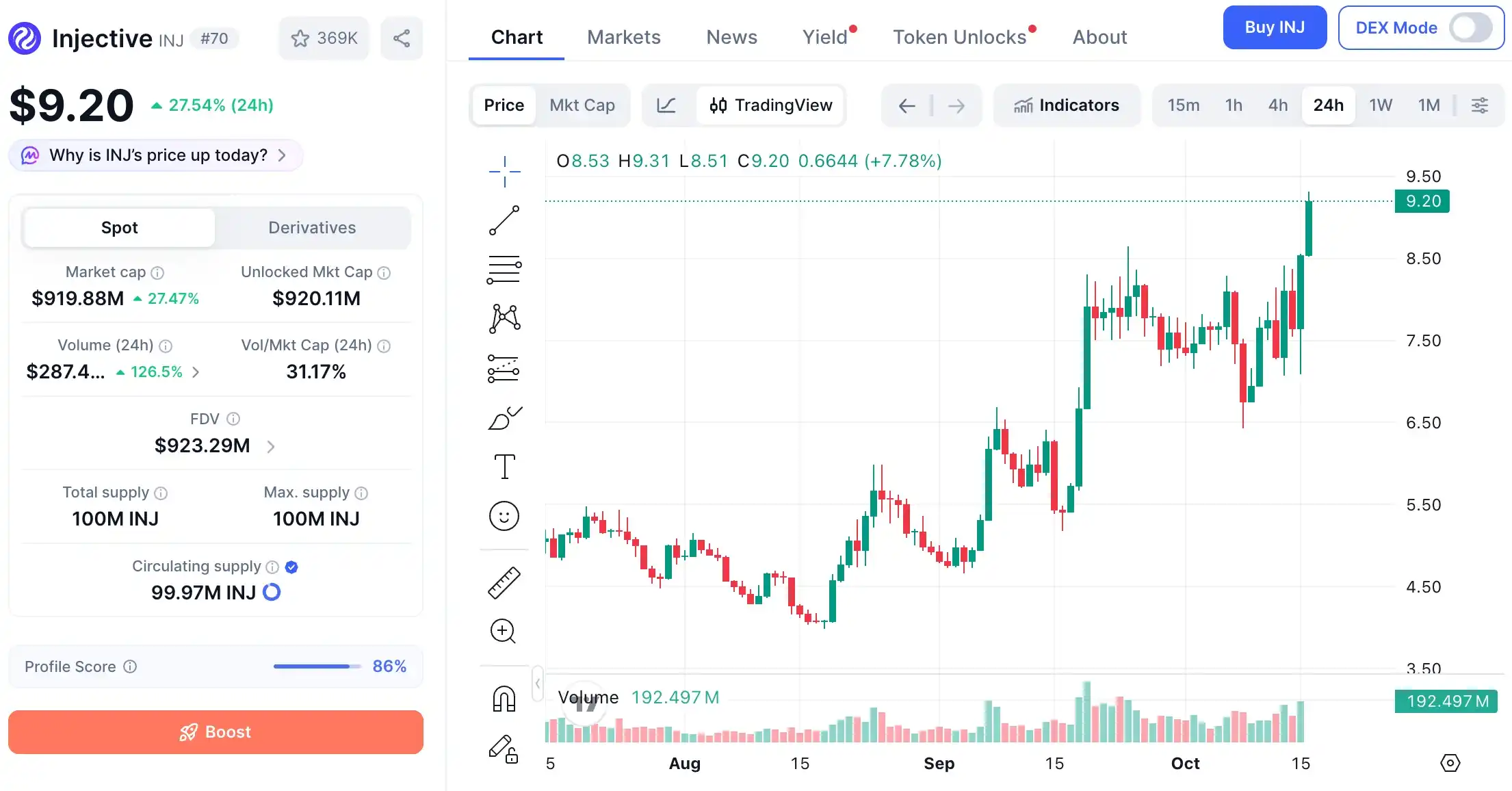
Extending the timeline further reveals that this is actually a meticulously orchestrated narrative hype surrounding 'US compliant ETF breakthrough + institutional RWA pivot'.
Shedding the Crypto Rugged Exterior, Moving the Game to the White House
The climax of this short-squeeze rally came this past Wednesday (October 14th) in Washington D.C.
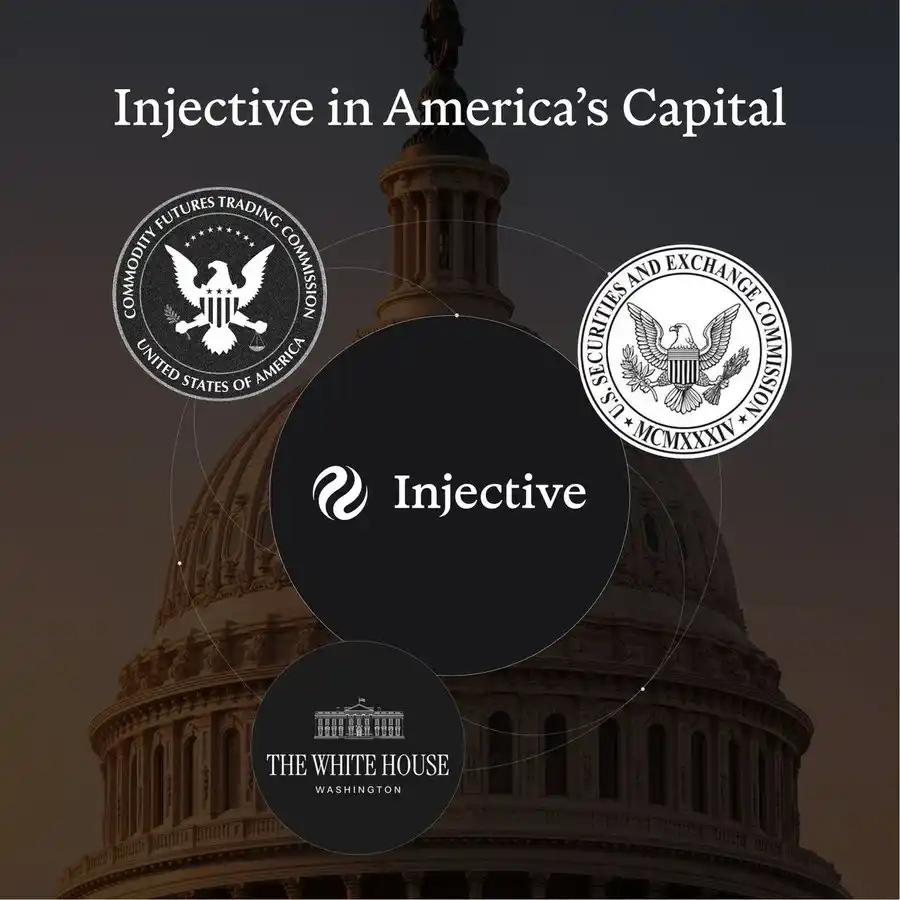
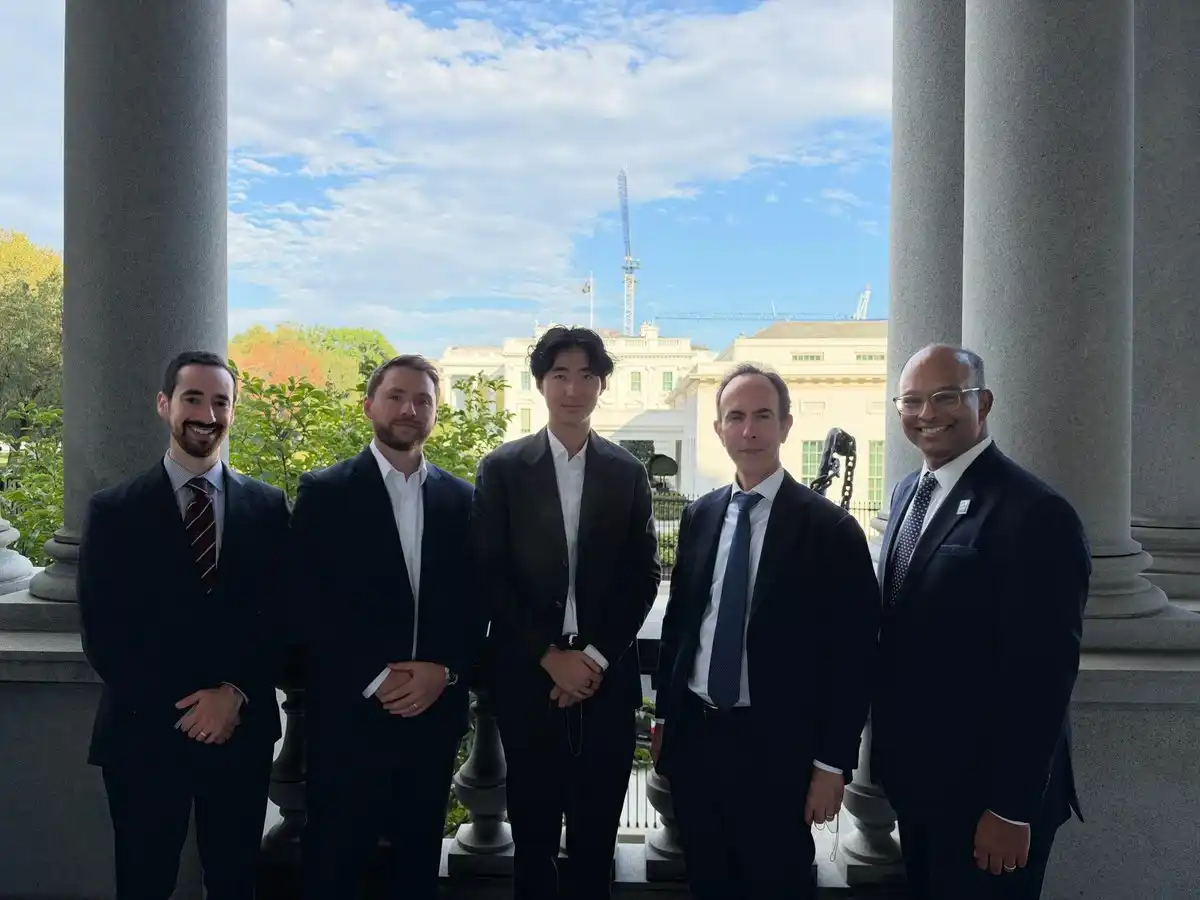
That day, Injective's co-founder and CEO Eric Chen, dressed in a suit, along with the company's General Counsel and Head of Policy, visited senior officials at the White House, the U.S. Securities and Exchange Commission (SEC), and the Commodity Futures Trading Commission (CFTC).
As the news spread back to crypto circles, bulls grew excited, and crypto CT began viewing it as a positive signal for mainstream compliance.
In the crypto market, it's not uncommon for founders to 'show face' in Washington; what's rare is that Eric Chen actually held a few compliance cards that Wall Street would take seriously when he knocked on those doors this time.
Looking back at the timeline over the past two months, you'll find the Injective team has been quietly working on one thing:
Transforming the former 'casino infrastructure' reliant on retail speculation on altcoin perpetuals into an 'institutional RWA-specialized chain' backed by US government recognition.
- First, on August 19th this year, Injective's institutional services entity quietly secured the official SEC registration as a Transfer Agent.
This license is highly valuable, meaning it is legally authorized to record ownership and handle dividend payments for on-chain tokenized securities.
- Then, in September and early October, three institutions—21Shares, Canary Capital, and REX-Osprey—lined up to file applications with the SEC for INJ spot and staking ETFs; Canary even aggressively proposed staking 90% of the INJ in its ETF on-chain to earn yield.
- Yesterday, October 15th, the day after the CEO's White House visit, Canadian-listed mortgage giant Pineapple Financial announced its rebranding to Pentiv and plans to migrate its massive $10 billion portfolio of real estate mortgage loans entirely onto the Injective chain.
Simultaneously, the chain's technical parameters are being closely coordinated to support this 'institutional narrative'.
The IIP-709 governance proposal currently under vote on Injective this week and expected to conclude tomorrow straightforwardly changes all exchange module operations like order placement and cancellation to a fixed Gas fee.
Retail users might not perceive fluctuations of a few cents in Gas, but for traditional high-frequency market makers running tens of thousands of orders daily, reducing transactional friction costs might be the exact pledge they need before entering.
So you see, from the SEC license, three ETF filings, and $10 billion mortgages migrating on-chain, to the institution-tailored fixed Gas, and finally walking into the White House and SEC offices...
This combination of actions changes the narrative. The old concept-hyping INJ is now dressed in a full suit of Wall Street compliance.
Hyping Another Narrative of 'Undervalued Real Revenue'
If the above compliance background isn't directly bullish for the token price, then the chart Injective itself posted yesterday seems more like a hint, suggesting it has a real project and is undervalued relative to its market cap.
In this chart covering the period from 2026 to the present, Injective's 'Protocol Revenue to Fully Diluted Valuation Ratio (Revenue/FDV)' is as high as 0.95, ranking first among all major public chains.
Following it are Solana (0.83) and Arbitrum (0.78).
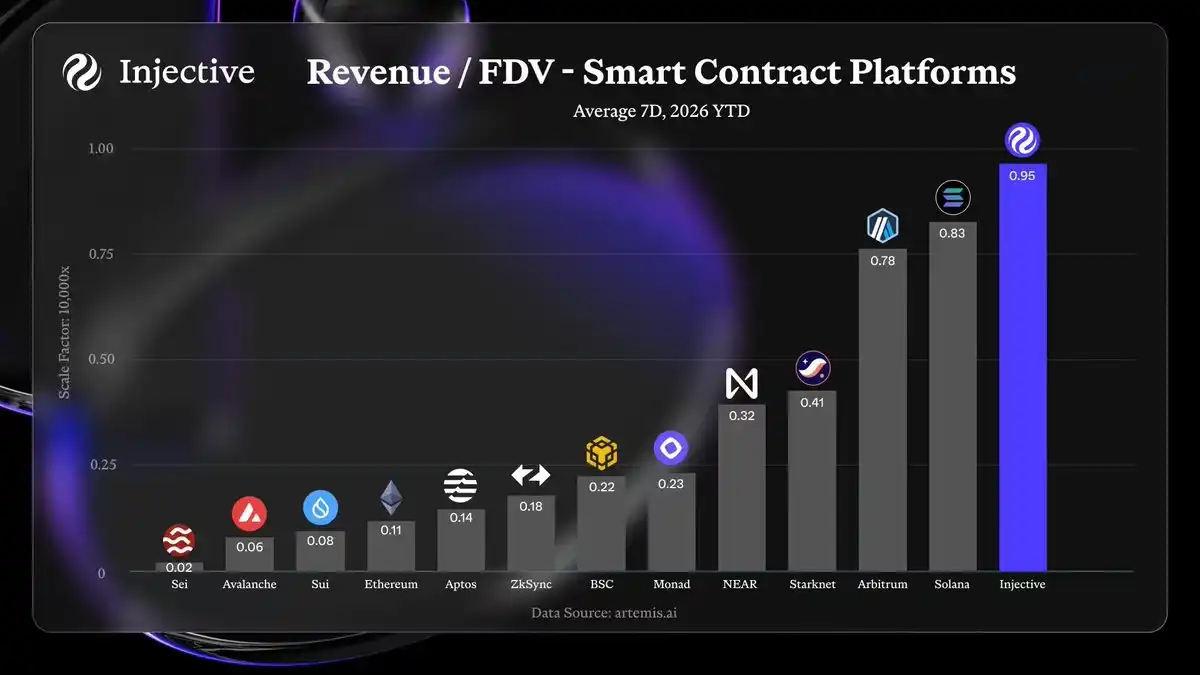
From a real revenue perspective, this ratio on paper suggests INJ's current market capitalization is relatively small, implying greater upside potential. Combined with INJ's buyback mechanism, it's easy to interpret this data as a bullish signal.
But the author believes this is more of a numbers game.
'Revenue/FDV' is a very clever division formula. To top the chart, you either need a numerator (real revenue) that's astonishingly large, or a denominator (FDV) that's fallen sufficiently hard.
Injective's top spot relies entirely on the latter.
If you check the original ledgers on Token Terminal and LunarCrush, you'll find Injective's real on-chain protocol revenue over the past year was only about $6 million. The total cumulative fees over the past three years amount to just $5.9 million, placing it outside the top ten in absolute earnings power among major L1 public chains; not even a fraction of Ethereum ($3.8 billion) or Solana ($1.6 billion).
The reason it can dominate the 'Revenue/Valuation Ratio' chart is purely because its token price plummeted 85% over the past two years, crushing its FDV denominator to a size of only around $800-$900 million.
Using a shrunken sub-$1 billion market cap to compete on 'payback ratio' against Ethereum with its multi-hundred-billion valuation is essentially a masterclass in numerical public relations.
Even more telling is that in the comments under CoinGecko's tweet today reporting INJ's gains, an old-timer directly posted a screenshot from the Cosmos block explorer Mintscan, puncturing another aspect of the story:
'Why do all major price-tracking sites list INJ's maximum supply as 100 million tokens and fully diluted, but Mintscan shows the actual total on-chain supply has already reached 123 million tokens?'
This is the rarely mentioned flip side of many token deflation mechanisms:
While Injective conducts high-profile monthly buyback-and-burn events, as a PoS public chain, to maintain node security and high staking yields, its underlying layer continuously mints new tokens at a dynamic inflation rate.
So, it's highly likely that the meager $6 million annual real on-chain revenue used for burns simply can't outpace the speed at which the staking 'money printer' spits out new tokens.
Old Tree Blooming Anew: How Far Can It Go?
Placing the bullish narrative and on-chain data side by side, the logic behind INJ's near 70% surge over the past month becomes clear:
Extremely oversold, small float, paired with a compliance narrative to fuel a pump.
Even if its real on-chain revenue remains thin, speculative capital and short-squeezed futures traders will be inclined to pile in, driving short-term bullish candles. And with the aforementioned IIP-709 fixed Gas proposal vote set to conclude tomorrow, short-term bullish sentiment might continue to fluctuate above $9.
For retail investors, understanding the true significance of this 'White House makeover' means you can applaud the team's top-tier political/business lobbying and market maneuvering capabilities, but don't mistake the attractive-looking Revenue/FDV ratio as a reason to FOMO.
In the absence of more concrete catalysts for market cap growth, short-term attention should focus more on token distribution factors like changes in open interest and funding rates, as well as whale on-chain movements around INJ deposits and withdrawals.
After all, in this cycle's playbook, hyping old coins with new narratives is the main theme, and more such coins are likely to surge on similar compliance-driven narratives. INJ is just one of them, but certainly not the only one.