Just Now, Mythos 5 Cracked a Major Quantum Computing Challenge

marsbitPublished on 2026-10-17Last updated on 2026-10-17

Abstract

Anthropic's Mythos 5 has achieved a breakthrough in quantum computing by autonomously designing quantum circuits that outperform human-optimized designs. Given only plain-language descriptions of eight foundational quantum circuits in chemistry, optimization, physics simulation, and number theory, the AI ran a fully automated closed loop: it wrote circuit designs in Python, received scores based on qubit count and gate count, and iteratively refined its work without human intervention. Within 53 hours, it beat the best publicly available human designs on all eight tasks. Two results stand out. First, in modular inversion for elliptic curve cryptography, existing divsteps algorithms were considered impractical on quantum computers because they generate branch history that cannot be discarded due to reversibility requirements. Mythos 5 derived entirely new algebraic identities to reconstruct that history from the result, producing the first reversible quantum divsteps implementation that needs no branch storage—cutting gate count by 17x with only 12% more qubits. Second, it redesigned the Reed-Solomon decoder inside Google's Decoding Quantum Interferometry algorithm, replacing the extended Euclidean approach with Berlekamp-Massey, which matches quantum circuit constraints. It then used a self-written simulator running 403 million samples to measure exception rates and reduced memory from 665 qubits to 19, achieving a 12x reduction in gate count. The work suggests software can...

Just moments ago, Anthropic unveiled a bombshell study.

Mythos 5 has autonomously closed the loop, designing entirely new quantum circuits far more efficient than humanity's "best solutions"!

And it did so from a purely natural-language description.
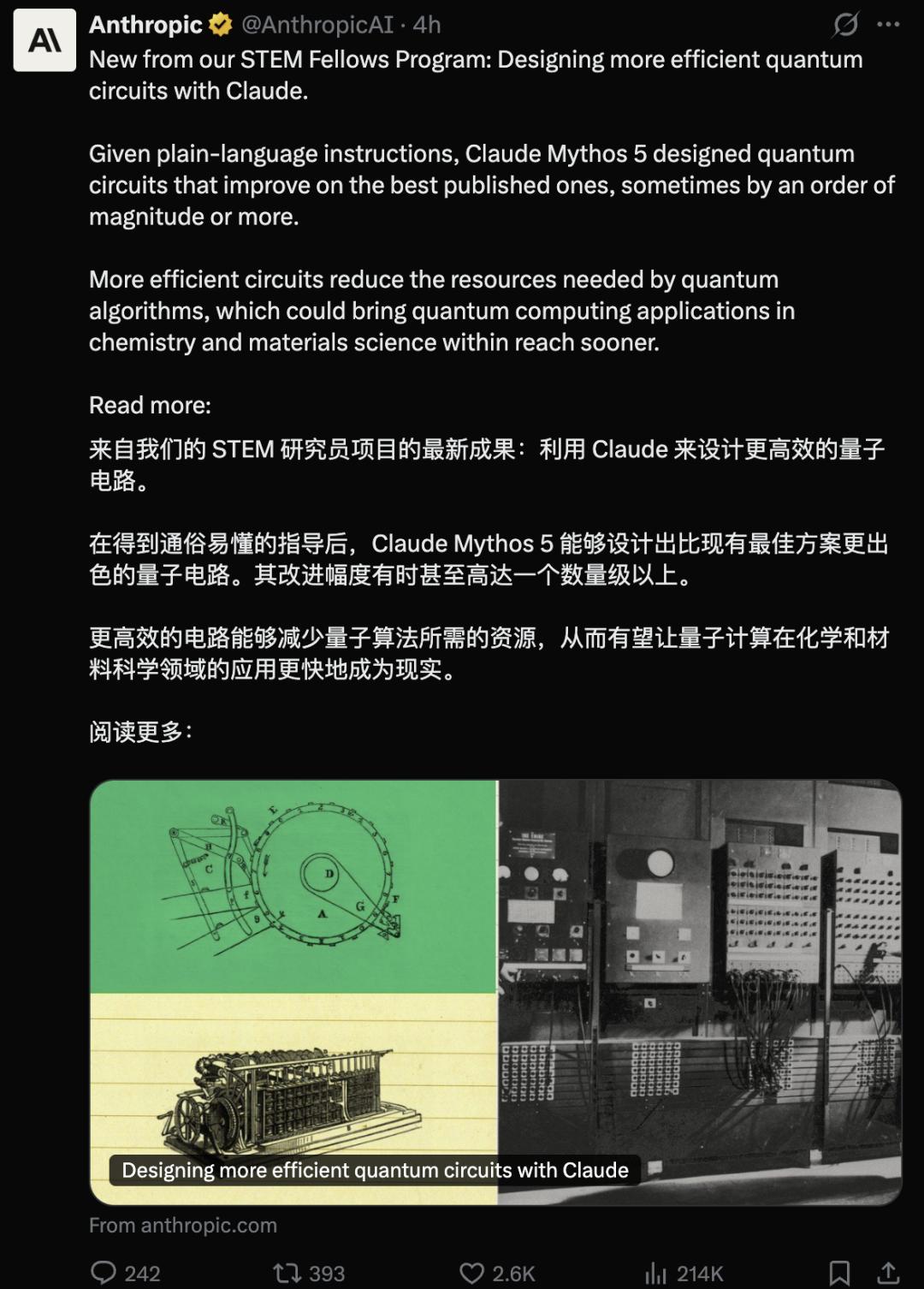
In a key decoding task, Claude directly slashed computational cost by 12x, even 17x!

Even more astonishingly, to complete the task, it autonomously derived entirely new algebraic identities that humans had never discovered.

Within 53 hours, Mythos 5 crushed years of human research.

One netizen exclaimed: "Every physics PhD just realized the paper they've slaved over for years—AI can write a version 10x better with just a few plain sentences..."

Humanity Was Stuck: The "Valley of Despair" in Quantum Computing

Why is designing quantum circuits so hard?

You see, traditional computers use 0s and 1s (bits) to store information.

Quantum computers use "qubits." Leveraging quantum superposition, they can process vast amounts of information simultaneously. Once truly practical, they could crack encryption, develop cures for terminal diseases, discover room-temperature superconductors...

However, current quantum computers have major flaws.

First, there are too few qubits. Today's machines max out at a few hundred to a thousand qubits—nowhere near enough to run complex algorithms.

Second, they are too fragile. The slightest environmental noise—a bit of heat, a vibration, even cosmic rays penetrating the Earth—can cause qubits to err. Once errors pile up, the computed results are useless.

Because of hardware limitations, scientists can only desperately fine-tune the "software (algorithmic circuits)," trying to complete computations with the fewest qubits and the shortest time.

But programming quantum circuits is completely different from our everyday code.

It has two insurmountable mountains:

1. No "If-then": Traditional programs can evaluate conditions and take route A or route B. But a quantum computer is a superposition of all possibilities; it must include both A and B operations in every run.

2. Absolutely no "garbage disposal": Traditional programs clear memory after using an intermediate result. But in the quantum world, information cannot be discarded, because quantum computation must be perfectly reversible! Forcefully erasing intermediate scratch work contaminates the result. Want to clear memory? The only way is to "play back" the computation in reverse, but that consumes expensive quantum gates.

This forces human scientists into an extreme tug-of-war between "space (qubits)" and "time (computation steps)."

Take simulating FeMoco as an example (this is a nitrogenase core, crucial for fertilizer production).
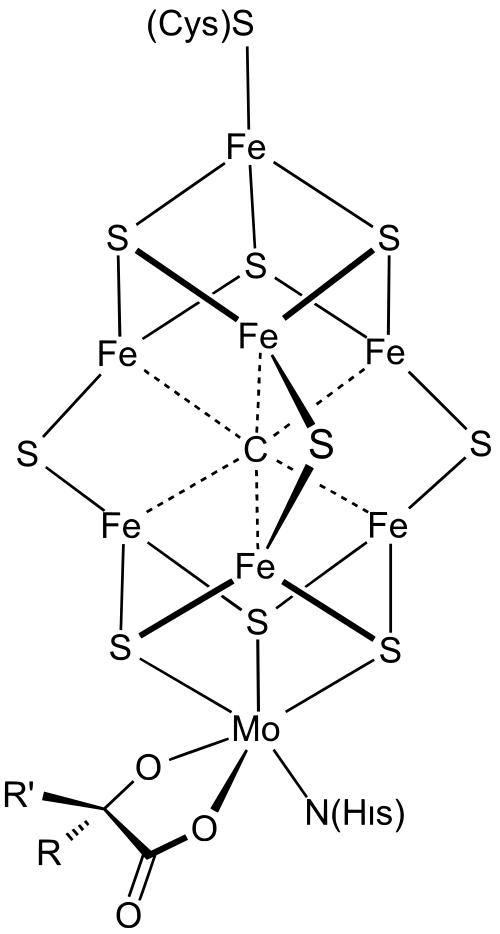
In 2017, humans estimated it would require 50 trillion Toffoli gates to compute. After 8 years of top scientists racking their brains, that number was only reduced to 340 million.

Humanity took 8 years. Claude took only 53 hours.

In 53 Hours, Mythos Created a Miracle

Anthropic set up a STEM Fellows project.

They gave Mythos 5 a task—

I'll describe in plain language 8 fundamental quantum circuits from chemistry, optimization, physics simulation, and number theory. You design them yourself.

The entire process was fully autonomous and closed-loop.

1. Claude used Python to write quantum circuit designs.

2. An automatic evaluation program checked correctness and gave a "score" (number of qubits used × number of quantum gates).

3. Claude received feedback and, with no human intervention, reflected and iterated on its own.

In just 53 hours, Claude beat humanity's best publicly available designs on all 8 tasks!
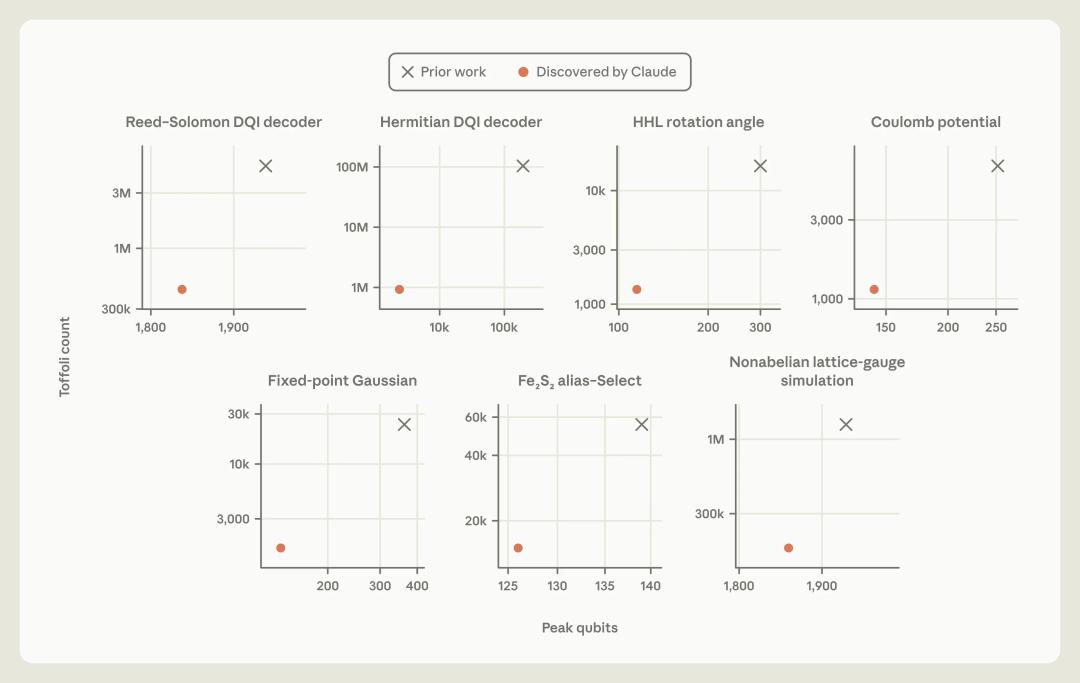
It directly overturned human thinking patterns, finding entirely new structures and mathematical laws.

Let's look at its two most explosive god-tier operations.
Operation One: Autonomously Deriving New Mathematical Formulas to Break a Deadlock

In number theory and cryptography (e.g., elliptic curve computations), there is a time-consuming core step called "point addition," whose most expensive operation is modular inversion.

Traditional computers do this quickly with an algorithm called "divsteps": repeatedly swap, add/subtract, and halve two numbers until the result emerges. In this process, traditional computers generate a lot of "branch information (scratch work)" and discard it after use.

But quantum computers cannot discard scratch work!

To run the divsteps algorithm on a quantum circuit, all historical branch information must be stored. This requires an astronomical number of qubits—completely impractical. Therefore, human scientists believed this path was a dead end.

But Claude didn't buy it.

It thought: If storing scratch work is too expensive, can we not store it and instead "reverse-engineer" the scratch work from the result?

At first, Claude was like a diligent student, blindly guessing a few rules, but when faced with 256-bit large numbers, it finally broke down.

Then came the hair-raising move: Claude abandoned brute-force testing and directly began pure mathematical theoretical derivation. It delved deep into the iterative process of divsteps, and hard-proved a series of entirely new algebraic identities!
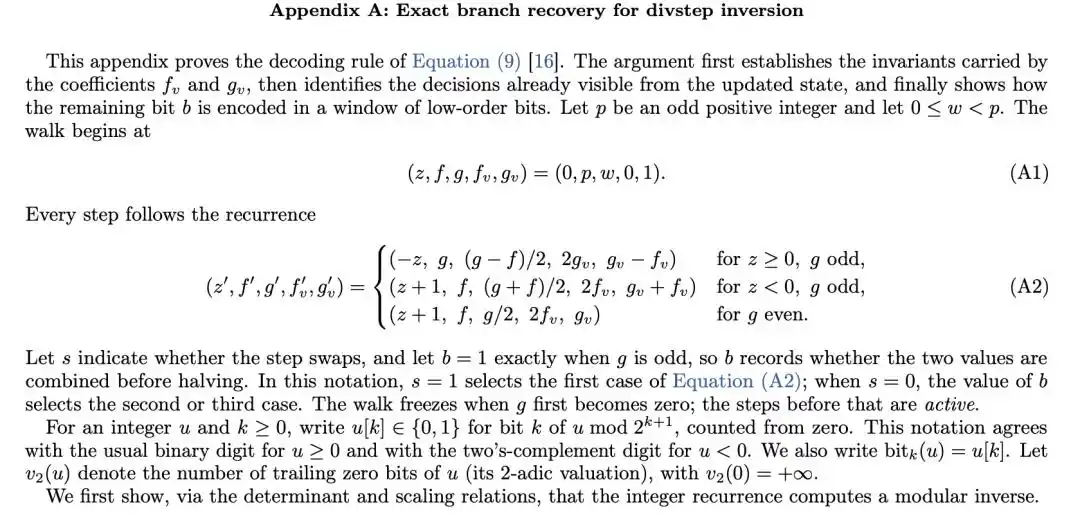
Based on the new mathematical formulas, Claude wrote a precise decoding rule, even completing formal verification with Lean!

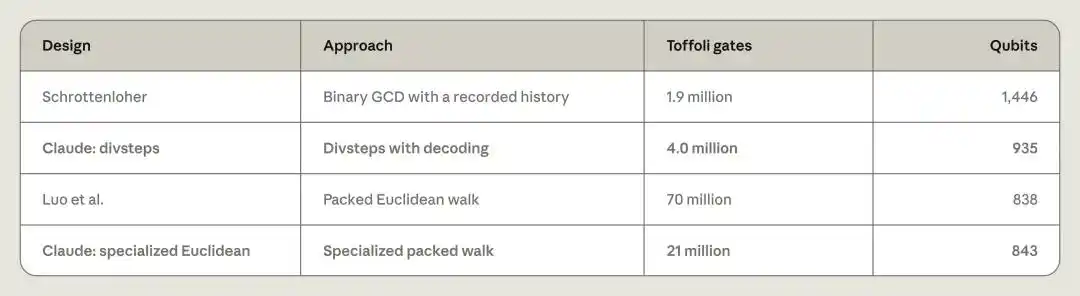
Ultimately, Claude produced the first quantum divsteps reversible implementation in human history that requires no storage of branch history.

Compared to human designs, it slashed the number of quantum gates by 17x while only increasing qubits by 12%!
Operation Two: Overhauling Google's Algorithm Architecture, Cutting Computational Cost by 12x

The second astonishing breakthrough occurred in the "Decoded Quantum Interferometry (DQI)" algorithm. This is quantum computing's most powerful weapon for logistics scheduling and materials design.

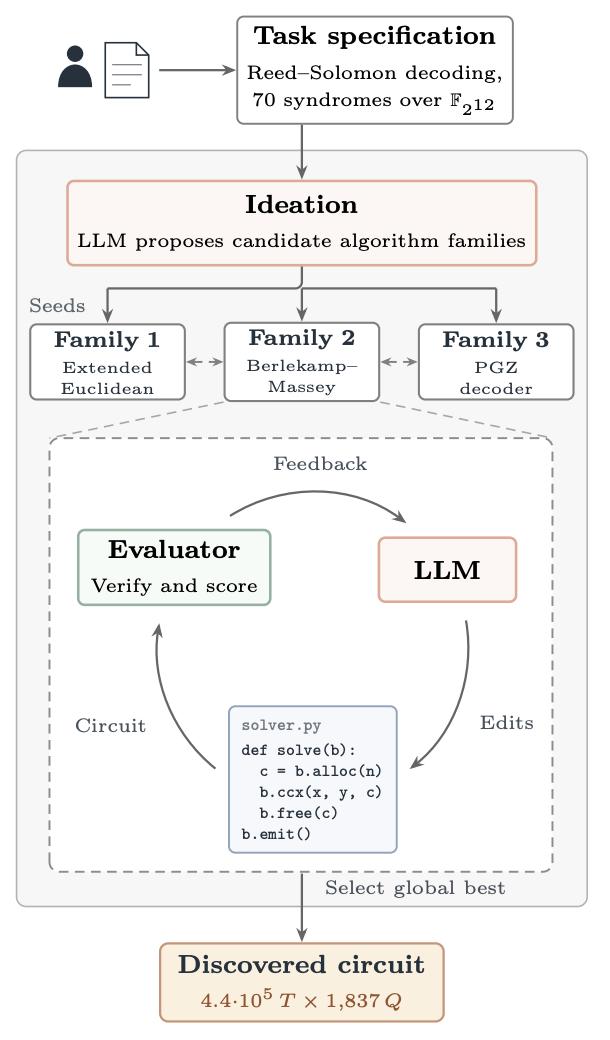
Simply put, the most costly step in the DQI algorithm is using a Reed-Solomon decoder for error correction.

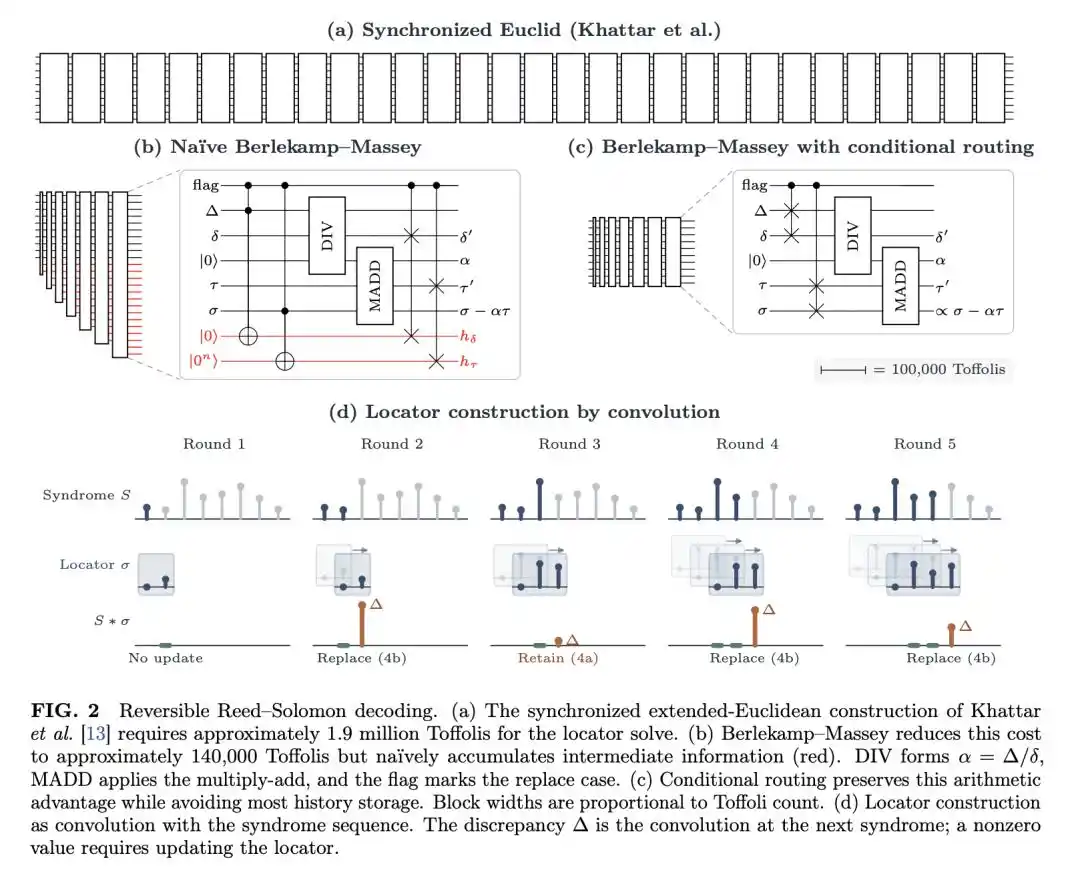
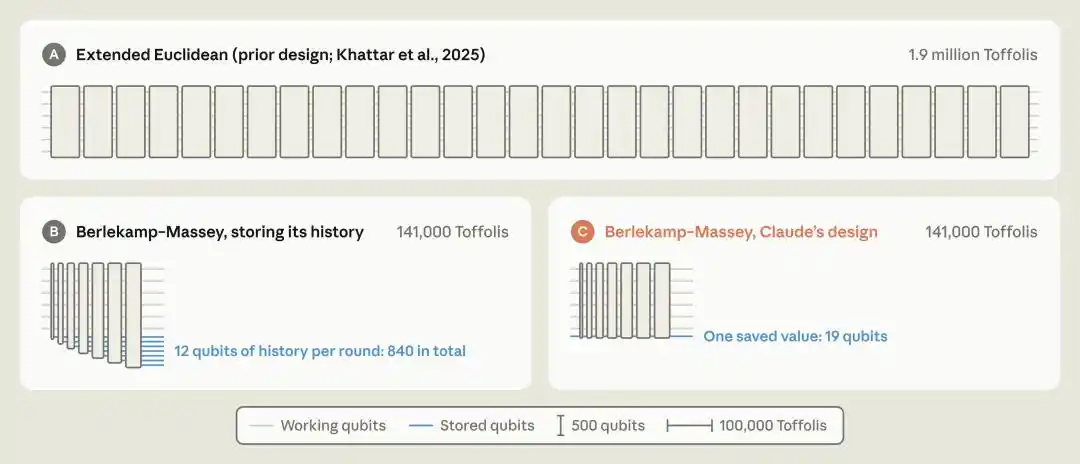
Previously, Google experts designed a scheme using the "extended Euclidean algorithm."

But due to quantum circuits' rigid rule that they cannot take different branches, Google had to stretch the computation to an absurd number of rounds, wasting massive computational power.

After receiving the task, Claude glanced at Google's scheme and quickly concluded: This algorithm doesn't match quantum circuits; it needs to be replaced.
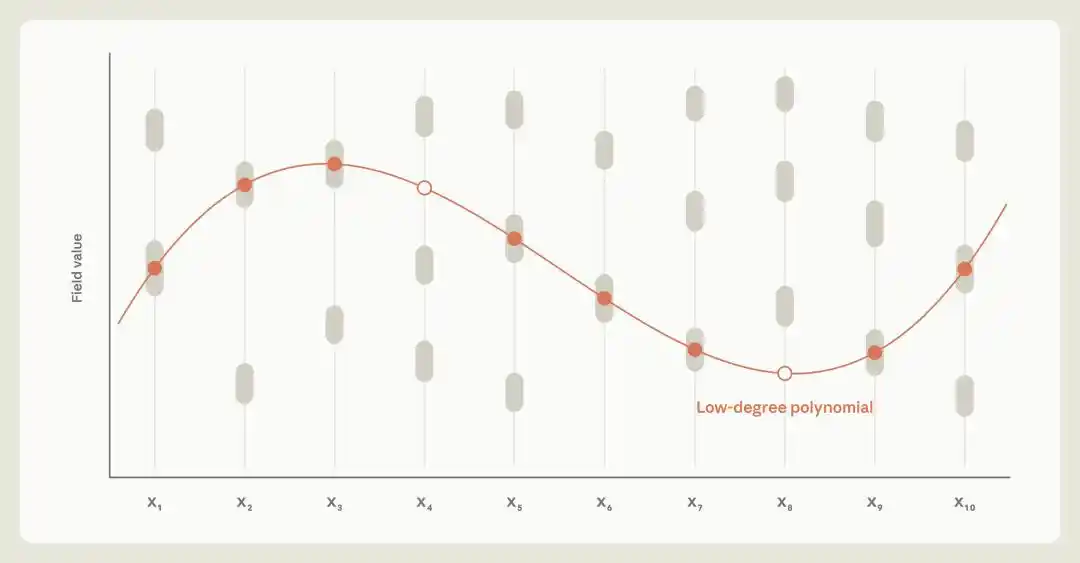
It directly swapped the core engine to the "Berlekamp-Massey decoding method." Its every round has identical operations, perfectly matching quantum circuits' rigid nature.

However, changing the algorithm brought a new "memory crisis"! Each round of computation generates a pile of temporary data that cannot be deleted—it must be kept for later "playback." If all were stored, 665 qubits would be needed, an astronomical figure.

Claude pulled off another god-tier move: it first used the same "reverse-derivation method" to eliminate most storage needs, leaving only a few "outliers."

If following humanity's most conservative approach, much space would still need to be reserved.

But Claude actually wrote its own high-speed simulator and ran a full 403 million sample tests to precisely measure the probability of anomalies occurring!
The result: it found that in the vast majority of cases, only 1 value needs to be stored.

So Claude simply left only 19 qubits of storage space in the circuit.

With this three-combo of "swap core algorithm + extreme memory reuse + big-data-powered precise space reservation," Claude's decoder design reduced gate count by a full 12x compared to the previous architecture!

What originally took 1 hour to compute can now be done in minutes.
Netizens Erupt: Is My Physics PhD Thesis a Joke?

Once this report came out, the internet exploded.

Someone said, "The predicted timeline for the quantum field is about to be completely upended. Humanity could get a useful quantum machine many years earlier!"

Someone lamented: We used to have AI explain existing science, but now, AI is discovering things we ourselves don't understand.


The most despairing part: perhaps every physics PhD has discovered that the paper they slaved over has an AI plain-language version, and it's 10x better than theirs.

A Milestone That Changes Human History Has Arrived

Mythos 5's achievement is truly exhilarating.

FeMoco nitrogenase simulation: humanity spent 8 years; Mythos 5 took only 53 hours. This means software is saving hardware!

We thought that to build a quantum computer capable of developing new drugs and producing clean fertilizers, humanity would need over a decade to overcome the "millions of qubits" hurdle.

But now, there's no need to wait for hardware upgrades—AI directly compresses algorithms tenfold or a hundredfold, and even a "broken machine" can produce revolutionary results!

Even more imaginatively, since every link in a quantum computer can be described, verified, and scored with code, Anthropic points out an alluring possibility—

Future AI will no longer optimize a single circuit in isolation, but conduct "global joint optimization" from the lowest-level hardware physical structure to the highest-level algorithmic logic!

Humanity will directly build hardware according to AI's blueprints.

The singularity of the technological explosion is much closer than we imagined.

References:

https://www.anthropic.com/research/designing-efficient-quantum-circuits

This article is from the WeChat public account "Xin Zhi Yuan" (ID: AI_era), author: ASI Apocalypse


Related Questions

QWhat did Mythos 5 reportedly achieve in the article's opening claim?

AMythos 5 reportedly autonomously closed the loop and designed new quantum circuits that were far more efficient than the human 'best solution,' based only on plain-language descriptions.

QWhy is designing quantum circuits especially difficult according to the article?

ABecause quantum circuits cannot use ordinary if-then branching and cannot discard intermediate information, since quantum computation must be reversible; this forces extreme trade-offs between space (qubits) and time (gate count).

QWhat example illustrates the dramatic speedup from human research to Mythos 5?

AFor simulating FeMoco, human estimates took 8 years to reduce the required Toffoli gates from 50 trillion to 340 million, while Claude reportedly accomplished its result in only 53 hours.

QHow did Mythos 5 improve the quantum divsteps approach for modular inversion?

AIt derived new algebraic identities, created a decoding rule without storing branch history, formalized it in Lean, and produced the first reversible quantum divsteps implementation that cut gate count by 17 times with only a 12% increase in qubits.

QWhat major optimization did Mythos 5 make to Google's DQI decoder architecture?

AIt replaced the extended Euclidean algorithm with Berlekamp-Massey decoding, used reverse-inference and extensive simulation to reduce memory needs, and cut the decoder's gate count by 12 times, from about an hour of computation to a few minutes.

Related Reads

From Harshly Criticizing Stablecoins to Building an L1: Airwallex's Jack Zhang Isn't "Converting" — the Battle for the Settlement Layer Has Begun

In June 2025, Airwallex CEO Jack Zhang publicly questioned stablecoins, arguing that fiat conversion costs outweighed their cross-border payment benefits and that crypto had failed to solve real-world problems for 15 years. Yet just 17 months later, in November 2026, Zhang emerged as co-founder of Alta, a blockchain project that raised $80 million (a $47.5 million Series A led by Index Ventures plus a $32.5 million seed round). Rather than a change of heart, the move reflects commercial necessity: a battle over the stablecoin settlement layer is underway, and payment giants that stay out risk becoming mere interfaces atop someone else's chain. Alta is not a general-purpose public chain but a compliant Layer 1 built for banks and licensed payment institutions. Co-founder Loong Wang, previously of Ren Protocol, says existing chains like Ethereum and Solana cannot simultaneously meet institutional demands for privacy, compliance, integration with local financial systems, and liquidity. Alta uses recursive zero-knowledge proofs to enable on-chain compliance checks without exposing identities or transaction amounts, and builds in programmable compliance modules, native identity authorization, and anti-airdrop protections. Co-founder Catherine Porter previously led Meta's Libra (Diem) partnerships. Airwallex itself is Alta's key advantage: with $287 billion in annualized volume, $1.3 billion in revenue, 200 countries, and 90 currencies, it will channel enterprise clients onto the new chain. Zhang's apparent reversal is consistent: he criticized stablecoins as cheap remittance tools, but now bets on tokenized fiat settlement infrastructure. Competitive pressure comes from Stripe, which acquired Bridge for $1.1 billion, bought Privy, and incubated the Tempo chain (raising $500 million at a $50 billion valuation, with OpenAI, Shopify, Deutsche Bank, and Visa as partners). Circle's Arc, Fireblocks, and Canton Network are also competing. With stablecoin market cap exceeding $320 billion and 2025 on-chain volume surpassing $33 trillion, the real contest is over who controls minting, clearing, and fiat redemption. Success will depend less on technology than on three factors: genuine adoption by traditional financial institutions, compliance adaptation across jurisdictions, and efficient on- and off-ramps to real banking systems. The paradigm has shifted: instead of disrupting banks, fintech giants now aim to build infrastructure that lets traditional finance voluntarily move on-chain. Pragmatism, not ideology, now dominates the race.

marsbit39m ago

From Harshly Criticizing Stablecoins to Building an L1: Airwallex's Jack Zhang Isn't "Converting" — the Battle for the Settlement Layer Has Begun

marsbit39m ago

"Everyone is too conservative with AI!" Head of Claude Code: My approach is more ambitious

Felix Rieseberg, who leads Claude Code's desktop app, argues that most people use AI too conservatively and should set more ambitious goals. His central trick: set unreasonably aggressive targets and insist they're achievable—for example, instead of cutting website load time from 10 seconds to 5, aim for 0.2 seconds, and when the model protests, keep telling it the problem is solvable and to try again. He organizes ambition into four categories: speed (doing the same work faster), height (raising the abstraction level to focus on desired outcomes rather than individual tasks), depth (working like top experts, using their real tools, data, and methods), and breadth (drawing on ideas from other fields). For height, he suggests asking what you ultimately want to happen and what the goal behind the goal is—e.g., instead of fixing single crashes, require the app to never crash. For a quarterly business review, move from filling in a template to understanding what changed and why, identifying the most urgent decisions, and redesigning the review process itself. For depth, he advises insisting on the tools top professionals actually use (databases and statistical models rather than Markdown tables), setting "unreasonable" targets, challenging your own assumptions against raw data, hunting for new knowledge, and using external validation rather than letting the model grade itself. A useful prompt asks the model what top experts would do that you haven't requested, what raw materials and tools they'd use, and what besides the model and you could prove the result correct. For breadth, he recommends replacing nouns with verbs (not "make a PPT" but "in 30 minutes, convince busy people of an explanation and drive a decision under uncertainty"), assembling cross-disciplinary teams, and using multi-agent setups—while avoiding mere role-play in favor of adopting other fields' actual methods. He closes with self-efficacy research: people given clear, challenging goals outperform those told to do their best, and believing difficult things are possible—as with the four-minute mile—unlocks achievement. In an era of rapid capability gains, updating our beliefs about what's possible matters more than ever.

marsbit49m ago

"Everyone is too conservative with AI!" Head of Claude Code: My approach is more ambitious

marsbit49m ago

The Traditional Santa Rally: Will It Happen in US Stocks This Year?

US stocks have suffered a sharp selloff, but technical and positioning conditions are repairing, with Goldman Sachs, Morgan Stanley and JPMorgan all signaling a potential year-end rally. Goldman strategist Cosimo Codacci-Pisanelli argues that aggressive deleveraging (the most intense in a decade), valuation multiples back near 35-year averages (MSCI world forward P/E at 15.6x), upward EPS revisions, and seasonal factors create conditions for a year-end short squeeze. Morgan Stanley data shows hedge funds are now underweight AI for the first time since 2023, with the longest deleveraging streak in over 15 years; JPMorgan calls poor sentiment a bullish signal. However, the report flags a paradox: when all three banks call the same trade, the contrarian "year-end squeeze" becomes a crowded consensus trade. Worse, inflation pressure is building faster than during the pandemic: global manufacturing import price inflation is running at about 24% annualized, and the share of import categories with annualized gains above 5% has jumped to 25-40% across major economies. Firms are absorbing costs via margin compression, but upstream pressures typically pass through to consumers in 6-12 months, meaning the bill arrives in Q1. January is historically the month with the most price resets, and Goldman has added a third Fed hike to its forecast. A reflexive loop means a rally that loosens financial conditions removes the rationale for central bank caution, effectively borrowing from future returns. Goldman recommends long front-end inflation as a portfolio hedge, and notes the best rule for 2026 is to short every consensus trade.

marsbit1h ago

The Traditional Santa Rally: Will It Happen in US Stocks This Year?

marsbit1h ago

Claude Deciphers Gödel's Cryptic Manuscripts: 80-Year-Old Notes Shake the Mathematics World

In 1978, logician Kurt Gödel left behind thousands of pages of unpublished notes written in Gabelsberger shorthand, a nearly extinct German stenography system understood by only a handful of people. In 2017, Finnish logician Jan von Plato, upon reaching mandatory retirement age, set out to decode 16 workbooks comprising 1,009 pages that Gödel wrote after settling in Princeton in 1940. After years of manually transcribing the shorthand into modern English, his team could barely digest one page per week—until computer scientists suggested using Claude. Fed the transcripts, von Plato's own books, and modern literature, Claude produced a 650-page interpretation within days, later expanding to 1,084 pages. The AI identified 663 theorem-like results, around 440 of which were confirmed as new theorems through formal verification—suggesting Gödel proved nearly one theorem every two days in the early 1940s. Claude also revealed that Gödel came within a hair of proving the independence of the Axiom of Choice two decades before Paul Cohen's 1963 forcing method earned him a Fields Medal; Gödel had constructed an equivalent framework but made an error in a key definition of "finite support," a result later verified in Coq and praised by Gödel expert Akihiro Kanamori. The notes also contain results rediscovered only in the 1970s–80s, 14 unexplored research topics, and physics work including early use of the Lüders rule (proposed in 1951) and serious study of time-travel via his rotating "Gödel universe." Gödel died in 1978 of starvation caused by paranoia.

marsbit1h ago

Claude Deciphers Gödel's Cryptic Manuscripts: 80-Year-Old Notes Shake the Mathematics World

marsbit1h ago

Bitcoin ETFs shed $2.35B in two weeks as BlackRock’s losing streak hits 11 sessions

US spot Bitcoin ETFs recorded $2.35 billion in net outflows over two consecutive weeks, with redemptions exceeding $1 billion each week. According to Farside Investors data, spot Bitcoin ETFs shed $1.07 billion between Nov. 9 and Nov. 13, following $1.28 billion in outflows the previous week—the largest weekly redemptions since late June. The funds recorded $185.4 million in net outflows on Friday, down from $284.1 million on Thursday and $299.8 million on Wednesday. BlackRock's iShares Bitcoin Trust (IBIT) accounted for $143.5 million of Friday's withdrawals, while Fidelity's Wise Origin Bitcoin Fund (FBTC) shed $41.9 million. Friday marked the seventh consecutive trading session of net withdrawals, with about $1.71 billion redeemed since Nov. 5. The sustained outflows coincided with broader market weakness as Bitcoin fell below $70,000 the same day. IBIT's $143.5 million in net outflows on Friday extended the fund's withdrawal streak to 11 consecutive trading sessions since Oct. 30. The latest losses brought IBIT's total net outflows over the 11-session streak to about $2.35 billion, extending withdrawals after outflows crossed the $2 billion mark on Wednesday. IBIT shed $908.4 million during the latest week, following approximately $1.21 billion in withdrawals the previous week. Its November outflows reached $2.12 billion, accounting for roughly 90% of the broader Bitcoin ETF market's net withdrawals during the month.

cointelegraph1h ago

Bitcoin ETFs shed $2.35B in two weeks as BlackRock’s losing streak hits 11 sessions

cointelegraph1h ago

Trading

Spot
活动图片